EVAL-AD7793EBZ
Analog Devices Inc.The?AD7792/AD7793 are low power, low noise, complete analog front ends for high precision measurement applications. The AD7792/AD7793 contain a low noise 16-/24-bit ?-? ADC with three differential analog inputs. The on-chip, low noise instrumentation amplifier means that signals of small amplitude can be interfaced directly to the ADC. With a gain setting of 64, the rms noise is 40 nV when the update rate equals 4.17 Hz.The devices contain a precision low noise, low drift internal band gap reference and can accept an external differential reference. Other on-chip features include programmable excitation current sources, burnout currents, and a bias voltage generator. The bias voltage generator sets the common-mode voltage of a channel to AVDD/2The devices can be operated with either the internal clock or an external clock. The output data rate from the parts is software-programmable and can be varied from 4.17 Hz to 470 Hz.The parts operate with a power supply from 2.7 V to 5.25 V. They consume a current of 400 ?A typical and are housed in a 16-lead TSSOP package.Applications Thermocouple measurements RTD measurements Thermistor measurements Gas analysis Industrial process control Instrumentation Portable instrumentation Blood analysis Smart transmitters Liquid/gas chromatography 6-digit DVM

EVAL-AD7794EBZ
Analog Devices Inc.The AD7794/AD7795 are low power, low noise, complete analog front ends for high precision measurement applications. They contain a low noise, 24-/16-bit ?-? ADC with six differential inputs. The on-chip low noise instrumentation amplifier means that signals of small amplitude can be interfaced directly to the ADC.Each device contains a precision, low noise, low drift internal band gap reference, and can also accept up to two external differential references. Other on-chip features include programmable excitation current sources, burnout currents, and a bias voltage generator that is used to set the common-mode voltage of a channel to AVDD/2. The low-side power switch can be used to power down bridge sensors between conversions, minimizing the system?s power consumption. The AD7794/AD7795 can operate with either an internal clock or an external clock. The output data rate from each part can vary from 4.17 Hz to 470 Hz.Both parts operate with a power supply from 2.7 V to 5.25 V. The B-grade parts (AD7794 and AD7795) are specified for a temperature range of ?40?C to +105?C while the C-grade part (AD7794) is specified for a temperature range of ?40?C to +125?C. They consume a current of 400 ?A typical and are housed in a 24-lead TSSOP.Applications Temperature measurement Pressure measurement Weigh scales Strain gage transducers Gas analysis

EVAL-AD5172SDZ
Analog Devices Inc.The AD5172 / AD5173?are dual-channel, 256-position, one-time programmable (OTP) digital potentiometers that employ fuse link technology to achieve memory retention of resistance settings. The digital potentiometer, VR, and RDAC terms are used interchangeably. OTP is a cost-effective alternative to EEMEM for users who do not need to program the digital potentiometer setting in memory more than once. These devices perform the same electronic adjustment function as mechanical potentiometers or variable resistors but with enhanced resolution, solid-state reliability, and superior low temperature coefficient performance.TheAD5172 / AD5173 are programmed using a 2-wire, I2C-compatible digital interface. Unlimited adjustments are allowed before permanently setting the resistance value. During OTP activation, a permanent blow fuse command freezes the wiper position (analogous to placing epoxy on a mechanical trimmer).Unlike traditional OTP digital potentiometers, the AD5172 / AD5173 have a unique temporary OTP overwrite feature that allows for new adjustments even after a fuse is blown. However, the OTP setting is restored during subsequent power-up conditions. This allows users to treat these digital potentiometers as volatile potentiometers with a programmable preset.APPLICATIONS Systems calibration Electronics level setting Mechanical trimmers replacement in new designs Permanent factory PCB setting Transducer adjustment of pressure, temperature, position, chemical, and optical sensors RF amplifier biasing Gain control and offset adjustment


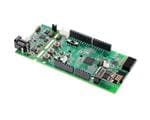
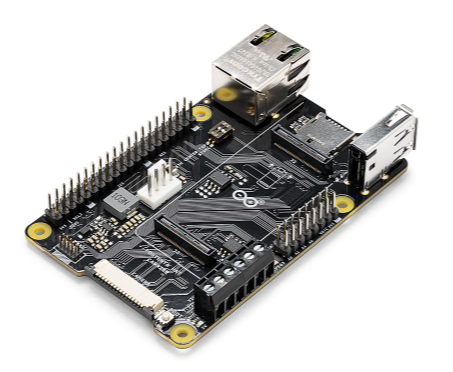
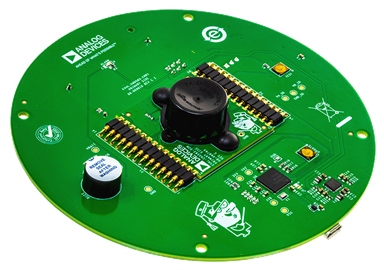
Arduino based Wireless Development Platform for Internet of Things applications based on an ultra-low power ARM Cortex-M3 processor
Analog Devices Inc.The EVAL-ADICUP3029 is an Arduino and PMOD compatible form factor development board that includes Bluetooth and WiFi connectivity. The board uses CrossCore Embedded Studio, an open source Eclipse based Interactive Development Environment (IDE), which can be downloaded free of charge. The platform contains many hardware and software example projects to make it easier for customers to prototype and create connected systems and solutions for Internet of Things (IoT) applications.
The EVAL-ADICUP3029 uses the ADuCM3029 ultra low power Arm Cortex-M3 processor as the main device on board. The ADuCM3029 is an integrated mixed-signal microcontroller system for processing, control and connectivity.

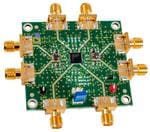
ADL5606-EVALZ
Analog Devices Inc.The ADL5606 is a broadband, two-stage, 1 W RF driver amplifier that operates over a frequency range of 1800 MHz to 2700 MHz. The device can be used in a wide variety of wired and wireless applications, including ISM, MC-GSM, W-CDMA, TD-SCDMA, and LTE.The ADL5606 operates on a 5 V supply voltage and a supply current of 362 mA. The driver also incorporates a fast power-up/power-down function for TDD applications, applications that require a power saving mode, and applications that intermittently transmit data.The ADL5606 is fabricated on a GaAs HBT process and is packaged in a compact 4 mm ? 4 mm, 16-lead LFCSP that uses an exposed paddle for excellent thermal impedance. The ADL5606 operates from ?40?C to +85?C. A fully populated evaluation board tuned to 2140 MHz is also available.Applications Wireless infrastructure Automated test equipment ISM/AMR applications

ADL5721-EVALZ
Analog Devices Inc.The ADL5721 is a narrow-band, high performance, low noise amplifier targeting microwave radio link receiver designs. The monolithic silicon germanium (SiGe) design is optimized for microwave radio link bands ranging from 5.9 GHz to 8.5 GHz. The unique design offers a single-ended 50 ? input impedance and provides a 100 ? balanced differential output that is ideal for driving Analog Devices, Inc., differential downconverters and radio frequency (RF) sampling analog-to-digital converters (ADCs). This low noise amplifier (LNA) provides noise figure performance that, in the past, required more expensive three-five (III-V) compounds process technology to achieve. This LNA uses a band switch feature to allow the input P1dB and noise figure to trade off for optimum system performance.The ADL5721 and ADL5723 to ADL5726 family of narrow-band LNAs are each packaged in a tiny, thermally enhanced, 2.00 mm ? 2.00 mm LFCSP package. The ADL5721 and ADL5723 to ADL5726 family operates over the temperature range of ?40?C to +85?C.Applications Point to point microwave radios Instrumentation Satellite communications (SATCOM) Phased arrays

ADL8111-EVALZ
Analog Devices Inc.The ADL8111 is a low noise amplifier (LNA) with a nonreflective bypass switch that provides broadband operation from 10 MHz to 8000 MHz. The ADL8111 provides a low noise figure of 2.8 dB with a high output third-order intercept (OIP3) of 34 dBm simultaneously, which delivers a high dynamic range. The ADL8111 provides a gain of 12.5 dB that is stable over frequency, temperature, power supply, and from device to device.The integration of an amplifier and two single-pole, quad-throw (SP4T) nonreflective switches allows multiple gain andlinearity values. The addition of switches also offers high input intercept performance and prevents distortion on the high signal level applications.The ADL8111 has a high electrostatic discharge (ESD) rating of ?750 V (Class 1B) and is fully specified for operation across a wide temperature range of ?40?C to +85?C. The ADL8111 is offered in a 6 mm ? 6 mm, 28-terminal land grid array (LGA) package.Applications Military Test instrumentation Communications

ADL8121-EVALZ
Analog Devices Inc.The ADL8121 is a gallium arsenide (GaAs), monolithic microwave integrated circuit (MMIC), pseudomorphic high electron mobility transistor (pHEMT), low noise wideband amplifier that operates from 0.025 GHz to 12 GHz.The ADL8121 provides a typical gain of 16.5 dB, a 2.5 dB typical noise figure, and a typical output third-order intercept (OIP3) of 36 dBm across the 0.025 GHz to 10 GHz frequency range, requiring only 95 mA from a 5 V supply voltage. The saturated output power (PSAT) of 21.5 dBm typical across the 0.025 GHz to 10 GHz frequency range enables the low noise amplifier (LNA) to function as a local oscillator (LO) driver for many of Analog Devices, Inc., balanced, in-phase and quadrature (I/Q) or image rejection mixers.The ADL8121 also features inputs and outputs that are internally matched to 50 ?, making the device ideal for surface-mounted technology (SMT)-based and is housed in a RoHS-compliant, 2 mm ? 2 mm, 6-lead LFCSP.APPLICATIONSTest instrumentationMilitary communicationsMilitary radarTelecommunications

ADM1266-EVALZ
Analog Devices Inc.The ADM1266 Super Sequencer? is a configurable supervisory/sequencing device that offers a single-chip solution for supply monitoring and sequencing in systems with up to 17 supplies.?For systems with more supplies (up to 257), the operation of up?to 16 ADM1266 devices can be synchronized through a proprietary?2-wire interface (interdevice bus). The sequencing engine (SE) monitors the supply fault detectors?(SFDs), programmable driver input/outputs (PDIOs), general-purpose?inputs/outputs (GPIOs), and timers, and controls the?PDIOs and GPIOs to sequence the supplies up and down as?required. The logical core of the device is an ARM? Cortex-M3?microcontroller. The firmware is supplied by Analog Devices,?Inc., and all configuration is performed through an intuitive?graphic user interface (GUI). Additionally, the ADM1266 integrates an analog-to-digital?converter (ADC) and voltage output digital-to-analog converters?(DACs) that can be used to adjust either the feedback node or?reference of a dc-to-dc converter to implement a closed-loop,?autonomous, margining system.A block of nonvolatile EEPROM is available to record voltage,?time, and fault information when instructed to by the sequencing?engine configuration.APPLICATIONS Communications infrastructure Industrial test and measurement

ADM7154CP-3.3EVALZ
Analog Devices Inc.TThe ADM7154 is a linear regulator that operates from 2.3 V to5.5 V and provides up to 600 mA of load current. Using anadvanced proprietary architecture, it provides high powersupply rejection and ultralow noise, achieving excellent line andload transient response with only a 10 ?F ceramic output capacitor.There are 16 standard output voltages for the ADM7154. Thefollowing voltages are available in stock: 1.2 V, 1.8 V, 2.5 V, 2.8 V,3.0 V, and 3.3 V. Additional voltages are available by specialorder: 1.3 V, 1.5 V, 1.6 V, 2.0 V, 2.2 V, 2.6 V, 2.7 V, 2.9 V, 3.1 V,and 3.2 V.The ADM7154 regulator typical output noise is 0.9 ?V rms from100 Hz to 100 kHz for fixed output voltage options and1.5 nV/?Hz for noise spectral density from 10 kHz to 1 MHz. The ADM7154 is available in 8-lead, 3 mm ? 3 mm LFCSP and8-lead SOIC packages, making it not only a very compactsolution, but also providing excellent thermal performance forapplications requiring up to 600 mA of load current in a small,low profile footprint.Applications Regulation to noise sensitive applications: PLLs, VCOs, and PLLs with integrated VCOs Communications and infrastructure Backhaul and microwave links