ANR024 - Proteus-E Advanced Developer Guide
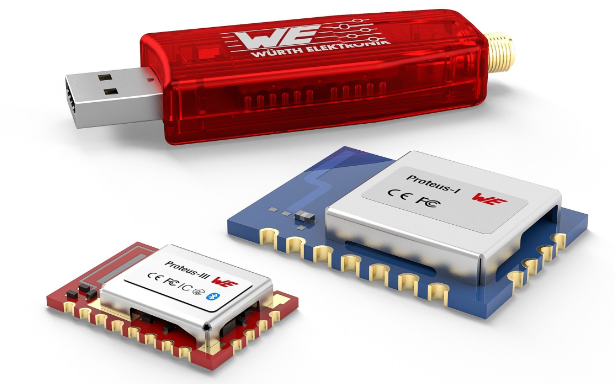
Wurth ElektronikThe advanced developer guide covers details on the Proteus Product family that are required to implement a module counterpart in form of an App for smart devices. It covers the documentation on the SPP-like profile available on Proteus and the used protocols and data coding for arbitrary user payload.
Also all information required to make a Custom Firmware on the Proteus module hardware platform are provided within.
AN3923 - AES Cipher Modes Using MPLAB Harmony v3 for the SAM E54
Microchip Technology Inc.This document describes the AES implementation of the following four confidentiality modes of operation in the MPLAB® Harmony v3 framework for SAME54:
• Electronic Code Book (ECB)
• Cipher Block Chaining (CBC)
• Counter (CTR)
• Galois Counter mode (GCM)
AN3342 - SleepWalking with Event System Using the SAM E54 AN
Microchip Technology Inc.To illustrate the benefits of SleepWalking using the Event System, a demonstrative application is provided along with this document. This application uses an ADC with a Window Monitoring feature in Standby mode for the following use cases:
• Standby mode with Interrupts (IRQ)
• Standby mode with Event System (SleepWalking)
This document also provides comparison on power consumption between these two use cases.
AN4723 - PolarFire SoC FPGA Video Kit Picture-in-Picture Application Note
Microchip Technology Inc.This application note describes the method to run the imaging and video demo using the PolarFire SoC video kit, a dual camera sensor module, and an HDMI monitor. This solution is developed on Microchip’s PolarFire SoC video kit, which features an MPFS250TS PolarFire SoC device.
AN1162 - DGD2005 Application Information
Diodes Inc.The DGD2005, High-side/Low-side gate driver is used to optimally drive the gate of MOSFETs or IGBTs.
AN1161 - BCR430UW6 Application Information
Diodes Inc.This document details the application and use of the Diodes BCR430UW6 low dropout linear LED driver. It should be used in conjunction with the BCR430UW6 data sheet which details the full electrical specification of the BCR430UW6.
ClockMatrix - Phase Noise Contributors
Renesas Electronics CorporationThis application note explains the major contributors of phase noise for the ClockMatrix family of devices. The document discusses the clocking architecture and how phase noise is shaped depending on the loop architecture and the bandwidths chosen. It also provides the reader with an idea of how to optimize for the lowest phase noise in a certain integration bandwidth
RL78/G22 - A/D Converter (Software Trigger and Scan Conversion Modes)
Renesas Electronics CorporationThis application note describes how to convert an analog voltage to a digital voltage by using the RL78/G22 A/D converter (software trigger, scan mode, and sequential conversion mode). In this application note, A/D conversion result data is converted and stored in the internal RAM.
AN4835 - LiteFast IP on RTG4 Device Application Note (Earlier DG0729)
Microchip Technology Inc.Microchip LiteFast IP is a scalable, lightweight in terms of utilization, high data-rate protocol for applications based upon high-speed serial communication. LiteFast has an in-built flow control scheme, and the physical link is maintained when there is no application data for transmission.
AN4949: PolarFire FPGA CPRI Application Note (Earlier DG0843)
Microchip Technology Inc.Common Public Radio Interface (CPRI) is an industry standard which defines the publicly available specification for the key internal interface of radio base stations between Radio Equipment Control (REC) and Radio Equipment (RE). Microchip provides the CPRI slave IP core that implements the transmitter and receiver interfaces of the CPRI standard.
AN-CM-333 2-Axis Robot Arm Controlled via Analog Joystick
Renesas Electronics CorporationThis application note explains how to build a 2-axis robot arm controlled via an analog joystick using a GreenPAK chip and two servomotors.
Robot arms are one of the most widely used robotic applications because they can make movements similar to a human hand.
A robot arm could be an independent application or part of a bigger robotic system.
Robot arms are maonly used in industry for pick and place applications.
They are also found in mobile security cameras and toys.
AN-1190 Ultra-low Power Low Voltage Lock-in Amplifier for Embedded Applications
Renesas Electronics CorporationThis application note explores the possibility of ultra-low power, low voltage (single supply), lock-in amplifier for portable or embedded applications circuitry design based only on the SLG88104 Rail to Rail I/O 375 nA Quad OpAmp and passive components.
AN-1176 RFID Sensor Dog Door
Renesas Electronics CorporationThis application note describes how to use a GreenPAK SLG46531V as the main controller for an RFIDbased pet door.
AN-CM-224 How to Test and Debug GreenPAK using a Website
Renesas Electronics CorporationThis application note shows how a GreenPAK design can be tested, debugged, and controlled using a website.
AN-CM-337 Monolithic Battery Charger
Renesas Electronics CorporationThis application note describes how to implement a monolithic battery charger with a GreenPAK mixed-signal integrated circuit.
Battery-powered electronic devices have become one of the key elements of everyday life. These devices include mobile phones, multimedia players, navigation devices, remotely operated sensors, and actuators, to name a few. It is more practical and cost-effective to use rechargeable battery cells instead of batteries which require frequent replacement.
AN-CM-334 Bidirectional I2C to SPI Bridge
Renesas Electronics CorporationThis application note describes how to use the SLG46811 IC to design a converter between the I2C and SPI data transmission protocols.
AN-CM-330 Ultrasonic Qualitative Distance Estimation Sensor
Renesas Electronics CorporationThe main goal of this application is to design an ultrasonic qualitative distance estimation sensor using the SLG47105V. The system is designed using the HV macrocells and other internal and external components with the GreenPAK to interact with an ultrasonic sensor.
AN-CM-316 Automatic Air Freshener
Renesas Electronics CorporationThis application note describes the High Voltage GreenPAK IC configurated as a control unit for an Automatic Air Freshener, reducing the number of external components and adding new features.
AN4997: PolarFire FPGA Building a Mi-V Processor Subsystem Application Note (Earlier TU0775)
Microchip Technology Inc.Microchip offers the Mi-V processor IP and software toolchain free of cost to develop RISC-V processor-based designs. RISC-V, a standard open Instruction Set Architecture (ISA) under the governance of the RISC-V foundation, offers numerous benefits, which include enabling the open source community to test and improve cores at a faster pace than closed ISAs.
PolarFire FPGAs support Mi-V soft processors to run user applications. The objective of the application notes is to build a Mi-V processor subsystem that can execute an application from the designated fabric RAMs initialised from the sNVM/SPI Flash. The application notes also describe how to build a RISC-V application using SoftConsole and run it on a PolarFire Evaluation Board.
AN-CM-319 Audio Signal Detector
Renesas Electronics CorporationThis application note describes the implementation of an audio signal detector with the SLG47512. The design can detect human speech or music and can ignore single tone noise or flat random noise. The audio signal detector can be used in safety services or to save energy in audio decks.