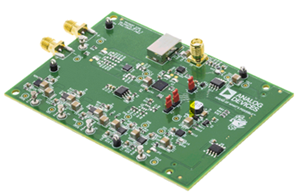
DC2303A-E
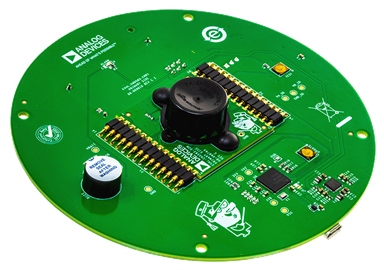
Analog Devices Inc.The LTC2000A is a family of 16-/14-/11-bit 2.7Gsps current steering DACs with exceptional spectral purity.The single (1.35Gsps mode) or dual (2.7Gsps mode) port source synchronous LVDS interface supports data rates of up to 1.35Gbps using a 675MHz DDR data clock, which can be either in quadrature or in phase with the data. An internal synchronizer automatically aligns the data with the DAC sample clock.Additional features such as pattern generation, LVDS loopout and junction temperature sensing simplify system development and testing.A serial peripheral interface (SPI) port allows configuration and read back of internal registers. Operating from 1.86V and 3.3V supplies, the LTC2000A consumes 2.41W at 2.7Gsps and 1.43W at 1.35Gsps.Applications Broadband Communication Systems DOCSIS CMTS Direct RF Synthesis Radar Instrumentation Automatic Test Equipment

DC230A-D
Analog Devices Inc.The LT1533 is a new class of switching regulator designed to reduce conducted and radiated electromagnetic interference (EMI). Ultralow noise and EMI are achieved by providing user control of the output switch slew rates. Voltage and current slew rates can be independently programmed to optimize switcher harmonic content versus efficiency. The LT1533 can reduce high frequency harmonic power by as much as 40dB with only minor losses in efficiency. The LT1533 utilizes a dual output switch current mode architecture optimized for low noise topologies. The IC includes two 1A power switches along with all necessary oscillator, control and protection circuitry. Unique error amp circuitry can regulate both positive and negative voltages. The internal oscillator may be synchronized to an external clock for more accurate placement of switching harmonics. Protection features include cycle by cycle current limit protection, undervoltage lockout and thermal shutdown. Low minimum supply voltage and low supply current during shutdown make the LT1533 well suited for portable applications. The part may also be forced into a 50% duty cycle mode for unregulated applications. The LT1533 is available in the 16-pin narrow SO package.Applications Precision Instrumentation Systems Isolated Supplies for Industrial Automation Medical Instruments Wireless Communications Single Board Data Acquisition Systems
DC2314A-B
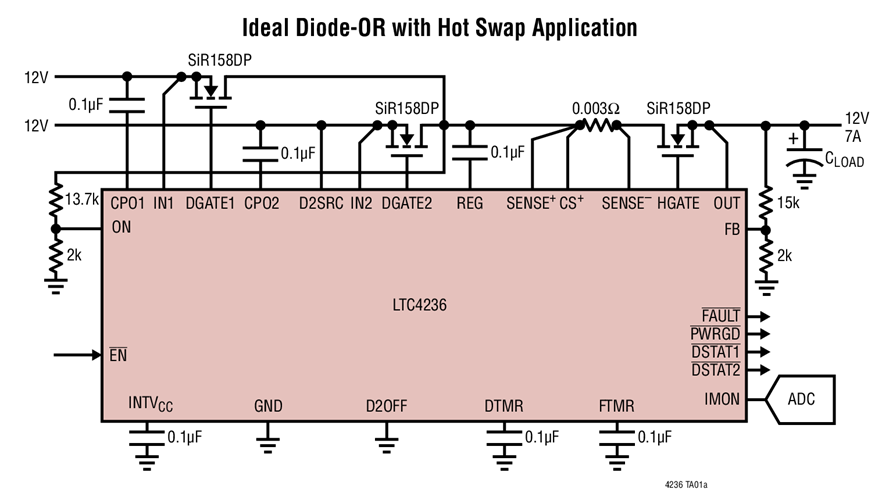
Analog Devices Inc.The LTC4236 offers ideal diode-OR and Hot Swap functions for two power rails by controlling external N-channel MOSFETs. MOSFETs acting as ideal diodes replace two high power Schottky diodes and the associated heat sinks, saving power and board area. A Hot Swap control MOSFET allows a board to be safely inserted and removed from a live backplane by limiting inrush current. The supply output is also protected against short-circuit faults with a fast acting foldback current limit and electronic circuit breaker.The LTC4236 regulates the forward voltage drop across the ideal diode MOSFETs to ensure smooth current transfer from one supply to the other without oscillation. The ideal diode MOSFETs turn on quickly to reduce the load voltage droop during supply switchover. If the input supply fails or is shorted, a fast turn-off minimizes reverse current transients.A current sense amplifier translates the voltage across the sense resistor to a ground referenced signal. The LTC4236 provides adjustable start-up delay, turn-on/-off control, and reports fault and power good status for the supply.Applications Redundant Power Supplies High Availability Systems and Servers Telecom and Network Infrastructure
DC2326A-A
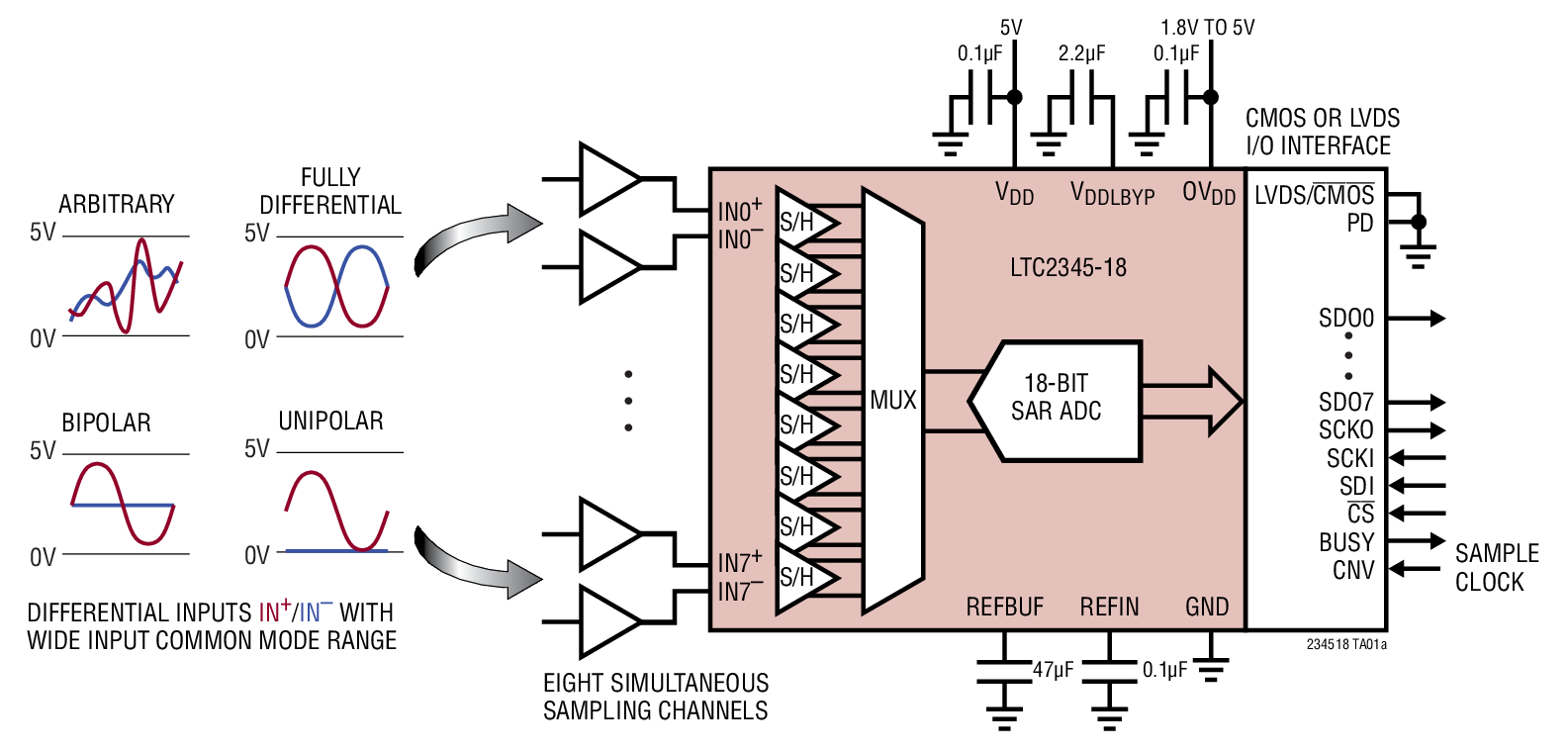
Analog Devices Inc.The LTC2345-18 is an 18-bit, low noise 8-channel simultaneous sampling successive approximation register (SAR) ADC with differential, wide common mode range inputs. Operating from a 5V low voltage supply and using the internal reference and buffer, each channel of this SoftSpanTM ADC can be independently configured on a conversion-by-conversion basis to accept ?4.096, 0V to 4.096V, ?2.048V, or 0V to 2.048V signals. Individual channels may also be disabled to increase throughput on the remaining channels.The wide input common mode range and 102dB CMRR of the LTC2345-18 analog inputs allow the ADC to directly digitize a variety of signals, simplifying signal chain design. This input signal flexibility, combined with ?5LSB INL, no missing codes at 18 bits, and 91.8dB SNR, makes the LTC2345-18 an ideal choice for many applications requiring wide dynamic range.The LTC2345-18 supports pin-selectable SPI CMOS (1.8V to 5V) and LVDS serial interfaces. Between one and eight lanes of data output may be employed in CMOS mode, allowing the user to optimize bus width and throughput.Applications Programmable Logic Controllers Industrial Process Control Medical Imaging High Speed Data Acquisition

DC2331A-A
Analog Devices Inc.The LT8550 is a multiphase expander for synchronous buck DC/DC converters. It operates in tandem with any buck DC/DC converter to increase the load current capability by adding additional phases, which are clocked outof-phase to reduce ripple current and filtering capacitance. It easily adds phases without the need to route sensitive feedback and control signals. The LT8550 integrates gate drivers and can support up to four buck phases per device. Multiple LT8550?s can be used for up to 18 phases. It accurately monitors and adjusts the current of each channel to achieve excellent DC and transient current sharing. The LT8550 operates over a fixed frequency from 100kHz to 1MHz, or can be synchronized to an external clock.??Applications?? High Current Distributed Power Systems Telecom, Datacom, and Storage Systems Industrial and Automotive

DC2332A-A
Analog Devices Inc.The LT8551 is a multiphase expander for synchronous boost DC/DC converters. It operates in tandem with any synchronous boost DC/DC converter to increase the load current capability by adding additional phases, which are clocked out-of-phase to reduce ripple current and filtering capacitance. It easily adds phases without the need to route sensitive feedback and control signals.The LT8551 integrates 5V gate drivers and can support up to four boost phases per device. Multiple LT8551 devices can be used for up to 18 phases. It accurately monitors and adjusts the current of each channel to achieve excellent DC and transient current sharing.?The LT8551 operates over a fixed frequency from 100kHz to 1MHz or can be synchronized to an external clock.Applications High Current Distributed Power Systems Telecom, Datacom, and Storage Systems Industrial and Automotive
DC2355A
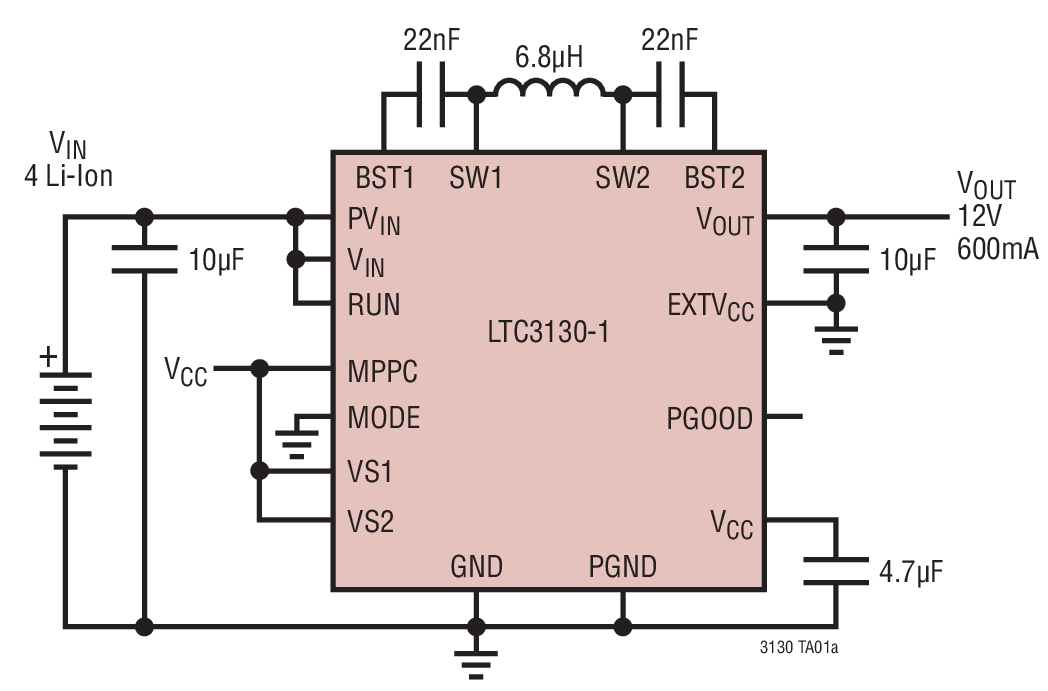
Analog Devices Inc.The LTC3130/LTC3130-1 are high efficiency, low noise, 600mA buck-boost converters with wide VIN and VOUT ranges. For high efficiency operation at light loads, BurstMode operation can be selected, reducing the quiescent current to just 1.6?A. Converter start-up is achieved from sources as low as 7.5?W.TheLTC3130/LTC3130-1 employ an ultralow noise, 1.2MHz PWM architecture that minimizes solution footprint by allowing the use of tiny, low profile inductors and ceramic capacitors. Built-in loop compensation and soft-start reduces external parts count and simplifies the design. Features include an accurate RUN comparator threshold to allow predictable regulator turn-on and a maximum power point control (MPPC) capability that ensures maximum power extraction from non-ideal sources such as photovoltaic panels. The LTC3130-1 includes an internal voltage divider to provide four selectable fixed output voltages.Additional features include a power good output, an external VCC input and thermal shutdown.The LTC3130 and LTC3130-1 are available in thermally-enhanced 20-lead 3mm ? 4mm QFN and 16-lead MSOP packages.Applications Long-Life, Battery-Operated Instruments Portable Military Radios Low Power Sensors Solar Panel Post-Regulator/Charger
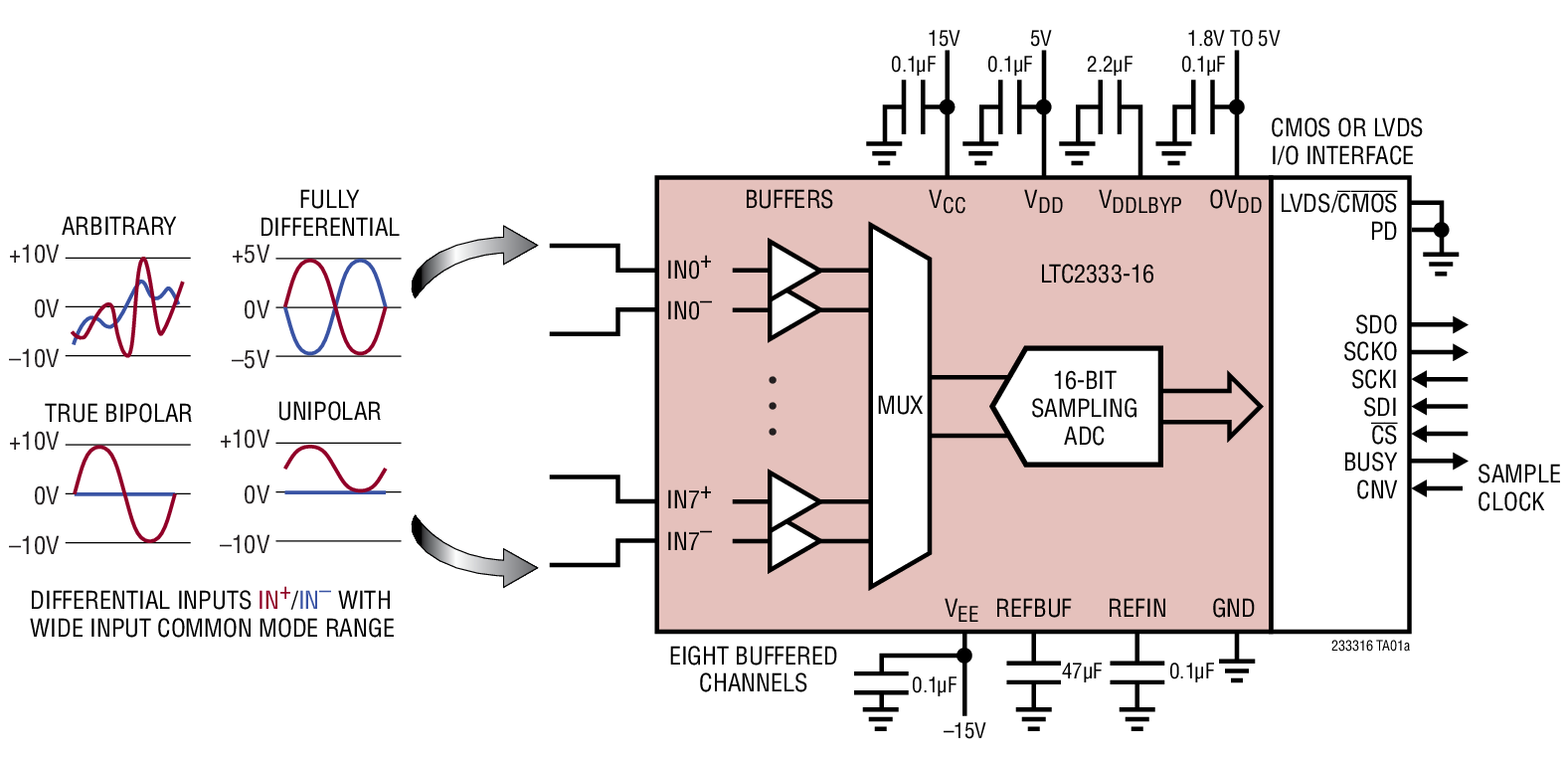
LTC2333-16 Demo Board | Buffered Octal, 16-Bit, 800ksps Mux'd SAR ADC (Requires DC590, DC2026 or DC890)
Analog Devices Inc.Demonstration circuit 2365A highlights the LTC2358 family of buffered input ADCs. The LTC2358/LTC2357/LTC2353/LTC2333 are low noise, high speed, 16-/18bit successive approximation register (SAR) ADCs with integrated front end buffers. These ADCs accept a wide common mode range. Pico-amp inputs and high CMRR enable these ADCs to connect directly to a wide range of sensors without compromising measurement accuracy. The following text refers to the LTC2358-18 but applies to all parts in the family, the only differences being the number of bits, number of channels and the maximum sample rate. The LTC2358-18 has a flexible SoftSpan™ interface that allows conversion-by-conversion control of the input voltage span on a per-channel basis. An internal 2.048V reference and 2X buffer simplify basic operation while an external reference can be used to increase the input range and the SNR of the ADC.

DC2372A
Analog Devices Inc.The LTC3121 is a synchronous step-up DC/DC converter with true output disconnect and inrush current limiting. The 1.5A current limit along with the ability to program output voltages up to 15V makes the LTC3121 well suited for a variety of demanding applications. Once started, operation will continue with inputs down to 500mV, extending run time in many applications.The LTC3121 features output disconnect in shutdown, dramatically reducing input power drain and enabling VOUT to completely discharge. Adjustable PWM switching from 100kHz to 3MHz optimizes applications for highest efficiency or smallest solution footprint. The oscillator can also be synchronized to an external clock for noise sensitive applications. Selectable Burst Mode operation reduces quiescent current to 25?A, ensuring high efficiency across the entire load range. An internal soft-start limits inrush current during start-up.Other features include a

DC2373A
Analog Devices Inc.The LT8641 step-down regulator features Silent Switcher architecture designed to minimize EMI/EMC emissions while delivering high efficiency at frequencies up to 3MHz. Assembled in a 3mm ? 4mm QFN, the monolithic construction with integrated power switches and inclusion of all necessary circuitry yields a solution with a minimal PCB footprint. An ultralow 2.5?A quiescent current?with the output in full regulation?enables applications requiring highest efficiency at very small load currents. Transient response remains excellent and output voltage ripple is below 10mVP-P at any load, from zero to full current.The LT8641 allows high VIN to low VOUT conversion at high frequency with a fast minimum top switch on-time of 35ns. Operation is safe in overload even with a saturated inductor.Essential features are included and easy to use: An open-drain PG pin signals when the output is in regulation. The SYNC/MODE pin selects between Burst Mode, pulse-skipping, or spread spectrum mode, and also allows synchronization to an external clock. Soft-start and tracking functionality is accessed via the TR/SS pin. An accurate enable threshold can be set using the EN/UV pin and a resistor at the RT pin programs switch frequency.APPLICATIONS Automotive and Industrial Supplies General Purpose Step-Down GSM Power Supplies
DC2376A-A
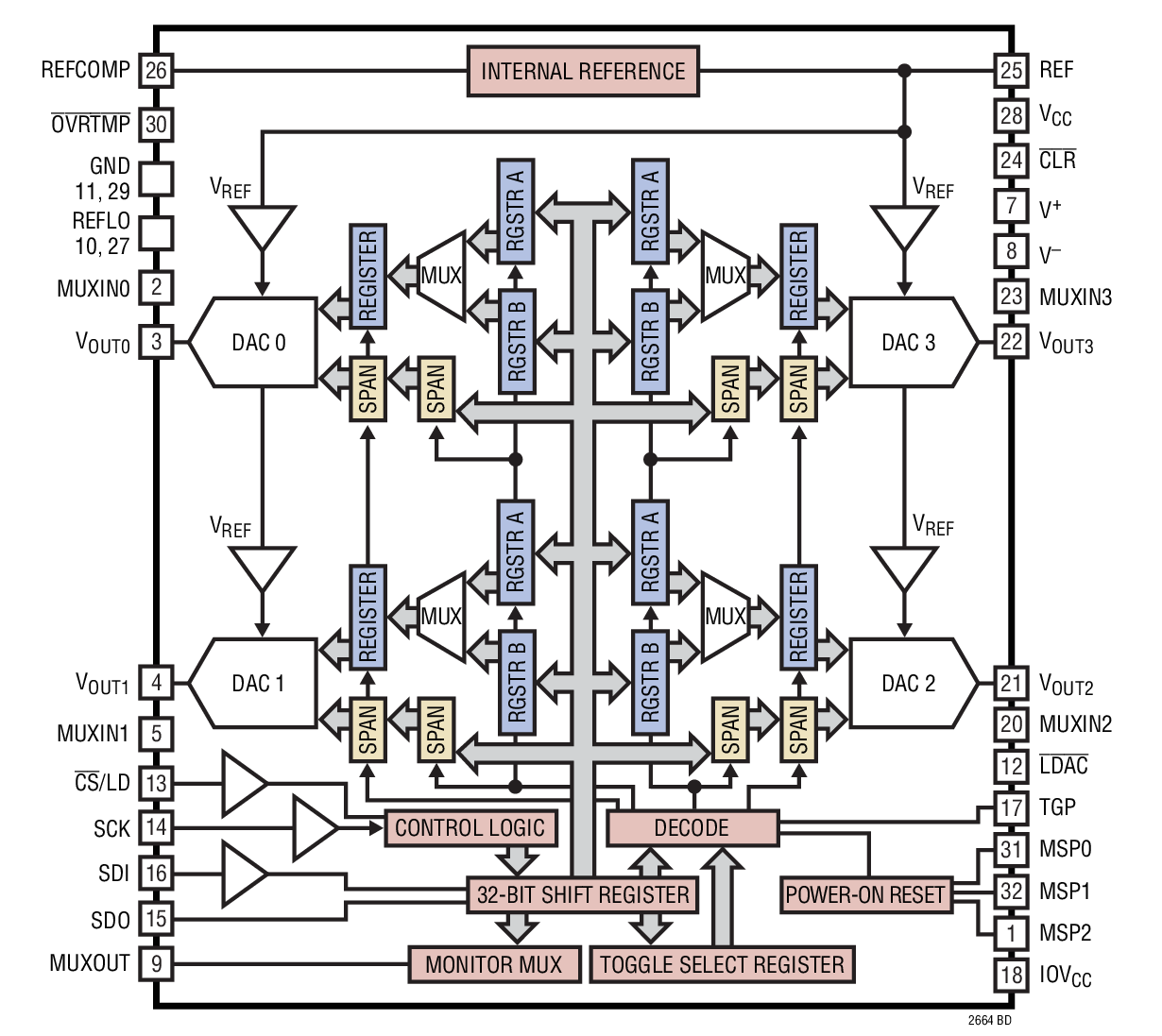
Analog Devices Inc.The LTC2664 is a family of four-channel, 16-/12-bit ?10V digital-to-analog converters with integrated precision references. They are guaranteed monotonic and have built-in rail-to-rail output buffers. These SoftSpan? DACs offer five output ranges up to ?10V. The range of each channel is independently programmable, or the part can be hardware-configured for operation in a fixed range.The integrated 2.5V reference is buffered separately to each channel; an external reference can be used for additional range options. The LTC2664 also includes A/B toggle capability via a dedicated pin or software toggle command.The SPI/Microwire-compatible 3-wire serial interface operates on logic levels as low as 1.71V at clock rates up to 50MHz.Applications Optical Networking Instrumentation Data Acquisition Automatic Test Equipment Process Control and Industrial Automation

LT1506CR | 4.5A Switch, 500KHz Step Down Switching Regulator, 4V to 15VIN, 3.3VOUT @ 4A
Analog Devices Inc.DC238A: Demo Board for the LT1506 4.5A, 500kHz Step-Down Switching Regulator.

DC2395A-A
Analog Devices Inc.The LTC2320-16 is a low noise, high speed octal 16?bit successive approximation register (SAR) ADC with differential inputs and wide input common mode range. Operating from a single 3.3V or 5V supply, the LTC2320-16 has an 8VP-P differential input range, making it ideal for applications which require a wide dynamic range with high common mode rejection. The LTC2320-16 achieves ?2LSB INL typical, no missing codes at 16 bits and 82dB SNR.The LTC2320-16 has an onboard low drift (20ppm/?C max) 2.048V or 4.096V temperature-compensated reference. The LTC2320-16 also has a high speed SPI-compatible serial interface that supports CMOS or LVDS. The fast 1.5Msps per channel throughput with no latency makes the LTC2320-16 ideally suited for a wide variety of high speed applications. The LTC2320-16 dissipates only 20mW per channel and offers nap and sleep modes to reduce the power consumption to 26?W for further power savings during inactive periods.Applications High Speed Data Acquisition Systems Communications Optical Networking Multiphase Motor Control
DC2395A-B
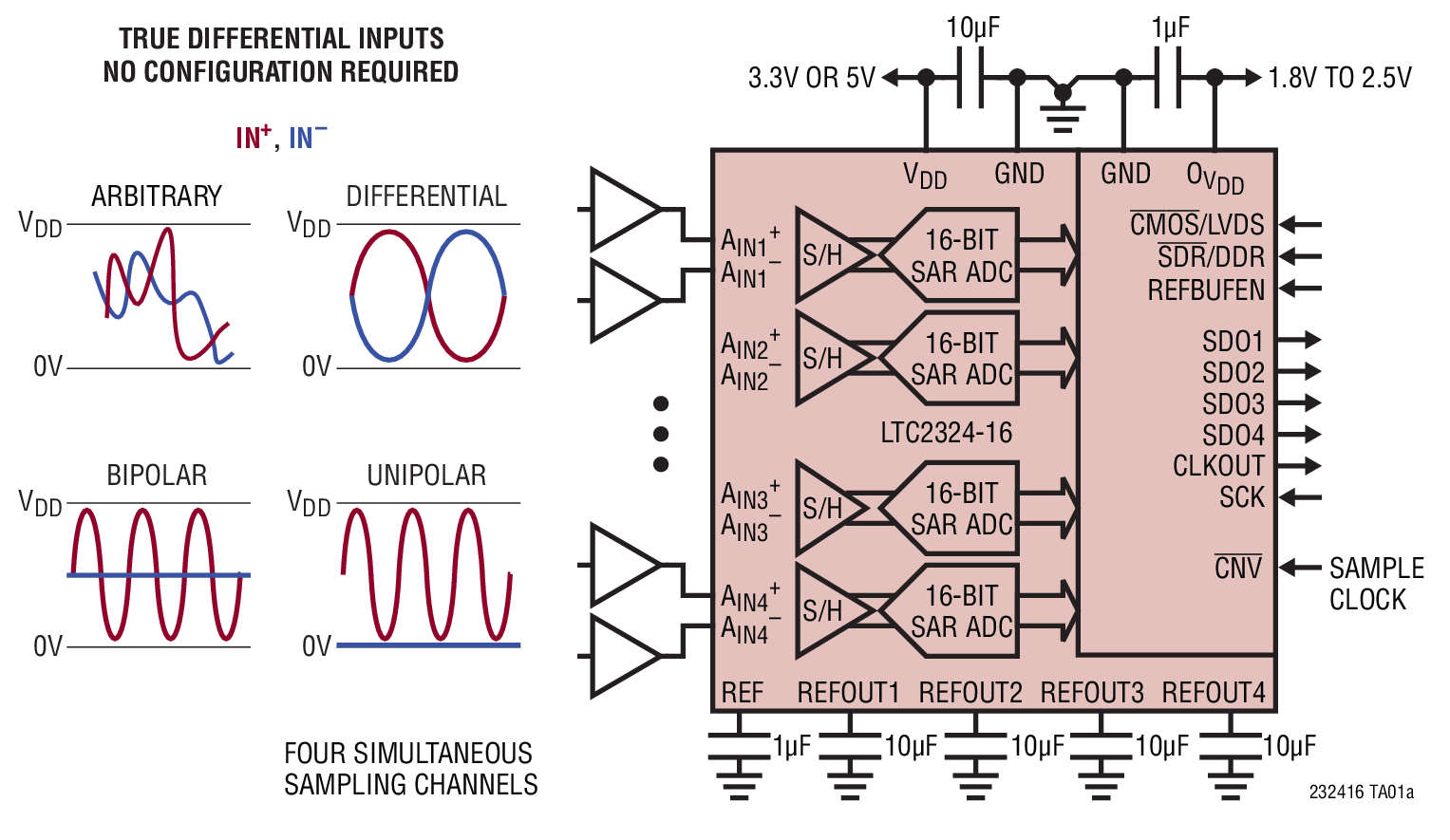
Analog Devices Inc.The LTC2324-16 is a low noise, high speed quad 16?bit successive approximation register (SAR) ADC with differential inputs and wide input common mode range. Operating from a single 3.3V or 5V supply, the LTC2324-16 has an 8VP-P differential input range, making it ideal for applications which require a wide dynamic range with high common mode rejection. The LTC2324-16 achieves ?2LSB INL typical, no missing codes at 16 bits and 82dB SNR.The LTC2324-16 has an onboard low drift (20ppm/?C max) 2.048V or 4.096V temperature-compensated reference. The LTC2324-16 also has a high speed SPI-compatible serial interface that supports CMOS or LVDS. The fast 2Msps per channel throughput with no latency makes the LTC2324-16 ideally suited for a wide variety of high speed applications. The LTC2324-16 dissipates only 40mW per channel and offers nap and sleep modes to reduce the power consumption to 26?W for further power savings during inactive periods.Applications High Speed Data Acquisition Systems Communications Optical Networking Multiphase Motor Control
DC2395A-D
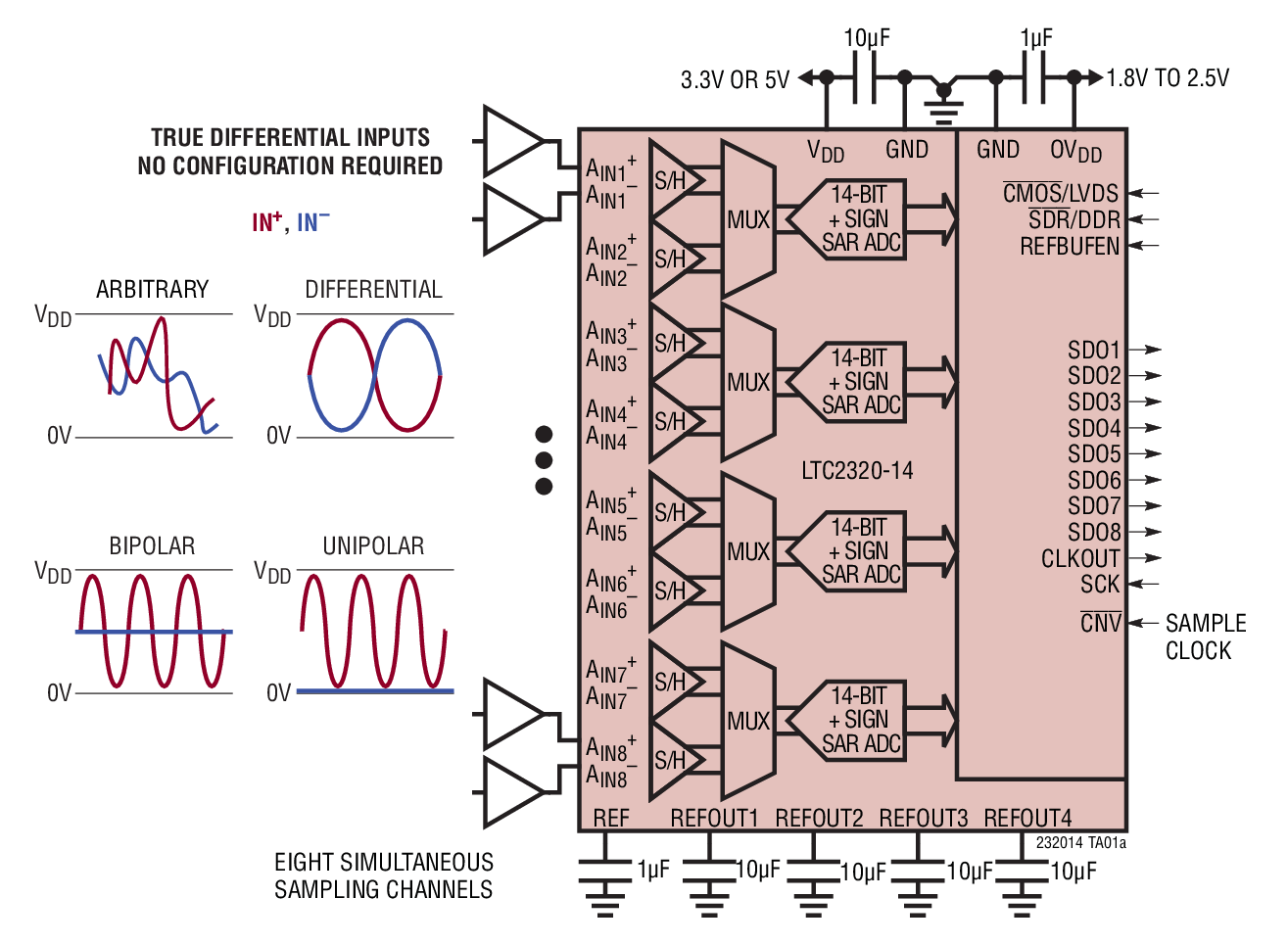
Analog Devices Inc.The LTC2320-14 is a low noise, high speed octal 14?bit + sign successive approximation register (SAR) ADC with differential inputs and wide input common mode range. Operating from a single 3.3V or 5V supply, the LTC2320-14 has an 8VP-P differential input range, making it ideal for applications which require a wide dynamic range with high common mode rejection. The LTC2320-14 achieves ?1LSB INL typical, no missing codes at 14 bits and 81dB SNR.The LTC2320-14 has an onboard low drift (20ppm/?C max) 2.048V or 4.096V temperature-compensated reference. The LTC2320-14 also has a high speed SPI-compatible serial interface that supports CMOS or LVDS. The fast 1.5Msps per channel throughput with no latency makes the LTC2320-14 ideally suited for a wide variety of high speed applications. The LTC2320-14 dissipates only 20mW per channel and offers nap and sleep modes to reduce the power consumption to 26?W for further power savings during inactive periods.Applications High Speed Data Acquisition Systems Communications Optical Networking Multiphase Motor Control

DC2395A-E
Analog Devices Inc.The LTC2324-12 is a low noise, high speed quad 12-bit + sign successive approximation register (SAR) ADC with differential inputs and wide input common mode range. Operating from a single 3.3V or 5V supply, the LTC2324- 12 has an 8VP-P differential input range, making it ideal for applications which require a wide dynamic range with high common mode rejection. The LTC2324-12 achieves ?0.5LSB INL typical, no missing codes at 12 bits and 78dB SNR.The LTC2324-12 has an onboard low drift (20ppm/?C max) 2.048V or 4.096V temperature-compensated reference. The LTC2324-12 also has a high speed SPI-compatible serial interface that supports CMOS or LVDS. The fast 2Msps per channel throughput with no latency makes the LTC2324-12 ideally suited for a wide variety of high speed applications. The LTC2324-12 dissipates only 40mW per channel and offers nap and sleep modes to reduce the power consumption to 26?W for further power savings during inactive periods.Applications High Speed Data Acquisition Systems Communications Optical Networking Multiphase Motor Control

DC2402A
Analog Devices Inc.The LT6236/LT6237/LT6238 are single/dual/quad low noise, rail-to-rail output op amps that feature 1.1nV/?Hz input referred noise voltage density and draw only 3.5mA of supply current per amplifier. These amplifiers combine very low noise and supply current with a 215MHz gain bandwidth product and a 70V/?s slew rate. Low noise, fast settling time and low offset voltage make this amplifier optimal to drive low noise, high speed SAR ADCs. The LT6236 includes a shutdown feature that can be used to reduce the supply current to less than 10?A.This amplifier family has an output that swings within 50mV of either supply rail to maximize the signal dynamic range in low supply applications and is specified on 3.3V, 5V and ?5V supplies.The LT6236/LT6237/LT6238 are upgrades to the LT6230/LT6231/LT6232, offering similar performance with reduced wideband noise beyond 100kHz.Applications 16-Bit and 18-Bit SAR ADC Drivers Active Filters Low Noise, Low Power Signal Processing

DC2417A-A
Analog Devices Inc.The LTC4367 protects applications where power supply input voltages may be too high, too low or even negative. It does this by controlling the gate voltages of a pair of external N-channel MOSFETs to ensure that the output stays within a safe operating range.The LTC4367 withstands voltages between ?40V and 100V and has an operating range of 2.5V to 60V, while consuming only 70?A in normal operation.Two comparator inputs allow configuration of the overvoltage (OV) and undervoltage (UV) set points using an external resistive divider. A shutdown pin provides external control for enabling and disabling the MOSFETs as well as placing the device in a low current shutdown state. A fault output indicates that the GATE pin is pulling low when the part is in shutdown or the input voltage is outside the UV and OV set points.The LTC4367 has a 32ms turn-on delay that debounces live connections and blocks 50Hz to 60Hz AC power. For fast recovery after faults, the LTC4367-1 has a reduced turn-on delay of 500?s.Applications Portable InstrumentationIndustrial AutomationAutomotive Surge (Load Dump) ProtectionNetwork Equipment

DC2425A-C
Analog Devices Inc.The LTC2311-14 is a low noise, high speed 14-bit + sign successive approximation register (SAR) ADC with differential inputs and wide input common mode range. Operating from a single 3.3V or 5V supply, the LTC2311- 14 has an 8VP-P differential input range, making it ideal for applications which require a wide dynamic range with high common mode rejection. The LTC2311-14 achieves ?0.75LSB INL typical, no missing codes at 14 bits and 80dB SNR typical.The LTC2311-14 has an onboard low drift (20ppm/?C max) 2.048V or 4.096V temperature compensated reference and provides an external 1.25V buffered reference input. The LTC2311-14 also has a high speed SPI-compatible serial interface that supports CMOS or LVDS. The fast 5Msps throughput with one-cycle latency makes the LTC2311-14 ideally suited for a wide variety of high speed applications. The LTC2311-14 dissipates only 50mW with a 5V supply and offers nap and sleep modes to reduce the power consumption to 5?W for further power savings during inactive periods.Applications High Speed Data Acquisition Systems Communications Remote Data Acquisition Imaging Optical Networking Automotive Multiphase Motor Control

LT6658-1.8 Demo Board | Low Noise, High Current, Precision Reference
Analog Devices Inc.Demonstration circuit 2432B features the LT6658, a precision dual output reference that combines the performance of a low drift low noise reference and a linear regulator. Demonstration circuits are available with 1.25V, 1.8V, 2.5V, 3.0V, 3.3V and 5V output option parts. Both outputs are ideal for driving the precision reference inputs of high resolution ADCs and DACs, even with heavy loading while simultaneously acting as output supplies for powering microcontrollers and other supporting devices. Both outputs have the same precision specifications and A track each other over temperature. Each output can be configured with external resistors to give an output voltage up to 6V.