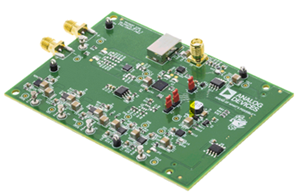
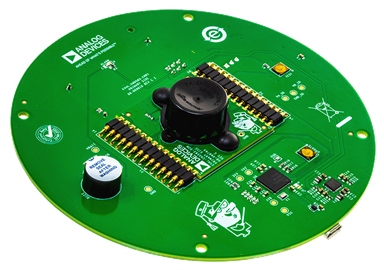
LTC4425EDD Demo Board | Linear SuperCap Charger with Current-Limited Ideal Diode and V/I Monitor
Analog Devices Inc.DC1589A: Demo Board for the LTC4425 Linear SuperCap Charger with Current-Limited Ideal Diode and V/I Monitor.

LTC2635-LZ12 | 12-Bit Quad I2C DAC (2.5V Internal Reference Mode, Reset to Zero-Scale), Requires DC590
Analog Devices Inc.DC1593A-C: Demo Board for LTC2635-12 Quad 12-Bit I2C VOUT DACs with 10ppm/°C Reference.
LTC2635-HZ12 | 12-Bit Quad I2C DAC (4.096V Internal Reference Mode, Reset to Zero-Scale), Requires DC590
Analog Devices Inc.DC1593A-E: Demo Board for LTC2635-12 Quad 12-Bit I2C VOUT DACs with 10ppm/°C Reference.
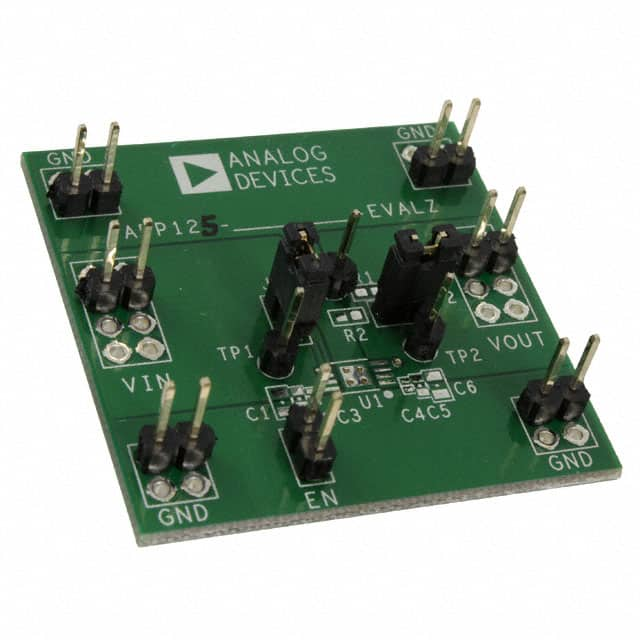

EVAL-AD5292DBZ
Analog Devices Inc.The AD5291 and AD5292 are single-channel, 256-/1024-position digital potentiometers that combine industry leading variable resistor performance with nonvolatile memory (NVM) in a compact package. These devices are capable of operating across a wide voltage range, supporting both dual supply operation?at ?10.5 V to ?16.5 V and single supply operation at +21 V to +33 V, while ensuring less than 1% end-to-end resistor tolerance error and offering 20-time programmable (20-TP) memory.The guaranteed industry leading low resistor tolerance error?feature simplifies open-loop applications as well as precision?calibration and tolerance matching applications.The AD5291 and AD5292 device wiper settings are controllable?through the SPI digital interface. Unlimited adjustments are?allowed before programming the resistance value into the 20-TP memory. The AD5291 and AD5292 do not require any?external voltage supply to facilitate fuse blow, and there are 20 opportunities for permanent programming. During 20-TP activation, a permanent blow fuse command freezes the wiper?position (analogous to placing epoxy on a mechanical trimmer).The AD5291 and AD5292 are available in a compact 14-lead?TSSOP package. The part is guaranteed to operate over the?extended industrial temperature range of ?40?C to +105?C.APPLICATIONS Mechanical potentiometer replacement Instrumentation: gain and offset adjustment Programmable voltage-to-current conversion Programmable filters, delays, and time constants Programmable power supply Low resolution DAC replacement Sensor calibration

EVAL-AD5316RDBZ
Analog Devices Inc.The AD5316R, a member of the nanoDAC? family, is a low power,quad, 10-bit buffered voltage output DAC. The device includesa 2.5 V, 2 ppm/?C internal reference (enabled by default) and again select pin giving a full-scale output of 2.5 V (gain = 1) or 5 V(gain = 2). The device operates from a single 2.7 V to 5.5 V supply,is guaranteed monotonic by design, and exhibits less than 0.1%FSR gain error and 1.5 mV offset error performance. The device is available in a 3 mm ? 3 mm lead lead frame chip scale package (LFCSP) and in a thin shrink small outline package (TSSOP).The AD5316R also incorporates a power-on reset circuit and aRSTSEL pin. The RSTSEL pin ensures that the DAC outputs powerup to zero scale or midscale and remain at that level until a validwrite takes place. The device contains a per channel power-down feature that reduces the current consumption of the device in power-down mode to 4 ?A at 3 V.The AD5316R uses a versatile 2-wire serial interface that operatesat clock rates up to 400 kHz and includes a VLOGIC pin intendedfor 1.8 V/3 V/5 V logic.Product Highlights Precision DC Performance. Total unadjusted error (TUE): ?0.1% of FSR maximum Offset error: ?1.5 mV maximum Gain error: ?0.1% of FSR maximum Low Drift 2.5 V On-Chip Reference. 2 ppm/?C typical temperature coefficient 5 ppm/?C maximum temperature coefficient Two Package Options. 3 mm ? 3 mm, 16-lead LFCSP 16-lead TSSOPApplications Digital gain and offset adjustment Programmable attenuators Industrial automation Data acquisition systems

EVAL-AD5323DBZ
Analog Devices Inc.The AD5303?/ AD5313?/ AD5323 are dual 8-/10-/12-bit buffered voltage output DACs in a 16-lead TSSOP package that operate from a single 2.5 V to 5.5 V supply, consuming 230 ?A at 3 V. Their on-chip output amplifiers allow the outputs to swing rail-to-rail with a slew rate of 0.7 V/?s. The AD5313 / AD5323 utilize a versatile 3-wire?serial interface that operates at clock rates up to 30 MHz and is?compatible with standard SPI, QSPI?, MICROWIRE?, and DSP?interface standards The references for the two DACs are derived from two reference pins (one per DAC). These reference inputs may be configured as buffered or unbuffered inputs. The parts incorporate a power-on reset circuit, which ensures that the DAC outputs power up to 0 V and remain there until a valid write to the device takes place. There is also an asynchronous active low CLR pin that clears both DACs to 0 V. The outputs of both DACs may be updated simultaneously using the asynchronous LDAC input. The parts contain a power-down feature that reduces the current consumption of the devices to 200 nA at 5 V (50 nA at 3 V) and provides software-selectable output loads while in power-down mode. The parts may also be used in daisy-chaining applications using the SDO pin.The low power consumption of these parts in normal operation makes them ideally suited to portable battery-operated equipment. The power consumption is 1.5 mW at 5 V and 0.7 mW at 3 V, reducing to 1 ?W in power-down mode.APPLICATIONS Portable battery-powered instruments Digital gain and offset adjustment Programmable voltage and current sources Programmable attenuators

EVAL-AD5324DBZ
Analog Devices Inc.The AD5304/AD5314/AD5324 are quad 8-, 10-, and 12-bit buffered voltage output DACs in 10-lead MSOP and 10-lead LFCSP packages that operate from a single 2.5 V to 5.5 V supply, consuming 500 ?A at 3 V. Their on-chip output amplifiers allow rail-to-rail output swing to be achieved with a slew rate of 0.7 V/?s. A 3-wire serial interface is used; it operates at clock rates up to 30 MHz and is compatible with standard SPI, QSPI, MICROWIRE, and DSP interface standards.The references for the four DACs are derived from one reference pin. The outputs of all DACs can be updated simultaneously using the software LDAC function. The parts incorporate a power-on reset circuit, and ensure that the DAC outputs power up to 0 V and remains there until a valid write takes place to the device. The parts contain a power-down feature that reduces the current consumption of the device to 200 nA @ 5 V (80 nA @ 3 V).The low power consumption of these parts in normal operation makes them ideally suited to portable battery-operated equipment. The power consumption is 3 mW at 5 V, 1.5 mW at 3 V, reducing to 1 ?W in power-down mode.Applications Portable battery-powered instruments Digital gain and offset adjustment Programmable voltage and current sources Programmable attenuators Industrial process controls

EVAL-AD5422EBZ
Analog Devices Inc.The AD5412/AD5422 are low cost, precision, fully integrated12-/16-bit digital-to-analog converters (DAC) offering a programmable current source and programmable voltage output designed to meet the requirements of industrial process control applications.The output current range is programmable at 4 mA to 20 mA, 0 mA to 20 mA, or an overrange function of 0 mA to 24 mA.The LFCSP version of this product has a CAP2 pin so that the HART signals can be coupled onto the current output of the AD5412/AD5422.Voltage output is provided from a separate pin that can be configured to provide 0 V to 5 V, 0 V to 10 V, ?5 V, or ?10 V output ranges; an overrange of 10% is available on all ranges.Analog outputs are short and open-circuit protected and can drive capacitive loads of 1 ?F.The device operates with an AVDD power supply range from 10.8 V to 40 V. Current loop compliance voltage is 0 V to AVDD ? 2.5 V.The flexible serial interface is SPI- and MICROWIRE?-compatible and can be operated in 3-wire mode to minimize the digital isolation required in isolated applications.The device also includes a power-on-reset function, ensuring that the device powers up in a known state. The part also includes an asynchronous clear pin (CLEAR) that sets the outputs to zero-scale/midscale voltage output or the low end of the selected current range.The total output error is typically ?0.01% in current mode and ?0.01% in voltage mode.Applications Process controls Actuator controls PLC HART network connectivity (LFCSP package only)

EVAL-AD5542ASDZ
Analog Devices Inc.The AD5512A?/ AD5542A are single, 12-/16-bit, serial input, unbuffered voltage output digital-to-analog converters (DAC) that operate from a single 2.7 V to 5.5 V supply. The DAC output range extends from 0 V to VREF?and is guaranteed monotonic, providing 1 LSB INL accuracy at 16 bits without adjustment over the full specified temperature range of ?40?C to +85?C (AD5542A) or ?40?C to +125?C (AD5512A).Offering unbuffered outputs, the AD5512A / AD5542A achieve a 1 ?s settling time with low offset errors ideal for high speed open loop control.The AD5512A / AD5542A incorporate a bipolar mode of operation that generates a ?VREF?output swing. The AD5512A / AD5542A also include Kelvin sense connections for the reference and analog ground pins to reduce layout sensitivity.The AD5512A / AD5542A are available in a 16-lead LFCSP with the AD5542A also available in a 10-lead LFCSP and a 16-lead TSSOP. The AD5512A / AD5542A use a versatile 3-wire interface that is compatible with 50 MHz SPI, QSPI?, MICROWIRE?, and DSP interface standards.APPLICATIONS Automatic test equipment Precision Source-measure Instruments Data Acquisition Systems Medical and aerospace Instrumentation Communications equipmentPRODUCT HIGHLIGHTS 16-bit performance without adjustment. 2.7 V to 5.5 V single supply operation. Low 11.8 nV/?Hz noise spectral density. Low 0.05 ppm/?C temperature drift. 3 mm ? 3 mm LFCSP and TSSOP packaging.

EVAL-AD5546SDZ
Analog Devices Inc.The AD5546 /?AD5556 are precision 16-/14-bit, multiplying, low power, current output, parallel input D/A converters. They operate from a single 2.7 V to 5.5 V supply with ?10 V multiplying references for 4-quadrant outputs. Built-in 4-quadrant resistors facilitate the resistance matching and temperaturetracking that minimize the number of components needed for multiquadrant applications. The feedback resistor (RFB) simplifies the I-V conversion with an external buffer. The AD5546/AD5556 are packaged in compact TSSOP-28 packages with operating temperatures from ?40?C to +125?C.APPLICATIONS Automatic test equipment Instrumentation Digitally controlled calibration Digital waveform generation?

EVAL-AD5666SDZ
Analog Devices Inc.The AD5666 is a low power, quad, 16-bit, buffered voltage-output DAC. The part operates from a single 2.7 V to 5.5 V supply and is guaranteed monotonic by design.The AD5666 has an on-chip reference with an internal gain of 2. The AD5666-1 has a 1.25 V 5 ppm/?C reference, giving a full-scale output of 2.5 V; the AD5666-2 has a 2.5 V 5 ppm/?C reference, giving a full-scale output of 5 V. The on-board reference is off at power-up, allowing the use of an external reference. The internal reference is turned on by writing to the DAC.The part incorporates a power-on reset circuit that ensures that the DAC output powers up to 0 V (POR pin low) or to midscale (POR pin high) and remains powered up at this level until a valid write takes place. The part contains a power-down feature that reduces the current consumption of the device to 400 nA at 5 V and provides software-selectable output loads while in power-down mode for any or all DAC channels.The outputs of all DACs can be updated simultaneously using the LDAC function, with the added functionality of user-select-able DAC channels to simultaneously update. There is also an asynchronous CLR that clears all DACs to a software-selectable code?0 V, midscale, or full scale.The AD5666 utilizes a versatile 3-wire serial interface that operates at clock rates of up to 50 MHz and is compatible with standard SPI?, QSPI?, MICROWIRE?, and DSP interface standards. The on-chip precision output amplifier enables rail-to-rail output swing.Product Highlights Quad, 16-bit DAC. On-chip 1.25 V/2.5 V, 5 ppm/?C reference. Available in 14-lead TSSOP. Selectable power-on reset to 0 V or midscale. Power-down capability. When powered down, the DAC typically consumes 200 nA at 3 V and 400 nA at 5 V.Applications Process control Data acquisition systems Portable battery-powered instruments Digital gain and offset adjustment Programmable voltage and current sources Programmable attenuators

EVAL-AD5676RARDZ
Analog Devices Inc.The AD5672R/AD5676R are low power, octal, 12-/16-bit buffered voltage output digital-to-analog converters (DACs). They include a 2.5 V, 2 ppm/?C internal reference (enabled by default) and a gain select pin giving a full-scale output of 2.5 V (gain = 1) or 5 V (gain = 2). The devices operate from a single 2.7 V to 5.5 V supply and are guaranteed monotonic by design. The AD5672R/AD5676R are available in a 20-lead TSSOP?and in a 20-lead LFCSP and incorporate a power-on reset circuit and a RSTSEL pin that ensures that the DAC outputs power up to zero scale or midscale and remains there until a valid write. The AD5672R/AD5676R contain a power-down mode, reducing the current consumption to 1 ?A typical while in power-down mode. The AD5676R is also available in a 16-ball WLCSP.PRODUCT HIGHLIGHTS High Relative Accuracy (INL). AD5672R (12-bit): ?1 LSB maximum AD5676R (16-bit): ?3 LSB maximum Low Drift 2.5 V On-Chip Reference. High Channel Density.Eight channels in 2.5 mm ? 2.4 mm WLCSP (AD5676R).APPLICATIONS Optical transceivers Base-station power amplifiers Process control (PLC input/output cards) Industrial automation Data acquisition systems

EVAL-AD5678DBZ
Analog Devices Inc.The AD5678 is a low power, octal, buffered voltage-output DAC with four 12-bit DACs and four 16-bit DACs in a single package. All devices operate from a single 2.7 V to 5.5 V supply and are guaranteed monotonic by design.The AD5678 has an on-chip reference with an internal gain of 2. The AD5678-1 has a 1.25 V 5 ppm/?C reference, giving a full-scale output of 2.5 V; the AD5678-2 has a 2.5 V 5 ppm/?C reference, giving a full-scale output of 5 V. The on-board reference is off at power-up, allowing the use of an external reference. The internal reference is enabled via a software write.The part incorporates a power-on reset circuit that ensures that the DAC output powers up to 0 V and remains powered up at this level until a valid write takes place. The part contains a power-down feature that reduces the current consumption of the device to 400 nA at 5 V and provides software-selectable output loads while in power-down mode for any or all DAC channels.The outputs of all DACs can be updated simultaneously using the LDAC function, with the added functionality of user-selectable DAC channels to simultaneously update. There is also an asynchronous CLR that clears all DACs to a software-selectable code?0 V, midscale, or full scale.The AD5678 utilizes a versatile 3-wire serial interface that operates at clock rates of up to 50 MHz and is compatible with standard SPI?, QSPI?, MICROWIRE?, and DSP interface standards. The on-chip precision output amplifier enables rail-to-rail output swing.PRODUCT HIGHLIGHTS Octal DAC (four 12-bit DACs and four 16-bit DACs). On-chip 1.25 V/2.5 V, 5 ppm/?C reference. Available in 14-lead/16-lead TSSOP. Power-on reset to 0 V. Power-down capability. When powered down, the DAC typically consumes 200 nA at 3 V and 400 nA at 5 VAPPLICATIONS Process control Data acquisition systems Portable battery-powered instruments Digital gain and offset adjustment Programmable voltage current sources Programmable attenuators

EVAL-AD5750EBZ
Analog Devices Inc.The AD5750 / AD5750-1 / AD5750-2 are single-channel, low cost, precision voltage/current output drivers with hardware- or software-programmable output ranges. The software ranges are configured via an SPI-/MICROWIRE?-compatible serial interface. The AD5750/AD5750-1/AD5750-2 target applications in PLC and industrial process control. The analog input to the AD5750/ AD5750-1/AD5750-2 is provided from a low voltage, single-supply digital-to-analog converter (DAC) and is internally conditioned to provide the desired output current/voltage range. Analog input ranges available are 0 V to 2.5 V (AD5750-1/AD5750-2) or 0 V to 4.096 V (AD5750).The output current range is programmable across five current ranges: 4 mA to 20 mA, 0 mA to 20 mA or 0 mA to 24 mA, ?20 mA, and ?24 mA. An overrange of 2% is available on the unipolar current ranges.Voltage output is provided from a separate pin that can be configured to provide 0 V to 5 V, 0 V to 10 V, ?5 V, or ?10 V output ranges. An overrange of 20% is available on the voltage ranges.Analog outputs are short-circuit and open-circuit protected and can drive capacitive loads of 1 ?F and inductive loads of 0.1 H.The device is specified to operate with a power supply range from ?12 V to ?24 V. Output loop compliance is 0 V to AVDD ? 2.75 V.The flexible serial interface is SPI and MICROWIRE compatible and can be operated in 3-wire mode to minimize the digital isolation required in isolated applications. The interface also features an optional PEC error checking feature using CRC-8 error checking, useful in industrial environments where data communication corruption can occur.The device also includes a power-on reset function, ensuring that the device powers up in a known state (0 V or tristate), and an asynchronous CLEAR pin that sets the outputs to zero scale/midscale voltage output or the low end of the selected current range.An HW SELECT pin is used to configure the part for hardware or software mode on power-up.APPLICATIONS Process Control Actuator Control PLCs

EVAL-AD5758SDZ
Analog Devices Inc.The AD5758 is a single-channel, voltage and current output digital-to-analog converter (DAC) that operates with a power supply range from ?33 V (minimum) on AVSS to +33 V (maximum) on AVDD1 with a maximum operating voltage between the two rails of 60 V. On-chip dynamic power control (DPC) minimizes package power dissipation, which is achieved by regulating the supply voltage (VDPC+) to the VIOUT output driver circuitry from 5 V to 27 V using a buck dc-to-dc converter, optimized for minimum on-chip power dissipation. The CHART pin enables a HART? signal to be coupled onto the current output.The device uses a versatile 4-wire serial peripheral interface (SPI) that operates at clock rates of up to 50 MHz and is compatible with standard SPI, QSPI?, MICROWIRE?, DSP, and microcontroller interface standards. The interface also features an optional SPI cyclic redundancy check (CRC) and a watchdog timer (WDT). The AD5758 offers improved diagnostic features from its predecessors, such as an integrated 12-bit diagnostic analog-to-digital converter (ADC). Additional robustness is provided by the inclusion of a line protector on the VIOUT, +VSENSE, and ?VSENSE pins. When used with its companion power management unit (PMU)/isolator (ADP1031), the AD5758 is capable of enabling customers to develop an eight channel to channel isolated analog output module with less than 2 W power dissipation, while meeting CISPR 11 Class B. Product Highlights DPC, using an integrated buck dc-to-dc converter for thermal management. When used with the ADP1031, the AD5758 enables eight channel to channel isolated outputs at

EVAL-AD5781SDZ
Analog Devices Inc.The AD5781 is a single 18-bit, unbuffered voltage-output DAC that operates from a bipolar supply of up to 33 V. The AD5781 accepts a positive reference input in the range 5V to VDD ? 2.5 V and a negative reference input in the range VSS?+ 2.5 V to 0 V. The AD5781 offers a relative accuracy specification of ?0.5 LSB max, and operation is guaranteed monotonic with a ?0.5 LSB DNL maximum specification.The part uses a versatile 3-wire serial interface that operates at clock rates up to 35 MHz and that is compatible with standard SPI?, QSPI?, MICROWIRE?, and DSP interface standards. The part incorporates a power-on reset circuit that ensures the DAC output powers up to 0 V and in a known output impedance state and remains in this state until a valid write to the device takes place. The part provides an output clamp feature that places the output in a defined load state.PRODUCT HIGHLIGHTS True 18-Bit Accuracy. Wide Power Supply Range of Up to ?16.5 V. ?40?C to +125?C Operating Temperature Range. Low 7.5 nV/?Hz Noise. Low 0.05 ppm/?C Temperature Drift.APPLICATIONS Medical Instrumentation Test and Measurement Industrial Control Scientific and Aerospace Instrumentation Data Acquisition Systems Digital Gain and Offset Adjustment Power Supply Control

EVAL-AD5940BIOZ
Analog Devices Inc.The AD5940 and AD5941 are high precision, low power analog front ends (AFEs) designed for portable applications that require high precision, electrochemical-based measurement techniques, such as amperometric, voltammetric, or impedance measurements. The AD5940/AD5941 is designed for skin impedance and body impedance measurements, and works with the AD8233 AFE in a complete bioelectric or biopotential measurement system. The AD5940/AD5941 is designed for electrochemical toxic gas sensing.The AD5940/AD5941 consist of two high precision excitation loops and one common measurement channel, which enables a wide capability of measurements of the sensor under test. The first excitation loop consists of an ultra low power, dual-output string, digital-to-analog converter (DAC), and a low power, low noise potentiostat. One output of the DAC controls the noninverting input of the potentiostat, and the other output controls the noninverting input of the transimpedance amplifier (TIA). This low power excitation loop is capable of generating signals from dc to 200 Hz.The second excitation loop consists of a 12-bit DAC, referred to as the high speed DAC. This DAC is capable of generating high frequency excitation signals up to 200 kHz.The AD5940/AD5941 measurement channel features a 16-bit, 800 kSPS, multichannel successive approximation register (SAR) analog-to-digital converter (ADC) with input buffers, a built in antialias filter, and a programmable gain amplifier (PGA). An input multiplexer (mux) in front of the ADC allows the user to select an input channel for measurement. These input channels include multiple external current inputs, external voltage inputs, and internal channels. The internal channels allow diagnostic measurements of the internal supply voltages, die temperature, and reference voltages.The current inputs include two TIAs with programmable gain and load resistors for measuring different sensor types. The first TIA, referred to as the low power TIA, measures low bandwidth signals. The second TIA, referred to as the high speed TIA, measures high bandwidth signals up to 200 kHz.An ultra low leakage, programmable switch matrix connects the sensor to the internal analog excitation and measurement blocks. This matrix provides an interface for connecting external transimpedance amplifier resistors (RTIAs) and calibration resistors. The matrix can also be used to multiplex multiple electronic measurement devices to the same wearable electrodes.A precision 1.82 V and 2.5 V on-chip reference source is available. The internal ADC and DAC circuits use this on-chip reference source to ensure low drift performance for the 1.82 V and 2.5 V peripherals.The AD5940/AD5941 measurement blocks can be controlled via direct register writes through the serial peripheral interface (SPI) interface, or, alternatively, by using a preprogrammable sequencer, which provides autonomous control of the AFE chip. 6 kB of static random access memory (SRAM) is partitioned for a deep data first in, first out (FIFO) and command FIFO. Measurement commands are stored in the command FIFO and measurement results are stored in the data FIFO. A number of FIFO related interrupts are available to indicate when the FIFO is full.A number of general-purpose inputs/outputs (GPIOs) are available and controlled using the AFE sequencer. The AFE sequencer allows cycle accurate control of multiple external sensor devices.The AD5940/AD5941 operate from a 2.8 V to 3.6 V supply and are specified over a temperature range of ?40?C to +85?C. The AD5940 is packaged in a 56-lead, 3.6 mm ? 4.2 mm WLCSP. The AD5941 is packaged in a 48-lead LFCSP.APPLICATIONS Electrochemical measurements Electrochemical gas sensors Potentiostat/amperometric/voltammetry/cyclic voltammetry Bioimpedance applications Skin impedance Body impedance Continuous glucose monitoring Battery impedance

EVAL-AD7091R-2SDZ
Analog Devices Inc.The AD7091R-2 /?AD7091R-4?/?AD7091R-8 family is a multichannel12-bit, ultralow power, successive approximation analog-to-digitalconverter (ADC) that is available in two, four, or eightanalog input channel options. The AD7091R-2 / AD7091R-4 /AD7091R-8 operate from a single 2.7 V to 5.25 V power supplyand are capable of achieving a sampling rate of 1 MSPS.The AD7091R-2 / AD7091R-4 / AD7091R-8 family offers up to eightsingle-ended analog input channels with a channel sequencerthat allows a preprogrammed selection of channels to be convertedsequentially. The AD7091R-2 / AD7091R-4 / AD7091R-8 alsofeature an on-chip conversion clock, an on-chip accurate 2.5 Vreference, and a high speed serial interface.The AD7091R-2 / AD7091R-4 / AD7091R-8 have a serial portinterface (SPI) that allows data to be read after the conversionwhile achieving a 1 MSPS throughput rate. The conversion processand data acquisition are controlled using the CONVST pin.The AD7091R-2 / AD7091R-4 / AD7091R-8 use advanced designtechniques to achieve ultralow power dissipation at highthroughput rates. They also feature flexible power managementoptions. An on-chip configuration register allows the user to set updifferent operating conditions. These include power management,alert functionality, busy indication, channel sequencing, andgeneral-purpose output pins. The MUXOUT and ADCIN pinsallow signal conditioning of the multiplexer output prior toacquisition by the ADC.APPLICATIONS Battery powered systems Personal digital assistants Medical instruments Mobile communications Instrumentation and control systems Data acquisition systems Optical sensors Diagnostic/monitoring functions

EVAL-AD7124-4SDZ
Analog Devices Inc.The AD7124-4 is a low power, low noise, completely integrated analog front end for high precision measurement applications. The device contains a low noise, 24-bit ?-? analog-to-digital converter (ADC), and can be configured to have 4 differential inputs or 7 single-ended or pseudo differential inputs. The onchip low gain stage ensures that signals of small amplitude can be interfaced directly to the ADC.One of the major advantages of the AD7124-4 is that it gives the user the flexibility to employ one of three integrated power modes. The current consumption, range of output data rates, and rms noise can be tailored with the power mode selected. The device also offers a multitude of filter options, ensuring that the user has the highest degree of flexibility.The AD7124-4 can achieve simultaneous 50 Hz and 60 Hz rejection when operating at an output data rate of 25 SPS (single cycle settling), with rejection in excess of 80 dB achieved at lower output data rates.The AD7124-4 establishes the highest degree of signal chain integration. The device contains a precision, low noise, low drift internal band gap reference, and also accepts an external differential reference, which can be internally buffered. Other key integrated features include programmable low drift excitation current sources, burnout currents, and a bias voltage generator, which sets the common-mode voltage of a channel to AVDD/2. The low-side power switch enables the user to power down bridge sensors between conversions, ensuring the absolute minimal power consumption of the system. The device also allows the user the option of operating with either an internal clock or an external clock.The integrated channel sequencer allows several channels to be enabled simultaneously, and the AD7124-4 sequentially converts on each enabled channel, simplifying communication with the device. As many as 16 channels can be enabled at any time; a channel being defined as an analog input or a diagnostic such as a power supply check or a reference check. This unique feature allows diagnostics to be interleaved with conversions.The AD7124-4 also supports per channel configuration. The device allows eight configurations or setups. Each configuration consists of gain, filter type, output data rate, buffering, and reference source. The user can assign any of these setups on a channel by channel basis.The AD7124-4 also has extensive diagnostic functionality integrated as part of its comprehensive feature set. These diagnostics include a cyclic redundancy check (CRC), signal chain checks, and serial interface checks, which lead to a morerobust solution. These diagnostics reduce the need for external components to implement diagnostics, resulting in reduced board space needs, reduced design cycle times, and cost savings. The failure modes effects and diagnostic analysis (FMEDA) of a typical application has shown a safe failure fraction (SFF) greater than 90% according to IEC 61508.The device operates with a single analog power supply from 2.7 V to 3.6 V or a dual 1.8 V power supply. The digital supply has a range of 1.65 V to 3.6 V. It is specified for a temperature range of ?40?C to +105?C. The AD7124-4 is housed in a 32-lead LFCSP package or a 24-lead TSSOP package.Applications Temperature measurement? Pressure measurement? Industrial process control? Instrumentation Smart transmitters Smart transmitters