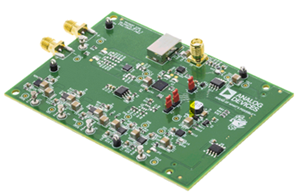
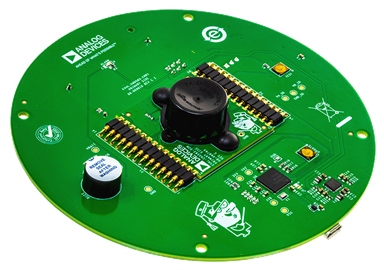
EVAL-AD7401EDZ
Analog Devices Inc.The AD7401?is a second-order, sigma-delta (?-?) modulator that converts an analog input signal into a high speed, 1-bit data stream with on-chip digital isolation based on Analog Devices, Inc.,?iCoupler? technology. The AD7401 operates from a 5 V power supply and accepts a differential input signal of ?200 mV (?320 mV full scale). The analog input is continuously sampled by the analog modulator, eliminating the need for external sample-and-hold circuitry. The input information is contained in the output stream as a density of ones with a data rate up to 20 MHz. The original information can be reconstructed with an appropriate digital filter. The serial input/output can use a 5 V or a 3 V supply (VDD2).The serial interface is digitally isolated. High speed CMOS, combined with monolithic air core transformer technology, means the on-chip isolation provides outstanding performance characteristics, superior to alternatives such as optocoupler devices. The device contains an on-chip reference. The AD7401 is offered in a 16-lead SOIC and has an operating temperature range of ?40?C to +105?C.An internal clock version, AD7400, is also available.APPLICATIONS AC motor controls Data acquisition systems A/D + opto-isolator replacements

EVAL-AD7414/15EBZ
Analog Devices Inc.The AD7414/AD7415 are complete temperature monitoring systems in 6-lead and 5-lead SOT-23 packages. They contain a band gap temperature sensor and a 10-bit ADC to monitor and digitize the temperature reading to a resolution of 0.25?C.The AD7414/AD7415 provide a 2-wire serial interface that is compatible with SMBus and I2C interfaces. The parts come in four versions: the AD7414/AD7415-0, AD7414/AD7415-1, AD7414-2, and AD7414-3. The AD7414/AD7415-0 and AD7414/AD7415-1 versions provide a choice of three different SMBus addresses for each version. All four AD7414 versions give the possibility of eight different I2C addresses while the two AD7415 versions allow up to six I2C addresses to be used.The AD7414/AD7415?s 2.7 V supply voltage, low supply current, serial interface, and small package size make them ideal for a variety of applications, including personal computers, office equipment, cellular phones, and domestic appliances.In the AD7414, on-chip registers can be programmed with high and low temperature limits, and an open-drain overtemperature indicator output (ALERT) becomes active when a programmed?limit is exceeded. A configuration register allows programming of the state of the ALERT output (active high or active low). This output can be used as an interrupt or as an SMBus alert.Applications Hard disk drives Personal computers Electronic test equipment Office equipment Domestic appliances Process control Cellular phones

EVAL-AD7416/7/8EBZ
Analog Devices Inc.The AD7417 and AD7418 are 10-bit, 4-channel and single-channelADCs with an on-chip temperature sensor that can operate from asingle 2.7 V to 5.5 V power supply. The devices contain a 15 ?ssuccessive approximation converter, a 5-channel multiplexer, atemperature sensor, a clock oscillator, a track-and-hold, and areference (2.5 V). The AD7416 is a temperature-monitoring onlydevice in an 8-lead package.The temperature sensor on the parts can be accessed via multiplexerChannel 0. When Channel 0 is selected and a conversionis initiated, the resulting ADC code at the end of the conversiongives a measurement of the ambient temperature (?1?C @ 25?C).On-chip registers can be programmed with high and low temperaturelimits, and an open-drain overtemperature indicator (OTI)output is provided, which becomes active when a programmedlimit is exceeded.A configuration register allows programming of the sense of theOTI output (active high or active low) and its operating mode(comparator or interrupt). A programmable fault queue counterallows the number of out-of-limit measurements that mustoccur before triggering the OTI output to be set to preventspurious triggering of the OTI output in noisy environments.An I2C? compatible serial interface allows the AD7416/AD7417/AD7418 registers to be written to and read back. The threeLSBs of the AD7416/AD7417 serial bus address can be selected,which allows up to eight AD7416/AD7417 devices to be connectedto a single bus.The AD7417 is available in a narrow body, 0.15 inch, 16-lead,small outline package (SOIC) and in a 16-lead, thin shrink,small outline package (TSSOP). The AD7416 and AD7418 areavailable in 8-lead SOIC and MSOP packages. Product Highlights The AD7416/AD7417/AD7418 have an on-chip temperature sensor that allows an accurate measurement of the ambient temperature (?1?C @ 25?C, ?2?C overtemperature) to be made. The measurable temperature range is ?40?C to +125?C. An overtemperature indicator is implemented by carrying out a digital comparison of the ADC code for Channel 0 (temperature sensor) with the contents of the on-chip TOTI setpoint register. The AD7417 offers a space-saving, 10-bit analog-to-digital solution with four external voltage input channels, an onchip temperature sensor, an on-chip reference, and a clock oscillator. The automatic power-down feature enables the AD7416/ AD7417/AD7418 to achieve superior power performance. At slower throughput rates, the part can be programmed to operate in a low power shutdown mode, allowing further savings in power consumption.Applications Data acquisition with ambient temperature monitoring Industrial process control Automotive Battery-charging applications Personal computers

EVAL-AD7492SDZ
Analog Devices Inc.The AD7492, AD7492-4, and AD7492-5 are 12-bit high speed, low power, successive approximation ADCs. The parts operate from a single 2.7 V to 5.25 V power supply and feature throughput rates up to 1.25 MSPS. They contain a low noise, wide bandwidth track/hold amplifier that can handle bandwidths up to 10 MHz.The conversion process and data acquisition are controlled using standard control inputs allowing for easy interface to microprocessors or DSPs. The input signal is sampled on the falling edge of CONVST and conversion is also initiated at this point. The BUSY pin goes high at the start of conversion and goes low 880 ns (AD7492/AD7492-4) or 680 ns (AD7492-5) later to indicate that the conversion is complete. There are no pipeline delays associated with the part. The conversion result is accessed via standard CS and RD signals over a high speed parallel interface.The AD7492 uses advanced design techniques to achieve very low power dissipation at high throughput rates. With 5 V supplies and 1.25 MSPS, the average current consumption AD7492-5 is typically 2.75 mA. The part also offers flexible power/throughput rate management.It is also possible to operate the part in a full sleep mode and a partial sleep mode, where the part wakes up to do a conversion and automatically enters a sleep mode at the end of conversion. The type of sleep mode is hardware selected by the PS/FS pin.Using these sleep modes allows very low power dissipation numbers at lower throughput rates.The analog input range for the part is 0 V to REFIN. The 2.5 V reference is supplied internally and is available for external referencing. The conversion rate is determined by the internal clock.PRODUCT HGHLIGHTS High Throughput with Low Power Consumption. The AD7492-5 offers 1.25 MSPS throughput with 16 mW power consumption. Flexible Power/Throughput Rate Management. The conversion time is determined by an internal clock. The part also features two sleep modes, partial and full, to maximize power efficiency at lower throughput rates. No Pipeline Delay. The part features a standard successive approximation ADC with accurate control of the sampling instant via a CONVST input and once-off conversion control. Flexible Digital Interface. The VDRIVE feature controls the voltage levels on the I/O digital pins. Fewer Peripheral Components. The AD7492 optimizes PCB space by using an internal reference and internal CLK. ol { margin-top:0px; margin-right:0px; margin-bottom:0px; margin-left:25px; padding-top:0px; padding-right:0px; padding-bottom:10px; padding-left:0px;} li { padding-top:0px; padding-right:0px; padding-bottom:5px; padding-left:0px; margin-top:0px; margin-right:0px; margin-bottom:0px; margin-left:0px;}

EVAL-AD7605-4SDZ
Analog Devices Inc.The AD7605-4 is a 4-channel, 16-bit, simultaneous sampling, analog-to-digital data acquisition system (DAS). The device contains analog input clamp protection, a second-order antialias-ing filter, a track-and-hold amplifier, a 16-bit charge redistribution successive approximation analog-to-digital converter (ADC), a 2.5 V reference and reference buffer, and high speed serial and parallel interfaces.The AD7605-4 operates from a single 5 V supply and can accommodate ?10 V and ?5 V true bipolar input signals while sampling at throughput rates of up to 300 kSPS for all channels. The input clamp protection circuitry can tolerate voltages up to ?16.5 V. The AD7605-4 has 1 M? analog input impedance, regardless of sampling frequency. The single-supply operation, on-chip filtering, and high input impedance eliminate the need for driver op amps and external bipolar supplies.The AD7605-4 is SPI, QSPI?, MICROWIRE?, and digital signal processor (DSP) compatible.Applications Power-line monitoring and protection systems Multiphase motor control Instrumentation and control systems Multiaxis positioning systems Data acquisition systems (DAS)

EVAL-AD7606BFMCZ
Analog Devices Inc.The AD7606B is a 16-bit, simultaneous sampling, analog-to-digital data acquisition system (DAS) with eight channels, each channel containing analog input clamp protection, a programable gain amplifier (PGA), a low-pass filter, and a 16-bit successive approximation register (SAR), analog-to-digital converter (ADC). The AD7606B also contains a flexible digital filter, low drift, 2.5 V precision reference and reference buffer to drive the ADC and flexible parallel and serial interfaces.The AD7606B operates from a single 5 V supply and accommodates ?10 V, ?5 V, and ?2.5 V true bipolar input ranges when sampling at throughput rates of 800 kSPS for all channels. The input clamp protection tolerates voltages up to ?21 V. The AD7606B has a 5 M? analog input impedance, resulting in less than 20 LSB bipolar zero code when the input signal is disconnected and pulled to ground through a 10 k? external resistor. The single supply operation, on-chip filtering, and high input impedance eliminates the need for external driver op amps, which require bipolar supplies. For applications with lower throughput rates, the AD7606B flexible digital filter can be used to improve noise performance.In hardware mode, the AD7606B is fully compatible with the AD7606. In software mode, the following advanced features are available: Additional ?2.5 V analog input range. Analog input range (?10 V, ?5 V, and ?2.5 V), selectable per channel. Additional oversampling (OS) options, up to OS ? 256. System gain, system offset, and system phase calibration per channel. Analog input open circuit detector. Diagnostic multiplexer. Monitoring functions (serial peripheral interface (SPI) invalid read/write, cyclic redundancy check (CRC), overvoltage and undervoltage events, busy stuck monitor, and reset detection).Note that throughout this data sheet, multifunction pins, such as the RD/SCLK pin, are referred to either by the entire pin name or by a single function of the pin, for example, the SCLK pin, when only that function is relevant.Applications Power line monitoring Protective relays Multiphase motor control Instrumentation and control systems Data acquisition systems

EVAL-AD7626FMCZ
Analog Devices Inc.The AD7626 is a 16-bit, 10 MSPS, charge redistributionsuccessive approximation register (SAR) based architectureanalog-to-digital converter (ADC). SAR architecture allowsunmatched performance both in noise (91.5 dB SNR) and inlinearity (?0.45 LSB INL). The AD7626 contains a high speed,16-bit sampling ADC, an internal conversion clock, and aninternal buffered reference. On the CNV edge, it samples thevoltage difference between the IN+ and IN? pins. The voltageson these pins swing in opposite phase between 0 V and REF.The 4.096 V reference voltage, REF, can be generated internallyor applied externally.All converted results are available on a single low voltagedifferential signaling (LVDS) self clocked or echoed clock serialinterface, reducing external hardware connections.The AD7626 is housed in a 32-lead, 5 mm ? 5 mm LFCSP withoperation specified from ?40?C to +85?C.Applications Digital imaging systems ??Digital X-ray ??Digital MRI ? CCD and IR cameras High speed data acquisition High dynamic range telecommunications receivers Spectrum analysis Test equipment

EVAL-AD7655EDZ
Analog Devices Inc.The AD7655 is a low cost, simultaneous sampling, dual-channel,16-bit, charge redistribution SAR, analog-to-digital converterthat operates from a single 5 V power supply. It contains twolow noise, wide bandwidth, track-and-hold amplifiers that allowsimultaneous sampling, a high speed 16-bit sampling ADC, aninternal conversion clock, error correction circuits, and bothserial and parallel system interface ports. Each track-and-holdhas a multiplexer in front to provide a 4-channel input ADC.The A0 multiplexer control input allows the choice ofsimultaneously sampling input pairs INA1/INB1 (A0 = low) orINA2/INB2 (A0 = high). The part features a very high samplingrate mode (normal) and, for low power applications, a reducedpower mode (impulse) where the power is scaled with thethroughput. Operation is specified from ?40?C to +85?C.Product Highlights Multichannel ADC. The AD7655 features 4-channel inputs with two sample-and-hold circuits that allow simultaneous sampling. Fast Throughput. The AD7655 is a 500 kSPS, charge redistribution, 16-bit SAR ADC with internal error correction circuitry. Single-Supply Operation. The AD7655 operates from a single 5 V supply. In impulse mode, its power dissipation decreases with throughput. Serial or Parallel Interface. Versatile parallel or 2-wire serial interface arrangements are compatible with both 3 V and 5 V logic.Applications AC motor control 3-phase power control 4-channel data acquisition Uninterrupted power supplies Communications

EVAL-AD7677EDZ
Analog Devices Inc.The AD7677 is a 16-bit, 1 MSPS, charge redistribution SAR, fully differential, analog-to-digital converter that operates from a single 5 V power supply. The part contains a high speed 16-bit sampling ADC, an internal conversion clock, error correction circuits, and both serial and parallel system interface ports.The AD7677 is hardware factory calibrated and comprehensively tested to ensure such ac parameters as signal-to-noise ratio (SNR) and total harmonic distortion (THD), in addition to the more traditional dc parameters of gain, offset, and linearity.It features a very high sampling rate mode (Warp); a fast mode (Normal) for asynchronous conversion rate applications; and, for low power applications, a reduced power mode (Impulse) where the power is scaled with the throughput.The AD7677 is available in a 48-lead LQFP or a tiny 48-lead LFCSP with operation specified from ?40?C to +85?C.PRODUCT HIGHLIGHTS Excellent INL The AD7677 has a maximum integral nonlinearity of 1 LSB with a no missing 16-bit code. Superior AC Performances The AD7677 has a minimum dynamic of 92 dB, 94 dB typical. Fast Throughput The AD7677 is a 1 MSPS, charge redistribution, 16-bit SAR ADC with internal error correction circuitry. Single-Supply Operation The AD7677 operates from a single 5 V supply and typically dissipates only 115 mW. Its power dissipation decreases with the throughput. It consumes 7 ?W maximum when in power-down. Serial or Parallel Interface Versatile parallel (8 bits or 16 bits) or 2-wire serial interface arrangement compatible with both 3 V or 5 V logic.

EVAL-AD7738EBZ
Analog Devices Inc.The AD7738 is a high precision, high throughput analog front end. True 16-bit peak-to-peak resolution is achievable with a total conversion time of 117 ?s (8.5 kHz channel switching) making it ideally suitable for high resolution multiplexing applications. The AD7738 is based on a sigma-delta architecture and features up to 24 bits of no missing codes performance. The part can be configured via a simple digital interface, which allows users to balance the noise performance against data throughput up to a 15.4 kHz conversion rate. The analog front end features 8 single-ended or 4 fully differential input channels with unipolar or bipolar 625 mV, 1.25 V and 2.5V input ranges and accepts a common mode input voltage from 200 mV above AGND to AVDD-300 mV. The multiplexer output is pinned out externally allowing the user to implement programmable gain or signal conditioning before applying the input signal to the ADC. The differential reference input features ?No Reference? detect capability. The ADC also supports per channel system calibration options. The digital serial interface can be configured for three-wire operation and is compatible with microcontrollers and digital signal processors. All interface inputs are Schmitt triggered. The part is specified for operation over the extended industrial temperature range of -40?C to +105?C and is available in 28-lead TSSOP package.

EVAL-AD7739EBZ
Analog Devices Inc.The AD7739 is a high precision, high throughput analog frontend. True 16-bit p-p resolution is achievable with a totalconversion time of 250 ?s (4 kHz channel switching), making itideally suited to high resolution multiplexing applications.The part can be configured via a simple digital interface, whichallows users to balance the noise performance against datathroughput up to 15 kHz.The analog front end features eight single-ended or four fullydifferential input channels with unipolar or bipolar 625 mV,1.25 V, and 2.5 V input ranges. It accepts a common-modeinput voltage from 200 mV above AGND to AVDD ? 300 mV.The differential reference input features no-reference detectcapability. The ADC also supports per channel systemcalibration options.The digital serial interface can be configured for 3-wireoperation and is compatible with microcontrollers and digitalsignal processors. All interface inputs are Schmitt triggered.The part is specified for operation over the extended industrialtemperature range of ?40?C to +105?C.Other parts in the AD7739 family are the AD7738, AD7734,and AD7732. The AD7738 is similar to the AD7739 but has higher speed(8.5 kHz channel switching for 16-bit performance) and higherAIN leakage current. The AD7738 multiplexer output is pinnedout externally, allowing the user to implement programmablegain or signal conditioning before being applied to the ADC.The AD7734 analog front end features four single-ended inputchannels with unipolar or true bipolar input ranges to ?10 Vwhile operating from a single +5 V analog supply. The AD7734accepts an analog input overvoltage to ?16.5 V withoutdegrading the performance of the adjacent channels. The AD7732 is similar to the AD7734, but its analog front endfeatures two fully differential input channels.APPLICATIONS PLCs/DCSs Multiplexing applications Process control Industrial instrumentation

EVAL-AD7746LDZ
Analog Devices Inc.The AD7745/AD7746 are a high resolution, ?-? capacitance-to-digital converter (CDC). The capacitance to be measured is connected directly to the device inputs. The architecture fea-tures inherent high resolution (24-bit no missing codes, up to 21-bit effective resolution), high linearity (?0.01%), and high accuracy (?4 fF factory calibrated). The AD7745/AD7746 capacitance input range is ?4 pF (changing), while it can accept up to 17 pF common-mode capacitance (not changing), which can be balanced by a programmable on-chip, digital-to-capacitance converter (CAPDAC). The AD7745 has one capacitance input channel, while the AD7746 has two channels. Each channel can be configured as single-ended or differential. The AD7745/AD7746 are designed for floating capacitive sensors. For capacitive sensors with one plate connected to ground, the AD7747 is recommended. The parts have an on-chip temperature sensor with a resolution of 0.1?C and accuracy of ?2?C. The on-chip voltage reference and the on-chip clock generator eliminate the need for any external components in capacitive sensor applications. The parts have a standard voltage input, which together with the differential reference input allows easy interface to an external temperature sensor, such as an RTD, thermistor, or diode. The AD7745/AD7746 have a 2-wire, I2C-compatible serial interface. Both parts can operate with a single power supply from 2.7 V to 5.25 V. They are specified over the automotive temperature range of ?40?C to +125?C and are housed in a 16-lead TSSOP package. ApplicationsAutomotive, Industrial and Medical Systems for: Pressure Measurement Position Sensors Level Sensors Flowmeters Humidity Sensors Impurity Detection

EVAL-AD7764EDZ
Analog Devices Inc.The AD7764 is a high performance, 24-bit, sigma-delta (?-?) analog-to-digital converter (ADC). It combines wide input bandwidth, high speed, and performance of 109 dB dynamic range at a 312.5 kHz output data rate. With excellent dc specifications, the converter is ideal for high speed data acquisition of ac signals where dc data is also required.Using the AD7764 eases front-end antialias filtering requirements, simplifying the design process significantly. The AD7764 offers pin-selectable decimation rates of 64?, 128?, and 256?. Other features include an integrated buffer to drive the reference, as well as a fully differential amplifier to buffer and level shift the input to the modulator.An overrange alert pin indicates when an input signal exceeds the acceptable range. The addition of internal gain and internal overrange registers makes the AD7764 a compact, highly integrated data acquisition device requiring minimal peripheral components.The AD7764 also offers a low power mode, significantly reducing power dissipation without reducing the output data rate or available input bandwidth.The differential input is sampled at up to 40 MSPS by an analog modulator. The modulator output is processed by a series of low-pass filters. The external clock frequency applied to the AD7764 determines the sample rate, filter corner frequencies, and output word rate.The AD7764 device boasts a full band, on-board FIR filter. The full stop-band attenuation of the filter is achieved at the Nyquist frequency. This feature offers increased protection from signals that lie above the Nyquist frequency being aliased back into the input signal bandwidth.The reference voltage supplied to the AD7764 determines the input range. With a 4 V reference, the analog input range is ?3.2768 V differential, biased around a common mode of 2.048 V. This common-mode biasing is achieved using the on-chip differential amplifier, further reducing the external signal conditioning requirements.The AD7764 is available in a 28-lead TSSOP package and is specified over the industrial temperature range of ?40?C to +85?C.Applications Data acquisition systems Vibration analysis Instrumentation

EVAL-AD7767-1EDZ
Analog Devices Inc.The AD7767/AD7767-1/AD7767-2 are high performance, 24-bit, oversampled SAR analog-to-digital converters (ADCs). The AD7767/AD7767-1/AD7767-2 combine the benefits of a large dynamic range and input bandwidth, consuming 15 mW, 10.5 mW, and 8.5 mW power, respectively, and are contained in a 16-lead TSSOP package.Ideal for ultralow power data acquisition (such as PCI- and USB-based systems), the AD7767/AD7767-1/AD7767-2 provide 24-bit resolution. The combination of exceptional SNR, wide dynamic range, and outstanding dc accuracy make the AD7767/AD7767-1/AD7767-2 ideally suited for measuring small signal changes over a wide dynamic range. This is particularly suitable for applications where small changes on the input are measured on larger ac or dc signals. In such an application, the AD7767/AD7767-1/AD7767-2 accurately gather both ac and dc information.The AD7767/AD7767-1/AD7767-2 include an on-board digital filter (complete with linear phase response) that acts to elimi-nate out-of-band noise by filtering the oversampled input voltage. The oversampled architecture also reduces front-end antialias requirements. Other features of the AD7767 include a SYNC/PD (synchronization/power-down) pin, allowing the synchronization of multiple AD7767 devices. The addition of an SDI pin provides the option of daisy chaining multiple AD7767 devices.The AD7767/AD7767-1/AD7767-2 operate from a 2.5 V supply using a 5 V reference. The devices operate from ?40?C to +105?C.ApplicationsLow power PCI/USB data acquisition systems Low power wireless acquisition systems Vibration analysis Instrumentation High precision medical acquisition

EVAL-AD7785EBZ
Analog Devices Inc.The AD7785 is a low power, low noise, complete analog front ends for high precision measurement applications. It contains a low noise 20-bit ?-? ADC with three differential analog inputs. The on-chip, low noise instrumentation amplifier means that signals of small amplitude can be interfaced directly to the ADC. With a gain setting of 64, the rms noise is 40 nV when the update rate equals 4.17 Hz.The device contains a precision low noise, low drift internal band gap reference and can also accept an external differential reference. Other on-chip features include programmable excitation current sources, burnout currents, and a bias voltage generator, the bias voltage generator being used to set the common-mode voltage of a channel to AVDD/2.The device can be operated with either the internal clock or an external clock. The output data rate from the part is software-programmable and can be varied from 4.17 Hz to 470 Hz.The part operates with a power supply from 2.7 V to 5.25 V. It consumes a current of 400 ?A typical and is housed in 16-lead TSSOP packages.APPLICATIONS Thermocouple measurements RTD measurements Thermistor measurements Gas analysis Industrial process control Instrumentation Portable instrumentation Blood analysis Smart transmitters Liquid/gas chromatography 6-digit DVM

EVAL-AD7796EBZ
Analog Devices Inc.The AD7796/AD7797 are complete, analog front ends for highprecision, bridge sensor applications such as weigh scales. TheAD7796/AD7797 contain a ?-? ADC capable of 16-/24-bitresolution, respectively. The on-chip instrumentation amplifierhas a fixed gain of 128, allowing small amplitude signals such asthose from bridge sensors to be directly interfaced to the ADC.Each device has one differential input and contains a temperaturesensor that is internally connected to the ADC. This sensor canbe used to perform temperature compensation of the bridge.The devices can be operated with the internal clock or an externalclock. The output data rate from the devices is software-programmableand can be varied from 4.17 Hz to 123 Hz.The AD7796/AD7797 operate with a power supply from 2.7 Vto 5.25 V. Each device consumes a current of 250 ?A typical andis housed in a 16-lead TSSOP.Applications Weigh scales Strain gages Industrial process control Instrumentation Portable instrumentation

EVAL-AD7799EBZ
Analog Devices Inc.The?AD7798/AD7799 are low power, low noise, complete analog front ends for high precision measurement applications. The AD7798/AD7799 contains a low noise, 16-/24-bit ?-? ADC with three differential analog inputs. The on-chip, low noise instrumentation amplifier means that signals of small amplitude can be interfaced directly to the ADC. With a gain setting of 64, the rms noise is 27 nV for the AD7799 and 40 nV for the AD7798 when the update rate equals 4.17 Hz.On-chip features include a low-side power switch, reference detect, programmable digital output pins, burnout currents, and an internal clock oscillator. The output data rate from the part is software-programmable and can be varied from 4.17 Hz to 470 Hz.The part operates with a power supply from 2.7 V to 5.25 V. The AD7798 consumes a current of 300 ?A typical, whereas the AD7799 consumes 380 ?A typical. Both devices are housed in a 16-lead TSSOP package.Applications Weigh scales Pressure measurement Strain gauge transducers Gas analysis Industrial process control Instrumentation Portable instrumentation Blood analysis Smart transmitters Liquid/gas chromotography 6-digit DVM

EVAL-AD7873EBZ
Analog Devices Inc.The AD7873 is a 12-bit successive approximation ADC with a synchronous serial interface and low on resistance switches for driving touch screens. The AD7873 operates from a single 2.2 V to 5.25 V supply, with a throughput rate of 125 kSPS.The AD7873 features direct battery measurement, temperature measurement, and touch pressure measurement. The AD7873 also has an on-board reference of 2.5 V that can be used for the auxiliary input, battery monitor, and temperature measurement modes. When not in use, the internal reference can be shut down to conserve power. An external reference can also be applied and varied from 1 V to VCC with an analog input range from 0 V to VREF. The device includes a shutdown mode that reduces the current consumption to less than 1 ?A.The AD7873 features on-board switches. This, coupled with low power and high speed operation, makes the device ideal for battery-powered systems with resistive touch screens. The part is available in a 16-lead, 0.15 inch quarter size outline package (QSOP), a 16-lead, thin shrink small outline package (TSSOP), and a 16-lead, lead frame chip scale package (LFCSP).PRODUCT HIGHLIGHTS Ratiometric conversion mode available, eliminating errors due to on-board switch resistances. On-board temperature sensor: ?40?C to +85?C. Battery monitor input. Touch pressure measurement capability. Low power consumption of 1.37 mW maximum with the reference off, or 2.41 mW typical with the reference on, at 125 kSPS and VCC at 3.6 V. Package options include 4 mm ? 4 mm LFCSP. Analog input range from 0 V to VREF. Versatile serial I/O ports.APPLICATIONS Personal digital assistants Smart hand-held devices Touch screen monitors Point-of-sale terminals Pagers

EVAL-AD7877EBZ
Analog Devices Inc.The AD7877 is a 12-bit, successive approximation ADC with a synchronous serial interface and low on resistance switches for driving touch screens. The AD7877 operates from a single 2.7 V to 5.25 V power supply (functional operation to 2.2 V), and features throughput rates of 125 kSPS. The AD7877 features direct battery measurement on two inputs, temperature and touch-pressure measurement.The AD7877 also has an on-board reference of 2.5 V. When not in use, it can be shut down to conserve power. An external reference can also be applied and varied from 1 V to +VCC, with an analog input range of 0 V to VREF. The device includes a shutdown mode that reduces its current consumption to less than 1 ?A.To reduce the effects of noise from LCDs, the acquisition phase of the on-board ADC is controlled via the STOPACQ pin. User-programmable conversion controls include variable acquisition time and first conversion delay. Up to 16 averages can be taken per conversion. There is also an on-board DAC for LCD back-light or contrast control. The AD7877 runs in either slave or master mode using a conversion sequencer and timer. It is ideal for battery-powered systems such as personal digital assistants with resistive touch screens and other portable equipment.The part is available in a 32-lead lead frame chip scale package (LFCSP), and a 25-ball wafer level chip scale package (WLCSP). AD7877W model is qualified for automotive applications.APPLICATIONS Personal digital assistants Smart hand-held devices Touch screen monitors Point-of-sale terminals Medical devices Cell phones Pagers

EVAL-AD7887SDZ
Analog Devices Inc.The AD7887 is a high speed, low power, 12-bit analog-to-digital converter (ADC) that operates from a single 2.7 V to 5.25 V power supply. The AD7887 is capable of 125 kSPS throughput rate. The input track-and-hold acquires a signal in 500 ns and features a single-ended sampling scheme. The output coding for the AD7887 is straight binary, and the part is capable of converting full power signals of up to 2.5 MHz.The AD7887 can be configured for either dual- or single-channel operation via the on-chip control register. There is a default single-channel mode that allows the AD7887 to be operated as a read-only ADC. In single-channel operation, there is one analog input (AIN0) and the AIN1/VREF pin assumes its VREF function. This VREF pin allows the user access to the part?s internal 2.5 V reference, or the VREF pin can be overdriven by an external reference to provide the reference voltage for the part. This external reference voltage has a range of 2.5 V to VDD. The analog input range on AIN0 is 0 to VREF.In dual-channel operation, the AIN1/VREF pin assumes its AIN1 function, providing a second analog input channel. In this case, the reference voltage for the part is provided via the VDD pin. As a result, the input voltage range on both the AIN0 and AIN1 inputs is 0 to VDD.CMOS construction ensures low power dissipation of typically 2 mW for normal operation and 3 ?W in power-down mode. The part is available in an 8-lead, 0.15-inch-wide narrow body SOIC and an 8-lead MSOP package.Product HighlightsSmallest 12-bit dual-/single-channel ADC; 8-lead MSOP package.Lowest power 12-bit dual-/single-channel ADC.Flexible power management options, including automatic power-down after conversion.Read-only ADC capability.Analog input range from 0 V to VREF.Versatile serial input/output port (SPI/QSPI/MICROWIRE/ DSP compatible).ApplicationsBattery-powered systems (personal digital assistants, medical instruments, mobile communications)Instrumentation and control systemsHigh speed modems