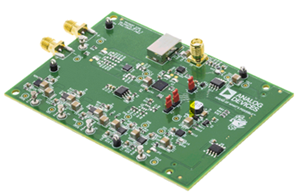
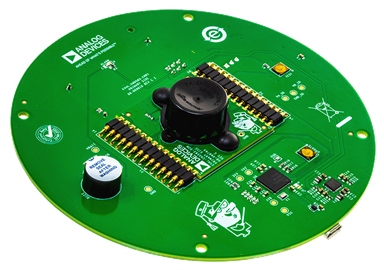
DC2204B
Analog Devices Inc.The LTM4677 is a dual 18A or single 36A step-down ?Module? (power module) DC/DC regulator with 40ms turn0on time. It features remote configurability and telemetry-monitoring of power management parameters over PMBus?an open standard I2C-based digital interface protocol. The LTM4677 is comprised of fast analog control loops, precision mixedsignal circuitry, EEPROM, power MOSFETs, inductors and supporting components.The LTM4677?s 2-wire serial interface allows outputs to be margined, tuned and ramped up and down at programmable slew rates with sequencing delay times. Input and output currents and voltages, output power, temperatures, uptime and peak values are readable. Custom configuration of the EEPROM contents is not required. At start-up, output voltages, switching frequency, and channel phase angle assignments can be set by pin-strapping resistors. The LTpowerPlay? GUI and DC1613 USB-to-PMBus converter and demo kits are available.The LTM4677 is pin compatible with the LTM4676A (dual 13A) and is offered in a 16mm ? 16mm ? 5.01mm BGA package available with SnPb or RoHS compliant terminal finish.APPLICATIONS System Optimization, Characterization and Data Mining?in Prototype, Production and Field Environments Telecom, Datacom, and Storage Systems

DC2213A
Analog Devices Inc.The LTC2983 measures a wide variety of temperature sensors and digitally outputs the result, in ?C or ?F, with 0.1?C accuracy and 0.001?C resolution. The LTC2983 can measure the temperature of virtually all standard (type B, E, J, K, N, S, R, T) or custom thermocouples, automatically compensate for cold junction temperatures and linearize the results. The device can also measure temperature with standard 2-, 3- or 4-wire RTDs, thermistors and diodes. It has 20 reconfigurable analog inputs enabling many sensor connections and configuration options. The LTC2983 includes excitation current sources and fault detection circuitry appropriate for each type of temperature sensor.The LTC2983 allows direct interfacing to ground referenced sensors without the need for level shifters, negative supply voltages, or external amplifiers. All signals are buffered and simultaneously digitized with three high accuracy, 24-bit ?? ADCs, driven by an internal 10ppm/?C (maximum) reference.Applications Direct Thermocouple Measurements Direct RTD Measurements Direct Thermistor Measurements Custom Sensor Applications
DC2217A
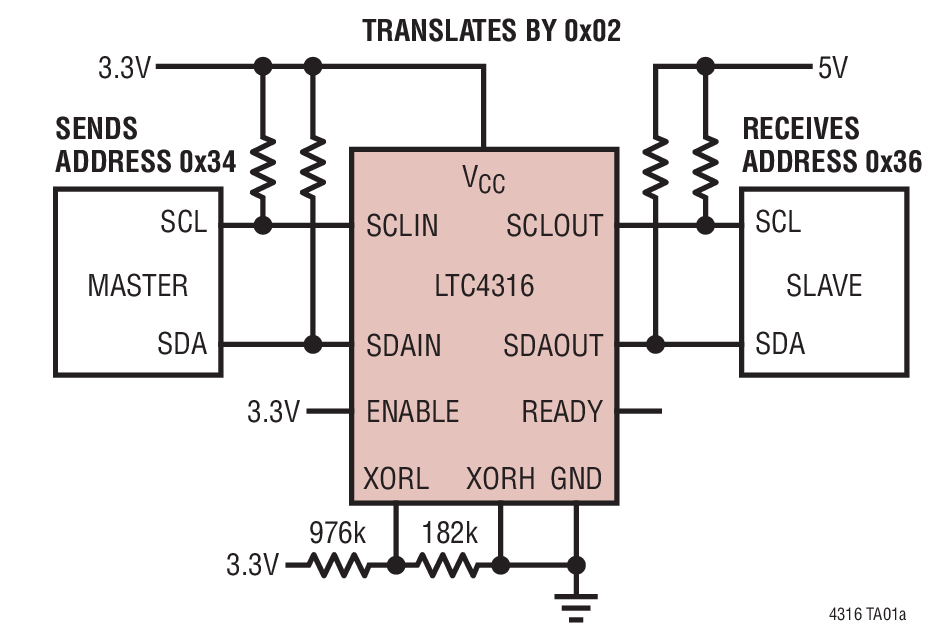
Analog Devices Inc.The LTC4316 enables the hardwired address of one or more I2C or SMBus slave devices to be translated to a different address. This allows slaves with the same hardwired address to coexist on the same bus. Only discrete resistors are needed to select the new address and no software programming is required. Up to 127 different address translations are available.The LTC4316 incorporates a pass-through mode which disables the address translation and allows general call addressing by the master. The LTC4316 is designed to automatically recover from abnormal bus conditions like bus stuck low or premature STOP bits. Part Number Number of Input Channels Number of Output Channels LTC4316 1 1 LTC4317 1 2 LTC4318 2 2 Applications I2C, SMBus Address Expansion Address Translation Servers Telecom
DC2221A
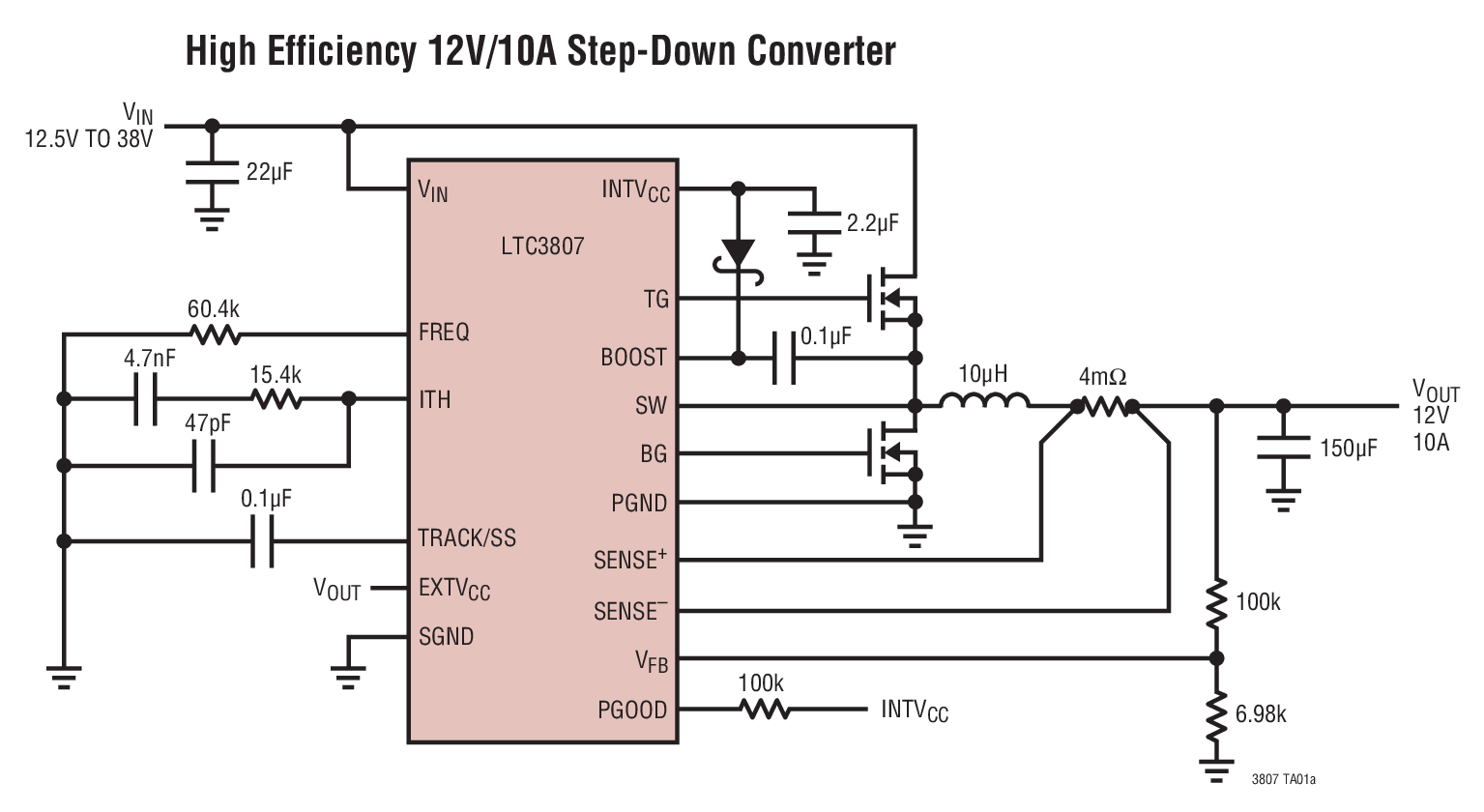
Analog Devices Inc.The LTC3807 is a high performance step-down switching regulator DC/DC controller that drives an all N-channel synchronous power MOSFET stage. A constant frequency current mode architecture allows a phase-lockable frequency of up to 750kHz.The 50?A no-load quiescent current extends operating run time in battery-powered systems. OPTI-LOOP? compensation allows the transient response to be optimized over a wide range of output capacitance and ESR values. The LTC3807 features a precision 0.8V reference and power good output indicator. A wide 4V to 38V input supply range encompasses a wide range of intermediate bus voltages and battery chemistries. The output voltage of the LTC3807 can be programmed between 0.8V to 24V.The TRACK/SS pin ramps the output voltages during start-up. Current foldback limits MOSFET heat dissipation during short-circuit conditions. The PLLIN/MODE pin selects among Burst Mode operation, pulse-skipping mode, or continuous conduction mode at light loads.Applications Automotive Always-On Systems Battery Powered Digital Devices Distributed DC Power Systems
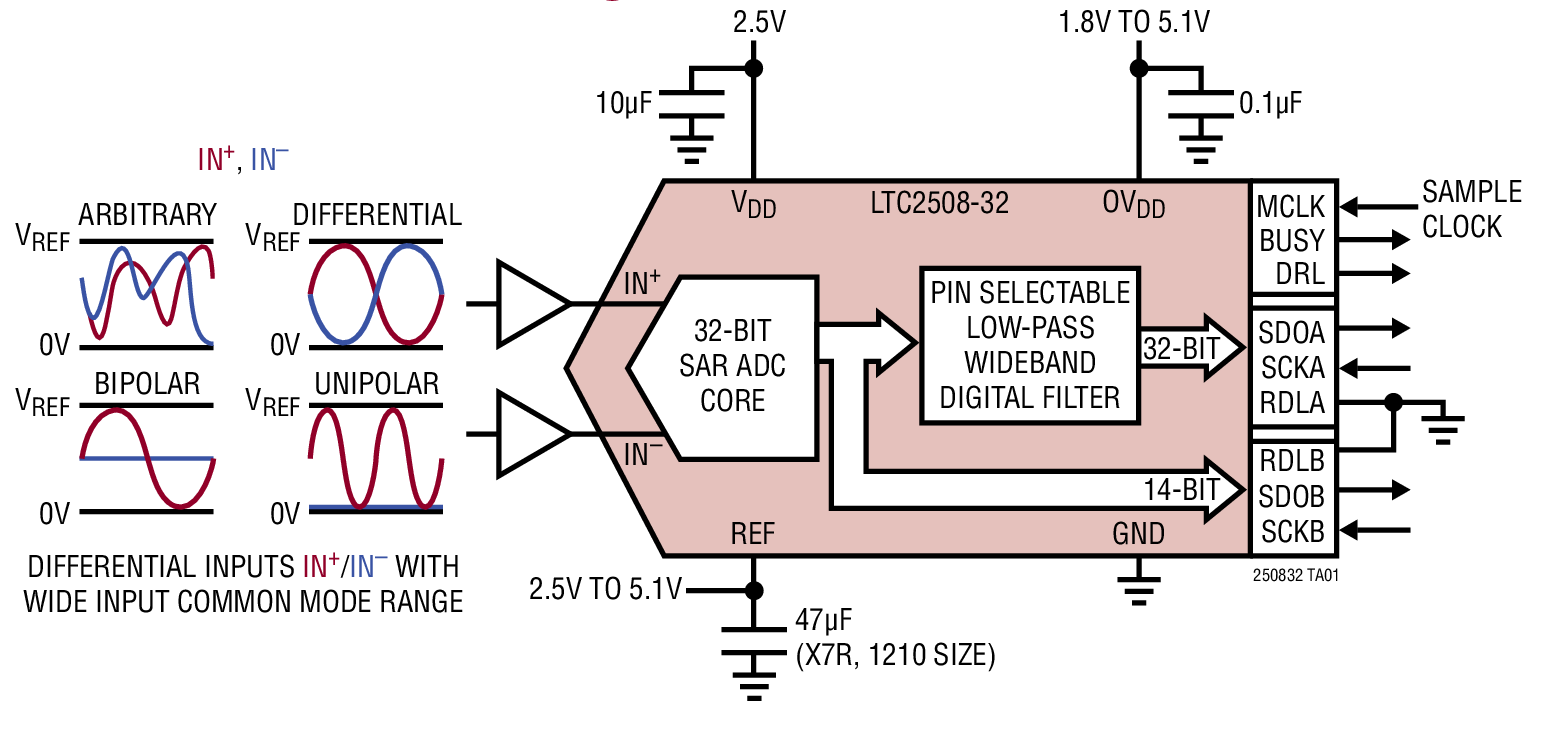
LTC2508-32 Demo Board | 32-Bit Over-Sampling ADC with Configurable Digital Filter (Requires DC590, DC2026 or DC890)
Analog Devices Inc.Demonstration circuit 2222A features the LTC2508-32 and LTC2512-24 ADCs. The LTC2508-32 and LTC2512-24 are low power, low noise, high speed, 32-bit/24-bit SAR ADCs with an integrated configurable digital averaging filter that operate from a single 2.5V supply. The demo manual refers to the LTC2508-32 but applies to both parts, the only difference being sample rate and number of bits. The DC2222A demonstrates the DC and AC performance of the LTC2508-32 in conjunction with the DC590 or DC2026 QuikEval™ and DC890 PScope™ data collection boards. Use the DC590 or DC2026 to demonstrate DC performance such as peak-to-peak noise and DC linearity.

DC2236A-A
Analog Devices Inc.The LTC3890-2 is a high performance dual step-down switching regulator DC/DC controller that drives all N-channel synchronous power MOSFET stages. A constant frequency current mode architecture allows a phase-lockable frequency of up to 850kHz. Power loss and noise due to the ESR of the input capacitor are minimized by operating the two controller output stages out-of-phase.The 50?A no-load quiescent current extends operating run time in battery-powered systems. OPTI-LOOP? compensation allows the transient response to be optimized over a wide range of output capacitance and ESR values. A wide 4V to 60V input supply range encompasses a wide range of intermediate bus voltages and battery chemistries.Independent TRACK/SS pins for each controller ramp the output voltages during start-up. Current mode control limits the inductor current during short-circuit conditions. The PLLIN/MODE pin selects among Burst Mode operation, pulse-skipping mode, or continuous conduction mode at light loads. For versions with different and/or additional features, see the LTC3890 family summary, Table 1, in the Pin Functions section of this data sheet. LTC3890 LTC3890-1 LTC3890-2 LTC3890-3 Adjustable Current Limit Yes No Yes No CLKOUT/PHASMD for Multiphase Operation Yes No Yes No Number of PGood Outputs 2 1 2 1 OVP ? Bottom Gate Crowbar Yes Yes No No Current Limit Foldback Yes Yes No No Light Load Operation when Synced to External Clock Forced Continuous Forced Continuous Pulse Skipping Pulse Skipping SENSE Pins Common Mode Range Common Mode < 0.5V Requires VFB < 0.65V Common Mode < 0.5V Requires VFB < 0.65V Not Dependant on VFB. Easy to make a non-synchronous Boost or SEPIC Not Dependant on VFB. Easy to make a non-synchronous Boost or SEPIC Package 5X5 QFN-32 SSOP-28 5X5 QFN-32 SSOP-28 Applications Automotive Always-On Systems Battery Operated Digital Devices Distributed DC Power Systems
DC2239A
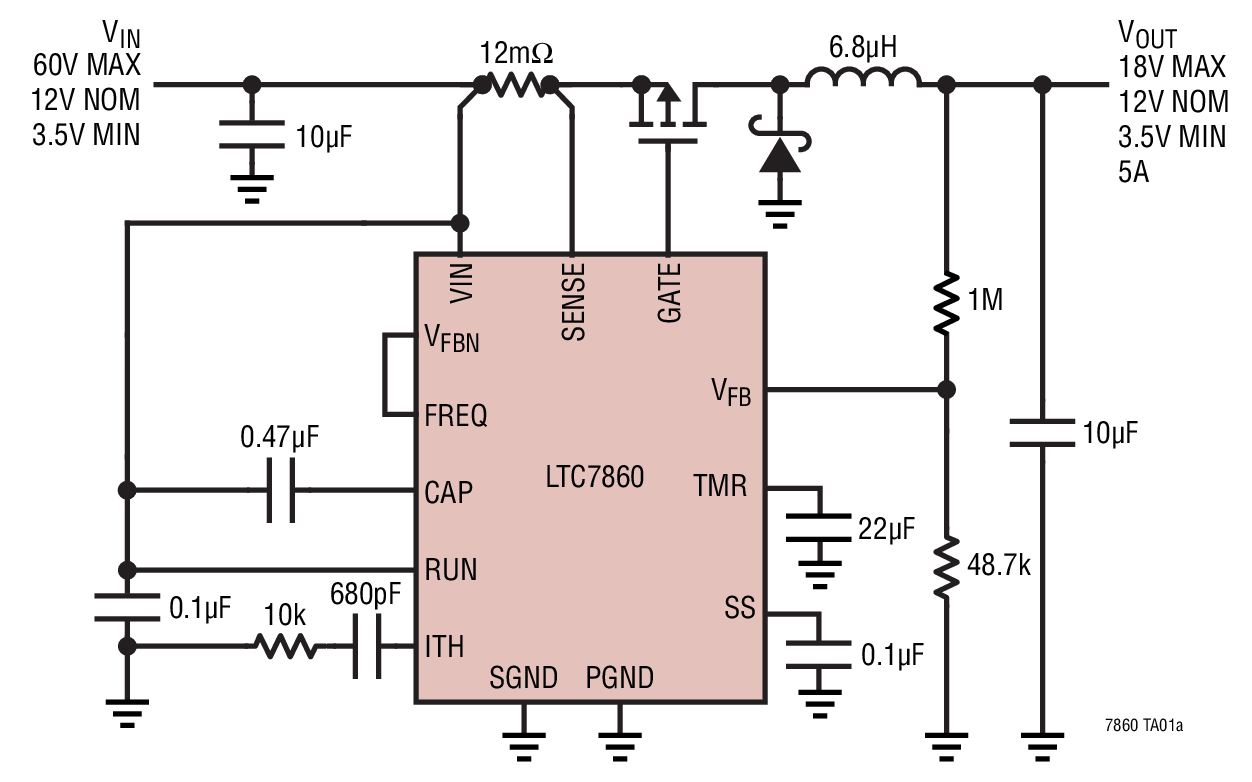
Analog Devices Inc.The LTC7860 high efficiency surge stopper protects loads from high voltage transients. High efficiency permits higher currents and smaller solution sizes. During an input overvoltage event, such as a load dump in vehicles, the LTC7860 controls the gate of an external MOSFET to act as a switching DC/DC regulator (PROTECTIVE PWM mode). This operation regulates the output voltage to a safe level, allowing the loads to operate through the input over-voltage event. During normal operation (SWITCH-ON mode), the LTC7860 turns on the external MOSFET continuously, passing the input voltage through to the output. An internal comparator limits the voltage across the current sense resistor and regulates the maximum output current to protect against overcurrent faults.An adjustable timer limits the time that the LTC7860 can spend in overvoltage or overcurrent regulation. When the timer expires, the external MOSFET is turned off until the LTC7860 restarts after a cool down period. By strictly limiting the time in PROTECTIVE PWM Mode when the power loss is high, the components and thermal design can be optimized for normal operation and safely operate through high voltage input surges and/or overcurrent faults. An additional PMOS can be added for reverse battery protection.Applications Industrial and Automotive Power Telecom Power Vehicle Power Including ISO7637 Military Power Including MIL1275

DC2244A
Analog Devices Inc.The LTM8049 is a Dual SEPIC/Inverting ?Module? (power module) DC/DC Converter. Each of the two outputs can be easily configured as a SEPIC or Inverting converter by simply grounding the appropriate output rail. The LTM8049 includes power devices, inductors, control circuitry and passive components. All that is needed to complete the design are input and output caps, and small resistors to set the output voltages and switching frequency. Other components may be used to control the soft-start and undervoltage lockout.The LTM8049 is packaged in a thermally enhanced, compact (15mm ? 9mm) over-molded Ball Grid Array (BGA) package suitable for automated assembly by standard surface mount equipment. The LTM8049 is RoHS compliant.Applications Battery Powered Regulator Local Negative Voltage Regulator Low Noise Amplifier Power

LTM4622 Demo Board | Ultrathin Dual 2.5A Step-Down µModule Regulator
Analog Devices Inc.Demonstration circuit 2249B features the LTM4622 µModule® regulator, a tiny low profile high performance high efficiency dual step-down regulator. The LTM4622 has an operating input voltage range of 3.6V to 20V and is able to provide an output current of up to 2.5A for each channel. Each output’s voltage is programmable from 0.6V to 5.5V. The LTM4622 is a complete DC-DC point of load regulator in a low profile thermally enhanced 6.25mm × 6.25mm × 1.82mm LGA package requiring only a few input and output capacitors. Output voltage tracking is available through the TRACK/SS pin for supply rail sequencing. External clock synchronization is available through the SYNC/MODE pin. For high efficiency at low load currents the MODE pin jumper (JP3) selects the Burst Mode® option for operation in less noise sensitive applications. The LTM4622 data sheet must be read in conjunction with this demo manual for working on or modifying demo circuit 2249B.

DC2252A-A
Analog Devices Inc.The LTC3882 is a dual, PolyPhase DC/DC synchronous step-down switching regulator controller with PMBus compliant serial interface. It uses a constant frequency, leading-edge modulation, voltage mode architecture for excellent transient response and output regulation. Each PWM channel can produce output voltages from 0.5V to 5.25V using a wide range of 3.3V compatible power stages, including power blocks, DrMOS or discrete FET drivers. Up to four LTC3882s can operate in parallel for 2-, 3-, 4-, 6- or 8-phase operation.LTC3882 system configuration and monitoring is supported by the LTpowerPlay? software tool. The device?s serial interface can be used to read back input voltage, output voltage and current, temperature and fault status. A wide range of operating parameters can be set via the digital interface or stored in internal EEPROM for use at power up. Switching frequency and phase, output voltage and device address can also be programmed using external configuration resistors. PWM?Enable Output TG/BG Control HW?Write Protect Dedicated PGOOD Differential Vout Sense LTC3882 Yes Yes Yes No? VOUT0 Only LTC3882-1 ?No No No Yes VOUT0 & VOUT1 Applications High Current Distributed Power Systems Servers, Network and Storage Equipment Intelligent Energy Efficient Power Regulation Industrial/Telecom/ATE Systems
DC2268A-B
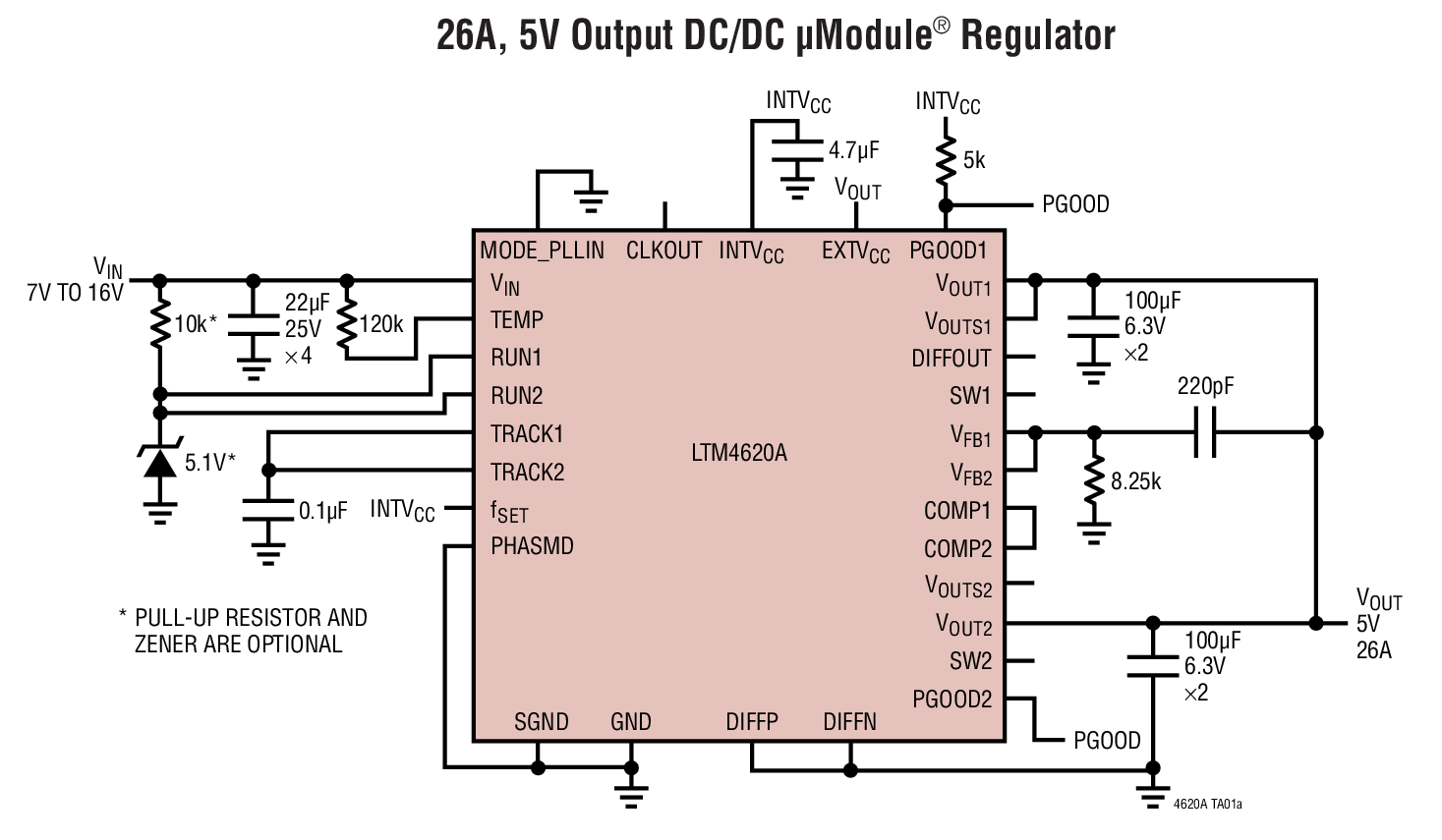
Analog Devices Inc.The LTM4620A is a complete dual 13A, or single 26A output switching mode DC/DC power supply with wider VOUT range and higher efficiency than the LTM4620. Included in the package are the switching controller, power FETs, inductors and all supporting components. Operating from an input voltage range of 4.5V to 16V, the LTM4620A supports two outputs each with an output voltage range of 0.6V to 5.3V, set by a single external resistor. Its high efficiency design delivers up to 13A continuous current for each output. Only a few input and output capacitors are needed.The device supports frequency synchronization, multiphase operation, Burst Mode? operation and output voltage tracking for supply rail sequencing and has an onboard temperature diode for device temperature monitoring. High switching frequency and a current mode architecture enable a very fast transient response to line and load changes without sacrificing stability.Fault protection features include overvoltage and overcurrent protection. The power module is offered in a proprietary space saving and thermally enhanced 15mm ? 15mm ? 4.41mm LGA package and 15mm ? 15mm ? 5.01mm BGA package. The LTM4620A is available with SnPb (BGA) or RoHS compliant terminal finish. Vout Range Efficiency 12Vin, 1.2Vout LTM4620 0.6V-2.5V 83% LTM4620A 0.6V-5.3V 86% Applications Telecom and Networking Equipment Industrial Equipment

LTC1629CG | Polyphase DC-DC Converter, 5 to 13VIN, 3.3VOUT @ 20A
Analog Devices Inc.DC226A: Demo Board for the LTC1629 PolyPhase, High Efficiency, Synchronous Step-Down Switching Regulator.

LTC4281 Demo Board with Programming Socket | 12V, 50A Hot Swap Controller with Telemetry [Requires DC1613]
Analog Devices Inc.Demonstration circuit 2278A features the LTC4281 hot swap controller. The LTC4281 is well suited to high power applications because the precise monitoring capability and accurate current limiting reduces the extremes in which both loads and power supplies must safely operate. Non-volatile configuration allows for flexibility in the autonomous generation of alerts and response to faults.
DC2289A-A
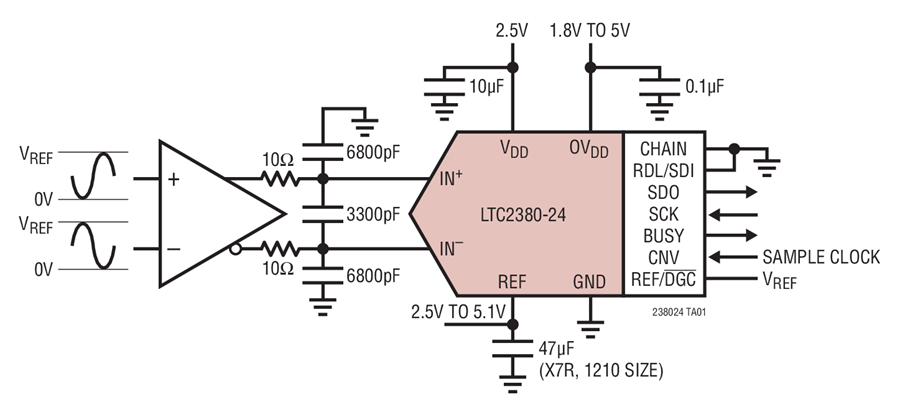
Analog Devices Inc.The LTC2380-24 is a low noise, low power, high speed 24-bit successive approximation register (SAR) ADC with an integrated digital averaging filter. Operating from a 2.5V supply, the LTC2380-24 has a ?VREF fully differential input range with VREF ranging from 2.5V to 5.1V. The LTC2380- 24 consumes only 28mW and achieves ?3.5ppm INL maximum and no missing codes at 24 bits.The LTC2380-24 has an easy to use integrated digital averaging filter that can average 1 to 65536 conversion results real-time, dramatically improving dynamic range from 101dB at 1.5Msps to 145dB at 30.5sps. No separate programming interface or configuration register is required.The high speed SPI-compatible serial interface supports 1.8V, 2.5V, 3.3V and 5V logic while also featuring a daisychain mode. The LTC2380-24 automatically powers down between conversions, reducing power dissipation at lower sampling rates.Applications Seismology Energy Exploration Medical Imaging High Speed Data Acquisition Industrial Process Control ATE
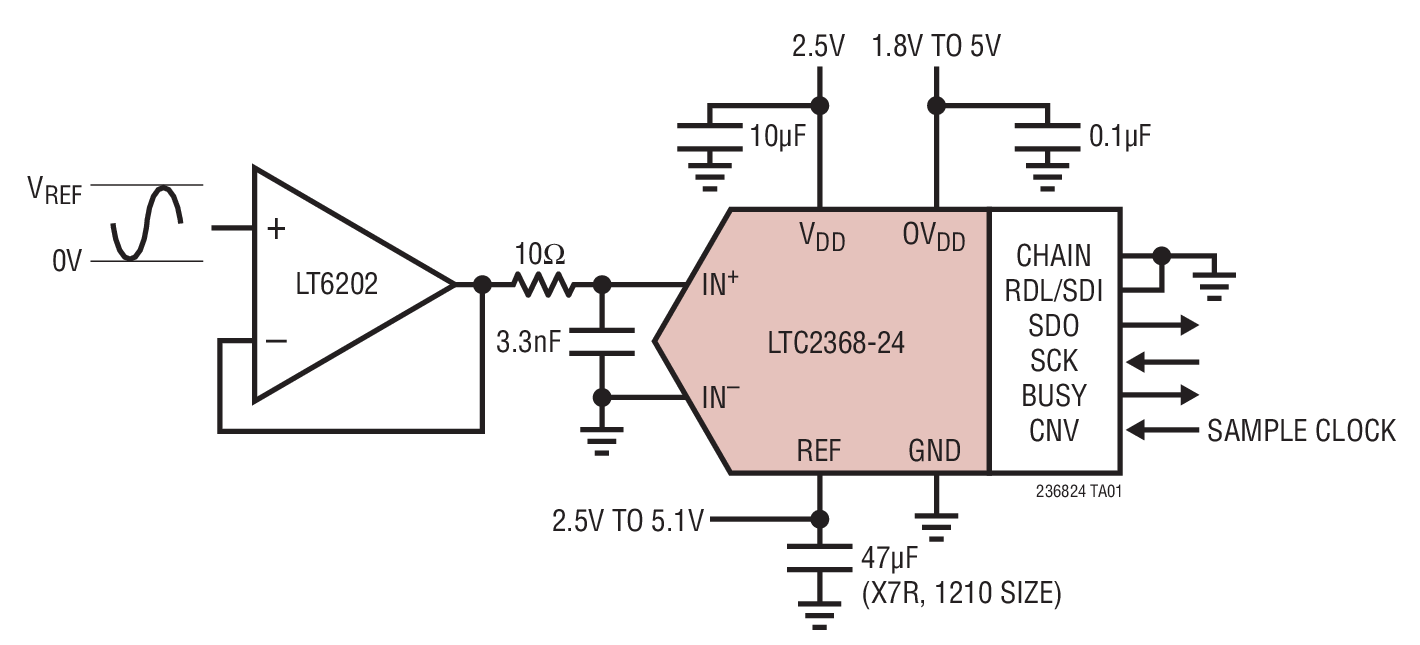
LTC2368-24 Demo Board | 24-Bit, 1Msps Pseudo-Differential Input SAR ADC with Integrated Filter (Requires DC590, DC2026 or DC890)
Analog Devices Inc.The LTC2380-24 and LTC2368-24 are low power, low noise, high speed, 24-bit SAR ADCs with an integrated digital averaging filter that operates from a single 2.5V supply. The demo manual refers to the LTC2380-24 but applies to both parts, the only difference being that the LTC2380-24 has fully differential inputs and the LTC2368-24 has pseudo-differential inputs. The LTC2380-24 has –117dB THD, consumes only 28mW and achieves ±4ppm INL max with no missing codes at 24 bits. The DC2289A demonstrates the DC and AC performance of the LTC2380-24 in conjunction with the DC590 or DC2026 QuikEval™ and DC890 PScope™ data collection boards. Use the DC590 or DC2026 to demonstrate DC performance such as peak-to-peak noise and DC linearity. Use the DC890 if precise sampling rates are required or to demonstrate AC performance such as SNR, THD, SINAD and SFDR. The Demonstration Circuit 2289A is intended to show recommended grounding, component placement and selection, routing and bypassing for this ADC.
DC2291A
Analog Devices Inc.The LTC3882 is a dual, PolyPhase DC/DC synchronous step-down switching regulator controller with PMBus compliant serial interface. It uses a constant frequency, leading-edge modulation, voltage mode architecture for excellent transient response and output regulation. Each PWM channel can produce output voltages from 0.5V to 5.25V using a wide range of 3.3V compatible power stages, including power blocks, DrMOS or discrete FET drivers. Up to four LTC3882s can operate in parallel for 2-, 3-, 4-, 6- or 8-phase operation.LTC3882 system configuration and monitoring is supported by the LTpowerPlay? software tool. The device?s serial interface can be used to read back input voltage, output voltage and current, temperature and fault status. A wide range of operating parameters can be set via the digital interface or stored in internal EEPROM for use at power up. Switching frequency and phase, output voltage and device address can also be programmed using external configuration resistors. PWM?Enable Output TG/BG Control HW?Write Protect Dedicated PGOOD Differential Vout Sense LTC3882 Yes Yes Yes No? VOUT0 Only LTC3882-1 ?No No No Yes VOUT0 & VOUT1 Applications High Current Distributed Power Systems Servers, Network and Storage Equipment Intelligent Energy Efficient Power Regulation Industrial/Telecom/ATE Systems

DC2293A-B
Analog Devices Inc.The LTC2933 is an EEPROM configurable voltage supervisor which can simultaneously monitor up to six power supply voltage inputs. Each voltage detector offers I2C programmable over/undervoltage thresholds in various ranges and increments.Two general purpose inputs (GPI) can be configured as programmable manual reset (MR), UV disable (UVDIS), margin (MARG) or auxiliary comparator (AUXC) inputs. Three general purpose pins (GPIO) can be configured for input or output operation. When configured as an input, a GPIO pin can be mapped to any other GPIO configured as output. The GPIO pins can also be configured as ALERT or fault outputs. Faults can be configured with programmable delay-on-release times. Output type and polarity are also configurable.Status and history registers log faults and can be polled via the I2C interface. A fault log snapshot is also backed up in internal EEPROM. All parameters are programmable via the I2C interface. Configuration EEPROM supports autonomous operation without additional software.Applications High Availability Computer Systems Network Servers Telecom Equipment Data Storage
DC2296A-KIT
Analog Devices Inc.The LTC2983 measures a wide variety of temperature sensors and digitally outputs the result, in ?C or ?F, with 0.1?C accuracy and 0.001?C resolution. The LTC2983 can measure the temperature of virtually all standard (type B, E, J, K, N, S, R, T) or custom thermocouples, automatically compensate for cold junction temperatures and linearize the results. The device can also measure temperature with standard 2-, 3- or 4-wire RTDs, thermistors and diodes. It has 20 reconfigurable analog inputs enabling many sensor connections and configuration options. The LTC2983 includes excitation current sources and fault detection circuitry appropriate for each type of temperature sensor.The LTC2983 allows direct interfacing to ground referenced sensors without the need for level shifters, negative supply voltages, or external amplifiers. All signals are buffered and simultaneously digitized with three high accuracy, 24-bit ?? ADCs, driven by an internal 10ppm/?C (maximum) reference.Applications Direct Thermocouple Measurements Direct RTD Measurements Direct Thermistor Measurements Custom Sensor Applications

DC2306A
Analog Devices Inc.The LT3753 is a current mode PWM controller optimized for an active clamp forward converter topology, allowing up to 100V input operation.A programmable volt-second clamp allows primary switch duty cycles above 50% for high switch, transformer and rectifier utilization. Active clamp control reduces switch voltage stress and increases efficiency. A synchronous output is available for controlling secondary side synchronous rectification.The LT3753 is available in a 38-lead plastic TSSOP package with missing pins for high voltage spacings.Applications Industrial, Automotive and Military Systems 48V Telecommunication Isolated Power Supplies

DC2313A
Analog Devices Inc.The LTC2937 is a 6-channel power supply sequencer and voltage supervisor. Supplies are enabled or disabled with precise user controlled order and time spacing. To detect power supply output faults during sequencing and monitoring, the LTC2937 accurately monitors supply turn-on/-off delays and output voltage levels. In the event of a fault, response actions include complete power supply shutdown and optional restarts. Root cause of power faults are logged to EEPROM. For systems with high supply count, a simple single wire connection between multiple LTC2937 devices allows sequencing expansion to 300 supplies. After successful sequencing and supply voltage stabilization, the reset output pulls high to initiate microprocessor or other system activity. To accommodate supply margin testing, the reset output can be disabled. Upon supply turn-off, integrated current sources are available as needed to discharge slowly decaying supplies. Configuration EEPROM supports autonomous operation without software.Applications Network Servers Data Storage Systems Telecom Equipment High Availability Computer Systems