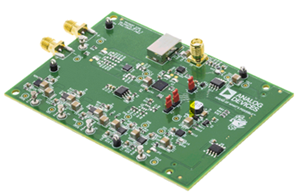
ADP1870-0.6-EVALZ
Analog Devices Inc.The ADP1870 / ADP1871?are versatile current-mode, synchronous step-down controllers that provide superior transient response, optimal stability, and current-limit protection by using a constant on-time, pseudo-fixed frequency with a programmable current limit, current-control scheme. In addition, these devices offer optimum performance at low duty cycles by utilizing valley current-mode control architecture. This allows the ADP1870 / ADP1871 to drive all N-channel power stages to regulate output voltages as low as 0.6 V.The ADP1871 is the power saving mode (PSM) version of the device and is capable of pulse skipping to maintain output regulation while achieving improved system efficiency at light loads (see the Power Saving Mode (PSM) Version (ADP1871) section for more information).Available in three frequency options (300 kHz, 600 kHz, and 1.0 MHz, plus the PSM option), the ADP1870 / ADP1871 are well suited for a wide range of applications that require a single-input power supply range from 2.95 V to 20 V. Low voltage biasing is supplied via a 5 V internal LDO.In addition, an internally fixed soft start period is included to limit input in-rush current from the input supply during startup and to provide reverse current protection during soft start for a precharged output. The low-side current-sense, current-gain scheme and integration of a boost diode, along with the PSM/forced pulse width modulation (PWM) option, reduce the external part count and improve efficiency.The ADP1870 / ADP1871 operate over the -40?C to +125?C junction temperature range and are available in 10-lead MSOP package.

ADP1871-0.6-EVALZ
Analog Devices Inc.The ADP1870?/ ADP1871 are versatile current-mode, synchronous step-down controllers that provide superior transient response, optimal stability, and current-limit protection by using a constant on-time, pseudo-fixed frequency with a programmable current-limit, current-control scheme. In addition, these devices offer optimum performance at low duty cycles by utilizing valley current-mode control architecture. This allows the ADP1870 / ADP1871 to drive all N-channel power stages to regulate output voltages as low as 0.6 V.The ADP1871 is the power saving mode (PSM) version of the device and is capable of pulse skipping to maintain output regulation while achieving improved system efficiency at light loads (see the Power Saving Mode (PSM) Version (ADP1871) section for more information).Available in three frequency options (300 kHz, 600 kHz, and 1.0 MHz, plus the PSM option), the ADP1870 / ADP1871 are well suited for a wide range of applications that require a single-input power supply range from 2.95 V to 20 V. Low voltage biasing is supplied via a 5 V internal LDO.In addition, an internally fixed soft start period is included to limit input in-rush current from the input supply during startup and to provide reverse current protection during soft start for a precharged output. The low-side current-sense, current-gain scheme and integration of a boost diode, along with the PSM/forced pulse-width modulation (PWM) option, reduce the external part count and improve efficiency.The ADP1870/ADP1871 operate over the -40?C to +125?C junction temperature range and are available in 10-lead MSOP package.APPLICATIONS Telecom and networking systems Mid to high end servers Set-top boxes DSP core power supplies 12 V input POL supplies

ADP1882-1.0-EVALZ
Analog Devices Inc.The ADP1882 / ADP1883?are versatile current-mode, synchronous step-down controllers that provide superior transient response, optimal stability, and current-limit protection by using a constant on-time, pseudo-fixed frequency with a programmable current-limit, current-control scheme. In addition, these devices offer optimum performance at low duty cycles by using valley current-mode control architecture. This allows the ADP1882 / ADP1883 to drive all N-channel power stages to regulate output voltages as low as 0.8 V.The ADP1883 is the power saving mode (PSM) version of the device and is capable of pulse skipping to maintain output regulation while achieving improved system efficiency at light loads (see the Power Saving Mode (PSM) Version (ADP1883) section for more information).Available in three frequency options (300 kHz, 600 kHz, and 1.0 MHz, plus the PSM option), the ADP1882 / ADP1883 are well suited for a wide range of applications. These ICs not only operate from a 2.75 V to 5.5 V bias supply, but they also can accept a power input as high as 20 V.In addition, an internally fixed soft start period is included to limit input in-rush current from the input supply during startup and to provide reverse current protection during soft start for a pre-charged output. The low-side current-sense, current-gain scheme and integration of a boost diode, along with the PSM/forced pulse-width modulation (PWM) option, reduce the external part count and improve efficiency.The ADP1882 / ADP1883 operate over the -40?C to +125?C junction temperature range and are available in a 10-lead MSOP.

ADP1974-EVALZ
Analog Devices Inc.The ADP1974 is a constant frequency, voltage mode, synchronous, pulse-width modulation (PWM) controller for bidirectional dc-to-dc applications. The ADP1974 is designed for use in battery testing, formation, and conditioning applications with an external, high voltage field effect transistor (FET) half bridge driver, and an external control device such as the AD8450/AD8451. The device operates as a buck converter in battery charge mode and as a boost converter in discharge mode to recycle energy to the input bus.The ADP1974 high voltage VIN supply pin can withstand a maximum operating voltage of 60 V and reduces the need for additional system supply voltages. The ADP1974 has integrated features such as precision enable, internal and external synchronization control with programmable phase shift, programmable maximum duty cycle, dead time control, and peak hiccup current-limit protection. Additional protection features include soft start to limit input inrush current during startup, precision enable, and thermal shutdown (TSD). The ADP1974 also has a COMP pin to provide external control of the PWM duty cycle and a FAULT pin that can disable the DH and DL outputs. These functions are compatible with the AD8450/AD8451 analog front-end (AFE) error amplifiers.The ADP1974 is available in a 16-lead TSSOP package and is pin compatible with the ADP1972.Applications Single and multicell battery formation and testing? High efficiency battery test systems with recycle capability Battery conditioning (charging and discharging) systems Compatible with AD8450/AD8451 constant voltage (CV) and constant current (CC) analog front end error amplifier

ADP199CB-EVALZ
Analog Devices Inc.The ADP199 is a high-side load switch designed for operation between 0.9 V to 3.6 V. A load switch provides power domain isolation, thereby helping to keep subsystems isolated and powered independently, and enabling reduced power consumption.The ADP199 contains a low on-resistance, N-channel MOSFET to minimize power loss, and supports over 500 mA of continuous load current. The low 6 ?A quiescent current and ultralow shutdown current make the ADP199 ideal for battery-operated portable equipment. The built-in level shifter for enable logic makes the ADP199 compatible with many processors and GPIO controllers.In addition to high performance, the ADP199 occupies mini-mal printed circuit board (PCB) space with an area of less than 0.64 mm2 and a height of 0.50 mm.The ADP199 is available in an ultra-small, 0.8 mm ? 0.8 mm ? 0.5 mm, 4-ball, 0.4 mm pitch WLCSP.APPLICATIONS Low operating voltage processors Mobile phones Digital cameras and audio devices Portable and battery-powered equipment Optical XMT/RCVR modules

ADP2107-EVALZ
Analog Devices Inc.The ADP2105 / ADP2106 / ADP2107 are low quiescent current,synchronous, step-down dc-to-dc converters in a compact 4 mm ?4 mm LFCSP package. At medium to high load currents, thesedevices use a current mode, constant frequency pulse-widthmodulation (PWM) control scheme for excellent stability andtransient response. To ensure the longest battery life in portableapplications, the ADP2105 / ADP2106 / ADP2107 use a pulsefrequency modulation (PFM) control scheme under light loadconditions that reduces switching frequency to save power.The ADP2105 / ADP2106 / ADP2107 run from input voltages of2.7 V to 5.5 V, allowing single Li+/Li? polymer cell, multiplealkaline/NiMH cells, PCMCIA, and other standard power sources.The output voltage of ADP2105 / ADP2106 / ADP2107 is adjustablefrom 0.8 V to the input voltage (indicated by ADJ), whereas theADP2105 / ADP2106 / ADP2107 are available in preset outputvoltage options of 3.3 V, 1.8 V, 1.5 V, and 1.2 V (indicated by x.x V).Each of these variations is available in three maximum currentlevels: 1 A (ADP2105), 1.5 A (ADP2106), and 2 A (ADP2107).The power switch and synchronous rectifier are integrated forminimal external part count and high efficiency. During logiccontrolled shutdown, the input is disconnected from the output,and it draws less than 0.1 ?A from the input source. Other keyfeatures include undervoltage lockout to prevent deep batterydischarge and programmable soft start to limit inrush current atstartup.Applications Mobile handsets PDAs and palmtop computers Telecommunication/networking equipment Set top boxes Audio/video consumer electronics

ADP2108-1.5-EVALZ
Analog Devices Inc.The ADP2108 is a high efficiency, low quiescent current step-down dc-to-dc converter manufactured in two different packages. The total solution requires only three tiny external components. It uses a proprietary, high speed current mode, constant frequency PWM control scheme for excellent stability and transient response. To ensure the longest battery life in portable applications, the ADP2108 has a power save mode that reduces the switching frequency under light load conditions.The ADP2108 runs on input voltages of 2.3 V to 5.5 V, which allows for single lithium or lithium polymer cell, multiple alkaline or NiMH cell, PCMCIA, USB, and other standard power sources. The maximum load current of 600 mA is achievable across the input voltage range.The ADP2108 is available in fixed output voltages of 3.3 V, 3.0 V, 2.5 V, 2.3 V, 1.82 V, 1.8 V, 1.5 V, 1.3 V, 1.2 V, 1.1 V, and 1.0 V. All versions include an internal power switch and synchronous rectifier for minimal external part count and high efficiency. The ADP2108 has an internal soft start and is internally compensated. During logic controlled shutdown, the input is disconnected from the output and the ADP2108 draws less than 1 ?A from the input source.Other key features include undervoltage lockout to prevent deep battery discharge and soft start to prevent input current over-shoot at startup. The ADP2108 is available in 5-ball WLCSP and 5-lead TSOT packages. The ADP2109 provides the same features and operations as the ADP2108 and has the additional function of a discharge switch in the WLCSP package.APPLICATIONS PDAs and palmtop computers Wireless handsets Digital audio, portable media players Digital cameras, GPS navigation units
ADP2108-1.8-EVALZ
Analog Devices Inc.The ADP2108 is a high efficiency, low quiescent current step-down dc-to-dc converter manufactured in two different packages. The total solution requires only three tiny external components. It uses a proprietary, high speed current mode, constant frequency PWM control scheme for excellent stability and transient response. To ensure the longest battery life in portable applications, the ADP2108 has a power save mode that reduces the switching frequency under light load conditions.The ADP2108 runs on input voltages of 2.3 V to 5.5 V, which allows for single lithium or lithium polymer cell, multiple alkaline or NiMH cell, PCMCIA, USB, and other standard power sources. The maximum load current of 600 mA is achievable across the input voltage range.The ADP2108 is available in fixed output voltages of 3.3 V, 3.0 V, 2.5 V, 2.3 V, 1.82 V, 1.8 V, 1.5 V, 1.3 V, 1.2 V, 1.1 V, and 1.0 V. All versions include an internal power switch and synchronous rectifier for minimal external part count and high efficiency. The ADP2108 has an internal soft start and is internally compensated. During logic controlled shutdown, the input is disconnected from the output and the ADP2108 draws less than 1 ?A from the input source.Other key features include undervoltage lockout to prevent deep battery discharge and soft start to prevent input current over-shoot at startup. The ADP2108 is available in 5-ball WLCSP and 5-lead TSOT packages. The ADP2109 provides the same features and operations as the ADP2108 and has the additional function of a discharge switch in the WLCSP package.APPLICATIONS PDAs and palmtop computers Wireless handsets Digital audio, portable media players Digital cameras, GPS navigation units

ADP2114-2PH-EVALZ
Analog Devices Inc.The ADP2114 is a highly versatile, synchronous step-down, switching regulator that can be configured to satisfy a wide range of customer point of load requirements. The two PWM channels can be configured to deliver independent outputs at 2 A and 2 A (or 3 A/1 A) or can be configured as a single interleaved output capable of delivering 4 A. The two PWM channels are 180? phase shifted to reduce input ripple current and reduce input capacitance.The ADP2114 provides high efficiency performance at full loads, enabling high switching frequencies at up to 1.2 MHz. At light loads, the ADP2114 can be set to operate in pulse skip mode for higher efficiency or in forced PWM mode to reduce EMI.The device is designed with an optimized gate slew rate to reduce ENI emissions, allowing the device to supply sensitive, high performance signal chain applications. The frequency can be set to 300 kHz, 600 kHz and 1.2 MHz and can be synchronized to an external clock signal, minimizing the system noise between converters. The bidirectional synchronization pin is also configurable as a 90? out-of-phase output clock, providing the possibility for a stackable multiphase power solution.The ADP2114 input voltage range is from 2.75 V to 5.5 V, and it converts to fixed outputs of 0.8 V, 1.2 V, 1.5 V, 1.8 V, 2.5 V, or 3.3 V that can be set independently for each channel using external resistors. Using a resistor divider, it is also possible to set the output voltage as low as 0.6 V. The ADP2114 operates over the ?40?C to +125?C junction temperature range.ApplicationsPoint-of-load regulationTelecom and networking systemsConsumer electronicsIndustrial and InstrumentationMedical

ADP2119-EVALZ
Analog Devices Inc.The ADP2119 / ADP2120 are low quiescent current, synchronous, step-down DC-to -DC regulators in a compact 3mm x 3mm LFCSP_WD package. Both Devices use current mode, constant frequency pulse-width modulation (PWM) control scheme for excellent stability and transient response. Under light load condition, they can be configured to operate in pulse frequency modulation (PFM) mode that reduces switching frequency to save power.The ADP2119 / ADP2120 can support input voltages from 2.3V to 5.5V. The output voltage can be adjusted from 0.6V to input voltage (VIN) for the adjustable version, while the fixed output version is available in preset output voltage options of 3.3V, 2.5V, 1.8V, 1.5V ,1.2V and 1.0V. The ADP2119 / ADP2120 require minimal external parts and provide a high efficiency solution with their integrated power switches, synchronous rectifier, and internal compensation. Each IC draws less than 3 ?A current from the input source when it is disabled. Other key features include under voltage lockout(UVLO), integrated soft start to limit inrush current at startup, overvoltage protection (OVP), over current protection (OCP) and thermal shutdown (TSD).APPLICATIONS Point of load conversion Communications and networking equipment Industrial and instrumentation Consumer electronics Medical appliances
ADP2120-EVALZ
Analog Devices Inc.The ADP2119?/ ADP2120 are low quiescent current, synchronous, step-down DC-to -DC regulators in a compact 3mm x3mm LFCSP_WD package. Both Devices use current mode, constant frequency pulse-width modulation (PWM) control scheme for excellent stability and transient response. Under light load condition, they can be configured to operate in pulse frequency modulation (PFM) mode that reduces switching frequency to save power.The ADP2119/ADP2120 can support input voltages from 2.3V to 5.5V. The output voltage can be adjusted from 0.6V to input voltage (VIN) for the adjustable version, while the fixed output version is available in preset output voltage options of 3.3V, 2.5V, 1.8V, 1.5V ,1.2V and 1.0V. The ADP2119/ADP2120 require minimal external parts and provide a high efficiency solution with their integrated power switches, synchronous rectifier, and internal compensation. Each IC draws less than 3 ?A current from the input source when it is disabled. Other key features include under voltage lockout(UVLO), integrated soft start to limit inrush current at startup, overvoltage protection (OVP), over current protection (OCP) and thermal shutdown (TSD).APPLICATIONS Point of load conversion Communications and networking equipment Industrial and instrumentation Consumer electronics Medical appliances

ADP2138CB-1.2EVALZ
Analog Devices Inc.The ADP2138 and ADP2139 are high efficiency, low quiescent current, synchronous step-down dc-to-dc converters. The ADP2139 has the additional feature of an internal discharge switch. The total solution requires only three tiny external components. When the MODE pin is set high, the buck regulator operates in forced PWM mode, which provides low peak-to-peak ripple for power supply noise sensitive loads at the expense of light load efficiency. When the MODE pin is set low, the buck regulator automatically switches operating modes, depending on the load current level. At higher output loads, the buck regulator operates in PWM mode. When the load current falls below a predefined threshold, the regulator operates in power save mode (PSM), improving light load efficiency.The ADP2138/ADP2139 operate on input voltages of 2.3 V to 5.5 V, which allows for single lithium or lithium polymer cell, multiple alkaline or NiMH cell, PCMCIA, USB, and other standard power sources. The maximum load current of 800 mA is achievable across the input voltage range.The ADP2138/ADP2139 are available in fixed output voltages of 3.3 V, 3.0 V, 2.8 V, 2.5 V, 1.8 V, 1.5 V, 1.2 V, 1.0 V, and 0.8 V. All versions include an internal power switch and synchronous rectifier for minimal external part count and high efficiency. The ADP2138/ADP2139 have internal soft start and they are internally compensated. During logic controlled shutdown, the input is disconnected from the output and the ADP2138/ADP2139 draw 0.2 ?A (typical) from the input source.Other key features include undervoltage lockout to prevent deep battery discharge, and soft start to prevent input current overshoot at startup. The ADP2138/ADP2139 are available in a 6-ball wafer level chip scale package (WLCSP).Applications PDAs and palmtop computers Wireless handsets Digital audio, portable media players Digital cameras, GPS navigation units
ADP2139CB-0.8EVALZ
Analog Devices Inc.The ADP2138 and ADP2139 are high efficiency, low quiescent current, synchronous step-down dc-to-dc converters. The ADP2139 has the additional feature of an internal discharge switch. The total solution requires only three tiny external components. When the MODE pin is set high, the buck regulator operates in forced PWM mode, which provides low peak-to-peak ripple for power supply noise sensitive loads at the expense of light load efficiency. When the MODE pin is set low, the buck regulator automatically switches operating modes, depending on the load current level. At higher output loads, the buck regulator operates in PWM mode. When the load current falls below a predefined threshold, the regulator operates in power save mode (PSM), improving light load efficiency.The ADP2138/ADP2139 operate on input voltages of 2.3 V to 5.5 V, which allows for single lithium or lithium polymer cell, multiple alkaline or NiMH cell, PCMCIA, USB, and other standard power sources. The maximum load current of 800 mA is achievable across the input voltage range.The ADP2138/ADP2139 are available in fixed output voltages of 3.3 V, 3.0 V, 2.8 V, 2.5 V, 1.8 V, 1.5 V, 1.2 V, 1.0 V, and 0.8 V. All versions include an internal power switch and synchronous rectifier for minimal external part count and high efficiency. The ADP2138/ADP2139 have internal soft start and they are internally compensated. During logic controlled shutdown, the input is disconnected from the output and the ADP2138/ADP2139 draw 0.2 ?A (typical) from the input source.Other key features include undervoltage lockout to prevent deep battery discharge, and soft start to prevent input current overshoot at startup. The ADP2138/ADP2139 are available in a 6-ball wafer level chip scale package (WLCSP).Applications PDAs and palmtop computers Wireless handsets Digital audio, portable media players Digital cameras, GPS navigation units
ADP2139CB-1.5EVALZ
Analog Devices Inc.The ADP2138 and ADP2139 are high efficiency, low quiescent current, synchronous step-down dc-to-dc converters. The ADP2139 has the additional feature of an internal discharge switch. The total solution requires only three tiny external components. When the MODE pin is set high, the buck regulator operates in forced PWM mode, which provides low peak-to-peak ripple for power supply noise sensitive loads at the expense of light load efficiency. When the MODE pin is set low, the buck regulator automatically switches operating modes, depending on the load current level. At higher output loads, the buck regulator operates in PWM mode. When the load current falls below a predefined threshold, the regulator operates in power save mode (PSM), improving light load efficiency.The ADP2138/ADP2139 operate on input voltages of 2.3 V to 5.5 V, which allows for single lithium or lithium polymer cell, multiple alkaline or NiMH cell, PCMCIA, USB, and other standard power sources. The maximum load current of 800 mA is achievable across the input voltage range.The ADP2138/ADP2139 are available in fixed output voltages of 3.3 V, 3.0 V, 2.8 V, 2.5 V, 1.8 V, 1.5 V, 1.2 V, 1.0 V, and 0.8 V. All versions include an internal power switch and synchronous rectifier for minimal external part count and high efficiency. The ADP2138/ADP2139 have internal soft start and they are internally compensated. During logic controlled shutdown, the input is disconnected from the output and the ADP2138/ADP2139 draw 0.2 ?A (typical) from the input source.Other key features include undervoltage lockout to prevent deep battery discharge, and soft start to prevent input current overshoot at startup. The ADP2138/ADP2139 are available in a 6-ball wafer level chip scale package (WLCSP).Applications PDAs and palmtop computers Wireless handsets Digital audio, portable media players Digital cameras, GPS navigation units

ADP2165-EVALZ
Analog Devices Inc.The ADP2165/ADP2166 are high efficiency, current modecontrol, step-down dc-to-dc regulators with an integrated 19 m?high-side FET and a 15 m? synchronous rectified FET. TheADP2165/ADP2166 combine a small size, 4 mm ? 4 mm LFCSPpackage with an accurate current limit, resulting in a smallerinductor size and a high power density, point of load solution.Key features include precision enable, power-good monitor,and output voltage tracking to facilitate robust sequencing.The switching frequency can be programmed from 250 kHzto 1.4 MHz, or it can be fixed at 620 kHz or 1.2 MHz. Thesynchronization function allows the switching frequency tosynchronize to an external clock, minimizing theelectromagnetic interference (EMI) of the system.The ADP2165/ADP2166 are designed to be extremely flexiblewith the addition of a minimal amount of external componentsto program soft start and control loop compensation.he ADP2165/ADP2166 are supplied from an input voltage of2.7 V to 5.5 V. Output voltage options include 3.3 V, 2.5 V, 1.8 V,1.5 V, 1.2 V, or 1.0 V fixed outputs and adjustable options capableof supporting an output voltage range from 0.6 V to 90% of theinput voltage. Protection features include undervoltage lockout(UVLO), overvoltage protection (OVP), overcurrent protection(OCP), and thermal shutdown (TSD) for robust performance.The ADP2165/ADP2166 operate over the ?40?C to +125?Cjunction temperature range and are available in a 24-leadLFCSP package.Applications Point of load regulation Communications and networking High end consumer Industrial, instrumentation, and healthcare

ADP2386BB-EVALZ
Analog Devices Inc.The ADP2386 is a synchronous step-down, dc-to-dc regulator with an integrated 44 m?, high-side power MOSFET and an 11 m?, synchronous rectifier MOSFET to provide a high efficiency solution in a compact 4 mm ? 4 mm LFCSP package. This device uses a peak current mode, constant frequency pulse-width modulation (PWM) control scheme for excellent stability and transient response. The switching frequency of the ADP2386 can be programmed between 200 kHz to 1.4 MHz. To minimize system noise, the synchronization function allows the switching frequency to be synchronized to an external clock.The ADP2386 requires minimal external components and operates from an input voltage of 4.5 V to 20 V. The output voltage can be adjusted from 0.6 V to 90% of the input voltage and delivers up to 6 A of continuous current. Each IC draws less than 110 ?A current from the input source when it is disabled.This regulator targets high performance applications that require high efficiency and design flexibility. External compensation and an adjustable soft start function provide design flexibility. The power-good output and precision enable input provide simple and reliable power sequencing.Other key features include undervoltage lockout (UVLO), overvoltage protection (OVP), overcurrent protection (OCP), short-circuit protection (SCP) and thermal shutdown (TSD).The ADP2386 operates over the ?40?C to +125?C junction temperature range and is available in a 24-lead, 4 mm ? 4 mm LFCSP package.Applications Communications infrastructure Networking and servers Industrial and instrumentation Healthcare and medical Intermediate power rail conversion DC-to-dc point-of-load applications

ADP2443-EVALZ
Analog Devices Inc.The ADP2443 is synchronous step-down, dc-to-dc regulator with an integrated 98 m?, high-side power metal oxide semicon-ductor field effect transistor (MOSFET) and a 35 m?, synchronous rectifier MOSFET to provide a high efficiency solution in a compact 4 mm ? 4 mm LFCSP package. The regulators operate from an input voltage range of 4.5 V to 36 V. The output voltage can be adjusted down to 0.6 V and deliver up to 3 A of continuous current. The fast 50 ns minimum on time allows the regulators convert high input voltage to low output voltage at high frequency.The ADP2443 uses an emulated current mode, constant frequency pulse-width modulation (PWM) control scheme for excellent stability and transient response. The switching frequency of the ADP2443 can be programmed from 200 kHz to 1.8 MHz. The synchronization function allows the switching frequency be syn-chronized with an external clock to minimize the system noise.The ADP2443 targets high performance applications that require high efficiency and design flexibility. External compensation and an adjustable soft start function provide design flexibility. The power-good output and precision enable input provide simple and reliable power sequencing.Other key features include undervoltage lockout (UVLO), overvoltage protection (OVP), overcurrent protection (OCP), short-circuit protection (SCP), and thermal shutdown (TSD).The ADP2443 operates over the ?40?C to +125?C operating junction temperature range and is available in a 24-lead, 4 mm ? 4 mm LFCSP package.Applications Intermediate power rail conversion Multicell battery powered systems Process control and industrial automation Healthcare and medical Networking and servers

ADP322CPZ-REDYKIT
Analog Devices Inc.The ADP322/ADP323 200 mA triple output LDOs combine high PSRR, low noise, low quiescent current, and low dropout voltage to extend the battery life of portable devices and are ideally suited for wireless applications with demanding performance and board space requirements.The ADP322/ADP323 PSRR is greater than 60 dB for frequencies as high as 100 kHz while operating with a low headroom voltage. The ADP322/ADP323 offer much lower noise performance than competing LDOs without the need for a noise bypass capacitor.The ADP322/ADP323 are available in a miniature 16-lead, 3 mm ? 3 mm LFCSP package and are stable with tiny 1 ?F ?30% ceramic output capacitors providing the smallest possible board area for a wide variety of portable power needs.The ADP322 is available in output voltage combinations ranging from 0.8 V to 3.3 V and offers overcurrent and thermal protection to prevent damage in adverse conditions. The ADP323 adjustable triple LDO can be configured for any output voltage between 0.5 V and 5 V with two resistors for each output.Applications Mobile phones Digital cameras and audio devices Portable and battery-powered equipment Portable medical devices Post dc-to-dc regulation

ADP5034-1-EVALZ
Analog Devices Inc.The ADP5034 combines two high performance buck regulators and two low dropout (LDO) regulators in a small, 24-lead 4 mm ? 4 mm LFCSP (QFN) to meet demanding performance and board space requirements.The high switching frequency of the buck regulators enables tiny multilayer external components and minimizes the board space. When the MODE pin is set high, the buck regulators operate in forced PWM mode. When the MODE pin is set low, the buck regulators operate in PWM mode when the load is around the nominal value. When the load current falls below a predefined threshold, the regulator operates in power save mode (PSM), improving the light-load efficiency.The two bucks operate out of phase to reduce the input capaci-tor requirement. The low quiescent current, low dropout voltage, and wide input voltage range of the ADP5034 LDOs extend the battery life of portable devices. The ADP5034 LDOs maintain power supply rejection greater than 60 dB for frequencies as high as 10 kHz while operating with a low headroom voltage.Regulators in the ADP5034 are activated though dedicated enable pins. The default output voltages can be externally set in the adjustable version, or factory programmable in the fixed voltage version, and can be set to a wide range of preset valuesAPPLICATIONSPower for processors, ASICS, FPGAs, and RF chipsetsPortable instrumentation and medical devicesSpace constrained devices

ADP5053-EVALZ
Analog Devices Inc.The ADP5053 combines four high performance buck regulators, a supervisory circuit, a watchdog timer, and a manual reset in a 48-lead LFCSP package that meets demanding performance and board space requirements. The device enables direct connection to high input voltages up to 15.0 V with no preregulators.Channel 1 and Channel 2 integrate high-side power MOSFET and low-side MOSFET drivers. External NFETs can be used in low-side power devices to achieve an efficiency optimized solution and deliver a programmable output current of 1.2 A, 2.5 A, or 4 A. Combining Channel 1 and Channel 2 in a parallel configuration can provide a single output with up to 8 A of current.Channel 3 and Channel 4 integrate both high-side and low-side MOSFETs to deliver an output current of 1.2 A.The switching frequency of the ADP5053 can be programmed or synchronized to an external clock. The ADP5053 contains a precision enable pin on each channel for easy power-up sequencing or adjustable UVLO threshold.The ADP5053 contains supervisory circuits that monitor the voltage level. The watchdog timer can generate a reset if the WDI pin is not toggled within a preset timeout period. Processor reset mode or system power on/off switch mode can be selected for manual reset functionality.Applications Small cell base stations FPGA and processor applications Security and surveillance Medical applications