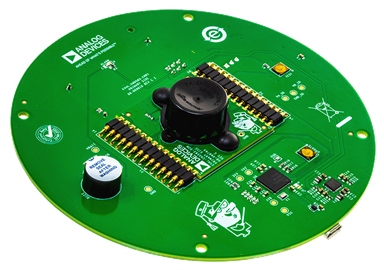
EV-ADA4571RSDZ
Analog Devices Inc.The ADA4571 is an anisotropic magnetoresistive (AMR) sensorwith integrated signal conditioning amplifiers and ADC drivers.The ADA4571 produces two analog outputs that indicate theangular position of the surrounding magnetic field.The ADA4571 consists of two die within one package, an AMRsensor, and a fixed gain (G = 40 nominally) instrumentationamplifier. The ADA4571 delivers clean and amplified cosineand sine output signals related to the angle of a rotatingmagnetic field. The output voltage range is ratiometric to thesupply voltage.The sensor contains two Wheatstone bridges, at a relative angleof 45? to one another. A rotating magnetic field in the x-ysensor plane delivers two sinusoidal output signals with thedouble frequency of the angle (?) between sensor and magneticfield direction. Within a homogeneous field in the x-y plane,the output signals are independent of the physical placement inthe z direction (air gap).The ADA4571 is available in an 8-lead SOIC package.Product Highlights Contactless angular measurement. Measures magnetic field direction rather than field intensity. Minimum sensitivity to air gap variations. Large working distance. Excellent accuracy, even for weak saturation fields. Minimal thermal and lifetime drift. Negligible hysteresis. Single chip solution.Applications Absolute position measurement (linear and angle) Brushless dc motor control and positioning Actuator control and positioning Contactless angular measurement and detection Magnetic angular position sensing

EV-ADE9000SHIELDZ
Analog Devices Inc.The ADE9000 is a highly accurate, fully integrated, multiphase energy and power quality monitoring device. Superior analog performance and a digital signal processing (DSP) core enable accurate energy monitoring over a wide dynamic range. An integrated high end reference ensures low drift over temperature with a combined drift of less than ?25 ppm/?C maximum for the entire channel including a programmable gain amplifier (PGA) and an analog-to-digital converter (ADC).The ADE9000 offers complete power monitoring capability by providing total as well as fundamental measurements on rms, active, reactive, and apparent powers and energies. Advanced features such as dip and swell monitoring, frequency, phase angle, voltage total harmonic distortion (VTHD), current total harmonic distortion (ITHD), and power factor measurements enable implementation of power quality measurements. The ? cycle rms and 10 cycle rms/12 cycle rms, calculated according to IEC 61000-4-30 Class S, provide instantaneous rms measurements for real-time monitoring.The ADE9000 offers an integrated flexible waveform buffer that stores samples at a fixed data rate of 32 kSPS or 8 kSPS, or a sampling rate that varies based on line frequency to ensure 128 points per line cycle. Resampling simplifies fast Fourier transform (FFT) calculation of at least 50 harmonics in an external processor.The ADE9000 simplifies the implementation of energy and power quality monitoring systems by providing tight integration of acquisition and calculation engines. The integrated ADCs and DSP engine calculate various parameters and provide data through user accessible registers or indicate events through interrupt pins. With seven dedicated ADC channels, the ADE9000 can be used on a 3-phase system or up to three single-phase systems. It supports current transformers (CTs) or Rogowski coils for current measurements. A digital integrator eliminates a discrete integrator required for Rogowski coils.The ADE9000 absorbs most complexity in calculations for a power monitoring system. With a simple host microcontroller, the ADE9000 enables the design of standalone monitoring or protection systems, or low cost nodes uploading data into the cloud.Note that throughout this data sheet, multifunction pins, such as CF4/EVENT/DREADY, are referred to either by the entire pin name or by a single function of the pin, for example, EVENT, when only that function is relevant.Applications Energy and power monitoring Power quality monitoring Protective devices Machine health Smart power distribution units Polyphase energy meters

EV-ADF41513SD1Z
Analog Devices Inc.The ADF41513 is an ultralow noise frequency synthesizer that can be used to implement local oscillators (LOs) as high as 26.5 GHz in the upconversion and downconversion sections of wireless receivers and transmitters.The ADF41513 is designed on a high performance silicon geranium (SiGe), bipolar complementary metal-oxide semiconductor (BiCMOS) process, achieving a normalized phase noise floor of ?235 dBc/Hz. The phase frequency detector (PFD) operates up to 250 MHz (integer N mode)/125 MHz (fractional-N mode) for improved phase noise and spur performance. The variable modulus, ?-? modulator allows extremely fine resolution when using a 49-bit divide value. The ADF41513 can be used as an integer N phase-locked loop (PLL), or it can be used as a fractional-N PLL with either a fixed modulus for subhertz frequency resolution or variable modulus for subhertz exact frequency resolution.A complete PLL is implemented when the synthesizer is used with an external loop filter and voltage controlled oscillator (VCO). The 26.5 GHz bandwidth eliminates the need for a frequency doubler or divider stage, simplifying system architecture and reducing cost. The ADF41513 is packaged in a compact, 24-lead, 4 mm ? 4 mm LFCSPApplications Test equipment and instrumentation Wireless infrastructure Microwave point to point and multipoint radios Very small aperture terminal (VSAT) radios Aerospace and defense
EV-ADF41513SD3Z
Analog Devices Inc.The ADF41513 is an ultralow noise frequency synthesizer that can be used to implement local oscillators (LOs) as high as 26.5 GHz in the upconversion and downconversion sections of wireless receivers and transmitters.The ADF41513 is designed on a high performance silicon geranium (SiGe), bipolar complementary metal-oxide semiconductor (BiCMOS) process, achieving a normalized phase noise floor of ?235 dBc/Hz. The phase frequency detector (PFD) operates up to 250 MHz (integer N mode)/125 MHz (fractional-N mode) for improved phase noise and spur performance. The variable modulus, ?-? modulator allows extremely fine resolution when using a 49-bit divide value. The ADF41513 can be used as an integer N phase-locked loop (PLL), or it can be used as a fractional-N PLL with either a fixed modulus for subhertz frequency resolution or variable modulus for subhertz exact frequency resolution.A complete PLL is implemented when the synthesizer is used with an external loop filter and voltage controlled oscillator (VCO). The 26.5 GHz bandwidth eliminates the need for a frequency doubler or divider stage, simplifying system architecture and reducing cost. The ADF41513 is packaged in a compact, 24-lead, 4 mm ? 4 mm LFCSPApplications Test equipment and instrumentation Wireless infrastructure Microwave point to point and multipoint radios Very small aperture terminal (VSAT) radios Aerospace and defense

EV-ADF4157SD1Z
Analog Devices Inc.The ADF4157 is a 6 GHz fractional-N frequency synthesizer with a 25-bit fixed modulus, allowing subhertz frequency resolution at 6 GHz. It consists of a low noise digital phase frequency detector (PFD), a precision charge pump, and a programmable reference divider. There is a ?-? based fractional interpolator to allow programmable fractional-N division. The INT and FRAC values define an overall N divider, N = INT + (FRAC/225). The ADF4157 features cycle slip reduction circuitry, which leads to faster locktimes without the need for modifications to the loop filter.Control of all on-chip registers is via a simple 3-wire interface.The device operates with a power supply ranging from 2.7 V to3.3 V and can be powered down when not in use.ApplicationsSatellite communications terminals, radar equipmentInstrumentation equipmentPersonal mobile radio (PMR)Base stations for mobile radioWireless handsets

EV-ADF4355-3SD1Z
Analog Devices Inc.The ADF4355-3 allows the implementation of fractional-N orinteger-N phase-locked loop (PLL) frequency synthesizers whenused with an external loop filter and an external referencefrequency. A series of frequency dividers at the output provideoperation from 51.5625 MHz to 6600 MHz.The ADF4355-3 has an integrated VCO with a fundamentaloutput frequency ranging from 3300 MHz to 6600 MHz. Inaddition, the VCO frequency is connected to divide by 1, 2, 4, 8,16, 32, or 64 circuits that allow the user to generate RF outputfrequencies as low as 51.5625 MHz. For applications that requireisolation, the RF output stage can be muted. The mute functionis both pin- and software-controllable.Control of all on-chip registers is through a simple 3-wire interface.The ADF4355-3 operates with analog, digital, charge pump, andVCO power supplies ranging from 3.1515 V to 3.4485 V. TheADF4355-3 also contains hardware and software power-downmodes.Applications Wireless infrastructure (W-CDMA, TD-SCDMA, WiMAX, GSM, PCS, DCS, DECT) Point to point/point to multipoint microwave links Satellites/VSATs Test equipment/instrumentation Clock generation

EV-ADF4360-2EB1Z
Analog Devices Inc.The ADF4360-2 is a fully integrated integer-N synthesizerand voltage-controlled oscillator (VCO). The ADF4360-2 isdesigned for a center frequency of 2000 MHz. In addition, adivide-by-2 option is available, whereby the user gets an RFoutput of between 925 MHz and 1085 MHz.Control of all the on-chip registers is through a simple 3-wireinterface. The device operates with a power supply rangingfrom 3.0 V to 3.6 V and can be powered down when not in use.Applications Wireless handsets (DECT, GSM, PCS, DCS, WCDMA) Test equipment Wireless LANs CATV equipment

EV-ADF4360-4EB1Z
Analog Devices Inc.The ADF4360-4 is a fully integrated integer-N synthesizerand voltage-controlled oscillator (VCO). The ADF4360-4 isdesigned for a center frequency of 1600 MHz. In addition, adivide-by-2 option is available, whereby the user gets an RFoutput of between 725 MHz and 875 MHz.Control of all the on-chip registers is through a simple 3-wireinterface. The device operates with a power supply rangingfrom 3.0 V to 3.6 V and can be powered down when not in use.Applications Wireless handsets (DECT, GSM, PCS, DCS, WCDMA) Test equipment Wireless LANs CATV equipment

EV-ADF5356SD1Z
Analog Devices Inc.The ADF5356 allows implementation of fractional-N or integer Nphase-locked loop (PLL) frequency synthesizers when used with an external loop filter and an external reference frequency. Thewideband microwave VCO design permits frequency operationfrom 6.8 GHz to 13.6 GHz at one radio frequency (RF) output. A series of frequency dividers at another frequency output permitsoperation from 53.125 MHz to 6800 MHz. The ADF5356 has an integrated VCO with a fundamental output frequency ranging from 3400 MHz to 6800 MHz. In addition, the VCO frequency is connected to divide by 1, 2, 4, 8,16, 32, or 64 circuits that allow the user to generate RF output frequencies as low as 53.125 MHz. For applications that requireisolation, the RF output stage can be muted. The mute functionis both pin- and software-controllable. Control of all on-chip registers is through a simple 3-wire interface.The ADF5356 operates with analog and digital power suppliesranging from 3.15 V to 3.45 V, with charge pump and VCOsupplies from 4.75 V to 5.25 V. The ADF5356 also containshardware and software power-down modes.Applications Wireless infrastructure (LTE, W-CDMA, TD-SCDMA, WiMAX, GSM, PCS, DCS) Point to point and point to multipoint microwave links Satellites and very small aperture terminals (VSATs) Test equipment and instrumentation Clock generation

EV-ADF70301-915AZ
Analog Devices Inc.The ADF7030-1 is a fully integrated, radio transceiver achieving high performance at very low power. The ADF7030-1 is ideally suited for applications that require long range, network robustness, and long battery life. It is suitable for applications that operate in the ISM, SRD, and licensed frequency bands at 169.4 MHz to 169.6 MHz, 426 MHz to 470 MHz, and 863 MHz to 960 MHz. It provides extensive support for standards-based protocols like IEEE802.15.4g while also providing flexibility to support a wide range of proprietary protocols.The highly configurable low intermediate frequency (IF) receiver supports a large range of receiver channel bandwidths from 2.6 kHz to 406 kHz. This range of receiver channel bandwidths allows the ADF7030-1 to support ultranarrow-band, narrow-band, and wideband channel spacing.The ADF7030-1 features two independent PAs supporting output power ranges of ?20 dBm to +13 dBm and ?20 dBm to +17 dBm. The PAs support ultrafine adjustment of the power with a step resolution of 0.1 dB. The PA output power is exceptionally robust over temperature and voltage. The PAs have an automatic power ramp control to limit spectral splatter to meet regulatory standards.The ADF7030-1 features an on-chip ARM??Cortex?-M0 processor that performs radio control, radio calibration, and packet management. Cortex-M0 eases the processing burden of the host processor because the ADF7030-1 integrates the lower layers of a typical communication protocol stack. This internal processor also permits the download and execution of Analog Devices, Inc., provided firmware modules that can extend the functionality of the ADF7030-1.The ADF7030-1 has two packet modes: generic packet mode and IEEE802.15.4g mode. In generic packet mode, the packet format is highly flexible and fully programmable, thereby ensuring its compatibility with proprietary packet formats. In IEEE802.15.4g packet mode, the packet format conforms to the?IEEE802.15.4g standard. FEC, as per the IEEE802.15.4g standard, is also supported.The ADF7030-1 operates with a power supply range of 2.2 V to 3.6 V and has very low power consumption in both Tx and Rx modes, enabling long lifetimes in battery-operated systems. An ultralow power deep sleep mode achieves a typical current of 10 nA with the configuration memory retained.A complete wireless solution can be built using a small number of external discrete components and a host processor (typically a microcontroller). The host processor can configure the ADF7030-1 using a simple command-based protocol over a standard 4-wire SPI interface. A single-byte command transitions the radio between states or performs a radio function.The ADF7030-1 is available in two package types: a 6 mm ? 6 mm, 40-lead LFCSP and a 7 mm ? 7 mm, 48-lead LQFP. Both package types use NiPdAu plating to mitigate against silver migration in high humidity applications. The ADF7030-1 operating temperature range is ?40?C to +85?C.For Figure 13 to Figure 19, Figure 30, Figure 42, Figure 60, Figure 61, and Figure 75 in the Typical Performance Characteristics section, PA_COARSE is a programmable value that provides a coarse adjustment of the PA output power. This value can be programmed in the range of 1 to 6 for PA1, and from 1 to 10 for PA2. PA_FINE is a programmable value that provides a fine adjustment of the PA output power. This value can be programmed in the range of 3 to 127 for both PA1 and PA2. PA_MICRO is a programmable value that provides a microadjustment (typically

EV-ADL5335SD1Z
Analog Devices Inc.The ADL5335 is a digital gain amplifier (DGA) optimized foruse in wireless transmitters. A differential input and single-ended output facilitates a balun free connection between thebroadband integrated transceivers with differential outputs andthe RF gain blocks and drivers amplifiers with single-ended inputs.The gain is programmable via a standard Analog Devices, Inc.,serial peripheral interface (SPI) port from a maximum gain of 12.0 dB down to a minimum gain of ?8.0 dB with a gain stepsize of 0.5 dB. The ADL5335 also features a fast attack functionwhere the gain can rapidly increase or decrease by theapplication of a single pulse.The use of a thermometer-based digital step attenuator (DSA)ensures that gain changes are fundamentally glitch free. TheADL5335 is packaged in a 4 mm ? 4 mm, 16-lead LFCSP. Afully populated evaluation board and system demonstrationplatform (SDP)-based control software are available.Applications RF power control and calibration in wireless transmitters

EV-ADRF6658SD1Z
Analog Devices Inc.The ADRF6658 is a high performance, low power, wideband, dual-channel radio frequency (RF) downconverter with integrated intermediate frequency (IF) digitally controlled amplifiers (DGAs) for wideband, low distortion base station radio receivers.The dual Rx mixers are doubly balanced Gilbert cell mixers with high linearity and excellent image rejection. Both mixers convert 50 ? RF inputs to open-collector broadband IF outputs. Internal tunable baluns on the RF inputs enable suppression of RF signal harmonics and attenuation of out-of-band signals before the mixer inputs, reducing input reflections and out-of-band interference signals. A flexible local oscillator (LO) architecture allows the use of differential or single-ended LO signals.The dual-channel IF DGAs are based on the ADL5201 and ADL5202 and have a fixed, differential output impedance of 100 ?. The gain is adjustable over a 31.5 dB range with a 0.5 dB step size via the on-chip SPI, or through independent, 6-bit parallel ports that support latch functionality. Each channel, from the mixer inputs to the IF amplifier outputs, together with an LC interstage band-pass filter, achieves a maximum voltage conversion gain of 26.5 dB.Fabricated with the Analog Devices, Inc., high speed SiGe process, the ADRF6658 is available in a compact, 7 mm ? 7 mm, 48-lead LFCSP package, and operates over the ?40?C to +105?C temperature range.APPLICATIONS Cellular base stations and wireless infrastructure receivers (W-CDMA, TD-SCDMA, WiMAX, GSM, LTE, PCS, DCS, DECT) Active antenna systems PTP radio link down converters Wireless LANs and CATV equipment

EV-ADUCM322QSPZ
Analog Devices Inc.The ADuCM322 is a fully integrated, single package device that incorporates high performance analog peripherals together with digital peripherals controlled by an 80 MHz ARM? Cortex?-M3 processor and integral flash for code and data.The ADC on the ADuCM322 provides 12-bit, 1 MSPS data acquisition on up to 16 input balls. Additionally, chip temperature and supply voltages can be measured.The ADC input voltage range is 0 V to VREF. A sequencer is provided, which allows a user to select a set of ADC channels to measure in sequence without software involvement during the sequence. The sequence can optionally repeat automatically at a user selectable rate. Up to eight VDACs are provided with output ranges that are programmable to one of two voltage ranges.The ADuCM322 can be configured so that the digital and analog outputs retain their output voltages through a watchdog or software reset sequence. Thus, a product can remain functional even while the ADuCM322 is resetting itself.The ADuCM322 has a low power ARM Cortex-M3 processor and a 32-bit RISC machine that offers up to 100 MIPS peak performance. Also integrated on-chip are 2 ? 128 kB Flash/EE memory blocks and 32 kB of SRAM. The flash comprises two separate 128 kB blocks supporting execution from one flash block and simultaneous writing/erasing of the other flash block.The ADuCM322 operates from an on-chip oscillator or a 16 MHz external crystal and a PLL at 80 MHz. This clock can optionally be divided down to reduce current consumption. Additional low power modes can be set via software. In normal operating mode, the ADuCM322 digital core consumes about 300 ?A per MHz.The device includes an MDIO interface capable of operating at up to 4 MHz. The capability to simultaneously execute from one flash block and write/erase the other flash block makes the ADuCM322 ideal for 10G, 40G, and 100G optical applications. In addition, the nonerasable kernel code plus flags in user flash provide assistance by allowing user code to robustly switch between the two blocks of user flash code and data spaces.The ADuCM322 integrates a range of on-chip peripherals that can be configured under software control, as required in the application. These peripherals include 1 ? UART, 2 ? I2C, and 2 ? SPI serial input/output communication controllers, GPIO, 32-element PLA, three general-purpose timers, plus a wake-up timer and system watchdog timer. A 16-bit PWM with seven output channels is also provided.GPIO balls on the device power up in high impedance input mode. In output mode, the software chooses between open-drain mode and push-pull mode. The pull-up resistors can be disabled and enabled in software. In GPIO output mode, the inputs can remain enabled to monitor the balls. The GPIO balls can also be programmed to handle digital or analog peripheral signals; in such cases, the ball characteristics are matched to the specific requirement.A large support ecosystem is available for the ARM Cortex-M3 processor to ease product development of the ADuCM322. Access is via the ARM serial wire debug port (SW-DP). On-chip factory firmware supports in-circuit serial download via MDIO. These features are incorporated into a QuickStart? development system, supporting this precision analog microcontroller family.APPLICATIONS Optical networking

EV-ADUCRF101MK1Z
Analog Devices Inc.The ADuCRF101 is a fully integrated, data acquisition solution that is designed for low power, wireless applications. It features a 12-bit analog-to-digital converter (ADC), a low power ARM Cortex?-M3 processor, a 862 MHz to 928 MHz and 431 MHz to 464 MHz RF transceiver, and Flash?/EE memory. The ADuCRF101 is packaged in a 9 mm ? 9 mm LFCSP.The data acquisition section consists of a 12-bit SAR ADC. The six inputs can be configured in single-ended or differential mode. When configured in single-ended mode, they can be used for ratiometric measurements on sensors that are powered, when required, from the internal low dropout regulator (LDO). An internal battery monitor channel and an on-chip temperature sensor are also available.This wireless data acquisition system is designed to operate in battery-powered applications where low power is critical. The device can be configured in normal operating mode or different low power modes under direct program control. In flexi mode, any peripheral can wake up the device and operate it. In hibernate mode, the internal wake-up timer remains active. In shutdown mode, only an external interrupt can wake up the device.The ADuCRF101 integrates a low power ARM Cortex-M3 processor. It is a 32-bit RISC machine, offering up to 1.25 DMIPS peak performance. The ARM Cortex-M3 processor also has a flexible 14-channel direct memory access (DMA) controller that supports communication peripherals, serial peripheral interface (SPI), UART, and I2C. Also provided on chip are 128 kB of nonvolatile Flash/EE memory and 16 kB of SRAM.A 16 MHz on-chip oscillator generates the system clock. This clock can be internally divided for the processor to operate at a lower frequency, thus saving power. A low power, internal 32 kHz oscillator is available and can be used to clock the four timers, as follows: two general-purpose timers, a wake-up timer, and a system watchdog timer.A range of communication peripherals can be configured, as required, in a specific application. These peripherals include UART, I2C, SPI, GPIO ports, PWM, and RF transceivers.The RF transceiver communicates in the 862 MHz to 928 MHz and 431 MHz to 464 MHz frequency bands using multiple configurations.On-chip factory firmware supports in-circuit serial download via the UART, and nonintrusive emulation and program download are also supported via the serial wire interface. These features are incorporated into a low cost development system supporting this precision analog microcontroller family.The ADuCRF101 operates from 2.2 V to 3.6 V and is specified over an industrial temperature range of ?40?C to +85?C. It is available in a 64-lead LFCSP packageApplications Battery powered wireless sensor Medical telemetry systems Industrial and home automation Asset tracking Security systems (access systems) Health and fitness applications??
EV-ADUCRF101QS3Z
Analog Devices Inc.The ADuCRF101 is a fully integrated, data acquisition solution that is designed for low power, wireless applications. It features a 12-bit analog-to-digital converter (ADC), a low power ARM Cortex?-M3 processor, a 862 MHz to 928 MHz and 431 MHz to 464 MHz RF transceiver, and Flash?/EE memory. The ADuCRF101 is packaged in a 9 mm ? 9 mm LFCSP.The data acquisition section consists of a 12-bit SAR ADC. The six inputs can be configured in single-ended or differential mode. When configured in single-ended mode, they can be used for ratiometric measurements on sensors that are powered, when required, from the internal low dropout regulator (LDO). An internal battery monitor channel and an on-chip temperature sensor are also available.This wireless data acquisition system is designed to operate in battery-powered applications where low power is critical. The device can be configured in normal operating mode or different low power modes under direct program control. In flexi mode, any peripheral can wake up the device and operate it. In hibernate mode, the internal wake-up timer remains active. In shutdown mode, only an external interrupt can wake up the device.The ADuCRF101 integrates a low power ARM Cortex-M3 processor. It is a 32-bit RISC machine, offering up to 1.25 DMIPS peak performance. The ARM Cortex-M3 processor also has a flexible 14-channel direct memory access (DMA) controller that supports communication peripherals, serial peripheral interface (SPI), UART, and I2C. Also provided on chip are 128 kB of nonvolatile Flash/EE memory and 16 kB of SRAM.A 16 MHz on-chip oscillator generates the system clock. This clock can be internally divided for the processor to operate at a lower frequency, thus saving power. A low power, internal 32 kHz oscillator is available and can be used to clock the four timers, as follows: two general-purpose timers, a wake-up timer, and a system watchdog timer.A range of communication peripherals can be configured, as required, in a specific application. These peripherals include UART, I2C, SPI, GPIO ports, PWM, and RF transceivers.The RF transceiver communicates in the 862 MHz to 928 MHz and 431 MHz to 464 MHz frequency bands using multiple configurations.On-chip factory firmware supports in-circuit serial download via the UART, and nonintrusive emulation and program download are also supported via the serial wire interface. These features are incorporated into a low cost development system supporting this precision analog microcontroller family.The ADuCRF101 operates from 2.2 V to 3.6 V and is specified over an industrial temperature range of ?40?C to +85?C. It is available in a 64-lead LFCSP packageApplications Battery powered wireless sensor Medical telemetry systems Industrial and home automation Asset tracking Security systems (access systems) Health and fitness applications??
EV-ADUCRF101QSP1Z
Analog Devices Inc.The ADuCRF101 is a fully integrated, data acquisition solution that is designed for low power, wireless applications. It features a 12-bit analog-to-digital converter (ADC), a low power ARM Cortex?-M3 processor, a 862 MHz to 928 MHz and 431 MHz to 464 MHz RF transceiver, and Flash?/EE memory. The ADuCRF101 is packaged in a 9 mm ? 9 mm LFCSP.The data acquisition section consists of a 12-bit SAR ADC. The six inputs can be configured in single-ended or differential mode. When configured in single-ended mode, they can be used for ratiometric measurements on sensors that are powered, when required, from the internal low dropout regulator (LDO). An internal battery monitor channel and an on-chip temperature sensor are also available.This wireless data acquisition system is designed to operate in battery-powered applications where low power is critical. The device can be configured in normal operating mode or different low power modes under direct program control. In flexi mode, any peripheral can wake up the device and operate it. In hibernate mode, the internal wake-up timer remains active. In shutdown mode, only an external interrupt can wake up the device.The ADuCRF101 integrates a low power ARM Cortex-M3 processor. It is a 32-bit RISC machine, offering up to 1.25 DMIPS peak performance. The ARM Cortex-M3 processor also has a flexible 14-channel direct memory access (DMA) controller that supports communication peripherals, serial peripheral interface (SPI), UART, and I2C. Also provided on chip are 128 kB of nonvolatile Flash/EE memory and 16 kB of SRAM.A 16 MHz on-chip oscillator generates the system clock. This clock can be internally divided for the processor to operate at a lower frequency, thus saving power. A low power, internal 32 kHz oscillator is available and can be used to clock the four timers, as follows: two general-purpose timers, a wake-up timer, and a system watchdog timer.A range of communication peripherals can be configured, as required, in a specific application. These peripherals include UART, I2C, SPI, GPIO ports, PWM, and RF transceivers.The RF transceiver communicates in the 862 MHz to 928 MHz and 431 MHz to 464 MHz frequency bands using multiple configurations.On-chip factory firmware supports in-circuit serial download via the UART, and nonintrusive emulation and program download are also supported via the serial wire interface. These features are incorporated into a low cost development system supporting this precision analog microcontroller family.The ADuCRF101 operates from 2.2 V to 3.6 V and is specified over an industrial temperature range of ?40?C to +85?C. It is available in a 64-lead LFCSP packageApplications Battery powered wireless sensor Medical telemetry systems Industrial and home automation Asset tracking Security systems (access systems) Health and fitness applications??

EV-ADUM7701-8FMCZ
Analog Devices Inc.The ADuM7701 is a high performance, second-order, ?-? modulator that converts an analog input signal into a high speed, single-bit data stream, with on-chip digital isolation based on Analog Devices, Inc., iCoupler technology. The devices operate from a 5 V (VDD1) power supply and accept a pseudo-differential input signal of ?250 mV (?320 mV full scale).The pseudo-differential input is ideally suited to shuntvoltage monitoring in high voltage applications where galvanicisolation is required.The analog input is continuously sampled by a high performanceanalog modulator, and converted to a ones density digital outputstream with a data rate of up to 21 MHz. The original informationcan be reconstructed with an appropriate digitalfilter to achieve 86 dB signal to noise ratio (SNR) at 78. l kSPSwith a 20 MHz MCLK for the ADuM7701. The serialinput/output operates from a 5 V or a 3.3 V supply (VDD2).The serial interface is digitally isolated. High speed complementarymetal oxide semiconductor (CMOS) technology, combined withmonolithic transformer technology, means the on-chip isolationprovides outstanding performance characteristics, superior toalternatives such as optocoupler devices. The ADuM7701 deviceis offered in both 16-lead and 8-lead wide-body SOIC packagesand have an operating temperature range of -40?C to +125? C.Applications Shunt curent monitoring AC motor controls Power and solar inverters Wind turbine inverters Analog-to-digital and optoisolator replacement

EV-ADUM7702-8FMCZ
Analog Devices Inc.The ADuM7702 is a high performance, second-order, ?-? modulator that converts an analog input signal to a high speed, single-bit data stream, with on-chip digital isolation based on Analog Devices, Inc., iCoupler? technology. The device operates from a 4.5 V to 5.5 V power supply range (VDD1) and accepts a pseudo differential input signal of ?50 mV (?64 mV full-scale). The pseudo differential input is ideally suited to shunt voltage monitoring in high voltage applications where galvanic isolation is required. The analog input is continuously sampled by a high performance analog modulator and converted to a ones density digital output stream with a data rate of up to 21 MHz. The original information can be reconstructed with an appropriate sinc3 digital filter to achieve an 82 dB signal-to-noise ratio (SNR) at 78.1 kSPS with a 256 decimation rate and a 20 MHz master clock. The serial input and output operates from a 5 V or a 3 V supply (VDD2).The serial interface is digitally isolated. High speed complementary metal-oxide semiconductor (CMOS) technology, combined with monolithic transformer technology, results in on-chip isolation providing outstanding performance characteristics, superior to alternatives such as optocoupler devices. The ADuM7702 is available in both a 16-lead SOIC_W and an 8-lead SOIC_IC and has an operating temperature range of ?40?C to +125?C.Applications Shunt current monitoring AC motor controls Power and solar inverters Wind turbine inverters Analog-to-digital and optoisolator replacement

EV-ADUM7704-8FMCZ
Analog Devices Inc.The ADuM7704 is a high performance, second-order, ?-? modulator that converts an analog input signal into a high speed, single-bit data stream, with on-chip digital isolation based on Analog Devices, Inc., iCoupler? technology. The device operates from a 4.5 V to 20 V power supply range (VDD1) and accepts a pseudo differential input signal of ?50 mV (?64 mV full-scale). The pseudo differential input is ideally suited to shunt voltage monitoring in high voltage applications where galvanic isolation is required.The analog input is continuously sampled by a high performance analog modulator and converted to a ones density digital output stream with a data rate of up to 21 MHz. The original information can be reconstructed with an appropriate sinc3 digital filter to achieve an 82 dB signal-to-noise ratio (SNR) at 78.1 kSPS with a 256 decimation rate and a 20 MHz master clock. The serial input and output operates from a 5 V or a 3.3 V supply (VDD2).The serial interface is digitally isolated. High speed complementary metal-oxide semiconductor (CMOS) technology, combined with monolithic transformer technology, results in the on-chip isolation providing outstanding performance characteristics, superior to alternatives such as optocoupler devices. The ADuM7704 is available in a 16-lead, wide-body SOIC_W with an operating temperature range of ?40?C to +125?C and an 8-lead, wide-body SOIC_IC with an operating temperature range of ?40?C to +105?C.APPLICATIONS Shunt current monitoring AC motor controls Power and solar inverters Wind turbine inverters Analog-to-digital and optoisolator replacement

EVAL01-HMC1040LP3C
Analog Devices Inc.The HMC1040LP3CE is a self-biased GaAs MMIC Low Noise Amplifier housed in a leadless 3x3 mm plastic surface mount package. The amplifier operates between 24 and 43.5 GHz, delivering 23 dB of small signal gain, 2.2 dB noise figure, and output IP3 of +22 dBm, while requiring only 70 mA from a +2.5 V supply. The P1dB output power of +12 dBm enables the LNA to function as a LO driver for many of Hittite?s balanced, I/Q and image reject mixers. The HMC1040LP 3CE features I/Os that are DC blocked and internally matched to 50 Ohms, and is ideal for high capacity microwave radios and VSAT applications.Applications Point-to-Point Radios Test Instrumentation SatCom Transponders & VSAT Industrial Sensors EW & ECM Subsystems