.jpg)
ANP114 - Voltage and Frequency Dependence of Ferroelectric Class 2 Multilayer Ceramic Capacitors
Wurth ElektronikFerroelectric multilayer ceramic capacitors (MLCCs) are electronic devices that exhibit the property of ferroelectricity, which means they can maintain stable electric polarization even in the absence of an external electric field and therefore have a voltage-dependent capacitance. Würth Elektronik has implemented the voltage capacitance behavior in the LTSpice files. The underlying model development is explained in this appnote. The use of the MLCC, e.g. for filtering, is thus significantly simplified for the developer. MLCCs are widely used in various electronic devices for energy storage and filtering.
This application note explains the voltage and frequency dependence of ferroelectric MLCCs. After an introduction to ferroelectricity, a mathematical model for the capacitance-voltage behavior of ceramic MLCCs is derived from a dipole polarization model. The parameters of the model are reduced to two fitting parameters. To demonstrate the practical applicability, the model is tested by measurements on a selection of MLCCs from Würth Elektronik's portfolio. Since the integral of the capacitance-voltage model mathematically contains only basic trigonometric expressions, it can be easily implemented in software that requires functions of charge instead of capacitance, such as the simulation software Spice. Furthermore, it is shown that the model can be used to describe the capacitance spectra of MLCCs at different DC voltages.
ANS019 - Bipolar power supply and isolated signal transmission with MagI³C-FIMM
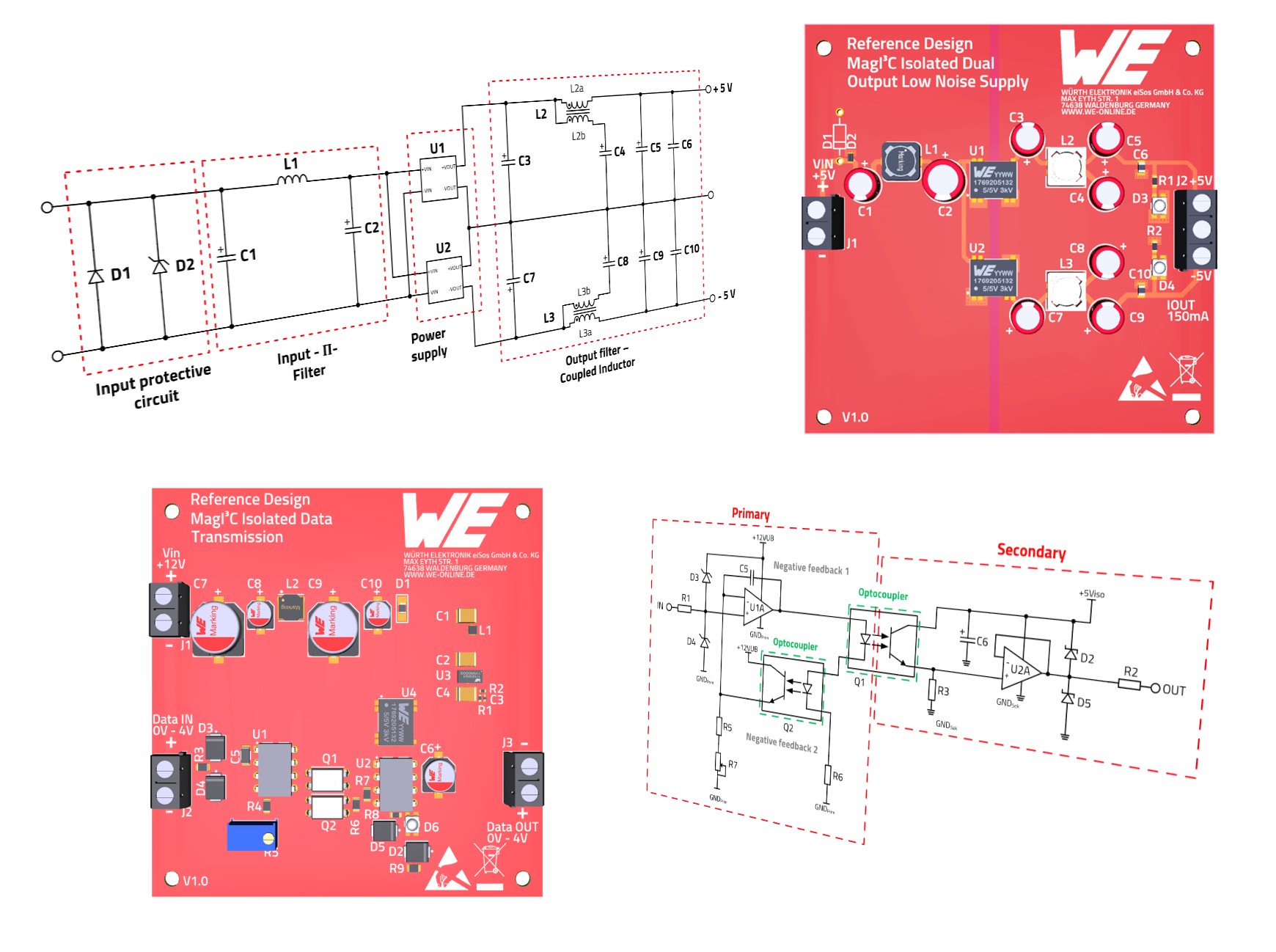
Wurth ElektronikIndustrial plants, such as warehouse logistics, filling plants, rolling mills, conveyor belts and printing presses, generally require the use of a selection of the following elements for safe operation:
- Isolation amplifiers, analog-to-digital converters
- Isolation of digital circuits
- Interfaces/bus isolation - RS232, RS485, CAN, Interbus, Profibus
- Measurement and data acquisition
All these applications have one thing in common, namely the isolation of the input supply voltage from the supplying bus voltage. But why galvanically isolate a supply from a bus or from switching components in general? Galvanic isolation prevents transient interference from the supply voltage from propagating into the bus and disrupting its operation.
All these applications share the fact that they are supplied by a power module with galvanic isolation. The Application Note explains the functionality and structure of the power module used for the applications described.
ANR031 - Certification of custom modules
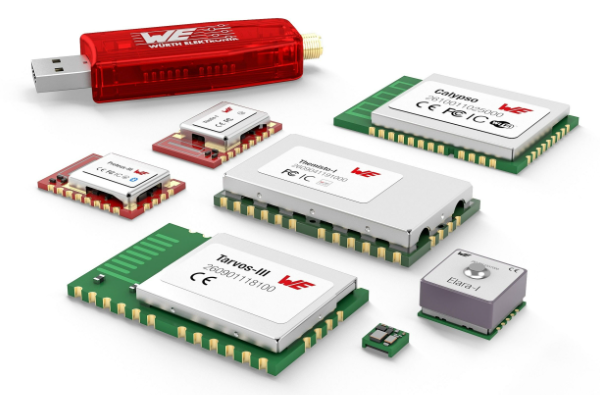
Wurth ElektronikCertified radio modules enabling the radio data transmission in numerous radio frequency bands and radio standards. The radio modules are designed in a way that the mode of operation can be configured via external host micro controller to meet best the requirements of the underlying application. Nevertheless, there are still cases where an adoption or complete change of the firmware is necessary to enable standalone operation, provide new interfaces or simply to optimize the behaviour of the underlying application. Due to the change in firmware the radio certification of the adopted radio module must be verified again. This application note describes in which cases the certification of an adapted radio module can be created on base of the certification of the Würth Elektronik eiSos standard product.
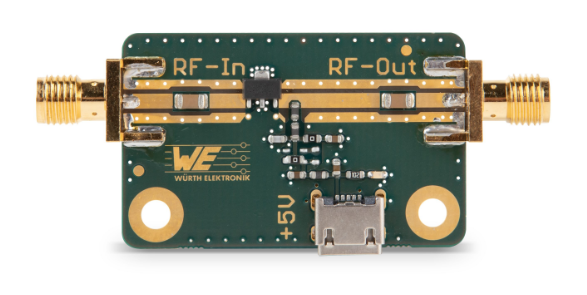
ANP101 - RF Gain Block Amplifier with integrated Multilayer Ferrite for Broadband Operation
Wurth ElektronikThe ubiquity of wireless communications is driving the need for general-purpose RF amplifiers that are applicable to many categories, from 5G systems to radio and antenna applications.
When designing an RF amplifier, the first step is to define some important parameters such as target frequency and gain factor. By selecting the optimal passive components, the transmission characteristics of the amplifier may be enhanced and improved. A well-designed layout that can transmit RF signals and the DC current to power the amplifier stage on a single line without interference or cross-talk further improves RF performance.
A key component for this interference-free operation of the transmission of mixed signals (RF and DC) is the inductor for decoupling the RF and DC supplies. In addition to the usual approach of using a standard inductor, another suitable alternative is to use a multilayer ferrite. To compare and evaluate the ferrite and inductor in this application, an evaluation board of an RF amplifier was realized and measured. This application note also includes circuit design considerations and various recommendations for achieving optimal parameters using two RF amplifier examples.
Contents:
- Component selection with REDEXPERT
- RF gain block amplifier types in comparison
- Inductors for blocking the RF signal
- DC blocking capacitor selection
- PCB layout considerations
- Measurement setup and results
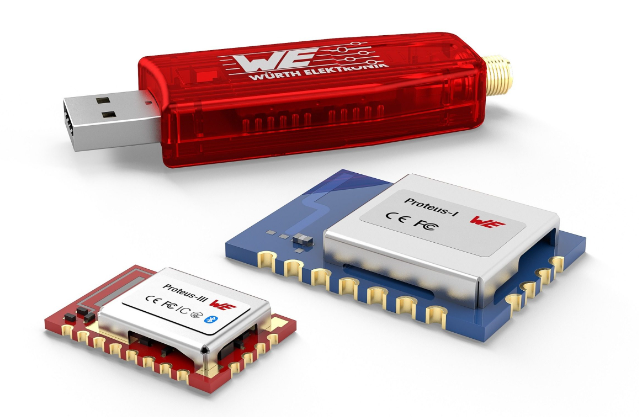
ANR025 - Proteus-e Quickstart
Wurth ElektronikThe Proteus-e is a radio module based on the nRF52 Nordic Semiconductors SoC, which provides various Bluetooth LE and has its focus on low power features. This Application Note shows how easy the "transparent mode" can be used to quickly connect the Proteus-e in order to communicate with a Bluetooth LE connection partner (e.g. a smart device). As second step with more advanced functions, and therefore recommended to be used in applications, the reader is introduced to the Command Mode that is also available to be used on the Proteus-e.
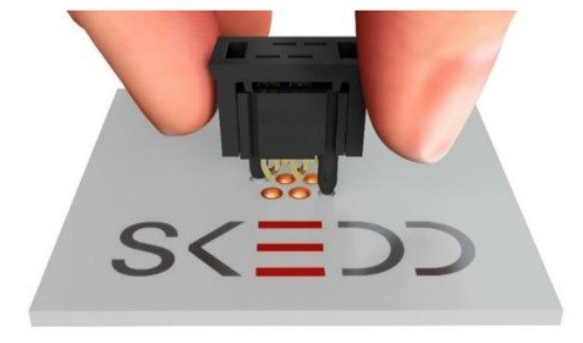
ANE011 - SKEDD Technology, Advantages & Application
Wurth ElektronikSKEDD is a technology developed by Würth Elektronik with which connectors can be connected to the circuit board directly without soldering. This type of contact offers considerable advantages over soldered connectors.
The REDFIT IDC (insulation displacement connector) is the first series of connectors from Würth Elektronik which comes with SKEDD technology. In the meantime, renowned companies worldwide trust the advantages of SKEDD technology. In this Product Guide you will learn about the advantages of SKEDD and suitable applications for using SKEDD.
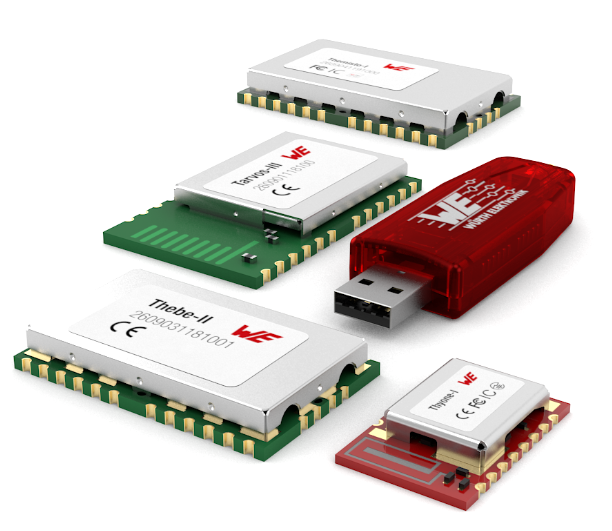
ANR022 - Radio module cross migration guide
Wurth ElektronikThis application note describes an adapter board, that is used to place a 2.4 GHz Thyone-I radio module on the footprint of a Tarvos-III/Telesto-III/Thebe-II/Themisto-I radio module.
Furthermore, the steps for hardware and firmware integration to replace an existing Tarvos-III/Telesto-III/Thebe-II/Themisto-I radio module by a Thyone-I radio module are described.
ANP008 - Negative input resistance of switching regulators
Wurth ElektronikDevelopers of switching regulators and switch mode power supplies attach great importance to the efficiency of their circuits. However, at the end of their development phase, they encounter unpleasant effects such as unwanted oscillations at the input of the switching regulator and these although the switching regulator produces a constant output voltage under all conditions. But why does the input of the switching regulator tend to oscillation under certain circumstances?
ANR024 - Proteus-E Advanced Developer Guide
Wurth ElektronikThe advanced developer guide covers details on the Proteus Product family that are required to implement a module counterpart in form of an App for smart devices. It covers the documentation on the SPP-like profile available on Proteus and the used protocols and data coding for arbitrary user payload.
Also all information required to make a Custom Firmware on the Proteus module hardware platform are provided within.