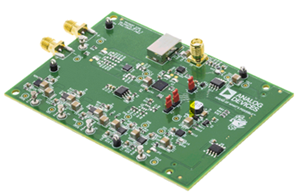
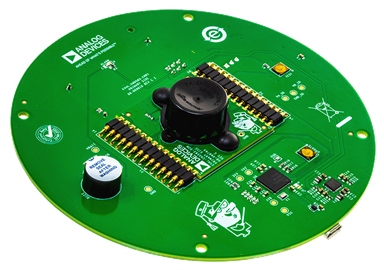
AD9094-1000EBZ
Analog Devices Inc.The AD9094 is an 8-bit, 1 GSPS, quad analog-to-digital converter (ADC). The device has an on-chip buffer and a sample-and-hold circuit designed for low power, small size, and ease of use. The device is designed to sample wide bandwidth analog signals up to 1.4 GHz. The AD9094 is optimized for wide input bandwidth, a high sampling rate, high works linearity, and low power in a small package. The quad-ADC cores feature multistage, differential pipelined architecture with integrated output error correction logic. Each ADC features wide bandwidth inputs that support a variety of user-selectable input ranges. An integrated voltage reference facilitates design considerations. The analog inputs and clock signals are differential inputs. Users can configure each pair of intermediate frequency (IF) receiver outputs onto either one or two lanes of JESD204B Subclass 1 or Subclass 0, high speed, serialized outputs, depending on the sample rate and the acceptable lane rate of the receiving logic device. Multiple device synchronization is supported through the SYSREF?, SYNCINB?AB, and SYNCINB?CD input pins. The AD9094 has flexible power-down options that allow significant power savings when desired. To program the power down options, use the 1.8 V capable, serial port interface (SPI). The AD9094 is available in a Pb-free, 72-lead, lead frame chip scale package (LFCSP) and is specified over a junction temperature range of ?40?C to +105?C. This product may be protected by one or more U.S. or international patents. Note that throughout the data sheet, multifunction pins, such as PDWN/STBY, are referred to either by the entire pin name or by a single function of the pin, for example, PDWN, when only that function is relevant. PRODUCT HIGHLIGHTS Low power consumption per channel. JESD204B lane rate support up to 15 Gbps. Wide, full power bandwidth supports IF sampling of signals up to 1.4 GHz. Buffered inputs ease filter design and implementation. Four integrated wideband decimation filters and numerically controlled oscillator (NCO) blocks supporting multiband receivers. Programmable fast overrange detection. On-chip temperature diode for system thermal management.APPLICATIONSLaser imaging, detection, and ranging (LIDAR)CommunicationsDigital oscilloscope (DSO)Ultrawideband satellite receiversInstrumentation

AD9106-ARDZ-EBZ
Analog Devices Inc.The AD9106 TxDAC? and waveform generator is a high performance, quad digital-to-analog converter (DAC) integrating on-chip pattern memory for complex waveform generation with a direct digital synthesizer (DDS). The DDS is a 12-bit output, up to 180 MHz master clock sinewave generator with a 24-bit tuning word allowing 10.8 Hz/LSB frequency resolution. The DDS has a single frequency output for all four DACs and independent programmable phase shift outputs for each of the four DACs.SRAM data can include directly generated stored waveforms, amplitude modulation patterns applied to DDS outputs, or DDS frequency tuning words.An internal pattern control state machine allows the user to program the pattern period for all four DACs as well as the start delay within the pattern period for the signal output on each DAC channel.Registers accessed using the serial peripheral interface (SPI) configure the digital waveform generator and load patterns into the SRAM.There are gain adjustment factors and offset adjustments applied to the digital signals on their way into the four DACs.The AD9106 offers exceptional ac and dc performance and supports DAC sampling rates up to 180 MSPS. The flexible power supply operating range of 1.8 V to 3.3 V and low power dissipation of the AD9106 make it well suited for portable and low power applications.Applications Medical instrumentation Ultrasound transducer excitation Portable instrumentation Signal generators, arbitrary waveform generators

AD9117-DPG2-EBZ
Analog Devices Inc.The AD9114/AD9115/AD9116/AD9117 are pin-compatible dual, 8-/10-/12-/14-bit, low power digital-to-analog converters (DACs) that provide a sample rate of 125 MSPS. These TxDAC? converters are optimized for the transmit signal path of communication systems. All the devices share the same interface, package, and pinout, providing an upward or downward component selection path based on performance, resolution, and cost.The AD9114/AD9115/AD9116/AD9117 offer exceptional ac and dc performance and support update rates up to 125 MSPS.The flexible power supply operating range of 1.8 V to 3.3 V and low power dissipation of the AD9114/AD9115/AD9116/AD9117 make them well suited for portable and low power applications.PRODUCT HIGHLIGHTS Low Power. DACs operate on a single 1.8 V to 3.3 V supply; total power consumption reduces to 225 mW at 100 MSPS. Sleep and power-down modes are provided for low power idle periods. CMOS Clock Input. High speed, single-ended CMOS clock input supports a 125 MSPS conversion rate. Easy Interfacing to Other Components. Adjustable output common mode from 0 V to 1.2 V allows for easy interfacing to other components that accept common-mode levels greater than 0 V.?APPLICATIONS Wireless infrastructures Picocell, femtocell base stations Medical instrumentation Ultrasound transducer excitation Portable instrumentation Signal generators, arbitrary waveform generators

AD9121-M5372-EBZ
Analog Devices Inc.The AD9121 is a dual, 14-bit, high dynamic range digital-to-analog converter (DAC) that provides a sample rate of 1230 MSPS, permitting multicarrier generation up to the Nyquist frequency.The AD9121 TxDAC+? includes features optimized for direct conversion transmit applications, including complex digital modulation, and gain and offset compensation. The DAC outputs are optimized to interface seamlessly with analog quadrature modulators, such as the ADL537x F-MOD series from Analog Devices, Inc. A 4-wire serial port interface provides for programming/readback of many internal parameters. Full-scale output current can be programmed over a range of 8.7 mA to 31.7 mA. The AD9121 comes in a 72-lead LFCSP.PRODUCT HIGHLIGHTS Ultralow noise and intermodulation distortion (IMD) enable high quality synthesis of wideband signals from baseband to high intermediate frequencies (IF). Proprietary DAC output switching technique enhances dynamic performance. Current outputs are easily configured for various single-ended or differential circuit topologies. Flexible LVDS digital interface allows the standard 28-wire bus to be reduced to one-half of the width.APPLICATIONS Wireless infrastructure W-CDMA, CDMA2000, TD-SCDMA, WiMAX, GSM, LTE Digital high or low IF synthesis Transmit diversity Wideband communications: LMDS/MMDS, point-to-point

AD9129-MIX-EBZ
Analog Devices Inc.The AD9119/AD9129 are high performance, 11-/14-bit RF digital-to-analog converters (DACs) supporting data rates up to 2.85 GSPS. The DAC core is based on a quad-switch architecture that enables dual-edge clocking operation, effectively increasing the DAC update rate to 5.7 GSPS when configured for Mix-Mode? or 2? interpolation. The high dynamic range and bandwidth enable multicarrier generation up to 4.2 GHz.In baseband mode, wide bandwidth capability combines with high dynamic range to support from 1 to 158 contiguous carriers for CATV infrastructure applications. A choice of two optional 2? interpolation filters is available to simplify the postreconstruction filter by effectively increasing the DAC update rate by a factor of 2. In Mix-Mode operation, the AD9119/AD9129 can reconstruct RF carriers in the second and third Nyquist zone while still maintaining exceptional dynamic range up to 4.2 GHz. The high performance NMOS DAC core features a quad-switch architecture that enables industry-leading direct RF synthesis performance with minimal loss in output power. The output current can be programmed over a range of 9.5 mA to 34.4 mA.The AD9119/AD9129 include several features that may further simplify system integration. A dual-port, source synchronous LVDS interface simplifies the data interface to a host FPGA/ASIC. A differential frame/parity bit is also included to monitor the integrity of the interface. On-chip delay locked loops (DLLs) optimize timing between different clock domains.A serial peripheral interface (SPI) configures the AD9119/ AD9129 and monitors the status of readback registers. The AD9119/AD9129 are manufactured on a 0.18 ?m CMOS process and operates from +1.8 V and ?1.5 V supplies. It is supplied in a 160-ball chip scale package ball grid array.Product Highlights High dynamic range and signal reconstruction bandwidth support RF signal synthesis of up to 4.2 GHz. Dual-port interface with double data rate (DDR) LVDS data receivers supports 2850 MSPS maximum conversion rate. Manufactured on a CMOS process; a proprietary switching technique enhances dynamic performance.Applications Broadband communications systems CMTS/VOD Wireless infrastructure: W-CDMA, LTE, point-to-point Instrumentation, automatic test equipment (ATE) Radar, jammers

AD9136-FMC-EBZ
Analog Devices Inc.The AD9135/AD9136 are dual, 11-/16-bit, high dynamic range digital-to-analog converters (DACs) that provide a maximum sample rate of 2800 MSPS, permitting a multicarrier generation over a very wide bandwidth. The DAC outputs are optimized to interface seamlessly with the ADRF6720, as well as other analog quadrature modulators (AQMs) from Analog Devices, Inc. An optional 3-wire or 4-wire serial port interface (SPI) provides for programming/readback of many internal parameters. The full-scale output current can be programmed over a typical range of 13.9 mA to 27.0 mA. The AD9135/AD9136 are available in an 88-lead LFCSP.Product Highlights Greater than 2 GHz, ultrawide complex signal bandwidth enables emerging wideband and multiband wireless applications. Advanced low spurious and distortion design techniques provide high quality synthesis of wideband signals from baseband to high intermediate frequencies. JESD204B Subclass 1 support simplifies multichip synchronization in software and hardware design. Fewer pins for data interface width with a serializer/deserializer (SERDES) JESD204B eight-lane interface. Programmable transmit enable function allows easy design balance between power consumption and wake-up time. Small package size with 12 mm ? 12 mm footprint.Applications Wireless communications 3G/4G W-CDMA base stations Wideband repeaters Software defined radios Wideband communications Point to point Local multipoint distribution service (LMDS) and multichannel multipoint distribution service (MMDS) Transmit diversity, multiple input/multiple output (MIMO) Instrumentation Automated test equipment

AD9146-M5375-EBZ
Analog Devices Inc.The AD9146 is a dual, 16-bit, high dynamic range digital-to-analog converter (DAC) that provides a sample rate of 1230 MSPS, permitting multicarrier generation up to the Nyquist frequency.The AD9146 TxDAC+? includes features optimized for direct conversion transmit applications, including complex digital modulation, and gain and offset compensation. The DAC outputs are optimized to interface seamlessly with analog quadrature modulators, such as the ADL537x F-MOD series from Analog Devices, Inc. A 3-wire serial port interface provides for programming/readback of many internal parameters. Full-scale output current can be programmed over a range of 8.7 mA to 31.7 mA. The AD9146 comes in a 48-lead LFCSP.PRODUCT HIGHLIGHTS Ultralow noise and intermodulation distortion (IMD) enable high quality synthesis of wideband signals from baseband to high intermediate frequencies. A proprietary DAC output switching technique enhances dynamic performance. The current outputs are easily configured for various single-ended or differential circuit topologies. Compact LVDS digital interface offers reduced width data bus.APPILICATIONS Wireless infrastructure W-CDMA, CDMA2000, TD-SCDMA, WiMAX, GSM, LTE Digital high or low IF synthesis Transmit diversity Wideband communications: LMDS/MMDS, point-to-point

AD9161-FMCC-EBZ
Analog Devices Inc.The AD9161 is a high performance, 11-bit digital-to-analog converter (DAC) that supports data rates to 6 GSPS. The DAC core is based on a quad-switch architecture coupled with a 2? interpolator filter that enables an effective DAC update rate of up to 12 GSPS in some modes. The high dynamic range and bandwidth makes these DACs ideally suited for the most demanding high speed radio frequency (RF) DAC applications.In baseband mode, wide bandwidth capability combines with high dynamic range to support DOCSIS 3.1 cable infrastructure compliance from the minimum of two carriers to full maximum spectrum of 1.794 GHz. A 2? interpolator filter (FIR85) enables the AD9161/AD9162 to be configured for lower data rates and converter clocking to reduce the overall system power and ease the filtering requirements. In Mix-Mode? operation, the AD9161/AD9162 can reconstruct RF carriers in the second and third Nyquist zones up to 7.5 GHz while still maintaining exceptional dynamic range. The output current can be programmed from 8 mA to 38.76 mA. The AD9161/AD9162 data interface consists of up to eight JESD204B serializer/deserializer (SERDES) lanes that are programmable in terms of lane speed and number of lanes to enable application flexibility.A serial peripheral interface (SPI) can configure the AD9161/AD9162 and monitor the status of all registers. The AD9161/AD9162 are offered in an 165-ball, 8.0 mm ? 8.0 mm, 0.5 mm pitch, CSP_BGA package and in an 169-ball, 11 mm ? 11 mm, 0.8 mm pitch, CSP_BGA package, including a leaded ball option for the AD9162.Product Highlights High dynamic range and signal reconstruction bandwidth supports RF signal synthesis of up to 7.5 GHz. Up to eight lanes JESD204B SERDES interface flexible in terms of number of lanes and lane speed. Bandwidth and dynamic range to meet DOCSIS 3.1 compliance with margin.Applications Broadband communications systems DOCSIS 3.1 cable modem termination system (CMTS)/video on demand (VOD)/edge quadrature amplitude modulation (EQAM) Wireless communications infrastructure W-CDMA, LTE, LTE-A, point to point Instrumentation, automatic test equipment (ATE) Radars and jammers
AD9162-FMCC-EBZ
Analog Devices Inc.The AD9162 is a high performance, 16-bit digital-to-analog converter (DAC) that supports data rates to 6 GSPS. The DAC core is based on a quad-switch architecture coupled with a 2? interpolator filter that enables an effective DAC update rate of up to 12 GSPS in some modes. The high dynamic range and bandwidth makes these DACs ideally suited for the most demanding high speed radio frequency (RF) DAC applications.In baseband mode, wide bandwidth capability combines with high dynamic range to support DOCSIS 3.1 cable infrastructure compliance from the minimum of two carriers to full maximum spectrum of 1.794 GHz. A 2? interpolator filter (FIR85) enables the AD9161/AD9162 to be configured for lower data rates and converter clocking to reduce the overall system power and ease the filtering requirements. In Mix-Mode? operation, the AD9161/AD9162 can reconstruct RF carriers in the second and third Nyquist zones up to 7.5 GHz while still maintaining exceptional dynamic range. The output current can be programmed from 8 mA to 38.76 mA. The AD9161/AD9162 data interface consists of up to eight JESD204B serializer/deserializer (SERDES) lanes that are programmable in terms of lane speed and number of lanes to enable application flexibility.A serial peripheral interface (SPI) can configure the AD9161/AD9162 and monitor the status of all registers. The AD9161/AD9162 are offered in an 165-ball, 8.0 mm ? 8.0 mm, 0.5 mm pitch, CSP_BGA package and in an 169-ball, 11 mm ? 11 mm, 0.8 mm pitch, CSP_BGA package, including a leaded ball option for the AD9162.Product Highlights High dynamic range and signal reconstruction bandwidth supports RF signal synthesis of up to 7.5 GHz. Up to eight lanes JESD204B SERDES interface flexible in terms of number of lanes and lane speed. Bandwidth and dynamic range to meet DOCSIS 3.1 compliance with margin.Applications Broadband communications systems DOCSIS 3.1 cable modem termination system (CMTS)/video on demand (VOD)/edge quadrature amplitude modulation (EQAM) Wireless communications infrastructure W-CDMA, LTE, LTE-A, point to point Instrumentation, automatic test equipment (ATE) Radars and jammers

AD9164-FMCC-EBZ
Analog Devices Inc.The AD91641 is a high performance, 16-bit digital-to-analog converter (DAC) and direct digital synthesizer (DDS) that supports update rates to 6 GSPS. The DAC core is based on a quad-switch architecture coupled with a 2? interpolator filter that enables an effective DAC update rate of up to 12 GSPS in some modes. The high dynamic range and bandwidth makes these DACs ideally suited for the most demanding high speed radio frequency (RF) DAC applications.The DDS consists of a bank of 32, 32-bit numerically controlled oscillators (NCOs), each with its own phase accumulator.When combined with a 100 MHz serial peripheral interface (SPI) and fast hop modes, phase coherent fast frequency hopping (FFH) is enabled, with several modes to support multiple applications.In baseband mode, wide analog bandwidth capability combines with high dynamic range to support DOCSIS 3.1 cable infrastructure compliance from the minimum of one carrier up to the full maximum spectrum of 1.791 GHz of signal bandwidth. A 2? interpolator filter (FIR85) enables the AD9164 to be configured for lower data rates and converter clocking to reduce the overall system power and ease the filtering requirements. In Mix-Mode? operation, the AD9164 can reconstruct RF carriers in the second and third Nyquist zones up to 7.5 GHz while still maintaining exceptional dynamic range. The output current can be programmed from 8 mA to 38.76 mA. The AD9164 data interface consists of up to eight JESD204B serializer/deserializer (SERDES) lanes that are programmable in terms of lane speed and number of lanes to enable application flexibility.An SPI interface configures the AD9164 and monitors the status of all registers. The AD9164 is offered in a 165-ball, 8 mm ? 8 mm, 0.5 mm pitch CSP_BGA package, and a 169-ball, 11 mm ? 11 mm, 0.8 mm pitch, CSP_BGA package, including a leaded ball option.Product Highlights High dynamic range and signal reconstruction bandwidth supports RF signal synthesis of up to 7.5 GHz. Up to eight lanes JESD204B SERDES interface flexible in terms of number of lanes and lane speed. Bandwidth and dynamic range to meet DOCSIS 3.1 compliance and multiband wireless communications standards with margin.?Applications Broadband communications systems DOCSIS 3.1 CMTS/ video on demand (VOD)/edge quadrature amplitude modulation (EQAM) Wireless communications infrastructure W-CDMA, LTE, LTE-A, point to point

AD9175-FMC-EBZ
Analog Devices Inc.The AD9175 is a high performance, dual, 16-bit digital-to-analog converter (DAC) that supports DAC sample rates up to 12.6 GSPS. The device features an 8-lane, 15.4 Gbps JESD204B data input port, a high performance, on-chip DAC clock?multiplier, and digital signal processing capabilities targeted at single-band and multiband direct to radio frequency (RF) wireless applications.The AD9175 features three complex data input channels per RF DAC datapath. Each input channel is fully bypassable. Each data input channel (or channelizer) includes a configurable gain stage, an interpolation filter, and a channel numerically controlled oscillator (NCO) for flexible, multiband frequency planning. The AD9175 supports an input data rate of up to 3.08 GSPS complex (in-phase/quadrature (I/Q)), or up to 3.4 GSPS noncomplex (real), and is capable of allocating multiple complex input data streams to the assigned channels for individual processing. Each group of three channelizers is summed into a respective main datapath for additional processing when needed. Each main datapath includes an interpolation filter and one 48-bit main NCO ahead of the RF DAC core. Using the modulator switch, the outputs of a main datapath can be either routed to DAC0 alone for operating as a single DAC, or routed to both DAC0 and DAC1 for operating as a dual, intermediate frequency DAC (IF DAC).The AD9175 also supports ultrawide data rate modes that allow bypassing the channelizers and main datapaths to provide maximum data rates of up to 3.4 GSPS as a dual, 11-bit DAC.The AD9175 is available in a 144-ball BGA_ED package.Applications Wireless communications infrastructure Multiband base station radios Microwave/E-band backhaul systems Instrumentation, automatic test equipment (ATE) Radars and jammersProduct Highlights A low power, multichannel, dual DAC design reduces power consumption in higher bandwidth and multichannel applications, while maintaining performance. Supports single-band and multiband wireless applications with three bypassable complex data channels per RF DAC, or configurations that use the two main datapaths as two wideband complex data channels when using the built in modulator switch. A maximum complex data rate (per I or Q) of up to 3.08 GSPS with 11-bit resolution, and up to 1.23 GSPS with 16-bit resolution. The AD9175 can be alternatively configured as a dual DAC, with each DAC operating across an independent JESD204B link, at the previously described data rates. Ultrawide bandwidth single DAC modes supporting up to 3.4 GSPS with 11-bit resolution, 12-bit SERDES packing.

AD9176-FMC-EBZ
Analog Devices Inc.The AD9176 is a high performance, dual, 16-bit digital-to-analog converter (DAC) that supports DAC sample rates up to 12.6 GSPS. The device features an 8-lane, 15.4 Gbps JESD204B data input port, a high performance, on-chip DAC clock multiplier, and digital signal processing capabilities targeted at single-band and multiband direct to radio frequency (RF) wireless applications.The AD9176 features three complex data input channels per RF DAC datapath. Each input channel is fully bypassable. Each data input channel (or channelizer) includes a configurable gain stage, an interpolation filter, and a channel numerically controlled oscillator (NCO) for flexible, multiband frequency planning. The AD9176 supports an input data rate of up to a 3.08 GSPS complex (inphase/quadrature (I/Q)), or up to 6.16 GSPS non-complex (real), and is capable of allocating multiple complex input data streams to the assigned channels for individual processing. Each group of three channelizers is summed into a respective main datapath for additional processing when needed. Each main datapath includes an interpolation filter and one 48-bit main NCO ahead of the RF DAC core. Using the modulator switch, the outputs of a main datapath can be either routed to DAC0 alone for operating as a single DAC, or routed to both DAC0 and DAC1 for operating as a dual, intermediate frequency DAC (IF DAC).The AD9176 also supports ultrawide data rate modes that allow bypassing the channelizers and main datapaths to provide maximum data rates of up to 6.16 GSPS as a single, 16-bit DAC, up to 3.08 GSPS as a dual, 16-bit DAC, or up to 4.1 GSPS as a dual, 12-bit DAC.The AD9176 is available in a 144-ball BGA_ED package.Applications Wireless communications infrastructure Multiband base station radios Microwave/E-band backhaul systems Instrumentation, automatic test equipment (ATE) Radars and jammersProduct Highlights A low power, multichannel, dual DAC design reduces power consumption in higher bandwidth and multichannel applications, while maintaining performance. Supports single-band and multiband wireless applications with three bypassable complex data channels per RF DAC, or configurations that use the two main datapaths as two wideband complex data channels when using the built in modulator switch. A maximum complex data rate (per I or Q) of up to 3.08 GSPS with 16-bit resolution, and up to 4.1 GSPS with 12-bit resolution. The AD9176 can be alternatively configured as a dual DAC, with each DAC operating across an independent JESD204B link, at the previously described data rates. Ultrawide bandwidth single-DAC modes, supporting up to 6.16 GSPS data rates with 16-bit resolution.

AD9204-20EBZ
Analog Devices Inc.The AD9204 is a monolithic, dual-channel, 1.8 V supply, 10-bit, 20 MSPS/40 MSPS/65 MSPS/80 MSPS analog-to-digital converter (ADC). It features a high performance sample-and-hold circuit and on-chip voltage reference.The product uses multistage differential pipeline architecture with output error correction logic to provide 10-bit accuracy at 80 MSPS data rates and to guarantee no missing codes over the full operating temperature range.The ADC contains several features designed to maximize flexibility and minimize system cost, such as programmable clock and data alignment and programmable digital test pattern generation. The available digital test patterns include built-in deterministic and pseudorandom patterns, along with custom user-defined test patterns entered via the serial port interface (SPI).A differential clock input controls all internal conversion cycles. An optional duty cycle stabilizer (DCS) compensates for wide variations in the clock duty cycle while maintaining excellent overall ADC performance.The digital output data is presented in offset binary, gray code, or twos complement format. A data output clock (DCO) is provided for each ADC channel to ensure proper latch timing with receiving logic. Both 1.8 V and 3.3 V CMOS levels are supported and output data can be multiplexed onto a single output bus.The AD9204 is available in a 64-lead RoHS compliant LFCSP and is specified over the industrial temperature range (?40?C to +85?C).PRODUCT HIGHLIGHTS The AD9204 operates from a single 1.8 V analog power supply and features a separate digital output driver supply to accommodate 1.8 V to 3.3 V logic families. The patented sample-and-hold circuit maintains excellent performance for input frequencies up to 200 MHz and is designed for low cost, low power, and ease of use. A standard serial port interface supports various product features and functions, such as data output formatting, internal clock divider, power-down, DCO/DATA timing and offset adjustments, and voltage reference modes. The AD9204 is packaged in a 64-lead RoHS compliant LFCSP that is pin compatible with the AD9268 16-bit ADC, the AD9251 and AD9258 14-bit ADCs, and the AD9231 12-bit ADC, enabling a simple migration path between 10-bit and 16-bit converters sampling from 20 MSPS to 125 MSPS.APPLICATIONS Communications Diversity radio systems Multimode digital receivers GSM, EDGE, W-CDMA, LTE, CDMA2000, WiMAX, TD-SCDMA I/Q demodulation systems Smart antenna systems Battery-powered instruments Handheld scope meters Ultrasound Radar/LIDAR PET/SPECT imaging
AD9204-65EBZ
Analog Devices Inc.The AD9204 is a monolithic, dual-channel, 1.8 V supply, 10-bit, 20 MSPS/40 MSPS/65 MSPS/80 MSPS analog-to-digital converter (ADC). It features a high performance sample-and-hold circuit and on-chip voltage reference.The product uses multistage differential pipeline architecture with output error correction logic to provide 10-bit accuracy at 80 MSPS data rates and to guarantee no missing codes over the full operating temperature range.The ADC contains several features designed to maximize flexibility and minimize system cost, such as programmable clock and data alignment and programmable digital test pattern generation. The available digital test patterns include built-in deterministic and pseudorandom patterns, along with custom user-defined test patterns entered via the serial port interface (SPI).A differential clock input controls all internal conversion cycles. An optional duty cycle stabilizer (DCS) compensates for wide variations in the clock duty cycle while maintaining excellent overall ADC performance.The digital output data is presented in offset binary, gray code, or twos complement format. A data output clock (DCO) is provided for each ADC channel to ensure proper latch timing with receiving logic. Both 1.8 V and 3.3 V CMOS levels are supported and output data can be multiplexed onto a single output bus.The AD9204 is available in a 64-lead RoHS compliant LFCSP and is specified over the industrial temperature range (?40?C to +85?C).PRODUCT HIGHLIGHTS The AD9204 operates from a single 1.8 V analog power supply and features a separate digital output driver supply to accommodate 1.8 V to 3.3 V logic families. The patented sample-and-hold circuit maintains excellent performance for input frequencies up to 200 MHz and is designed for low cost, low power, and ease of use. A standard serial port interface supports various product features and functions, such as data output formatting, internal clock divider, power-down, DCO/DATA timing and offset adjustments, and voltage reference modes. The AD9204 is packaged in a 64-lead RoHS compliant LFCSP that is pin compatible with the AD9268 16-bit ADC, the AD9251 and AD9258 14-bit ADCs, and the AD9231 12-bit ADC, enabling a simple migration path between 10-bit and 16-bit converters sampling from 20 MSPS to 125 MSPS.APPLICATIONS Communications Diversity radio systems Multimode digital receivers GSM, EDGE, W-CDMA, LTE, CDMA2000, WiMAX, TD-SCDMA I/Q demodulation systems Smart antenna systems Battery-powered instruments Handheld scope meters Ultrasound Radar/LIDAR PET/SPECT imaging
AD9204-80EBZ
Analog Devices Inc.The AD9204 is a monolithic, dual-channel, 1.8 V supply, 10-bit, 20 MSPS/40 MSPS/65 MSPS/80 MSPS analog-to-digital converter (ADC). It features a high performance sample-and-hold circuit and on-chip voltage reference.The product uses multistage differential pipeline architecture with output error correction logic to provide 10-bit accuracy at 80 MSPS data rates and to guarantee no missing codes over the full operating temperature range.The ADC contains several features designed to maximize flexibility and minimize system cost, such as programmable clock and data alignment and programmable digital test pattern generation. The available digital test patterns include built-in deterministic and pseudorandom patterns, along with custom user-defined test patterns entered via the serial port interface (SPI).A differential clock input controls all internal conversion cycles. An optional duty cycle stabilizer (DCS) compensates for wide variations in the clock duty cycle while maintaining excellent overall ADC performance.The digital output data is presented in offset binary, gray code, or twos complement format. A data output clock (DCO) is provided for each ADC channel to ensure proper latch timing with receiving logic. Both 1.8 V and 3.3 V CMOS levels are supported and output data can be multiplexed onto a single output bus.The AD9204 is available in a 64-lead RoHS compliant LFCSP and is specified over the industrial temperature range (?40?C to +85?C).PRODUCT HIGHLIGHTS The AD9204 operates from a single 1.8 V analog power supply and features a separate digital output driver supply to accommodate 1.8 V to 3.3 V logic families. The patented sample-and-hold circuit maintains excellent performance for input frequencies up to 200 MHz and is designed for low cost, low power, and ease of use. A standard serial port interface supports various product features and functions, such as data output formatting, internal clock divider, power-down, DCO/DATA timing and offset adjustments, and voltage reference modes. The AD9204 is packaged in a 64-lead RoHS compliant LFCSP that is pin compatible with the AD9268 16-bit ADC, the AD9251 and AD9258 14-bit ADCs, and the AD9231 12-bit ADC, enabling a simple migration path between 10-bit and 16-bit converters sampling from 20 MSPS to 125 MSPS.APPLICATIONS Communications Diversity radio systems Multimode digital receivers GSM, EDGE, W-CDMA, LTE, CDMA2000, WiMAX, TD-SCDMA I/Q demodulation systems Smart antenna systems Battery-powered instruments Handheld scope meters Ultrasound Radar/LIDAR PET/SPECT imaging

AD9219-65KITZ
Analog Devices Inc.The AD9219 is a quad, 10-bit, 40/65 MSPS analog-to-digital con-verter (ADC) with an on-chip sample-and-hold circuit designedfor low cost, low power, small size, and ease of use. The productoperates at a conversion rate of up to 65 MSPS and is optimized foroutstanding dynamic performance and low power in applications where a small package size is critical.The ADC requires a single 1.8 V power supply and LVPECL-/ CMOS-/LVDS-compatible sample rate clock for full performanceoperation. No external reference or driver components arerequired for many applications.The ADC automatically multiplies the sample rate clock for theappropriate LVDS serial data rate. A data clock output (DCO) for capturing data on the output and a frame clock output (FCO) for signaling a new output byte are provided. Individual-channel power-down is supported and typically consumes less than 2 mW when all channels are disabled.The ADC contains several features designed to maximizeflexibility and minimize system cost, such as programmableclock and data alignment and programmable digital test patterngeneration. The available digital test patterns include built-in deterministic and pseudorandom patterns, along with custom user- defined test patterns entered via the serial port interface (SPI).The AD9219 is available in an RoHS compliant, 48-lead LFCSP. It is specified over the industrial temperature range of ?40?C to +85?C.Product Highlights Small Footprint. Four ADCs are contained in a small, space-saving package. Low power of 94 mW/channel at 65 MSPS. Ease of Use. A data clock output (DCO) is provided that operates at frequencies of up to 390 MHz and supports double data rate (DDR) operation. User Flexibility. The SPI control offers a wide range of flexible features to meet specific system requirements. Pin-Compatible Family. This includes the AD9287 (8-bit), AD9228 (12-bit), and AD9259 (14-bit). ApplicationsMedical imaging and nondestructive ultrasoundPortable ultrasound and digital beam-forming systemsQuadrature radio receiversDiversity radio receiversTape drivesOptical networkingTest equipment

AD9231-80EBZ
Analog Devices Inc.The AD9231 is a monolithic, dual-channel, 1.8 V supply, 12-bit, 20 MSPS / 40?MSPS / 65 MSPS/80 MSPS analog-to-digital converter (ADC). It features a high performance sample-and-hold circuit and on-chip voltage reference.The product uses multistage differential pipeline architecture with output error correction logic to provide 12-bit accuracy at 80 MSPS data rates and to guarantee no missing codes over the full operating temperature range.The ADC contains several features designed to maximize flexibility and minimize system cost, such as programmable clock and data alignment and programmable digital test pattern generation. The available digital test patterns include built-in deterministic and pseudorandom patterns, along with custom user-defined test patterns entered via the serial port interface (SPI).A differential clock input controls all internal conversion cycles. An optional duty cycle stabilizer (DCS) compensates for wide variations in the clock duty cycle while maintaining excellent overall ADC performance.The digital output data is presented in offset binary, gray code, or twos complement format. A data output clock (DCO) is provided for each ADC channel to ensure proper latch timing with receiving logic. Both 1.8 V and 3.3 V CMOS levels are supported, and output data can be multiplexed onto a single output bus.The AD9231 is available in a 64-lead RoHS compliant LFCSP and is specified over the industrial temperature range (?40?C to +85?C).PRODUCT HIGHLIGHTS The AD9231 operates from a single 1.8 V analog power supply and features a separate digital output driver supply to accommodate 1.8 V to 3.3 V logic families. The patented sample-and-hold circuit maintains excellent performance for input frequencies up to 200 MHz and is designed for low cost, low power, and ease of use. A standard serial port interface supports various product features and functions, such as data output formatting, internal clock divider, power-down, DCO/DATA timing and offset adjustments, and voltage reference modes. The AD9231 is packaged in a 64-lead RoHS compliant LFCSP that is pin compatible with the AD9268 16-bit ADC, the AD9258 14-bit ADC, the AD9251 14-bit ADC, and the AD9204 10-bit ADC, enabling a simple migration path between 10-bit and 16-bit converters sampling from 20 MSPS to 125 MSPS.?APPLICATIONS Communications Diversity radio systems Multimode digital receivers GSM, EDGE, W-CDMA, LTE, CDMA2000, WiMAX, TD-SCDMA I/Q demodulation systems Smart antenna systems Battery-powered instruments Hand held scope meters Portable medical imaging Ultrasound Radar/LIDAR

AD9250-250EBZ
Analog Devices Inc.The AD9250 is a dual, 14-bit ADC with sampling speeds of up to 250 MSPS. The AD9250 is designed to support communications applications where low cost, small size, wide bandwidth, and versatility are desired.The ADC cores feature a multistage, differential pipelined architecture with integrated output error correction logic. The ADC cores feature wide bandwidth inputs supporting a variety of user-selectable input ranges. An integrated voltage reference eases design considerations. A duty cycle stabilizer is provided to compensate for variations in the ADC clock duty cycle, allowing the converters to maintain excellent performance. The JESD204B high speed serial interface reduces board routing requirements and lowers pin count requirements for the receiving device.By default, the ADC output data is routed directly to the two JESD204B serial output lanes. These outputs are at CML voltage levels. Four modes support any combination of M = 1 or 2 (single or dual converters) and L = 1 or 2 (one or two lanes). For dual ADC mode, data can be sent through two lanes at the maximum sampling rate of 250 MSPS. However, if data is sent through one lane, a sampling rate of up to 125 MSPS is supported. Synchronization inputs (SYNCINB? and SYSREF?) are provided.Flexible power-down options allow significant power savings, when desired. Programmable overrange level detection is supported for each channel via the dedicated fast detect pins.Programming for setup and control are accomplished using a 3-wire SPI-compatible serial interface.The AD9250 is available in a 48-lead LFCSP and is specified over the industrial temperature range of ?40?C to +85?C.Product Highlights Integrated dual, 14-bit, 170 MSPS/250 MSPS ADC. The configurable JESD204B output block supports up to 5 Gbps per lane. An on-chip, phase-locked loop (PLL) allows users to provide a single ADC sampling clock; the PLL multiplies the ADC sampling clock to produce the corresponding JESD204B data rate clock. Support for an optional RF clock input to ease system board design. Proprietary differential input maintains excellent SNR performance for input frequencies of up to 400 MHz. Operation from a single 1.8 V power supply. Standard serial port interface (SPI) that supports various product features and functions such as controlling the clock DCS, power-down, test modes, voltage reference mode, over range fast detection, and serial output configuration.Applications Diversity radio systems Multimode digital receivers (3G) TD-SCDMA, WiMAX, W-CDMA, CDMA2000, GSM, EDGE, LTE DOCSIS 3.0 CMTS upstream receive paths HFC digital reverse path receivers I/Q demodulation systems Smart antenna systems Electronic test and measurement equipment Radar receivers COMSEC radio architectures IED detection/jamming systems General-purpose software radios Broadband data applications

AD9251-65EBZ
Analog Devices Inc.The AD9251 is a monolithic, dual-channel, 1.8 V supply, 14-bit, 20 MSPS/40 MSPS/65 MSPS/80 MSPS analog-to-digital converter (ADC). It features a high performance sample-and hold circuit and on-chip voltage reference.The product uses multistage differential pipeline architecture with output error correction logic to provide 14-bit accuracy at80 MSPS data rates and to guarantee no missing codes over the full operating temperature range.The ADC contains several features designed to maximize flexibility and minimize system cost, such as programmable clock and data alignment and programmable digital test pattern generation. The available digital test patterns include built-in deterministic and pseudorandom patterns, along with custom user-defined test patterns entered via the serial port interface (SPI).A differential clock input controls all internal conversion cycles. An optional duty cycle stabilizer (DCS) compensates for wide variations in the clock duty cycle while maintaining excellent overall ADC performance.The digital output data is presented in offset binary, gray code, or twos complement format. A data output clock (DCO) is provided for each ADC channel to ensure proper latch timing with receiving logic. Both 1.8 V and 3.3 V CMOS levels are supported and output data can be multiplexed onto a single output bus.The AD9251 is available in a 64-lead RoHS Compliant LFCSP and is specified over the industrial temperature range (?40?C to +85?C).PRODUCT HIGHLIGHTS The AD9251 operates from a single 1.8 V analog power supply and features a separate digital output driver supply to accommodate 1.8 V to 3.3 V logic families. The patented sample-and-hold circuit maintains excellent performance for input frequencies up to 200 MHz and is designed for low cost, low power, and ease of use. A standard serial port interface supports various product features and functions, such as data output formatting, internal clock divider, power-down, DCO/DATA timing and offset adjustments, and voltage reference modes. The AD9251 is packaged in a 64-lead RoHS compliant LFCSP that is pin compatible with the AD9268 16-bit ADC, the AD9258 14-bit ADC, the AD9231 12-bit ADC, and the AD9204 10-bit ADC, enabling a simple migration path between 10-bit and 16-bit converters sampling from 20 MSPS to 125 MSPS.?APPLICATIONS Communications Diversity radio systems Multimode digital receivers GSM, EDGE, W-CDMA, LTE, CDMA2000, WiMAX, TD-SCDMA I/Q demodulation systems Smart antenna systems Battery-powered instruments Hand held scope meters Portable medical imaging Ultrasound Radar/LIDAR

AD9253-125EBZ
Analog Devices Inc.The AD9253 is a quad, 14-bit, 80 MSPS/105 MSPS/125 MSPSanalog-to-digital converter (ADC) with an on-chip sample-and-holdcircuit designed for low cost, low power, small size,and ease of use. The product operates at a conversion rate ofup to 125 MSPS and is optimized for outstanding dynamicperformance and low power in applications where a smallpackage size is critical.The ADC requires a single 1.8 V power supply and LVPECL-/CMOS-/LVDS-compatible sample rate clock for full performanceoperation. No external reference or driver components arerequired for many applications.The ADC automatically multiplies the sample rate clock for theappropriate LVDS serial data rate. A data clock output (DCO) forcapturing data on the output and a frame clock output (FCO)for signaling a new output byte are provided. Individual-channelpower-down is supported and typically consumes less than 2 mWwhen all channels are disabled. The ADC contains several featuresdesigned to maximize flexibility and minimize system cost, such as programmable output clock and data alignment and digitaltest pattern generation. The available digital test patternsinclude built-in deterministic and pseudorandom patterns, alongwith custom user-defined test patterns entered via the serial portinterface (SPI).The AD9253 is available in a RoHS-compliant, 48-lead LFCSP.It is specified over the industrial temperature range of ?40?C to+85?C. This product is protected by a U.S. patent.PRODUCT HIGHLIGHTS Small Footprint. Four ADCs are contained in a small, spacesaving package. Low power of 110 mW/channel at 125 MSPS with scalable power options. Pin compatible to the AD9633 12-bit quad ADC. Ease of Use. A data clock output (DCO) operates at frequencies of up to 500 MHz and supports double data rate (DDR) operation. User Flexibility. The SPI control offers a wide range of flexible features to meet specific system requirementsAPPLICATIONS Medical imaging and nondestructive ultrasound Quadrature radio receivers Diversity radio receivers Optical networking Test equipment