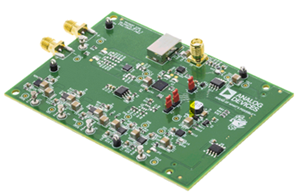
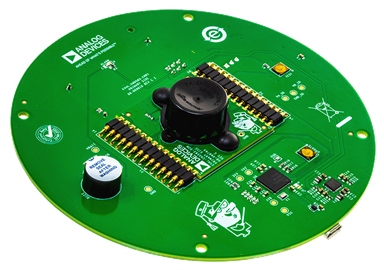
EVAL-ADF7241DB1Z
Analog Devices Inc.The ADF7241 is a highly integrated, low power, and high performance transceiver for operation in the global 2.4 GHz ISM band. It is designed with emphasis on flexibility, robustness, ease of use, and low current consumption. The IC supports the IEEE 802.15.4-2006 2.4 GHz PHY requirements in both packet and data streaming modes. With a minimum number of external components, it achieves compliance with the FCC CFR47 Part 15, ETSI EN 300 440 (Equipment Class 2), ETSI EN 300 328 (FHSS, DR > 250 kbps), and ARIB STD T-66 standards.The ADF7241 complies with the IEEE 802.15.4-2006 2.4 GHz PHY requirements with a fixed data rate of 250 kbps and DSSS-OQPSK modulation. The transmitter path of the ADF7241 is based on a direct closed-loop VCO modulation scheme using a low noise fractional-N RF frequency synthesizer. The automatically calibrated VCO operates at twice the fundamental frequency to reduce spurious emissions and avoid PA pulling effects. The bandwidth of the RF frequency synthesizer is automatically optimized for transmit and receive operations to achieve best phase noise, modulation quality, and synthesizer settling time performance. The transmitter output power is programmable from ?20 dBm to +4 dBm with automatic PA ramping to meet transient spurious specifications. An integrated biasing and control circuit is available in the IC to significantly simplify the interface to external PAs.For more information, please refer to the data sheet.Applications Wireless sensor networks Automatic meter reading/smart metering Industrial wireless control Healthcare Wireless audio/video Consumer electronics ZigBee

EVAL-ADFS5758SDZ
Analog Devices Inc.The ADFS5758 is a single-channel, 16-bit, current/voltage output DAC. The device is functional safety approved for unipolar current output and is a fully compliant item with a systematic capability of SC3, which can be used in safety-related applications up to SIL 2, according to IEC 61508. This arrangement allows a single ADFS5758 to be used to achieve SIL 2 for a nonredundant configuration. The safe state for the ADFS5758 is open circuit/high impedance.The ADFS5758 is a single-channel, voltage and current output digital-to-analog converter (DAC) that operates with a power supply range from ?33 V minimum on AVSS to +33 V maximum on AVDD1 with a maximum operating voltage between the two rails of 60 V. On-chip dynamic power control (DPC) minimizes package power dissipation, which is achieved by regulating the supply voltage (VDPC+) to the VIOUT output driver circuitry from 4.95 V to 27 V using a buck dc-to-dc converter, optimized for minimum on-chip power dissipation. The CHART pin enables a HART? signal to be coupled onto the current output.The device uses a versatile 4-wire serial peripheral interface (SPI) that operates at clock rates of up to 50 MHz and is compatible with standard SPI, QSPI?, MICROWIRE?, DSP, and microcontroller interface standards. The interface also features an optional SPI cyclic redundancy check (CRC) and a windowed watchdog timer. The ADFS5758 offers improved diagnostic features from its predecessors, such as an integrated independent 12-bit diagnostic analog-to-digital converter (ADC) that can be used to digitize both internal and external nodes.Product HighIights Functional safety approved to SIL 2/SC3 by T?V Rheinland. Range of advanced diagnostic features, including an integrated ADC for high reliability. DPC using an integrated buck dc-to-dc converter for thermal management. When used with the ADP1031, the ADFS5758 enables eight channel to channel isolated outputs at

EVAL-ADG5208FEBZ
Analog Devices Inc.The ADG5208F and ADG5209F are 8:1 and dual 4:1 analogmultiplexers. The ADG5208F switches one of eight inputs to acommon output, and the ADG5209F switches one of fourdifferential inputs to a common differential output. An EN inputon both devices enables or disables the device. Each channelconducts equally well in both directions when on, and eachchannel has an input signal range that extends to the supplies.The digital inputs are compatible with 3 V logic inputs over thefull operating supply range.When no power supplies are present, the channelremains in the offcondition, and the switch inputs are high impedance. Under normaloperating conditions, if the analog input signal levels on any Sx pinexceed positive fault voltage (VDD) or negative fault voltage (VSS)by a threshold voltage (VT), the channel turns off and that Sx pinbecomes high impedance. If the fault channel is selected, the drainpin is pulled to the secondary supply voltage that was exceeded.Input signal levels of up to ?55 V or +55 V relative to ground areblocked, in both the powered and unpowered conditions.The low capacitance and charge injection of these switches makethem ideal solutions for data acquisition and sample-and-holdapplications, where low glitch switching and fast settling timesare required.Product Highlights The source pins are protected against voltages greater than the supply rails, up to ?55 V and +55 V. The source pins are protected against voltages between ?55 V and +55 V in an unpowered state. Trench isolation guards against latch-up. Optimized for low charge injection and on capacitance. The ADG5208F/ADG5209F can be operated from a dual supply of ?5 V up to ?22 V or a single power supply of 8 V up to 44 V.Applications Analog input/output modules Process control/distributed control systems Data acquisition Instrumentation Avionics Automatic test equipment Communication systems Relay replacement

EVAL-ADG5243FEBZ
Analog Devices Inc.The ADG5243F comprises three independently selectable, singlepole/double-throw (SPDT) switches. All channels exhibit break-before-make switching action that prevents momentary shorting when switching channels. An EN input enables or disables the device. When disabled, all channels are switched off. Each switch conducts equally well in both directions when on, and each switch has an input signal range that extends to the supplies. The primary supply voltages define the on-resistance profile, whereas the secondary supply voltages define the voltage level at which the overvoltage protection engages.When no power supplies are present, the channel remains in the off condition, and the switch inputs are high impedance. Undernormal operating conditions, if the analog input signal levels on any Sx pin exceed the positive fault voltage (POSFV) or the negative fault voltage (NEGFV) by a threshold voltage (VT), the channel turns off and that Sx pin becomes high impedance. If the switch is selected to be on, then the drain pin is pulled to the secondary supply voltage that was exceeded. Input signal levels upto ?55 V or +55 V relative to ground are blocked, in both the powered and unpowered conditions.The low capacitance and charge injection of these switches make them ideal solutions for data acquisition and sample-andholdapplications, where low glitch switching and fast settling times are required.Note that, throughout this data sheet, multifunction pins, such as IN1/F1, are referred to either by the entire pin name or by asingle function of the pin, for example, IN1, when only that function is relevant.Product Highlights The source pins are protected against voltages greater than?the secondary supply rails, up to ?55 V and +55 V. The source pins are protected against voltages between??55 V and +55 V in an unpowered state. Overvoltage detection with the digital output indicates the?operating state of the switches. Trench isolation guards against latch-up. Optimized for low charge injection and on-capacitance. The ADG5243F can be operated from a dual supply of ?5 V?to ?22 V or a single power supply of 8 V to 44 V.Applications Analog input/output modules? Process control/distributed control systems? Data acquisition? Instrumentation? Avionics? Automatic test equipment? Communication systems? Relay replacement?

EVAL-ADG5248FEBZ
Analog Devices Inc.The ADG5248F and ADG5249F are 8:1 and dual 4:1 analog multiplexers. The ADG5248F switches one of eight inputs to a common output and the ADG5249F switches one of four differential inputs to a common differential output. Each channel conducts equally well in both directions when on, and each channel has an input signal range that extends to the supplies. The primary supply voltages define the on-resistance profile, whereas the secondary supply voltages define the voltage level at which the overvoltage protection engages.When no power supplies are present, the channel remains in the off condition, and the switch inputs are high impedance. Under normal operating conditions, if the analog input signal levels on any Sx pin exceed positive fault voltage (POSFV) or negative fault voltage (NEGFV) by a threshold voltage (VT), the channel turns off and that Sx pin becomes high impedance. If the switch is selected to be on, then the drain pin is pulled to the secondary supply voltage that was exceeded. Input signal levels up to +55 V or ?55 V relative to ground are blocked, in both the powered and unpowered condition.The low capacitance and charge injection of these switches make them ideal solutions for data acquisition and sample-and-hold applications, where low glitch switching and fast settling times are required.?Note that, throughout this data sheet, multifunction pins, such as A0/F2, are referred to either by the entire pin name or by a single function of the pin, for example, A0, when only that function is relevant.?Product Highlights Source pins are protected against voltages greater than the secondary supply rails, up to ?55 V and +55 V. Source pins are protected against voltages between ?55 V and +55 V in an unpowered state. Overvoltage detection with digital output indicates operating state of switches. Trench isolation guards against latch-up. Optimized for low charge injection and on-capacitance. The ADG5248F/ADG5249F can be operated from a dual?supply of ?5 V to ?22 V or a single power supply of 8 V to 44 V.Applications Analog input/output modules Process control/distributed control systems Data acquisition Instrumentation Avionics Automatic test equipment Communication systems Relay replacement

EVAL-ADG5401FEBZ
Analog Devices Inc.The ADG5401F main channel switch is a SPST, low on-resistance switch that features overvoltage protection, power off protection, and overvoltage detection on the source pins (S and SFB). The ADG5401F also features a protected secondary feedback channel for use with digital-to-analog converter (DAC) or amplifier outputs.When no power supplies are present, the switch remains in the off condition, and the switch inputs are high impedance.When powered, if the analog input signal levels on the S pin exceed VDD or VSS by a threshold voltage (VT) the switch turns off, the open-drain FF pin pulls to a logic low and a path between the D and DFB pins is switched on to prevent an open-loop condition on the amplifier output. Input signal levels up to +60 V or ?60 V relative to ground are blocked, in both the powered and unpowered condition. The selectable POC pin function allows the protected switch terminal, S, to be connected to GND to minimize glitches on the output. The switch turns on with a Logic 1 input and conducts equally well in both directions. The digital input is compatible with 1.8 V logic inputs over the full operating supply range.Product Highlights Source pin is protected against voltages greater than the supply rails, up to ?60 V and +60 V in both powered and unpowered states. Overvoltage detection with digital output indicates operating state of switches. Trench isolation guards against latch-up. The ADG5401F can operate from a dual supply range of ?5 V to ?22 V or a single-supply range of +8 V to +44 V. Negative channel metal oxide semiconductor (NMOS) only architecture requires 2 V headroom toward VDD and provides low RON and ultraflat RON across the VSS to VDD ? 5 V signal range.Application DAC output protection Amplifier output protection Analog output modules Process control/distributed control systems Data acquisition Instrumentation

EVAL-ADG854EBZ
Analog Devices Inc.The ADG854 is a low voltage CMOS device containing two independently selectable single-pole, double-throw (SPDT) switches. This device offers ultralow on resistance of less than 0.8 ? over the full temperature range. The ADG854 is fully specified for 5.5 V, 3.3 V, and 2.5 V supply operation. Each switch conducts equally well in both directions when on, and has an input signal range that extends to the supplies. The ADG854 exhibits break-before-make switching action. The ADG854 is available in a 1.6 mm ? 1.3 mm 10-lead mini LFCSP package.Applications Cellular phones PDAs MP3 players Power routing Battery-powered systems PCMCIA cards Modems Audio and video signal routing Communication systems

EVAL-ADG902EBZ
Analog Devices Inc.The ADG901/ADG902 are wideband switches that use a complementary metal-oxide semiconductor (CMOS) process to provide high isolation and low insertion loss to 1 GHz. The ADG901 is an absorptive (matched) switch with 50 ? terminated shunt legs, while the ADG902 is a reflective switch. These devices are designed such that the isolation is high over the dc to 1 GHz frequency range. These switches enable the user to pass dc signals up to 0.5 V without the use of a dc blocking capacitor. They have on-board CMOS control logic, thus eliminating the need for external controlling circuitry. The control inputs are both CMOS and LVTTL compatible. The low power consumption of these CMOS devices makes them ideally suited to wireless applications and general-purpose high frequency switching.Product Highlights 40 dB Off Isolation at 1 GHz 0.8 dB Insertion Loss at 1 GHz 17 dBm P1dB at 1 GHzApplications Wireless communications General purpose RF switching Dual-band applications High speed filter selection Digital transceiver front-end switch IF switching Tuner modules Antenna diversity switching list

EVAL-ADG904EBZ
Analog Devices Inc.The ADG904 and ADG904-R are wideband analog 4:1 multiplexers that use a CMOS process to provide high isolation and low insertion loss to 1 GHz. The ADG904 is an absorptive/matched mux with 50 ? terminated shunt legs; the ADG904-R is a reflective mux. These devices are designed such that the isolation is high over the dc to 1 GHz frequency range.The ADG904 and ADG904-R switch one of four inputs to a common output, RFC, as determined by the 3-bit binary address lines A0, A1, and EN. A Logic 1 on the EN pin disables the device.The parts have on-board CMOS control logic, which eliminates the need for external control circuitry. The control inputs are both CMOS and LVTTL compatible. The low power consumption of these devices makes them ideally suited for wireless applications and general-purpose high frequency switching.Product Highlights ?37 dB off isolation at 1 GHz 1.1 dB insertion loss at 1 GHz 20-lead TSSOP/LFCSP packagesApplications Wireless communications General-purpose RF switching Dual-band applications High speed filter selection Digital transceiver front end switch IF switching Tuner modules Antenna diversity switching

EVAL-ADG919EBZ
Analog Devices Inc.The ADG918/ADG919 are wideband switches using a CMOSprocess to provide high isolation and low insertion loss to1 GHz. The ADG918 is an absorptive (matched) switch having50 ? terminated shunt legs, whereas the ADG919 is a reflectiveswitch. These devices are designed such that the isolation ishigh over the dc to 1 GHz frequency range. They have on-boardCMOS control logic, thus eliminating the need for externalcontrolling circuitry. The control inputs are both CMOS andLVTTL compatible. The low power consumption of theseCMOS devices makes them ideally suited to wireless andgeneral-purpose high frequency switching applications.Product Highlights ?43 dB off isolation at 1 GHz. 0.8 dB insertion loss at 1 GHz. Tiny 8-lead MSOP/LFCSP.Applications Wireless communications General-purpose RF switching Dual-band applications High speed filter selection Digital transceiver front end switch IF switching Tuner modules Antenna diversity switching

EVAL-ADGM1004SDZ
Analog Devices Inc.The ADGM1004 is a wideband, single-pole, four-throw (SP4T)?switch fabricated using Analog Devices, Inc., microelectro-mechanical system (MEMS) switch technology. This technology enables a small form factor, wide RF bandwidth, highly linear, low insertion loss switch that is operational from 0 Hz/dc to 13 GHz, making it an ideal solution for a wide range of RF and precision?equipment switching needs.An integrated driver chip generates a high voltage to electrostatically actuate switch that can be controlled by a parallel interface and a serial peripheral interface (SPI). All four switches are independently controllable.The device is packaged in a 24-lead, 5 mm ? 4 mm ? 1.45 mm, lead frame chip-scale package (LFCSP).To ensure optimum operation of the ADGM1004, follow the?Critical Operational Requirements section exactly. The on resistance (RON) performance of the ADGM1004 is?affected by part to part variation, channel to channel variation,?cycle actuations, settling time post turn on, bias voltage, and?temperature changes. Note that throughout this data sheet, multifunction pins, such?as IN1/SDI, are referred to either by the entire pin name or by a?single function of the pin, for example, SDI, when only that function is relevant.Applications Relay replacements Automatic test equipment (ATE): RF, digital, and mixed signals Load and probe boards: RF, digital, and mixed signals RF test instrumentation Reconfigurable filters and attenuators High performance RF switching

EVAL-ADGS1412SDZ
Analog Devices Inc.The ADGS1412 contains four independent single-pole/single-throw(SPST) switches. A serial peripheral interface (SPI)controls the switches. The SPI interface has robust error detectionfeatures such as cyclic redundancy check (CRC) error detection,invalid read/write address detection, and SCLK count errordetection.It is possible to daisy-chain multiple ADGS1412 devices together.Daisy-chain mode enables the configuration of multiple deviceswith a minimal amount of digital lines. The ADGS1412 can alsooperate in burst mode to decrease the time between SPIcommands.iCMOS construction ensures ultralow power dissipation, makingthe device ideally suited for portable and battery-poweredinstruments.Each switch conducts equally well in both directions when on,and each switch has an input signal range that extends to thesupplies. In the off condition, signal levels up to the suppliesare blocked.The on-resistance profile is flat over the full analog input range,which ensures good linearity and low distortion when switchingaudio signals.Product Highlights SPI interface removes the need for parallel conversion, logic traces and reduces general-purpose input/output (GPIO) channel count. Daisy-chain mode removes additional logic traces when multiple devices are used. CRC error detection, invalid read/write address detection, and SCLK count error detection ensures a robust digital interface. CRC and error detection capabilities allow the use of the ADGS1412 in safety critical systems. Guaranteed break-before-make switching allows the use of the ADGS1412 in multiplexer configurations with external wiring. Minimum distortion.Applications Automated test equipment Data acquisition systems Battery-powered systems Sample-and-hold systems Audio signal routing Video signal routing Communications systems Relay replacement

EVAL-ADIN1100EBZ
Analog Devices Inc.The ADIN1100 is a low power, single port, 10BASE-T1L transceiver designed for industrial Ethernet applications and is compliant with the IEEE? 802.3cg-2019? Ethernet standard for long reach 10 Mbps single pair Ethernet (SPE). The ADIN1100 integrates an Ethernet PHY core with all the associated analog circuitry, input and output clock buffering, the management interface control register and subsystem registers, as well as the MAC interface and control logic to manage the reset, clock control, and pin configuration.The ADIN1100 supports cable reach of up to 1700 meters with autonegotiation enabled and has ultra low power consumption of 39 mW.The PHY core supports the 1.0 V p-p operating mode and the 2.4 V p-p operating mode defined in the IEEE 802.3cg standard and can operate from a single power supply rail of 1.8 V or 3.3 V, with the lower voltage option supporting the 1.0 V p-p transmit voltage level.The ADIN1100 has an integrated voltage supply monitoring circuit and power-on reset (POR) circuitry to improve system level robustness.The MDIO interface is a 2-wire serial interface for communication between a host processor or MAC and the ADIN1100, thereby allowing access to control and status information in the PHY core management registers. This interface is compatible with both the IEEE 802.3 Standard Clause 22 and Clause 45 management frame structures.APPLICATIONS Process Control Factory Automation Building Automation Field instruments and switches

EVAL-ADIN1110EBZ
Analog Devices Inc.The ADIN1110 is an ultra low power, single port, 10BASE-T1L transceiver design for industrial Ethernet applications and is com-pliant with the IEEE? 802.3cg-2019? Ethernet standard for long reach, 10 Mbps single pair Ethernet (SPE). Featuring an integrated media access control (MAC) interface, the ADIN1110 enables direct connectivity with a variety of host controllers via a serial peripheral interface (SPI). This SPI enables the use of lower power processors without an integrated MAC, which provides for the lowest overall system level power consumption. The ADIN1110 is designed for edge node sensors and field instruments deployed in building, factor, and process automation.The device operates from a single power supply rail of 1.8 V or 3.3 V. Supporting both 1.0 V and 2.4 V amplitude modes of operations and external termination resistors, the ADIN1110 supports use within intrinsically safe environments. The programmable transmit levels, external termination resistors, and independent receive and transmit pins make the ADIN1110 suited to intrinsic safety applications.The ADIN1110 has an integrated voltage supply monitoring and power-on reset (POR) circuitry to improve system level robustness, and has a 4-wire SPI for communication between the MAC inter-face and host processor.The ADIN1110 is available in a 40-lead, 6 mm ? 6 mm lead frame chip scale package (LFCSP).APPLICATIONSField instruments Flow meters Pressure and temperature transducers Building automation Actuators Fire panels Elevators Edge node sensors Factory automation
EVAL-ADIN11X0DB1Z
Analog Devices Inc.The ADIN1100 is a low power, single port, 10BASE-T1L transceiver designed for industrial Ethernet applications and is compliant with the IEEE? 802.3cg-2019? Ethernet standard for long reach 10 Mbps single pair Ethernet (SPE). The ADIN1100 integrates an Ethernet PHY core with all the associated analog circuitry, input and output clock buffering, the management interface control register and subsystem registers, as well as the MAC interface and control logic to manage the reset, clock control, and pin configuration.The ADIN1100 supports cable reach of up to 1700 meters with autonegotiation enabled and has ultra low power consumption of 39 mW.The PHY core supports the 1.0 V p-p operating mode and the 2.4 V p-p operating mode defined in the IEEE 802.3cg standard and can operate from a single power supply rail of 1.8 V or 3.3 V, with the lower voltage option supporting the 1.0 V p-p transmit voltage level.The ADIN1100 has an integrated voltage supply monitoring circuit and power-on reset (POR) circuitry to improve system level robustness.The MDIO interface is a 2-wire serial interface for communication between a host processor or MAC and the ADIN1100, thereby allowing access to control and status information in the PHY core management registers. This interface is compatible with both the IEEE 802.3 Standard Clause 22 and Clause 45 management frame structures.APPLICATIONS Process Control Factory Automation Building Automation Field instruments and switches

EVAL-ADIN2111EBZ
Analog Devices Inc.The ADIN2111 is a low power, low complexity, two-Ethernet ports switch with integrated 10BASE-T1L PHYs and one serial peripheral interface (SPI) port. The device is designed for industrial Ethernet applications using low power constrained nodes and is compliant with the IEEE? 802.3cg-2019? Ethernet standard for long reach 10 Mbps single pair Ethernet (SPE). The switch (cut through or store and forward) supports various routing configurations between the two Ethernet ports and the SPI host port providing a flexible solution for line, daisy-chain, or ring network topologies.The ADIN2111 supports cable reach of up to 1700 meters with ultra low power consumption of 77 mW. The two PHY cores support the 1.0 V p-p operating mode and the 2.4 V p-p operating mode defined in the IEEE 802.3cg standard, and can operate from a single power supply rail of 1.8 V or 3.3 V. The ADIN2111 can be used in unmanaged configurations where the device automatically forwards the traffic between the two Ethernet ports.The device integrates the switch, two Ethernet physical layer (PHY) cores with a media access control (MAC) interface and all the associated analog circuitry, and input and output clock buffering. The device also includes internal buffer queues, the SPI and subsystem registers, as well as the control logic to manage the reset and clock control and hardware pin configuration.The ADIN2111 has an integrated voltage supply monitoring circuit and power-on reset (POR) circuitry to improve system level robust-ness. The 4-wire SPI for communication with the host can be configured to OPEN Alliance SPI or generic SPI. Both modes support optional data protection or cyclic redundancy check (CRC).APPLICATIONSBuilding automation and fire safetyFactory AutomationEdge sensors and actuatorsCondition monitoring and machine connectivity

EVAL-ADM1075MEBZ
Analog Devices Inc.The ADM1075 is a full feature, negative voltage, hot swap controllerwith constant power foldback and high accuracy digital currentand voltage measurement that allows boards to be safely insertedand removed from a live -48 V backplane. The part providesprecise and robust current limiting and protection against bothtransient and nontransient short circuits and overvoltage andundervoltage conditions. The ADM1075 typically operates froma negative voltage of -35 V to -80 V and, due to shunt regulation,has excellent voltage transient immunity. The operating range ofthe part is flexible due to the shunt regulator, and the part can bepowered directly by a 10 V rail to save shunt power dissipation(see the Powering the ADM1075 section for more details).A full-scale current limit of 25 mV or 50 mV can be selected bychoosing the appropriate model. The maximum current limit isset by the combination of the sense resistor, RSENSE, and the inputvoltage on the ISET pin, using external resistors. This allows finetuning of the trip voltage so that standard sense resistors can beused. Inrush current is limited to this programmable value bycontrolling the gate drive of an external N-channel FET. A builtinsoft start function allows control of the inrush current profile byan external capacitor on the soft start (SS) pin.Refer to the datasheet for more information.PRODUCT HIGHLIGHTS Constant Power Foldback. Maximum FET power set by a PLIM resistor divider. This eases complexity when designing to maintain FET SOA. Adjustable Current Limit. The current limit is adjustable via the ISET pin allowing for the use of a standard value sense resistor. 12-Bit ADC. Accurate voltage, current, and power measurements. Also enables calculation of energy consumption over time. PMBus Interface. PMBus fast mode compliant interface used to read back status and data registers and set warning and fault limits. Fault Recording. Latched status registers provide useful debugging information to help trace faults in high reliability systems. Built-In Soft Start. Soft start capacitor controls inrush current profile with di/dt control.APPLICATIONS Telecommunication and data communication equipment Central office switching -48 V distributed power systems Negative power supply control High availability servers

EVAL-ADM1166TQEBZ
Analog Devices Inc.The ADM1166 Super Sequencer? is a configurable supervisory/ sequencing device that offers a single-chip solution for supply monitoring and sequencing in multiple-supply systems. In addition to these functions, the ADM1166 integrates a 12-bit ADC and six 8-bit voltage output DACs. These circuits can be used to implement a closed-loop margining system that enables supply adjustment by altering either the feedback node or reference of a dc-to-dc converter using the DAC outputs.Supply margining can be performed with a minimum of external components. The margining loop can be used for in-circuit testing of a board during production (for example, to verify board func-tionality at ?5% of nominal supplies), or it can be used dynamically to accurately control the output voltage of a dc-to-dc converter. APPLICATIONS Central office systems Servers/routers Multivoltage system line cards DSP/FPGA supply sequencing In-circuit testing of margined supplies

EVAL-ADM1278EBZ
Analog Devices Inc.The ADM1278 is a hot swap controller that allows a circuit board to be removed from or inserted into a live backplane. It also features current, voltage, power, and temperature readback via an integrated 12-bit analog-to-digital converter (ADC), accessed using a PMBus? interface. The load current is measured using an internal current sense amplifier that measures the voltage across a sense resistor in the power path via the HS+ and HS? pins. A default current limit of 20 mV is set, but this limit can be adjusted, if required.The ADM1278 limits the current through the sense resistor by controlling the gate voltage of an external N-channel FET in the power path, via the GATE pin. The sense voltage, and therefore the load current, is maintained below the preset maximum. The ADM1278 protects the external FET by limiting the time that the FET remains on while the current is at its maximum value.This current-limit time is set by the choice of capacitor connected to the TIMER pin. In addition, a constant power foldback scheme is used to control the power dissipation in the MOSFET during power-up and fault conditions. The level of this power, along with the TIMER regulation time, can be set to ensure that the MOSFET remains within safe operating area (SOA) limits.In case of a short-circuit event, a fast internal overcurrent detector responds within 320 ns and signals the gate to shut down. A 1500 mA pull-down device ensures a fast FET response.The ADM1278 features overvoltage (OV) and undervoltage (UV) protection, programmed using external resistor dividers on the UV and OV pins. A PWRGD signal can be used to detect when the output supply is valid, using the PWGIN pin to accurately monitor the output.The ADM1278 is available in a 32-lead LFCSP with a RETRY pin that can be configured for automatic retry or latch-off when an overcurrent fault occurs.Applications Servers Power monitoring and control/power budgeting Telecommunication and data communication equipment?

EVAL-ADM2485EB3Z
Analog Devices Inc.The ADM2485 differential bus transceiver is an integrated, galvanically isolated component designed for bidirectional data communication on multipoint bus transmission lines. It is designed for balanced transmission lines and complies with ANSI/TIA/EIA RS-485-A-98 and ISO 8482:1987(E).The device employs Analog Devices, Inc., iCoupler? technology to combine a 3-channel isolator, a three-state differential line driver, and a differential input receiver into a single package. An on-chip oscillator outputs a pair of square waveforms that drive an external transformer to provide isolated power with an external transformer. The logic side of the device can be powered with either a 5 V or a 3.3 V supply, and the bus side is powered with an isolated 5 V supply.The ADM2485 driver has an active high enable. The driver differential outputs and the receiver differential inputs are connected internally to form a differential input/output port that imposes minimal loading on the bus when the driver is disabled or when VDD1 or VDD2 = 0 V. Also provided is an active high receiver disable that causes the receive output to enter a high impedance state.The device has current-limiting and thermal shutdown features to protect against output short circuits and situations where bus contention might cause excessive power dissipation. The part is fully specified over the industrial temperature range and is available in a 16-lead, wide-body SOIC package.Applications Isolated RS-485/RS-422 interfaces PROFIBUS networks Industrial field networks Multipoint data transmission systems