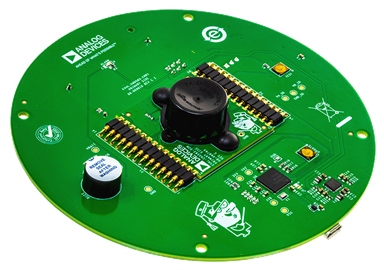
EVAL-ADXL363Z-MLP
Analog Devices Inc.The ADXL363 is an ultralow power, three-sensor combination consisting of a 3-axis MEMS accelerometer, a temperature sensor, and an on-board analog-to-digital converter (ADC) input for synchronous conversion of an external signal. The entire system consumes less than 2 ?A at a 100 Hz output data rate and 270 nA when in motion triggered wake-up mode.The ADXL363 communicates via a serial port interface (SPI) and always provides 12-bit output resolution for all three sensors.The ADXL363 temperature sensor operates with a scale factor of 0.065?C/LSB (typical). Acceleration and temperature data can be stored in a 512-sample multimode first in, first out (FIFO) buffer, allowing up to 13 sec of data to be stored.In addition to the accelerometer and temperature sensor, the ADXL363 also provides access to an internal ADC for synchronous conversion of an additional analog input.The ADXL363 operates on a wide 1.6 V to 3.5 V supply range, and can interface, if necessary, to a host operating on a separate, lower supply voltage. The ADXL363 is available in a 3 mm ? 3.25 mm ? 1.06 mm package.APPLICATIONS Home healthcare devices Wireless sensors Motion enabled metering devices

EVAL-ADXL372Z
Analog Devices Inc.The ADXL372 is an ultralow power, 3-axis, ?200 g MEMS accelerometer that consumes 22 ?A at a 3200 Hz output data rate (ODR). The ADXL372 does not power cycle its front end to achieve its low power operation and therefore does not run the risk of aliasing the output of the sensor.In addition to its ultralow power consumption, the ADXL372 has many features to enable impact detection while providing system level power reduction. The device includes a deep multimode output first in, first out (FIFO), several activity detection modes, and a method for capturing only the peak acceleration of over threshold events.Two additional lower power modes with interrupt driven, wake-up features are available for monitoring motion during periods of inactivity. In wake-up mode, acceleration data can be averaged to obtain a low enough output noise to trigger on low g thresholds. In instant on mode, the ADXL372 consumes 1.4 ?A while continuously monitoring the environment for impacts. When an impact event that exceeds the internally set threshold is detected, the device switches to normal operating mode fast enough to record the event.High g applications tend to experience acceleration content over a wide range of frequencies. The ADXL372 includes a 4-pole low-pass antialiasing filter to attenuate out of band signals that are common in high g applications. The ADXL372 also incorporates a high-pass filter to eliminate initial and slow changing errors, such as ambient temperature drift.The ADXL372 provides 12-bit output data at 100 mg/LSB scale factor. The user can access configuration and data registers via the serial peripheral interface (SPI) or limited I2C protocol. The ADXL372 operates over a wide supply voltage range and is available in a 3 mm ? 3.25 mm ? 1.06 mm package.Multifunction pin names may be referenced by their relevant function only.APPLICATIONS Impact and shock detection Asset health assessment Portable Internet of Things (IoT) edge nodes Concussion and head trauma detection

EVAL-ADXRS450Z
Analog Devices Inc.The ADXRS450 is an angular rate sensor (gyroscope) intended for industrial, medical, instrumentation, stabilization, and other high performance applications. An advanced, differential, quad sensor design rejects the influence of linear acceleration, enabling the ADXRS450 to operate in exceedingly harsh environments where shock and vibration are present.The ADXRS450 uses an internal, continuous self-test architecture. The integrity of the electromechanical system is checked by applying a high frequency electrostatic force to the sense structure to generate a rate signal that can be differentiated from the baseband rate data and internally analyzed.The ADXRS450 is capable of sensing angular rate of up to ?300?/sec. Angular rate data is presented as a 16-bit word, as part of a 32-bit SPI message.The ADXRS450 is available in a cavity plastic 16-lead SOIC (SOIC_CAV) and an SMT-compatible vertical mount package (LCC_V), and is capable of operating across both a wide voltage range (3.3 V to 5 V) and temperature range (?40?C to +105?C).APPLICATIONSRotation sensing medical applicationsRotation sensing industrial and instrumentationHigh performance platform stabilization

EVAL-ADXRS620Z
Analog Devices Inc.The ADXRS620 is a complete angular rate sensor (gyroscope)that uses the Analog Devices, Inc. surface-micromachiningprocess to create a functionally complete and low cost angularrate sensor integrated with all required electronics on one chip.The manufacturing technique for this device is the same highvolume BiMOS process used for high reliability automotiveairbag accelerometers.The ADXRS620 is an automotive grade gyroscope that has 100% pin, package, temperature, and function compatible to the available industrial grade ADXRS652 gyro. Automotive grade gyroscopes have more extensive guaranteed min/max specifications due to automotive testing.The output signal, RATEOUT (1B, 2A), is a voltageproportional to angular rate about the axis normal to the topsurface of the package. The output is ratiometric with respect toa provided reference supply. A single external resistor can beused to lower the scale factor. An external capacitor sets thebandwidth. Other external capacitors are required for operation.A temperature output is provided for compensation techniques.Two digital self-test inputs electromechanically excite thesensor to test proper operation of both the sensor and the signalconditioning circuits. The ADXRS620 is available in a 7 mm ?7 mm ? 3 mm BGA ceramic package.APPLICATIONS Vehicle chassis rollover sensing Inertial measurement units Platform stabilization

EVAL-ADXRS622Z
Analog Devices Inc.The ADXRS622 is a complete angular rate sensor (gyroscope) that uses the Analog Devices, Inc., surface-micromachining process to make a functionally complete and low cost angular rate sensor, integrated with all of the required electronics on one chip. The manufacturing technique for this device is the same high volume BiMOS process used for high reliability automotive airbag accelerometers.The ADXRS622 is an automotive grade gyroscope that has 100% pin, package, temperature, and function compatible to the available industrial grade ADXRS652 gyroscope. Automotive grade gyroscopes have more extensive guaranteed minimum/ maximum specifications due to automotive testing. The output signal, RATEOUT (1B, 2A), is a voltage proportional to the angular rate about the axis that is normal to the top surface of the package. The output is ratiometric with respect to a provided reference supply. An external capacitor sets the bandwidth. Other external capacitors are required for operation.A temperature output is provided for compensation techniques. Two digital self-test inputs electromechanically excite the sensor to test proper operation of both the sensor and the signal condi-tioning circuits. The ADXRS622 is available in a 7 mm ? 7 mm ? 3 mm BGA chip-scale package.APPLICATIONS Vehicle chassis rollover sensing Inertial measurement units Platform stabilization
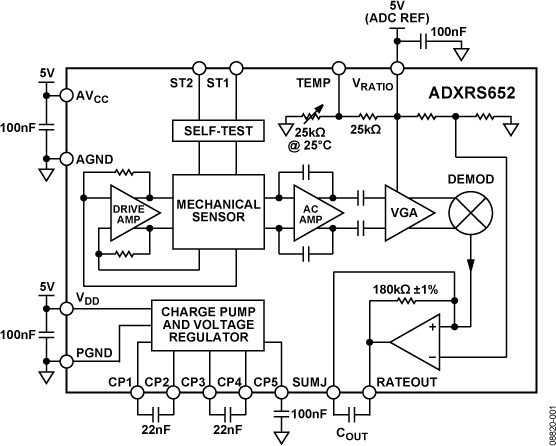
EVAL-ADXRS652Z
Analog Devices Inc.The ADXRS652 is a complete angular rate sensor (gyroscope) that uses the Analog Devices, Inc. surface-micromachining process to make a functionally complete and low cost angular rate sensor integrated with all of the required electronics on one chip. The manufacturing technique for this device is a patented high volume BIMOS process with years of proven field reliability.The ADXRS652 is an industrial grade gyroscope that 100% pin, package, temperature, and function compatible to the related automotive grade ADXRS620 and ADXRS622 gyroscopes. Automotive grade gyroscopes have more guaranteed min/max specifications due to automotive testing.The output signal, RATEOUT (1B, 2A), is a voltage proportional to angular rate about the axis normal to the top surface of the package. The output is ratiometric with respect to a provided reference supply. An external capacitor is used to set the bandwidth. Other external capacitors are required for operation.A temperature output is provided for compensation techniques. Two digital self-test inputs electromechanically excite the sensor to test proper operation of both the sensor and the signal conditioning circuits. The ADXRS652 is available in a 7 mm ? 7 mm ? 3 mm BGA chip-scale package.

EVAL-ADXRS800Z-M
Analog Devices Inc.The ADXRS800 is an angular rate sensor (gyroscope) intended for automotive electronic stability control, vehicle rollover detection, and other high performance applications. An advanced, differential, quad-sensor design rejects the influence of linear acceleration, enabling the ADXRS800 to operate in exceedingly harsh environments where shock and vibration are present.The ADXRS800 uses an internal, continuous self-test archi-tecture. The integrity of the electromechanical system is checked by applying a high frequency electrostatic force to the sense structure to generate a rate signal that can be differentiated from the baseband rate data and internally analyzed.The ADXRS800 is capable of sensing an angular rate of up to ?300?/sec. Angular rate data is presented as a 16-bit word, as part of a 32-bit SPI message.The ADXRS800 is available in a cavity plastic SOIC-16 and an SMT-compatible vertical mount package and is capable of operating across both a wide voltage range (3.3 V to 5 V) and temperature range (?40?C to 105?C).APPLICATIONS Electronic stability control High performance platform stabilization

EVAL-LT5401_32FDAZ
Analog Devices Inc.The LT5401 is an ultra-precision matched resistor network optimized for use with fully differential or difference amplifiers, and with excellent matching specifications over the entire temperature range. The LT5401 contains two strings of matched resistors, each providing three tap points. The resulting matched ratios arewell suited for precisely setting a differential amplifier?s gain or attenuation.When used to configure differential or difference gain, the LT5401?s excellent ratio matching ensures high CMRR, low gain errors and low gain drift to levels far too difficult to achieve with discrete passive components. This high level of precision reduces calibration requirements in many applications and offers 10 times higher performance than a ?0.01% discrete solution.The LT5401 is available in a compact 10-lead MSOP package with exposed paddle for improved thermal performance over a temperature range of ?55?C to 150?C.Applications Fully Differential Amplifiers Difference Amplifiers Reference Dividers Precision Summing/Subtracting
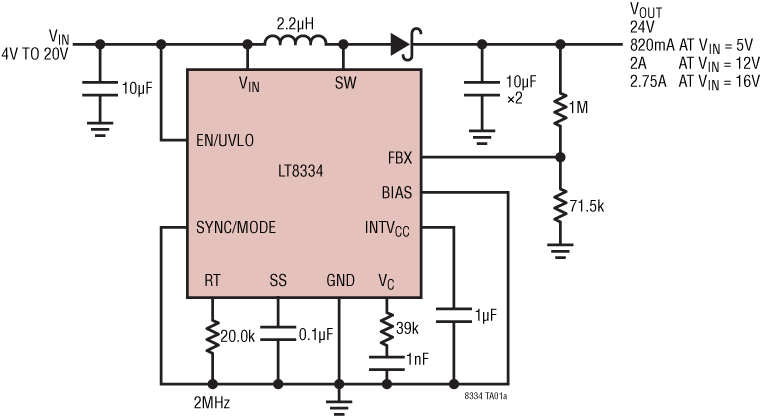
LT8334 | Low IQ Boost/SEPIC/Inverting Converter with 5A, 40V Switch
Analog Devices Inc.Evaluation circuit EVAL-LT8334-AZ features the LT8334 in a SEPIC configuration. It operates with a switching frequency of 2MHz and is designed to convert a 3V to 26V source to 12V output. The converter can output up to 2.2A depending on the input voltage (see Figure 3 in the user guide for the maximum output current vs VIN curve).
This evaluation circuit features Spread Spectrum Frequency Modulation (SSFM), EMI filters, and space for an option EMI shield to provide optimum EMI performance. This PCB layout is optimized for good EMI performance and small solution size. The evaluation board contains a selectable jumper, JP1, to aid in the selection of the desired SYNC pin mode of operation. At light load, either PULSE SKIP or low-ripple BURST mode can be selected to improve the efficiency.
The LT8334 boost/SEPIC/inverting converter IC operates over an input range of 2.8V to 40V, suitable for automotive, telecom, and industrial applications. The converter provides adjustable and synchronizable operation from 300kHz to 2MHz with SSFM option. The LT8334 packs other popular features such as soft-start, bias pin, input undervoltage lockout. The IC can exhibit a low quiescent current down to 9μA in BURST mode and 1μA in shutdown, which makes it ideal for battery-operated systems. The LT8334 is assembled in a thermally enhanced 12-lead 4mm × 3mm DFN package.
The data sheet gives a complete description of the device, operation, and applications information. The data sheet must be read in conjunction with the demo manual for EVAL-LT8334-AZ.

EVAL-LTC4306-PMDZ
Analog Devices Inc.The LTC4306 is a 4-channel, 2-wire bus multiplexer with bus buffers to provide capacitive isolation between the upstream bus and downstream buses. Through software control, the LTC4306 connects the upstream 2-wire bus to any desired combination of downstream buses. Each channel can be pulled up to a supply voltage ranging from 2.2V to 5.5V, independent of the LTC4306 supply voltage.The downstream channels are also provided with ALERT1-ALERT4 inputs for fault reporting.Programmable timeout circuitry disconnects the downstream buses if the bus is stuck low. When activated, rise time accelerators source currents into the 2-wire bus pins to reduce rise time. Driving the ENABLE pin low restores all features to their default states. Three address pins provide 27 distinct addresses.The LTC4306 is available in 24-lead QFN (4mm ? 5mm) and SSOP packages.Applications Nested Addressing 5V/3.3V Level Translator Capacitance Buffer/Bus Extender

EVAL-LTC4331-PMDZ
Analog Devices Inc.The LTC4331 is a point-to-point SMBus compatible I2Cslave device extender designed for operation in high noiseindustrial environments. Using a ?60V fault protecteddifferential transceiver, the LTC4331 can extend an I2C/SMBus bus, including SMBALERT and a control signal,over a single twisted pair differential link up to 1200m.With an extended common mode operating range thesolution provides tolerance to large ground differencesbetween nodes. For EMI sensitive environments, a slewrate control pin reduces the EMI emitted from the differentiallink.In addition, the LTC4331 can act as an I2C to I2C bridgeallowing independent bus frequencies between the localand remote networks. The solution is completely transparentto the master requiring no additional code in mostcases; however, a control interface is provided for additionalconfiguration and fault monitoring.A master controller fully supporting SCL clock-stretchingis strongly recommended.Applications Industrial Control and Sensors Lighting and Sound System Control

EVAL-LTC6226S8
Analog Devices Inc.The LTC6226 are very fast, low noise rail-to-rail output, unity gain stable single/dual op amps, with a gainbandwidth product of 420MHz and a slew rate of 180V/?s. The low input referred voltage noise of only 1nV/?Hz and low distortion of less than ?90dBC for 4VP-P signals at 1MHz makes them ideal for applications that require high dynamic range and deal with very fast signals, such as driving A/D converters.The combination of low offset, low offset drift, high gain (139dB) and high CMRR (114dB) make these excellent devices for high dynamic range applications.The LTC6226 family maintains excellent performance for supply voltages of 2.8V to 11.75V and the devices are fully specified at supplies of 3V, 5V and 10V (?5V).With an input range extending to the negative rail and rail-to-rail output stage, the operational amplifier can accommodate wide swinging signals, and true single supply operation.For space constrained applications, the amplifiers come in 2mm ? 2mm DFN (single) and 3mm ? 3mm DFN (dual) packages. The devices are also available in 8-lead SOIC,TSOT-23 and MS8E.These amplifiers can be used as replacements for many high speed op amps to improve speed, noise and dynamic range.?Applications Optical Electronics: Fast AC-Coupled Transimpedance Amplifiers Driving High Dynamic Range A/D Converters Active Filters Video Amplifiers Low Voltage Low Distortion Amplification

EVAL-LTC6228IS8
Analog Devices Inc.The LTC6228/LTC6229 are single/dual very fast, low noise rail-to-rail output, unity gain stable op amps. They have a gain-bandwidth product of 890MHz and a slew rate of 500V/?s. The low input referred voltage noise of only 0.88nV/?Hz and low distortion performance of better than ?100dB at 4VP-P even for signals as fast as 2MHz make them ideal for applications that require high dynamic range and deal with high slew rate signals, such as driving A/D converters. Additional features include Shutdown and the ability to enable/disable internal bias current cancellation to optimize noise performance.The combination of low offset, low offset drift, high gain and high CMRR make the LTC6228 family the superior choice for wide dynamic range applications.The LTC6228 family maintains excellent performance for supply voltages of 2.8V to 11.75V and the devices are specified at supplies of 3V, 5V and 10V(?5V). With an input range extending to the negative rail and an output range that encompasses the entire supply range, the operational amplifier can accommodate wide swinging signals, and single supply operation.For space constrained PCB layouts, the LTC6228 is available in a 2mm ? 2mm DFN and the LTC6229 is available in a 3mm ? 3mm DFN. The amplifiers are also available in conventional leaded packages. These amplifiers can be used as improved replacements for many high speed op amps to improve speed, noise, distortion and dynamic range.Applications Optical Electronics: Fast Transimpedance Amplifiers Driving High Dynamic Range A/D Converters Active Filters Video Amplifiers High Speed Differential to Single-Ended Conversion Low Voltage Hi-Fi Amplification

EVAL-LTC6563TQFN-EZKIT
Analog Devices Inc.The LTC6563 is a low-noise four-channel transimpedance amplifier (TIA) with 600MHz bandwidth. The LTC6563 TIA?s low noise, wide linear range, and low power dissipation are ideal for LIDAR receivers using Avalanche photodiodes (APDs) and photodiodes (PDs). The amplifier features selectable 22.2/16.7/11.1/5.55k? Transimpedance gain (RT) and 90?A linear input current range. Using an APD with a total input capacitance of 0.5pF, the input current noise density is 1.8pA/?Hz at 100MHz and 3.7pA/?Hz at 600MHz. The LTC6563 consumes between 194mW and 325mW on a 3.3V supply depending on output mode. An internal 4-to-1 MUX simplifies the system design. In addition, external multiplexing capability allows channel expansion up to 64 channels, saving space and power. Fast overload recovery and fast channel switchover make the LTC6563 well suited for LIDAR receivers with multiple APDs. The built-in high-speed differential ADC driver can swing as much as 2VP-P while driving into 100? external differential load. The LTC6563 is packaged in a 3mm ? 5mm 24-pin exposed pad QFN package with wettable flanks.APPLICATIONS Automotive LIDAR Receiver Industrial LIDAR Receiver

EVAL-SSM2518Z
Analog Devices Inc.The SSM2518 is a digital input, Class-D power amplifier that combinesa digital-to-analog converter (DAC) and a sigma-delta(?-?) Class-D modulator. This unique architecture enablesextremely low real-world power consumption from digitalaudio sources with excellent audio performance. The SSM2518is ideal for power sensitive applications, such as mobile phonesand portable media players, where system noise can corruptsmall analog signals such as those sent to an analog input audioamplifier.Using the SSM2518, audio data can be transmitted to the amplifierover a standard digital audio serial interface, thereby significantlyreducing the effect of noise sources such as GSM interference orother digital signals on the transmitted audio. The closed-loopdigital input design retains the benefits of an all digital amplifier,yet enables very good PSRR and audio performance. The threelevel, ?-? Class-D modulator is designed to provide the leastamount of EMI interference, the lowest quiescent power dissipation,and the highest audio efficiency without sacrificingaudio quality.Input is provided via a serial audio interface, programmable toaccept all common audio formats including I2S and TDM. Controlof the IC is provided via an I2C control interface. The SSM2518can accept a variety of input MCLK frequencies and can useBCLK as the clock source in some configurations.Additional features include a soft digital volume control, deemphasis,and a programmable digital dynamic rangecompressor.The architecture of the SSM2518 provides a solution that offerslower power and higher performance than existing DAC plusClass-D solutions. Its digital interface also offers a better systemsolution for other products whose sole audio source is digital,such as wireless speakers, laptop PCs, portable digital televisions,and navigation systems.Applications Mobile phones Portable media players Laptop PCs Wireless speakers Portable gaming Small LCD televisions Navigation systems

EVALZ-ADPD2210
Analog Devices Inc.The ADPD2210 is a low noise current amplifier designed to allow the use of smaller photodiodes by amplifying sensor signal currents by a factor of 24 while adding minimal noise. This amplification provides the system sensitivity of a large photodiode with the benefits of a smaller photodiode. A minimum linearity of 60 dB allows accurate extraction of very small time variant signals on top of large dc or low frequency offsets.The ADPD2210 is optimized for pulse mode applications such as wrist worn heart rate monitoring (HRM) or finger worn pulse oximeter oxygen saturation (SpO2), where low power consumption and rejection of ambient light is critical. In photodiode applications, the ADPD2210 holds the sensor input to within ?5 mV (typical) of the reference terminal, providing near zero-bias voltage and allowing minimal dark current and shot noise limited performance.The ADPD2210 is designed for applications where power conservation is critical. The ADPD2210 uses very little power, typically 140 ?A with no input to 954 ?A at full scale. A power-down pin places the ADPD2210 in standby when sensing is inactive. This mode adds critical time for battery-powered monitoring and can reduce battery costs in disposable applications.Using the ADPD2210 to provide sensor site amplification reduces the effect of electromagnetic interference (EMI) in low level wired interfaces, providing improved signal-to-noise ratio (SNR) and rejection of interferer signals from nearby equipment. The combination of low power, high SNR, and EMI immunity enables low power system solutions not possible with traditional small current sensors, such as photodiodes plus transimpedance amplifiers (TIAs).Applications: Photoplethysmography Photodiode measurements Small current pulsed amperometry Any application requiring the ultralow noise amplification of small currents

EV-COG-LTP5901Z
Analog Devices Inc.SmartMesh IP wireless sensor networks are self managing, low power internet protocol (IP) networks built from wireless nodes called motes. The LTP5901-IPM is printed circuit board assembly (PCBA) product with on-board chip antenna in the Eterna? family of IEEE 802.15.4e solutions, featuring a highly integrated, low power radio design as well as an ARM Cortex-M3 32-bit microprocessor running SmartMesh IP embedded networking software. The LTP5901-IPM, at 24mm ? 42mm, is built for surface-mount assembly.With SmartMesh IP time-synchronized networks, all motes in the network may route, source or terminate data, while providing many years of battery powered operation. SmartMesh IP is a highly flexible network with proven reliability and low power performance in an easy-to-integrate platform.The LTP5901-IPM?s behavior in a SmartMesh IP network is determined by the choice of SmartMesh IP network software loaded: Wireless Mote, EManager, or Access Point Mote in a SmartMesh IP network. The SmartMesh IP software provided with the LTP5901-IPM is fully tested and validated, and is readily configured via a software Application Programming Interface. Once you have purchased SmartMesh IP products, the SmartMesh IP stack binaries may be downloaded via your myAnalog account.The pin signaling behavior of the LTP5901IPC-IPMA hardware is determined by the software loaded and is described in detail in the following product datasheets: LTP5901-IPM = LTP5901IPC-IPMA hardware + SmartMesh IP ?Mote? Software ? LTP5901-IPM Datasheet LTP5901-IPR = LTP5901IPC-IPMA hardware + SmartMesh IP EManager Software ? LTP5901-IPR Datasheet LTP5901-IPA = LTP5901IPC-IPMA hardware + SmartMesh IP Access Point Software ? LTP5901-IPA Datasheet Network Features Feature Benefit >99.999% Network Reliability Avoids communications dropouts common with other wireless networks NIST-certified AES-128 bit Encryption Data protected by end-to-end encryption, message integrity checking and device authentication Scalable Uses time-slotted channel-hopping protocol to avoid in-network collisions to maximize scale while minimizing power and latency-hungry transmission retries due to congestion Bidirectional Communications Ideal for both monitoring and control applications Up to 10 messages/second/node Time-slotted communications avoids contention. This data rate includes built-in margin for packet retries. Device Features Feature Benefit Industry-Leading Low Power Radio Technology ? 4.5mA to Receive a Packet ? 5.4mA to Transmit at 0dBm ? 9.7mA to Transmit at 8dBm Pre-engineered RF RF elements include an on-chip power amplifier and are pre-tuned for optimized performance, including temperature compensation, saving development time. RF Modular Certifications Pre-certified in USA, Canada, EU, Australia/New Zealand, India, Japan, Korea, Taiwan Energy Harvesting Support Very low power design enables motes to be powered by a wide variety of energy harvesters. Click here to see a demonstration circuit of a SmartMesh IP mote powered by indoor light. Integrated Temperature Sensor Precise temperature sensor is integrated directly into the mote. ApplicationsSmartMesh IP is ideally suited for wireless Industrial Internet of Things (IoT) applications. Learn more about SmartMesh applications.

EV-MOD2-AGILE-900Z
Analog Devices Inc.The ADuCM4050 microcontroller unit (MCU) is an ultra low power integrated microcontroller system with integrated power management for processing, control, and connectivity. The MCU system is based on the ARM? Cortex?-M4F processor. The MCU also has a collection of digital peripherals, embedded static random access memory (SRAM) and embedded flash memory, and an analog subsystem that provides clocking, reset, and power management capabilities in addition to an analog-to-digital converter (ADC) subsystem.This data sheet describes the ARM Cortex-M4F core and memory architecture used on the ADuCM4050 MCU. It does not provide detailed programming information about the ARM processor.The system features include an up to 52 MHz ARM Cortex-M4F processor, 512 kB of embedded flash memory with error correction code (ECC), an optional 4 kB cache for lower active power, and 128 kB system SRAM with parity. The ADuCM4050 features a power management unit (PMU), multilayer advanced microcontroller bus architecture (AMBA) bus matrix, central direct memory access (DMA) controller, and beeper interface.The ADuCM4050 features cryptographic hardware supporting advanced encryption standard (AES)-128 and AES-256 with secure hash algorithm (SHA)-256 and the following modes: electronic code book (ECB), cipher block chaining (CBC), counter (CTR), and cipher block chaining-message authentication code (CCM/CCM*) modes.The ADuCM4050 has protected key storage with key wrap/ unwrap, and keyed hashed message authentication code (HMAC) with key unwrap.The ADuCM4050 supports serial port (SPORT), serial peripheral interface (SPI), I2C, and universal asynchronous receiver/ transmitter (UART) peripheral interfaces.The ADuCM4050 features a real-time clock (RTC), general-purpose and watchdog timers, and programmable general-purpose input/output (GPIO) pins. There is a hardware cyclic redundancy check (CRC) calculator with programmable generator polynomial. The device also features a power on reset (POR) and power supply monitor (PSM), a 12-bit successive approximation register (SAR) ADC, a red/green/blue (RGB) timer for driving RGB LED, and a true random number generator (TRNG).To support low dynamic and hibernate power management, the ADuCM4050 MCU provides a collection of power modes and features such as dynamic- and software-controlled clock gating and power gating.For full details on the ADuCM4050 MCU, refer to the ADuCM4050 Ultra Low Power ARM Cortex-M4F MCU with Integrated Power Management Hardware Reference.Product Highlights Ultra low power consumption. Robust operation. Full voltage monitoring in deep sleep modes. ECC support on flash. Parity error detection on SRAM memory. Leading edge security. Fast encryption provides read protection to user algorithms. Write protection prevents device reprogramming by unauthorized code. Failure detection of 32 kHz low frequency external crystal oscillator (LFXTAL) via interrupt. SensorStrobe? for precise time synchronized sampling of external sensors. Works in hibernate mode, resulting in drastic current reduction in system solutions. Current consumption reduces by 10 times when using, for example, the ADXL363 accelerometer. Software intervention is not required after setup. No pulse drift due to software execution.Applications Internet of Things (IoT) Smart agriculture, smart building, smart metering, smart city, smart machine, and sensor network Wearables Fitness and clinical Machine learning and neural networks

EV-RPG2-MBZ
Analog Devices Inc.The ADIN2299 is a complete, pretested solution that manages the industrial protocol and network traffic for an applications processor.The module contains everything needed to participate in a Ether-CAT, PROFINET? real-time (RT) and isochronous real time (IRT), EtherNet/IP network, including a communications controller, protocol stack, flash, RAM, follower controller, and physical layer (PHY). An applications processor connects via a universal asynchronousreceiver transmitter (UART), serial peripheral interface (SPI), or Ethernet interface.At the software layer, the applications processor connects to a unified interface so the supported industrial protocols can be used without changing the applications processor software. The ADIN2299 platform was precertified so that the field device can operate in any of the supported industrial Ethernet networks.PRODUCT HIGHLIGHTSMultiprotocol supportSmall form factor for embedded applicationsLow power and low latencyRobust network policing ensures passing PROFINET Netload Class 3APPLICATIONS Factory and process automation Motion control Building automation Transportation
EV-RPG2-TSNZ
Analog Devices Inc.The ADIN2299 is a complete, pretested solution that manages the industrial protocol and network traffic for an applications processor.The module contains everything needed to participate in a Ether-CAT, PROFINET? real-time (RT) and isochronous real time (IRT), EtherNet/IP network, including a communications controller, protocol stack, flash, RAM, follower controller, and physical layer (PHY). An applications processor connects via a universal asynchronousreceiver transmitter (UART), serial peripheral interface (SPI), or Ethernet interface.At the software layer, the applications processor connects to a unified interface so the supported industrial protocols can be used without changing the applications processor software. The ADIN2299 platform was precertified so that the field device can operate in any of the supported industrial Ethernet networks.PRODUCT HIGHLIGHTSMultiprotocol supportSmall form factor for embedded applicationsLow power and low latencyRobust network policing ensures passing PROFINET Netload Class 3APPLICATIONS Factory and process automation Motion control Building automation Transportation