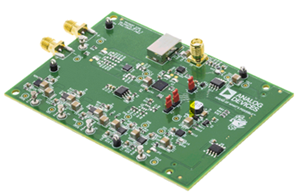
EVAL-ADN2818EBZ
Analog Devices Inc.The ADN2817/ADN2818 provide the receiver functions of quantization, signal level detect, and clock and data recovery for continuous data rates from 10 Mbps to 2.7 Gbps. The ADN2817/ ADN2818 automatically lock to all data rates without the need for an external reference clock or programming. All SONET jitter requirements are exceeded, including jitter transfer, jitter generation, and jitter tolerance. All specifications are quoted for ?40?C to +85?C ambient temperature, unless otherwise noted.This device, together with a PIN diode and a TIA preamplifier, can implement a highly integrated, low cost, and low power fiber optic receiver.The ADN2817/ADN2818 have many optional features available through an I2C interface. For example, the user can read back the data rate onto which the ADN2817 or ADN2818 is locked, or the user can set the device to lock only to one particular data rate if provisioning of data rates is required. A BERMON circuit provides an estimate of the received bit error rate (BER) without interruption of the data. Alternatively, the user can adjust the data sampling phase to optimize the received BER.The ADN2817/ADN2818 are available in a compact 5 mm ? 5 mm, 32-lead, lead frame chip scale package.ApplicationsSONET OC-1, OC-3, OC-12, OC-48, and all associated FEC rates Fibre Channel, 2? Fibre Channel, GbE, HDTV, and others WDM transponders Regenerators/repeaters Test equipment

EVAL-ADN4650EBZ
Analog Devices Inc.The ADN4650/ADN4651/ADN46521 are signal isolated, low voltage differential signaling (LVDS) buffers that operate at up to 600 Mbps with very low jitter.The devices integrate Analog Devices, Inc., iCoupler? technology, enhanced for high speed operation, to provide galvanic isolation of the TIA/EIA-644-A compliant LVDS drivers and receivers. This technology allows drop-in isolation of an LVDS signal chain.Multiple channel configurations are offered, and the LVDS receivers on the ADN4651/ADN4652 include a fail-safe mechanism to ensure a Logic 1 on the corresponding LVDS driver output when the inputs are floating, shorted, or terminated, but not driven.For high speed operation with low jitter, the LVDS and isolator circuits rely on a 2.5 V supply. An integrated on-chip low dropout regulator (LDO) can provide the required 2.5 V from an external 3.3 V power supply. The devices are fully specified over a wide industrial temperature range and are available in a 20-lead, wide body SOIC package with 5 kV rms isolation or a 20-lead SSOP package with 3.75 kV rms isolation.Applications Analog front-end (AFE) isolation Data plane isolation Isolated high speed clock and data links Isolated serial peripheral interface (SPI) over LVDS

EVAL-ADN4651EB1Z
Analog Devices Inc.The ADN4650/ADN4651/ADN46521 are signal isolated, low voltage differential signaling (LVDS) buffers that operate at up to 600 Mbps with very low jitter.The devices integrate Analog Devices, Inc., iCoupler? technology, enhanced for high speed operation, to provide galvanic isolation of the TIA/EIA-644-A compliant LVDS drivers and receivers. This technology allows drop-in isolation of an LVDS signal chain.Multiple channel configurations are offered, and the LVDS receivers on the ADN4651/ADN4652 include a fail-safe mechanism to ensure a Logic 1 on the corresponding LVDS driver output when the inputs are floating, shorted, or terminated, but not driven.For high speed operation with low jitter, the LVDS and isolator circuits rely on a 2.5 V supply. An integrated on-chip low dropout regulator (LDO) can provide the required 2.5 V from an external 3.3 V power supply. The devices are fully specified over a wide industrial temperature range and are available in a 20-lead, wide body SOIC package with 5 kV rms isolation or a 20-lead SSOP package with 3.75 kV rms isolation.Applications Analog front-end (AFE) isolation Data plane isolation Isolated high speed clock and data links Isolated serial peripheral interface (SPI) over LVDS
EVAL-ADN4651EBZ
Analog Devices Inc.The ADN4650/ADN4651/ADN46521 are signal isolated, low voltage differential signaling (LVDS) buffers that operate at up to 600 Mbps with very low jitter.The devices integrate Analog Devices, Inc., iCoupler? technology, enhanced for high speed operation, to provide galvanic isolation of the TIA/EIA-644-A compliant LVDS drivers and receivers. This technology allows drop-in isolation of an LVDS signal chain.Multiple channel configurations are offered, and the LVDS receivers on the ADN4651/ADN4652 include a fail-safe mechanism to ensure a Logic 1 on the corresponding LVDS driver output when the inputs are floating, shorted, or terminated, but not driven.For high speed operation with low jitter, the LVDS and isolator circuits rely on a 2.5 V supply. An integrated on-chip low dropout regulator (LDO) can provide the required 2.5 V from an external 3.3 V power supply. The devices are fully specified over a wide industrial temperature range and are available in a 20-lead, wide body SOIC package with 5 kV rms isolation or a 20-lead SSOP package with 3.75 kV rms isolation.Applications Analog front-end (AFE) isolation Data plane isolation Isolated high speed clock and data links Isolated serial peripheral interface (SPI) over LVDS

EVAL-ADN4652EBZ
Analog Devices Inc.The ADN4650/ADN4651/ADN46521 are signal isolated, low voltage differential signaling (LVDS) buffers that operate at up to 600 Mbps with very low jitter.The devices integrate Analog Devices, Inc., iCoupler? technology, enhanced for high speed operation, to provide galvanic isolation of the TIA/EIA-644-A compliant LVDS drivers and receivers. This technology allows drop-in isolation of an LVDS signal chain.Multiple channel configurations are offered, and the LVDS receivers on the ADN4651/ADN4652 include a fail-safe mechanism to ensure a Logic 1 on the corresponding LVDS driver output when the inputs are floating, shorted, or terminated, but not driven.For high speed operation with low jitter, the LVDS and isolator circuits rely on a 2.5 V supply. An integrated on-chip low dropout regulator (LDO) can provide the required 2.5 V from an external 3.3 V power supply. The devices are fully specified over a wide industrial temperature range and are available in a 20-lead, wide body SOIC package with 5 kV rms isolation or a 20-lead SSOP package with 3.75 kV rms isolation.Applications Analog front-end (AFE) isolation Data plane isolation Isolated high speed clock and data links Isolated serial peripheral interface (SPI) over LVDS

EVAL-ADN4654EB1Z
Analog Devices Inc.The ADN4654/ADN4655/ADN46561? are signal isolated, low voltage differential signaling (LVDS) buffers that operate at up to 1.1 Gbps with low jitter. The devices integrate Analog Devices, Inc., iCoupler? technology, enhanced for high speed operation to provide galvanic isolation of the TIA/EIA-644-A compliant LVDS drivers and receivers. This integration allows drop-in isolation of an LVDS signal chain.The ADN4654/ADN4655/ADN4656 comprise multiple channel configurations, and the LVDS receivers on the ADN4655 and ADN4656 include a fail-safe mechanism to ensure a Logic 1 on the corresponding LVDS driver output when the inputs are floating, shorted, or terminated but not driven.For high speed operation with low jitter, the LVDS and isolator circuits rely on a 2.5 V supply. An integrated on-chip low dropout (LDO) regulator can provide the required 2.5 V from an external 3.3 V power supply. The devices are fully specified over a wide industrial temperature range and come in a 20-lead, wide body SOIC_W package with 5 kV rms isolation or in a 20-lead SSOP package with 3.75 kV rms isolation.Applications Isolated video and imaging data Analog front-end isolation Data plane isolation Isolated high speed clock and data links1 Protected by U.S. Patents 5,952,849; 6,873,065; 6,903,578; and 7,075,329. Other patents are pending.

EVAL-ADN4693E-1EBZ
Analog Devices Inc.The ADN4693E-1 is a multipoint, low voltage differential signaling (M-LVDS) transceiver (driver and receiver pair) that can operate at up to 200 Mbps (100 MHz) nonreturn to zero (NRZ). The receiver detects the bus state with a differential input of as little as ?50 mV over the common-mode voltage range of the device. Electrostatic discharge (ESD) protection of up to ?15 kV is implemented on the bus pins. The ADN4693E-1 is designed to the TIA/EIA-899 standard for M-LVDS and complement TIA/EIA-644 LVDS devices with additional multipoint capabilities.The ADN4693E-1 features a Type 1 receiver with 25 mV of hysteresis so that slow-changing signals or loss of input does not lead to output oscillations.This full-duplex device is available in a compact 16-lead, 4 mm ? 4 mm lead frame chip scale package (LFCSP). The ADN4693E-1 is specified over the -40?C to +120?C junction temperature range.APPLICATIONS Backplane and cable multipoint data transmission Multipoint clock distribution Low power, high speed alternative to shorter RS-485 links Networking and wireless base station infrastructure Grid infrastructure and relay protection systems

EVAL-ADN469XEHDEBZ
Analog Devices Inc.The ADN4691E?/?ADN4693E?/ ADN4696E /?ADN4697E aremultipoint, low voltage differential signaling (M-LVDS)transceivers (driver and receiver pairs) that can operate at up to200 Mbps (100 MHz). The receivers detect the bus state with adifferential input of as little as 50 mV over a common-modevoltage range of ?1 V to +3.4 V. ESD protection of up to ?15 kVis implemented on the bus pins. The devices adhere to theTIA/EIA-899 standard for M-LVDS and complement TIA/EIA-644 LVDS devices with additional multipoint capabilities.The ADN4691E / ADN4693E are Type 1 receivers with 25 mV ofhysteresis so that slow-changing signals or loss of input does notlead to output oscillations. The ADN4696E / ADN4697E areType 2 receivers exhibiting an offset threshold, guaranteeing theoutput state when the bus is idle (bus-idle fail-safe) or the inputs areopen (open-circuit fail-safe).The devices are available as half-duplex in an 8-lead SOIC package(the ADN4691E / ADN4696E) or as full-duplex in a 14-leadSOIC package (the ADN4693E / ADN4697E).APPLICATIONS Backplane and cable multipoint data transmission Multipoint clock distribution Low power, high speed alternative to shorter RS-485 links Networking and wireless base station infrastructure

EVAL-ADPAQ3029EBZ
Analog Devices Inc.The ADuCM3027/ADuCM3029 microcontroller units (MCUs) are ultra low power microcontroller systems with integrated power management for processing, control, and connectivity. The MCU system is based on the ARM? Cortex?-M3 processor, a collection of digital peripherals, embedded SRAM and flash memory, and an analog subsystem which provides clocking, reset, and power management capability in addition to an analog-to-digital converter (ADC) subsystem. For a feature comparison across the ADuCM3027/ADuCM3029 product offerings, see Table 1. Table 1. Product Flash Memory Options Device Embedded Flash Memory Size ADuCM3029 256 kB ADuCM3027 128 kB System features that are common across the ADuCM3027/ADuCM3029/ADuCM3029-1/ADuCM3029-2 MCUs include the following: Up to 26 MHz ARM Cortex-M3 processor Up to 256 kB of embedded flash memory with error correction code (ECC) Optional 4 kB cache for lower active power 64 kB system SRAM with parity Power management unit (PMU) Multilayer advanced microcontroller bus architecture (AMBA) bus matrix Central direct memory access (DMA) controller Beeper interface Serial port (SPORT), serial peripheral interface (SPI), inter-integrated circuit (I2C), and universal asynchronous receiver/transmitter (UART) peripheral interfaces Cryptographic hardware support with advanced encryption standard (AES) and secure hash algorithm (SHA)-256 Real-time clock (RTC) General-purpose and watchdog timers Programmable general-purpose input/output (GPIO) pins Hardware cyclic redundancy check (CRC) calculator with programmable generator polynomial Power-on reset (POR) and power supply monitor (PSM) 12-bit successive approximation register (SAR) ADC True random number generator (TRNG)To support low dynamic and hibernate power management, the ADuCM3027/ADuCM3029 MCUs provide a collection of power modes and features, such as dynamic and software controlled clock gating and power gating.The ADuCM3029-1 and ADuCM3029-2 MCU models share the same features and functionality as that of the ADuCM3029 MCU. All specifications pertaining to the ADuCM3027 and ADuCM3029 are also applicable to the ADuCM3029-1 and ADuCM3029-2.For full details on the ADuCM3027/ADuCM3029 MCUs, refer to the ADuCM302x Ultra Low Power ARM Cortex-M3 MCU with Integrated Power Management Hardware Reference Manual.Product Highlights Industry leading ultralow power consumption. Robust operation, including full voltage monitoring in deep sleep modes, ECC support on flash, and parity error detection on SRAM memory. Leading edge security. Fast encryption provides read protection to customer algorithms. Write protection prevents device reprogramming by unauthorized code. Failure detection of 32 kHz LFXTAL via interrupt. SensorStrobe? for precise time synchronized sampling of external sensors. Works in hibernate mode, resulting in drastic current reduction in system solutions. Current consumption reduces by 10 times when using, for example, the ADXL363 accelerometer. Software intervention is not required after setup. No pulse drift due to software execution.Applications Internet of Things (IoT) Electronic shelf label (ESL) and signage Smart infrastructure Smart lock Asset tracking Smart machine, smart metering, smart building, smart city, and smart agriculture Wearables Fitness and clinical Machine learning and neural network?

EVAL-ADPD188GGZ
Analog Devices Inc.The ADPD188GG is a complete photometric system designed to measure optical signals from ambient light and from synchronous reflected light emitting diode (LED) pulses. Synchronous measurement offers best-in-class rejection of ambient light interference, both dc and ac. The module integrates a highly efficient photometric front end, two LEDs, and two photodiode (PD). All of these items are housed in a custom package that prevents light from going directly from the LED to the photodiode without first entering the subject.The front end of the application specific integrated circuit (ASIC) consists of a control block, a 14-bit analog-to-digital converter (ADC) with a 20-bit burst accumulator, and three flexible, independently configurable LED drivers. The control circuitry includes flexible LED signaling and synchronous detection. The analog front end (AFE) features best-in-class rejection of signal offset and corruption due to modulated interference commonly caused by ambient light. The data output and functional configuration occur over a 1.8 V I2C interface or a serial peripheral interface (SPI) port.Applications Optical heart rate monitoring Reflective PPG measurement CNIBP measurement?

ADPD2140 Evaluation Board
Analog Devices Inc.The EVAL-ADPD2140Z evaluation kit allows users to interface with the ADPD2140 infrared (IR) light angle sensor, collect data from the ADPD2140, and evaluate gesture recognition and triangulation capabilities.
The evaluation kit requires the EVAL-ADPDM3Z evaluation board and the Applications Wavetool, a graphical user interface (GUI) that provides users with low level and high level config-urability, real-time data analysis, and user datagram protocol (UDP) transfer capability, which allows the EVAL-ADPDM3Z evaluation board to interface to a PC. The Applications Wavetool can be downloaded from the EVAL-ADPD2140Z evaluation board product page.
The USB port of the PC powers the EVAL-ADPDM3Z evaluation board and provides power to the EVAL-ADPD2140Z evaluation board. On-board voltage regulators provide voltage supplies for the ADPD2140.
The EVAL-ADPD2140Z evaluation board schematic indicates signal names for easy identification.
Full specifications for the ADPD2140 are available in the ADPD2140 data sheet, which should be consulted in conjunction with this user guide when working with the EVAL-ADPD2140Z evaluation board.

EVAL-ADRF6755SDZ
Analog Devices Inc.The ADRF6755 is a highly integrated quadrature modulator, frequency synthesizer, and programmable attenuator. The device covers an operating frequency range from 100 MHz to 2400 MHz for use in satellite, cellular, and broadband communications.The ADRF6755 modulator includes a high modulus, fractional-N frequency synthesizer with integrated VCO, providing less than 1 Hz frequency resolution, and a 47 dB digitally controlled output attenuator with 1 dB steps.Control of all the on-chip registers is through a user-selected SPI interface or I2C interface. The device operates from a single power supply ranging from 4.75 V to 5.25 V.

EVAL-ADSW4000BNZ
Analog Devices Inc.The ADSW4000 ADI EagleEye? PeopleCount algorithm enables a people counting function within internal spaces, such as meeting rooms or office spaces. The system edge node analytics unlocks informed insights and analytics with an accurate and secure people counting capability. This data can provide the insight to improve asset and people management, social distancing, security, employee engagement, space utilization, labor productivity, and energy efficiency.The ADSW4000 is designed to operate solely with the Analog Devices, Inc., ADSP-BF707 Blackfin+? core embedded processor (ADSPBF707BBCZ4-EGE) and is optimized for a CMOS 2D video graphics array (VGA) sensor and lens (the recommended Chicony CYFI013 module incorporates an ON Semiconductor? ASX340AT3C00XPED0-DPBR CMOS image sensor, Chicony YT70005 lens, and lens holder with infrared (IR) filter).The ADSW4000 ADI EagleEye? PeopleCount algorithm provides up to a 90% accurate people count within the target area.The following are the accuracies achieved for tested radii from 3 m to 5 m:90% accuracy in 3 m radius85% accuracy in 4 m radius80% accuracy in 5 m radiusAPPLICATIONSBuilding technology solutionsIntelligent buildingsOccupancy analyticsBuilding management systems

EVAL-ADT7320MBZ
Analog Devices Inc.The ADT7320 is a high accuracy digital temperature sensor that offers breakthrough performance over a wide industrial temperaturerange, housed in a 4 mm ? 4 mm LFCSP package. It contains aninternal band gap reference, a temperature sensor, and a 16-bit analog-to-digital converter (ADC) to monitor and digitize the temperature to a resolution of 0.0078?C. The ADC resolution, by default, is set to 13 bits (0.0625?C). The ADC resolution is a user programmable mode that can be changed through the serial interface.The ADT7320 is guaranteed to operate over supply voltages from2.7 V to 5.5 V. Operating at 3.3 V, the average supply current istypically 210 ?A. The ADT7320 has a shutdown mode that powers down the device and offers a shutdown current of typically 2.0 ?A at 3.3 V. The ADT7320 is rated for operation over the ?40?C to +150?C temperature range.The CT pin is an open-drain output that becomes active when thetemperature exceeds a programmable critical temperature limit.The INT pin is also an open-drain output that becomes active when the temperature exceeds a programmable limit. The INT pinand CT pin can operate in either comparator or interrupt mode.PRODUCT HIGHLIGHTS Ease of use, no calibration or correction required by the user. Low power consumption. Excellent long term stability and reliability. High accuracy for industrial, instrumentation, and medical applications. Packaged in a 16-lead RoHS-compliant, 4 mm x 4 mm LFCSP package.APPLICATIONS RTD and thermistor replacement Thermocouple cold junction compensation Medical equipment Industrial controls and test Food transportation and storage Environmental monitoring and HVAC Laser diode temperature controls

EVAL-ADT7420MBZ
Analog Devices Inc.The ADT7420 is a high accuracy digital temperature sensoroffering breakthrough performance over a wide industrialrange, housed in a 4 mm ? 4 mm LFCSP package. It contains aninternal band gap reference, a temperature sensor, and a 16-bitADC to monitor and digitize the temperature to 0.0078?Cresolution. The ADC resolution, by default, is set to 13 bits(0.0625?C). The ADC resolution is a user programmable modethat can be changed through the serial interface.The ADT7420 is guaranteed to operate over supply voltages from2.7 V to 5.5 V. Operating at 3.3 V, the average supply current is typically210 ?A. The ADT7420 has a shutdown mode that powersdown the device and offers a shutdown current of typically 2.0 ?Aat 3.3 V. The ADT7420 is rated for operation over the ?40?C to+150?C temperature range.Pin A0 and Pin A1 are available for address selection, giving theADT7420 four possible I2C addresses. The CT pin is an open-drainoutput that becomes active when the temperature exceedsa programmable critical temperature limit. The INT pin is alsoan open-drain output that becomes active when the temperatureexceeds a programmable limit. The INT pin and CT pincan operate in comparator and interrupt event modes.Product Highlights Ease of use, no calibration or correction required by the user. Low power consumption. Excellent long-term stability and reliability. High accuracy for industrial, instrumentation, and medical applications. Packaged in a 16-lead, 4 mm ? 4 mm LFCSP RoHS-compliant package.Applications RTD and thermistor replacement Thermocouple cold junction compensation Medical equipment Industrial control and test Food transportation and storage Environmental monitoring and HVAC Laser diode temperature control

EVAL-ADT7516EBZ
Analog Devices Inc.The ADT7516 / ADT7517?/ ADT7519?combine a 10-bit temperature-to-digital converter, a 10-bit 4-channel ADC, and a quad 12-/10-/8-bit DAC, respectively, in a 16-lead QSOP package. The parts also include a band gap temperature sensor and a 10-bit ADC to monitor and digitize the temperature reading to a resolution of 0.25?C.The ADT7516 / ADT7517 / ADT7519 operate from a single 2.7 V to 5.5 V supply. The input voltage range on the ADC channels is 0 V to 2.28 V, and the input bandwidth is dc. The reference for the ADC channels is derived internally. The output voltage of the DAC ranges from 0 V to VDD, with an output voltage settling time of 7 ?s typical.The ADT7516 / ADT7517 / ADT7519 provide two serial interface options: a 4-wire serial interface that is compatible with SPI?, QSPI?, MICROWIRE?, and DSP interface standards, and a 2-wire SMBus/I2C interface. They feature a standby mode that is controlled through the serial interface.The reference for the four DACs is derived either internally or from a reference pin. The outputs of all DACs can be updated simultaneously using the software LDAC function or the external LDAC pin. The ADT7516 / ADT7517 / ADT7519 incorporate a power-on reset circuit, ensuring that the DAC output powers up to 0 V and remains there until a valid write takes place.The wide supply voltage range, low supply current, and SPI-/ I2C-compatible interface of the ADT7516 / ADT7517 / ADT7519 make them ideal for a variety of applications, including personal computers, office equipment, and domestic appliances.APPLICATIONS Portable battery-powered instruments Personal computers Smart battery chargers Telecommunications systems Electronic text equipment Domestic appliances Process control

EVAL-ADUC7023QSPZ1
Analog Devices Inc.The ADuC7023 is a fully integrated, 1 MSPS, 12-bit data acquisition system, incorporating high performance multichannel ADCs, 16-bit/32-bit MCUs, and Flash/EE memory on a single chip.The ADC consists of up to 12 single-ended inputs. An additional four inputs are available but are multiplexed with the four DAC output pins. The ADC can operate in single-ended or differential input modes. The ADC input voltage is 0 V to VREF. A low drift band gap reference, temperature sensor, and voltage comparator complete the ADC peripheral set.The DAC output range is programmable to one of two voltage ranges. The DAC outputs have an enhanced feature of being able to retain their output voltage during a watchdog or software reset sequence.The devices operate from an on-chip oscillator and a PLL, generating an internal high frequency clock of 41.78 MHz. This clock is routed through a programmable clock divider from which the MCU core clock operating frequency is generated. The microcontroller core is an ARM7TDMI?, 16-bit/32-bit RISC machine that offers up to 41 MIPS peak performance. Eight kilobytes of SRAM and 62 kilobytes of nonvolatile Flash/EE memory are provided on chip. The ARM7TDMI core views all memory and registers as a single linear array.The ADuC7023 contains an advanced interrupt controller. The vectored interrupt controller (VIC) allows every interrupt to be assigned a priority level. It also supports nested interrupts to a maximum level of eight per IRQ and FIQ. When IRQ and FIQ interrupt sources are combined, a total of 16 nested interrupt levels are supported.On-chip factory firmware supports in-circuit download via the I2C serial interface port, and non-intrusive emulation is supported via the JTAG interface. These features are incorporated into a low cost QuickStart? development system supporting this MicroConverter? family. The part contains a 16-bit PWM with five output signals.For communication purposes, the part contains 2 ? I2C channels that can be individually configured for master or slave mode. An SPI interface supporting both master and slave modes is also provided.The parts operate from 2.7 V to 3.6 V and are specified over an industrial temperature range of ?40?C to +125?C. The ADuC7023 is available in either a 32-lead or 40-lead LFCSP package. A 36-ball wafer level CSP package (WLCSP) is also available.Applications Optical networking Industrial control and automation systems Smart sensors, precision instrumentation Base station systems

EVAL-ADUC7024QSZ
Analog Devices Inc.The ADuC7019?/?ADuC7020?/ ADuC7021 /?ADuC7022?/?ADuC7024?/?ADuC7025?/ ADuC7026?/?ADuC7027?/?ADuC7028?/?ADuC7029 are fully integrated,1 MSPS, 12-bit data acquisition systems incorporating highperformance multichannel ADCs, 16-bit/32-bit MCUs, andFlash?/EE memory on a single chip.The ADC consists of up to 12 single-ended inputs. An additionalfour inputs are available but are multiplexed with the four DACoutput pins. The four DAC outputs are available only on certainmodels (ADuC7020, ADuC7026, ADuC7028, and ADuC7029).However, in many cases where the DAC outputs are not present,these pins can still be used as additional ADC inputs, giving amaximum of 16 ADC input channels. The ADC can operate insingle-ended or differential input mode. The ADC input voltageis 0 V to VREF. A low drift band gap reference, temperature sensor,and voltage comparator complete the ADC peripheral set.Depending on the part model, up to four buffered voltageoutput DACs are available on-chip. The DAC output range isprogrammable to one of three voltage ranges.The devices operate from an on-chip oscillator and a PLLgenerating an internal high frequency clock of 41.78 MHz(UCLK). This clock is routed through a programmable clockdivider from which the MCU core clock operating frequencyis generated. The microcontroller core is an ARM7TDMI?,16-bit/32-bit RISC machine, which offers up to 41 MIPS peakperformance. Eight kilobytes of SRAM and 62 kilobytes ofnonvolatile Flash/EE memory are provided on-chip. TheARM7TDMI core views all memory and registers as a singlelinear array.On-chip factory firmware supports in-circuit serial downloadvia the UART or I2C serial interface port; nonintrusive emulationis also supported via the JTAG interface. These features areincorporated into a low cost QuickStart? development systemsupporting this MicroConverter? family.The parts operate from 2.7 V to 3.6 V and are specified over anindustrial temperature range of ?40?C to +125?C. Whenoperating at 41.78 MHz, the power dissipation is typically120 mW. The ADuC7019/ADuC7020/ADuC7021/ ADuC7022/ADuC7024/ADuC7025/ADuC7026/ADuC7027/ADuC7028/ ADuC7029 areavailable in a variety of memory models and packages (seeOrdering Guide).APPLICATIONS Industrial control and automation systems Smart sensors, precision instrumentation Base station systems, optical networking

EVAL-ADUC7029QSZ
Analog Devices Inc.The ADuC7019?/?ADuC7020?/?ADuC7021?/?ADuC7022?/?ADuC7024?/?ADuC7025?/?ADuC7026?/?ADuC7027?/?ADuC7028?/ ADuC7029 are fully integrated,1 MSPS, 12-bit data acquisition systems incorporating highperformance multichannel ADCs, 16-bit/32-bit MCUs, andFlash?/EE memory on a single chip.The ADC consists of up to 12 single-ended inputs. An additionalfour inputs are available but are multiplexed with the four DACoutput pins. The four DAC outputs are available only on certainmodels (ADuC7020, ADuC7026, ADuC7028, and ADuC7029).However, in many cases where the DAC outputs are not present,these pins can still be used as additional ADC inputs, giving amaximum of 16 ADC input channels. The ADC can operate insingle-ended or differential input mode. The ADC input voltageis 0 V to VREF. A low drift band gap reference, temperature sensor,and voltage comparator complete the ADC peripheral set.Depending on the part model, up to four buffered voltageoutput DACs are available on-chip. The DAC output range isprogrammable to one of three voltage ranges.The devices operate from an on-chip oscillator and a PLLgenerating an internal high frequency clock of 41.78 MHz(UCLK). This clock is routed through a programmable clockdivider from which the MCU core clock operating frequencyis generated. The microcontroller core is an ARM7TDMI?,16-bit/32-bit RISC machine, which offers up to 41 MIPS peakperformance. Eight kilobytes of SRAM and 62 kilobytes ofnonvolatile Flash/EE memory are provided on-chip. TheARM7TDMI core views all memory and registers as a singlelinear array.On-chip factory firmware supports in-circuit serial downloadvia the UART or I2C serial interface port; nonintrusive emulationis also supported via the JTAG interface. These features areincorporated into a low cost QuickStart? development systemsupporting this MicroConverter? family.The parts operate from 2.7 V to 3.6 V and are specified over anindustrial temperature range of ?40?C to +125?C. Whenoperating at 41.78 MHz, the power dissipation is typically120 mW. The ADuC7019 / ADuC7020 / ADuC7021 / ADuC7022 / ADuC7024 / ADuC7025 / ADuC7026 / ADuC7027 / ADuC7028 / ADuC7029 areavailable in a variety of memory models and packages (seeOrdering Guide).APPLICATIONS Industrial control and automation systems Smart sensors, precision instrumentation Base station systems, optical networking

EVAL-ADUC7061MKZ
Analog Devices Inc.The ADuC7060/ADuC7061 are fully integrated, 8 kSPS, 24-bit data acquisition systems incorporating high performance multi-channel sigma-delta (?-?) analog-to-digital converters (ADCs), 16-bit/ 32-bit ARM7TDMI? MCU, and Flash/EE memory on a single chip.The ADCs consists of a 5-channel primary ADC and up to an 8-channel auxiliary ADC. The ADCs operate in single-ended or differential input modes. A single channel buffered voltage output DAC is available on-chip. The DAC output range is programmable to one of two voltage ranges.The devices operate from an on-chip oscillator and a PLL gene-rating an internal high frequency clock up to 10.24 MHz. The microcontroller core is an ARM7TDMI, 16-bit/32-bit RISC machine offering up to 10 MIPS peak performance. 4 kB of SRAM and 32 kB of nonvolatile Flash/EE memory are provided on-chip. The ARM7TDMI core views all memory and registers as a single linear array.The ADuC7060/ADuC7061 contain four timers. Timer 1 is wake-up timer with the ability to bring the part out of power saving mode. Timer 2 may be configured as a watchdog timer. A 16-bit PWM with six output channels is also provided.The ADuC7060/ADuC7061 contain an advanced interrupt controller. The vectored interrupt controller (VIC) allows every interrupt to be assigned a priority level. It also supports nested interrupts to a maximum level of eight per IRQ and FIQ. When IRQ and FIQ interrupt sources are combined, a total of 16 nested interrupt levels are supported. On-chip factory firmware supports in-circuit serial download via the UART serial interface ports and nonintrusive emulation via the JTAG interface.The parts operate from 2.375 V to 2.625 V over an industrial temperature range of ?40?C to +125?C.Applications Industrial automation and process control Intelligent, precision sensing systems, 4 mA to 20 mA loop-based smart sensors