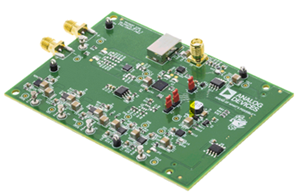
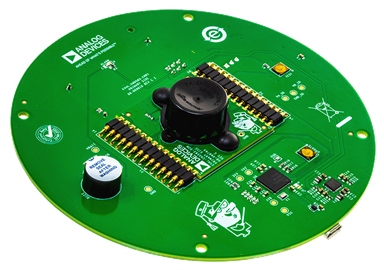
EVAL-SSM2375Z
Analog Devices Inc.The SSM2375 is a fully integrated, high efficiency, Class-D audioamplifier. It is designed to maximize performance for mobilephone applications. The application circuit requires a minimumof external components and operates from a single 2.5 V to 5.5 Vsupply. It is capable of delivering 3 W of continuous output powerwith 100 dB.Spread-spectrum pulse density modulation (PDM) is used toprovide lower EMI-radiated emissions compared with otherClass-D architectures. The inherent randomized nature ofspread-spectrum PDM eliminates the clock intermodulation(beating effect) of several amplifiers in close proximity.The SSM2375 includes an optional modulation select pin(ultralow EMI emissions mode) that significantly reduces theradiated emissions at the Class-D outputs, particularly above100 MHz. In ultralow EMI emissions mode, the SSM2375can pass FCC Class B radiated emission testing with 50 cm,unshielded speaker cable without any external filtering.The device also includes a highly flexible gain select pin thatallows the user to select a gain of 0 dB, 3 dB, 6 dB, 9 dB, or12 dB. The gain selection feature improves gain matchingbetween multiple SSM2375 devices within a single applicationas compared to using external resistors to set the gain.The SSM2375 has a micropower shutdown mode with a typicalshutdown current of 20 nA. Shutdown is enabled by applyinga logic low to the SD pin.The device also includes pop-and-click suppression circuitry.This suppression circuitry minimizes voltage glitches at theoutput during turn-on and turn-off, reducing audible noiseon activation and deactivation.Other features that simplify system-level integration of theSSM2375 include input low-pass filtering to suppress out-of-bandDAC noise interference to the PDM modulator and fixed-inputimpedance to simplify component selection across multipleplatform production builds.The SSM2375 is specified over the industrial temperature rangeof ?40?C to +85?C. It has built-in thermal shutdown and outputshort-circuit protection. It is available in a halide-free, 9-ball,1.5 mm ? 1.5 mm wafer level chip scale package (WLCSP).Applications Mobile phones MP3 players Portable electronics

EVAL-SSM4321Z
Analog Devices Inc.The SSM4321 is a fully integrated, high efficiency, Class-Daudio amplifier with digitized output of output voltage, outputcurrent, and the PVDD supply voltage. It is designed to maximize performance for mobile phone applications. The application circuit requires a minimum of external components and operates from a 2.5 V to 5.5 V supply for the amplifier and a 1.42 V to 3.6 V supply for input/output. The SSM4321 is capable of delivering 2.2 W of continuous output power with 100 dB.The SSM4321 includes circuitry to sense output current, output voltage, and the PVDD supply voltage. Current sense is performedusing an external sense resistor that is connected between anoutput pin and the load. The output current and voltage are sentto ADCs with 16-bit resolution; the PVDD supply voltage is sent to an ADC with 8-bit resolution.The outputs of these ADCs are available on the TDM or I2S output serial port. The SLOT pin is used to determine which of four possible output slots is used on the TDM interface. A stereo I2S interface can be selected by reversing the pin connections forBCLK and FSYNC. Also, a direct PDM bit stream of voltage andcurrent data can be selected via the SLOT pin.Spread-spectrum pulse density modulation (PDM) is used to provide lower EMI-radiated emissions compared with other Class-D architectures. The inherent randomized nature of spread-spectrum PDM eliminates the clock intermodulation (beating effect) of several amplifiers in close proximity.The SSM4321 produces ultralow EMI emissions that significantlyreduce the radiated emissions at the Class-D outputs, particularly above 100 MHz. The ultralow EMI emissions of the SSM4321 arealso helpful for antenna and RF sensitivity problems.The device includes a highly flexible gain select pin that requiresonly one series resistor to select a gain setting of 0 dB, 3 dB, 6 dB, 9 dB, or 12 dB. Input impedance is fixed at 80 k?, independent of the selected gain.The SSM4321 has a shutdown mode with a typical shutdowncurrent of

EV-BURN-MONITOR-1Z
Analog Devices Inc.The ADuCM4050 microcontroller unit (MCU) is an ultra low power integrated microcontroller system with integrated power management for processing, control, and connectivity. The MCU system is based on the ARM? Cortex?-M4F processor. The MCU also has a collection of digital peripherals, embedded static random access memory (SRAM) and embedded flash memory, and an analog subsystem that provides clocking, reset, and power management capabilities in addition to an analog-to-digital converter (ADC) subsystem.This data sheet describes the ARM Cortex-M4F core and memory architecture used on the ADuCM4050 MCU. It does not provide detailed programming information about the ARM processor.The system features include an up to 52 MHz ARM Cortex-M4F processor, 512 kB of embedded flash memory with error correction code (ECC), an optional 4 kB cache for lower active power, and 128 kB system SRAM with parity. The ADuCM4050 features a power management unit (PMU), multilayer advanced microcontroller bus architecture (AMBA) bus matrix, central direct memory access (DMA) controller, and beeper interface.The ADuCM4050 features cryptographic hardware supporting advanced encryption standard (AES)-128 and AES-256 with secure hash algorithm (SHA)-256 and the following modes: electronic code book (ECB), cipher block chaining (CBC), counter (CTR), and cipher block chaining-message authentication code (CCM/CCM*) modes.The ADuCM4050 has protected key storage with key wrap/ unwrap, and keyed hashed message authentication code (HMAC) with key unwrap.The ADuCM4050 supports serial port (SPORT), serial peripheral interface (SPI), I2C, and universal asynchronous receiver/ transmitter (UART) peripheral interfaces.The ADuCM4050 features a real-time clock (RTC), general-purpose and watchdog timers, and programmable general-purpose input/output (GPIO) pins. There is a hardware cyclic redundancy check (CRC) calculator with programmable generator polynomial. The device also features a power on reset (POR) and power supply monitor (PSM), a 12-bit successive approximation register (SAR) ADC, a red/green/blue (RGB) timer for driving RGB LED, and a true random number generator (TRNG).To support low dynamic and hibernate power management, the ADuCM4050 MCU provides a collection of power modes and features such as dynamic- and software-controlled clock gating and power gating.For full details on the ADuCM4050 MCU, refer to the ADuCM4050 Ultra Low Power ARM Cortex-M4F MCU with Integrated Power Management Hardware Reference.Product Highlights Ultra low power consumption. Robust operation. Full voltage monitoring in deep sleep modes. ECC support on flash. Parity error detection on SRAM memory. Leading edge security. Fast encryption provides read protection to user algorithms. Write protection prevents device reprogramming by unauthorized code. Failure detection of 32 kHz low frequency external crystal oscillator (LFXTAL) via interrupt. SensorStrobe? for precise time synchronized sampling of external sensors. Works in hibernate mode, resulting in drastic current reduction in system solutions. Current consumption reduces by 10 times when using, for example, the ADXL363 accelerometer. Software intervention is not required after setup. No pulse drift due to software execution.Applications Internet of Things (IoT) Smart agriculture, smart building, smart metering, smart city, smart machine, and sensor network Wearables Fitness and clinical Machine learning and neural networks

EV-K800A0-1512AZ
Analog Devices Inc.The ADRF8800/ADRF8850 are low power, integrated systems on chip (SoC) that include a 2.4 GHz (industrial scientific medical) ISM band radio and an embedded microcontroller unit (MCU) subsystem.The ADRF8800/ADRF8850 provide wireless communications between the battery cell monitoring chip and the battery management system (BMS) controller. In the wireless battery management system (wBMS), the ADRF8800 nodes reside at the battery cells and take sensor data from the battery cell monitors. The nodes send the data over the air to an ADRF8850 network manager, and the manager provides the data to the BMS controller. The ADRF8850 network manager configures the network of nodes and manages the communications protocol.The embedded MCUs integrate static random access memory (SRAM), embedded flash memory, one-time programmable (OTP) memory, and an analog subsystem that provides clocking and reset.The ADRF8800/ADRF8850 has a rich set of peripherals, including serial peripheral interface (SPI), general-purpose input and output (GPIOs) ports, universal asynchronous receiver/transmitter (UART), and Joint Test Action Group (JTAG) port, as well as an analog-to-digital converter (ADC) and temperature sensor.The ADRF8800/ADRF8850 provide secure boot using software stored in read only memory (ROM) that authenticates the next boot stage using a hardware accelerated 256-bit elliptic curve cryptography (ECC-256) engine. Other hardware accelerated cryptographic features include the 128-bit advanced encryption standard (AES-128), 256-bit advanced encryption standard (AES-256), and Secure Hash Algorithm 256 (SHA-256). The ADRF8800/ADRF8850 have protected key storage with a root encrypted key generated on-chip that is only accessible to the on-chip hardware. The devices incorporate a true random number generator (TRNG) that is used to seed a National Institute of Standards and Technology (NIST) certified deterministic random bit generator (DRBG). The ADRF8800/ADRF8850 also include support for secure firmware updates with rollback protection. The in-field OTP memory is included to enforce the access control of debug ports and memory access once a device is ready for deployment.The ADRF8800/ADRF8850 feature on-chip, low dropout (LDO) regulators that allow the devices to be powered by a single 3.3 V nominal supply, provided by an external power management IC (PMIC) either stepping down from a high voltage bus or a 12 V battery.Each ADRF8800/ADRF8850 uses a single 40 MHz crystal to provide precision timing for the system.The ADRF8800/ADRF8850 are available in a 7 mm ? 7 mm body size, 48-lead LQFP_EP package, measuring 9 mm ? 9 mm when leads are included.APPLICATIONS Wireless Battery Management Systems

EV-LTC6655-REFZ
Analog Devices Inc.The AD57911 is a single 20-bit, unbuffered voltage-output DACthat operates from a bipolar supply of up to 33 V. The AD5791accepts a positive reference input in the range 5 V to VDD ? 2.5 Vand a negative reference input in the range VSS + 2.5 V to 0 V.The AD5791 offers a relative accuracy specification of ?1 LSBmax, and operation is guaranteed monotonic with a ?1 LSBdifferential nonlinearity (DNL) maximum specification.The device uses a versatile 3-wire serial interface that operates atclock rates up to 35 MHz and that is compatible with standardserial peripheral interface (SPI), QSPI?, MICROWIRE?, and DSP interface standards. The device incorporates a power-on reset circuit that ensures the DACoutput powers up to 0 V and in a known output impedance stateand remains in this state until a valid write to the device takesplace. The device provides an output clamp feature that places the outputin a defined load state.Product Highlights 1 ppm Accuracy. Wide Power Supply Range up to ?16.5 V. Operating Temperature Range: ?40?C to +125?C. Low 7.5 nV/?Hz Noise Spectral Density. Low 0.05 ppm/?C Temperature Drift.Applications Medical instrumentation Test and measurement Industrial control High end scientific and aerospace instrumentation1 Protected by U.S. Patent No. 7,884,747. Other patents pending.
EV-LTZ1000-REFZ
Analog Devices Inc.The AD57911 is a single 20-bit, unbuffered voltage-output DACthat operates from a bipolar supply of up to 33 V. The AD5791accepts a positive reference input in the range 5 V to VDD ? 2.5 Vand a negative reference input in the range VSS + 2.5 V to 0 V.The AD5791 offers a relative accuracy specification of ?1 LSBmax, and operation is guaranteed monotonic with a ?1 LSBdifferential nonlinearity (DNL) maximum specification.The device uses a versatile 3-wire serial interface that operates atclock rates up to 35 MHz and that is compatible with standardserial peripheral interface (SPI), QSPI?, MICROWIRE?, and DSP interface standards. The device incorporates a power-on reset circuit that ensures the DACoutput powers up to 0 V and in a known output impedance stateand remains in this state until a valid write to the device takesplace. The device provides an output clamp feature that places the outputin a defined load state.Product Highlights 1 ppm Accuracy. Wide Power Supply Range up to ?16.5 V. Operating Temperature Range: ?40?C to +125?C. Low 7.5 nV/?Hz Noise Spectral Density. Low 0.05 ppm/?C Temperature Drift.Applications Medical instrumentation Test and measurement Industrial control High end scientific and aerospace instrumentation1 Protected by U.S. Patent No. 7,884,747. Other patents pending.

EV-MOTE-AGILE-900Z
Analog Devices Inc.The ADF7030-1 is a fully integrated, radio transceiver achieving high performance at very low power. The ADF7030-1 is ideally suited for applications that require long range, network robustness, and long battery life. It is suitable for applications that operate in the ISM, SRD, and licensed frequency bands at 169.4 MHz to 169.6 MHz, 426 MHz to 470 MHz, and 863 MHz to 960 MHz. It provides extensive support for standards-based protocols like IEEE802.15.4g while also providing flexibility to support a wide range of proprietary protocols.The highly configurable low intermediate frequency (IF) receiver supports a large range of receiver channel bandwidths from 2.6 kHz to 406 kHz. This range of receiver channel bandwidths allows the ADF7030-1 to support ultranarrow-band, narrow-band, and wideband channel spacing.The ADF7030-1 features two independent PAs supporting output power ranges of ?20 dBm to +13 dBm and ?20 dBm to +17 dBm. The PAs support ultrafine adjustment of the power with a step resolution of 0.1 dB. The PA output power is exceptionally robust over temperature and voltage. The PAs have an automatic power ramp control to limit spectral splatter to meet regulatory standards.The ADF7030-1 features an on-chip ARM??Cortex?-M0 processor that performs radio control, radio calibration, and packet management. Cortex-M0 eases the processing burden of the host processor because the ADF7030-1 integrates the lower layers of a typical communication protocol stack. This internal processor also permits the download and execution of Analog Devices, Inc., provided firmware modules that can extend the functionality of the ADF7030-1.The ADF7030-1 has two packet modes: generic packet mode and IEEE802.15.4g mode. In generic packet mode, the packet format is highly flexible and fully programmable, thereby ensuring its compatibility with proprietary packet formats. In IEEE802.15.4g packet mode, the packet format conforms to the?IEEE802.15.4g standard. FEC, as per the IEEE802.15.4g standard, is also supported.The ADF7030-1 operates with a power supply range of 2.2 V to 3.6 V and has very low power consumption in both Tx and Rx modes, enabling long lifetimes in battery-operated systems. An ultralow power deep sleep mode achieves a typical current of 10 nA with the configuration memory retained.A complete wireless solution can be built using a small number of external discrete components and a host processor (typically a microcontroller). The host processor can configure the ADF7030-1 using a simple command-based protocol over a standard 4-wire SPI interface. A single-byte command transitions the radio between states or performs a radio function.The ADF7030-1 is available in two package types: a 6 mm ? 6 mm, 40-lead LFCSP and a 7 mm ? 7 mm, 48-lead LQFP. Both package types use NiPdAu plating to mitigate against silver migration in high humidity applications. The ADF7030-1 operating temperature range is ?40?C to +85?C.For Figure 13 to Figure 19, Figure 30, Figure 42, Figure 60, Figure 61, and Figure 75 in the Typical Performance Characteristics section, PA_COARSE is a programmable value that provides a coarse adjustment of the PA output power. This value can be programmed in the range of 1 to 6 for PA1, and from 1 to 10 for PA2. PA_FINE is a programmable value that provides a fine adjustment of the PA output power. This value can be programmed in the range of 3 to 127 for both PA1 and PA2. PA_MICRO is a programmable value that provides a microadjustment (typically

EV-RAPID-ESL2-JZ
Analog Devices Inc.The ADuCM3027/ADuCM3029 microcontroller units (MCUs) are ultra low power microcontroller systems with integrated power management for processing, control, and connectivity. The MCU system is based on the ARM? Cortex?-M3 processor, a collection of digital peripherals, embedded SRAM and flash memory, and an analog subsystem which provides clocking, reset, and power management capability in addition to an analog-to-digital converter (ADC) subsystem. For a feature comparison across the ADuCM3027/ADuCM3029 product offerings, see Table 1. Table 1. Product Flash Memory Options Device Embedded Flash Memory Size ADuCM3029 256 kB ADuCM3027 128 kB System features that are common across the ADuCM3027/ADuCM3029/ADuCM3029-1/ADuCM3029-2 MCUs include the following: Up to 26 MHz ARM Cortex-M3 processor Up to 256 kB of embedded flash memory with error correction code (ECC) Optional 4 kB cache for lower active power 64 kB system SRAM with parity Power management unit (PMU) Multilayer advanced microcontroller bus architecture (AMBA) bus matrix Central direct memory access (DMA) controller Beeper interface Serial port (SPORT), serial peripheral interface (SPI), inter-integrated circuit (I2C), and universal asynchronous receiver/transmitter (UART) peripheral interfaces Cryptographic hardware support with advanced encryption standard (AES) and secure hash algorithm (SHA)-256 Real-time clock (RTC) General-purpose and watchdog timers Programmable general-purpose input/output (GPIO) pins Hardware cyclic redundancy check (CRC) calculator with programmable generator polynomial Power-on reset (POR) and power supply monitor (PSM) 12-bit successive approximation register (SAR) ADC True random number generator (TRNG)To support low dynamic and hibernate power management, the ADuCM3027/ADuCM3029 MCUs provide a collection of power modes and features, such as dynamic and software controlled clock gating and power gating.The ADuCM3029-1 and ADuCM3029-2 MCU models share the same features and functionality as that of the ADuCM3029 MCU. All specifications pertaining to the ADuCM3027 and ADuCM3029 are also applicable to the ADuCM3029-1 and ADuCM3029-2.For full details on the ADuCM3027/ADuCM3029 MCUs, refer to the ADuCM302x Ultra Low Power ARM Cortex-M3 MCU with Integrated Power Management Hardware Reference Manual.Product Highlights Industry leading ultralow power consumption. Robust operation, including full voltage monitoring in deep sleep modes, ECC support on flash, and parity error detection on SRAM memory. Leading edge security. Fast encryption provides read protection to customer algorithms. Write protection prevents device reprogramming by unauthorized code. Failure detection of 32 kHz LFXTAL via interrupt. SensorStrobe? for precise time synchronized sampling of external sensors. Works in hibernate mode, resulting in drastic current reduction in system solutions. Current consumption reduces by 10 times when using, for example, the ADXL363 accelerometer. Software intervention is not required after setup. No pulse drift due to software execution.Applications Internet of Things (IoT) Electronic shelf label (ESL) and signage Smart infrastructure Smart lock Asset tracking Smart machine, smart metering, smart building, smart city, and smart agriculture Wearables Fitness and clinical Machine learning and neural network?

EV-RPG2-ENZ
Analog Devices Inc.The ADIN2299 is a complete, pretested solution that manages the industrial protocol and network traffic for an applications processor.The module contains everything needed to participate in a Ether-CAT, PROFINET? real-time (RT) and isochronous real time (IRT), EtherNet/IP network, including a communications controller, protocol stack, flash, RAM, follower controller, and physical layer (PHY). An applications processor connects via a universal asynchronousreceiver transmitter (UART), serial peripheral interface (SPI), or Ethernet interface.At the software layer, the applications processor connects to a unified interface so the supported industrial protocols can be used without changing the applications processor software. The ADIN2299 platform was precertified so that the field device can operate in any of the supported industrial Ethernet networks.PRODUCT HIGHLIGHTSMultiprotocol supportSmall form factor for embedded applicationsLow power and low latencyRobust network policing ensures passing PROFINET Netload Class 3APPLICATIONS Factory and process automation Motion control Building automation Transportation
EV-RPG2-PNZ
Analog Devices Inc.The ADIN2299 is a complete, pretested solution that manages the industrial protocol and network traffic for an applications processor.The module contains everything needed to participate in a Ether-CAT, PROFINET? real-time (RT) and isochronous real time (IRT), EtherNet/IP network, including a communications controller, protocol stack, flash, RAM, follower controller, and physical layer (PHY). An applications processor connects via a universal asynchronousreceiver transmitter (UART), serial peripheral interface (SPI), or Ethernet interface.At the software layer, the applications processor connects to a unified interface so the supported industrial protocols can be used without changing the applications processor software. The ADIN2299 platform was precertified so that the field device can operate in any of the supported industrial Ethernet networks.PRODUCT HIGHLIGHTSMultiprotocol supportSmall form factor for embedded applicationsLow power and low latencyRobust network policing ensures passing PROFINET Netload Class 3APPLICATIONS Factory and process automation Motion control Building automation Transportation

SOM-Compatible Carrier Board Providing EZ-KIT® Peripheral Functions Including Audio I/O, Ethernet, USB, and More
Analog Devices Inc.The EV-SOMCRR-EZKIT carrier board enables users to plug-n-play with any of ADI’s System-on-Module (SoM) boards (e.g., EV-21569-SOM). It allows users to evaluate the most common peripherals and interfaces featured on ADI’s SHARC+ audio processors (e.g., Audio, Ethernet, MLB, USB, CAN, etc.) and features an on-board ICE emulator to provide additional cost savings by eliminating the need for an external emulator. Finally, the EV-SOMCRR-EZKIT carrier board also provides a connection to external A2B boards to allow for easy application expandability of customers’ systems. The EV-SOMCRR-EZKIT carrier board can be purchased individually or as part of an EZ-KIT evaluation system bundle (e.g., EV-21569-EZKIT)
When attached to a supported SOM board, the EV-SOMCRR-EZKIT carrier board utilizes the CrossCore® Embedded Studio (CCES) development tools to enable developers to achieve faster time to market. The development environment aids advanced application code development and debug, such as:
Create, compile, assemble, and link application programs written in C++, C, and assembly
Load, run, step, halt, and set breakpoints in application programs
Read and write data and program memory
Read and write core and peripheral registers

EV-SOMCRR-PAM
Analog Devices Inc.Reaching speeds of up to 1 GHz, the ADSP-SC598/SC596/SC595 processors are members of the ADSP-SC59x SHARC? family of products. Containing the same dual-SHARC+? DSP core architecture as the ADSP-SC594/SC592/SC591, these processors upgrade the integrated Arm core to a Cortex-A55 running at up to 1.2 GHz. The A55 processor, with FPU and Neon? DSP extensions, handles additional real-time processing tasks and manages peripherals used to interface to time-critical data in audio applications. These interfaces include Gigabit Ethernet, USB High-Speed, CAN FD, and a rich variety of other connectivity options for a flexible and simplified system design.The ADSP-SC59x SHARC processors are members of the SIMD SHARC family of digital signal processors (DSPs) that feature Analog Devices, Inc., Super Harvard Architecture. These 32-bit/40-bit/64-bit floating-point processors are optimized for high performance audio/floating-point applications with large on-chip static random-access memory (SRAM), multiple internal buses that eliminate input/output (I/O) bottlenecks, and innovative digital audio interfaces (DAI). New additions to the SHARC+ core include cache enhancements and branch prediction, while maintaining instruction set compatibility to previous SHARC products.By integrating a rich set of industry-leading system peripherals and memory (see Table 1 in the data sheet), the SHARC+ processor is the platform of choice for applications that require programmability similar to reduced instruction set computing (RISC), multimedia support, and leading edge signal processing in one integrated package. These applications span a wide array of markets, including automotive, professional audio, and industrial-based applications that require high floating-point performance.APPLICATIONS Automotive: audio amplifier, head unit, ANC/RNC, rear seat entertainment, digital cockpit, ADAS Consumer & Professional Audio: speakers, sound bars, AVRs, conferencing systems, mixing consoles, microphone arrays, headphones

ADP7142 Signal Chain Evaluation Board | 200mA Low Noise Positive LDO
Analog Devices Inc.Demonstration circuit SCP-ADP7142-EVALZ is a 40V, 200mA low dropout (LDO) regulator designed to allow low noise operation in noise sensitive circuits. It is easily con-figured for a wide output range and can provide extremely quiet operation with its high PSRR.
Like all boards in the Signal Chain Power series, this board is designed to be easily plugged into other SCP boards to form a complete signal chain power system, enabling fast evaluation of low power signal chains. To evaluate this board, some universal SCP hardware is required, namely:
SCP-INPUT-EVALZ
SCP-OUTPUT-EVALZ
SCP-1X5BKOUT-EVALZ
SCP-FILTER-EVALZ
SCP-1X2BKOUT-EVALZ
SCP-5X1-EVALZ
SCP-THRUBRD-EVALZ
To properly evaluate SCP series demo boards, you will need the SCP Configurator companion software. SCP Configurator can help you choose the right board and topology for your design.
Note that the Demo Manual does not cover details important to the operation and configuration regarding the ADP7142. Please refer to the ADP7142 datasheet for a complete description of the part.

LT1956 Signal Chain Evaluation Board | 60V/1.5A Buck Converter
Analog Devices Inc.Demonstration circuit SCP-LT1956-BEVALZ is a 48V, 1A load current, monolithic step-down DC/DC switching converter with a wide input range for applications which require higher input voltage.
Like all boards in the Signal Chain Power series, this board is designed to be easily plugged into other SCP boards to form a complete signal chain power system, enabling fast evaluation of low power signal chains. To evaluate this board, some universal SCP hardware is required, namely:
SCP-INPUT-EVALZ
SCP-OUTPUT-EVALZ
SCP-FILTER-EVALZ
SCP-THRUBRD-EVALZ
SCP-1X2BKOUT-EVALZ
SCP-1X5BKOUT-EVALZ
SCP-5X1-EVALZ
To properly evaluate SCP series demo boards, you will need the SCP Configurator companion software. SCP Configurator can help you choose the right board and topology for your design.
Note that the Demo Manual does not cover details important to the operation and configuration regarding the LT1956. Please refer to the LT1956 data sheet for a complete description of the part.

LT1964 Signal Chain Evaluation Board | 200mA Low Noise Negative LDO
Analog Devices Inc.Demonstration circuit SCP-LT1964-EVALZ is a –20V, 200mA Low Dropout (LDO) regulator designed to allow low noise operation in noise sensitive circuits. It is easily configured for a wide output range and can provide extremely quiet operation with its high PSRR.
Like all boards in the Signal Chain Power series, this board is designed to be easily plugged into other SCP boards to form a complete signal chain power system, enabling fast evaluation of low power signal chains. To evaluate this board, some universal SCP hardware is required, namely:
SCP-INPUT-EVALZ
SCP-OUTPUT-EVALZ
SCP-1X5BKOUT-EVALZ
SCP-THRUBRD-EVALZ
SCP-FILTER-EVALZ
SCP-1X2BKOUT-EVALZ
SCP-5X1-EVALZ
To properly evaluate SCP series demo boards, you will need the SCP Configurator companion software. SCP Configurator can help you choose the right board and topology for your design.
Note that the Demo Manual does not cover details important to the operation and configuration regarding the LT1964. Please refer to the LT1964 data sheet for a complete description of the part.

DC2658A
Analog Devices Inc.The LT8640S/LT8643S synchronous step-down regulator?features second generation Silent Switcher architecture designed to minimize EMI emissions while delivering high?efficiency at high switching frequencies. This includes the integration of bypass capacitors to optimize all the?fast current loops inside and make it easy to achieve?advertised EMI performance by reducing layout sensitivity.?This performance makes the LT8640S/LT8643S ideal for?noise-sensitive applications and environments.Peak current mode control with a 30ns minimum on-time?allows high step-down ratios even at high switching frequencies. The LT8643S has external compensation to?enable current sharing and fast transient response at high?switching frequencies.Burst Mode operation enables ultralow standby current?consumption, forced continuous mode can control frequency?harmonics across the entire output load range, or spread?spectrum operation can further reduce EMI emissions.APPLICATIONS Automotive and Industrial Supplies General Purpose Step-Down

LTM4664 Demo Board | 48VIN, Single 50A μModule Regulator With Digital Power System Management
Analog Devices Inc.Demonstration circuit 2672A-B is a complete non-isolated 48V input, dual-phase single output, high efficiency, high density µModule regulator with 30V to 58V input range. The output can supply 50A maximum load current. The demo board has a LTM4664 µModule regulator, which is a dual 25A or single 50A step-down regulator with digital power system management. Please see LTM4664 datasheet for more detailed information.
DC2672A-B powers up to default settings and produces power based on configuration resistors without the need for any serial bus communication. This allows easy evaluation of the DC/DC converter. To fully explore the extensive power system management features of the part, download the GUI software LTpowerPlay™ onto your PC and use ADI’s I2C/SMBus/PMBus dongle DC1613A to connect to the board. LTpowerPlay allows the user to reconfigure the part on the fly and store the configuration in EEPROM, view telemetry of voltage, current, temperature and fault status.
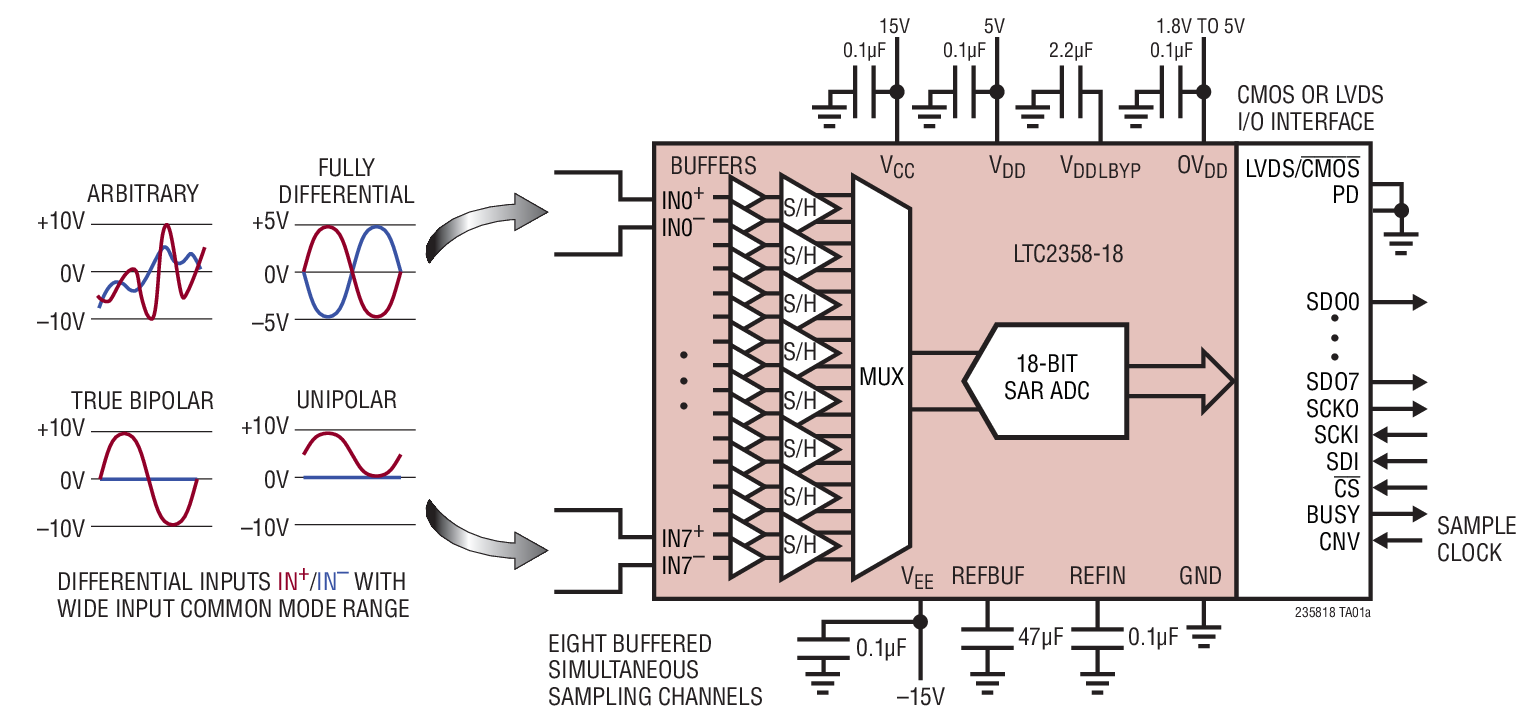
LTC2358-18, LT6658, ADA4522-2 Industrial Data Acquisition Nonisolated Board
Analog Devices Inc.Demonstration circuit 2677A is a reference design for robust industrial data acquisition applications for the LTC®2358-18. The LTC2358-18 is capable of high voltage measurements with a large input common range; however, the DC2677A implements input protection that allows up to 400V of continuous input protection. Combined with gas discharge tubes, which provide protection from surges, the DC2677A is capable of surviving extreme abuse.
This reference design includes the LTC2358-18 SAR ADC, ADA4522-2 dual zero-drift operational amplifier, and an LT6658 dual-output, high current reference for sensor
excitation.
The digital interface is an HSMC (high-speed mezzanine connector), which is compatible with Altera Cyclone V SoCkit and other Altera FPGA evaluation boards that support
3.3V CMOS I/O.

LTC2662 Demo Board | 5-Channel, 16-/12-Bit, 300mA, SoftSpan Current Source DACs
Analog Devices Inc.Demonstration circuit 2692A-A features the LTC2662,
5-channel, 16-bit, 300mA, current source DACs with
10ppm/°C reference in a 5mm × 5mm QFN package.
This device features per-channel SoftSpan™ configuration
of 3.125mA to 300mA, a separate supply for each
output, and an internal switch to allow any output pin to
be connected to V−.
Pin-compatible 12-bit versions are available for lower
resolution requirements on the DC2692A-B.

LTM4623EY Demo Board | 20VIN, 3A Step-Down µModule Regulator Configured as Inverting Output. –0.9VOUT to –5.2VOUT
Analog Devices Inc.Demonstration circuit 2721A-A features the LTM4623
µModule® regulator, a tiny high performance high efficiency
step-down regulator configured as an inverting
buck-boost regulator. The DC2721A-A has an operating
input voltage range of 4V to 15V and is able to provide
an output current of up to 2A. The output voltage can be
programmed between –0.6V and –5.5V. The LTM4623 is
a complete DC/DC point of load regulator in a thermally enhanced 6.25mm × 6.25mm × 1.82mm LGA package
requiring only a few input and output capacitors. The
LTM4623 data sheet must be read in conjunction with
this demo manual for working on or modifying demo circuit
2721A-A