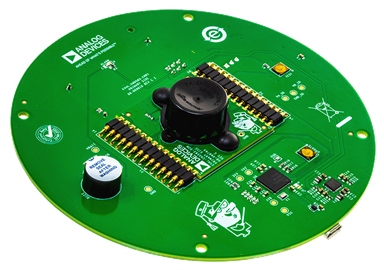
DC2951A
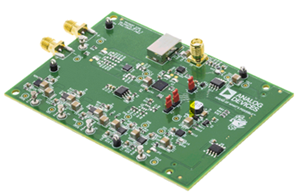
Analog Devices Inc.The LTC7806 is a high performance 2-phase single output synchronous boost converter controller that drives two N-channel power MOSFET stages out-of-phase. Its constant-frequency current mode architecture allows a phase-lockable switching frequency of up to 3MHz. High frequency 2-phase operation reduces input and output capacitor requirements and allows the use of smaller inductors compared to the single-phase equivalent. Synchronous rectification increases efficiency, reduces power losses, and eases thermal requirements, simplifying high power boost applications. The synchronous PassThru capability also minimizes losses in automotive start-stop applications.The LTC7806 operates from a wide 4.5V to 40V input supply range. When biased from the boost converter output, the LTC7806 can operate from an input supply as low as 1V after start-up. The very low no-load quiescent current extends operating run time in battery powered systems. OPTI-LOOP? compensation allows the transient response to be optimized over a wide range of output capacitance and ESR values. The LTC7806 features a precision 1.2V reference, a power good output indicator, and an inductor current monitor.APPLICATIONS Automotive and Transportation Audio and RF Power Amplifiers Industrial and Medical Communications

DC2966A
Analog Devices Inc.The LTC3376 is a highly flexible multioutput power supply IC. The device includes four synchronous buck converters, configured to share eight 1.5A power stages, powered from independent 3V to 20V inputs. The DC/DCs are assigned to one of fifteen power configurations via pin strappable CFG0 to CFG3 pins. The LTC3376 includes the integration of ceramic capacitors into the package for the BST pins thereby saving PCB space. The common buck switching frequency may be programmed with an external resistor, synchronized to an external oscillator, or set to a default internal 2MHz clock. The operating mode for all DC/DCs may be programmed via the SYNC/MODE pin for Burst Mode or forced continuous mode operation. The PGOOD1 to PGOOD4 outputs indicate when each enabled DC/DC is within a specified percentage of its final output. Current monitors allow for external monitoring of each buck?s load. The EXTVCC pin allows for the internal circuitry to run from a 3V to 5.5V rail for improved efficiency. Precision RUN pin thresholds facilitate power-up sequencing. The LTC3376 is available in a 64 lead 7mm ? 7mm BGA (0.8mm ball pitch).Applications? Telecom/Industrial? 12V Distributed Power Systems

DC2969A-A
Analog Devices Inc.The LTC4372/LTC4373 are positive high voltage ideal diode controllers that drive an external N-channel MOSFET to replace a Schottky diode. They control the forward voltage drop across the MOSFET to ensure current delivery or current transfer from one path to the other even at light loads.A 5?A operating current achieves high efficiency for intermittent load applications or always-on backup power supplies. If a power source fails or is shorted, a fast turn-off minimizes reverse current transients. The LTC4372/LTC4373 control back-to-back N-channel MOSFETs for inrush current control and load switching.The LTC4372?s SHDN pin keeps the MOSFET off and reduces the quiescent current to 3.5?A. The LTC4373 has a UV pin for undervoltage monitoring while the UVOUT?pin provides hysteresis adjustment and status information. During undervoltage, the back-to-back MOSFETs are cut off and quiescent current reduces to 0.5?A.APPLICATIONS Automotive Battery Protection Redundant Power Supplies Portable Instrumentation Solar Powered Systems Energy Harvesting Applications Supply Holdup

LTC3337 | Primary Battery SOH Monitor with Precision Coulomb Counter
Analog Devices Inc.Demonstration circuit 2973A shows the LTC3337 Primary Battery State of Health (SOH) monitor with precision coulomb counter operating with a configurable peak current limit. The LTC3337 supports input voltages from 1.8V to 5.5V and a peak current up to 100mA with a quiescent current of 100nA. Coulomb count, battery voltage, and Battery Series Resistance (BSR) are measurable and can be used to quantify the charge state and health of a battery.
The DC2973A demonstrates a simple layout for the highest-power configuration of the LTC3337. The circuit can be reduced for lower IPEAK levels. The demo board can be connected directly to a PC using a micro USB cable in order to run a GUI and configure simple a Battery State of Charge (SOC) monitor. Source code for the GUI is available and can be used as a starting point for LTC3337 firmware development.
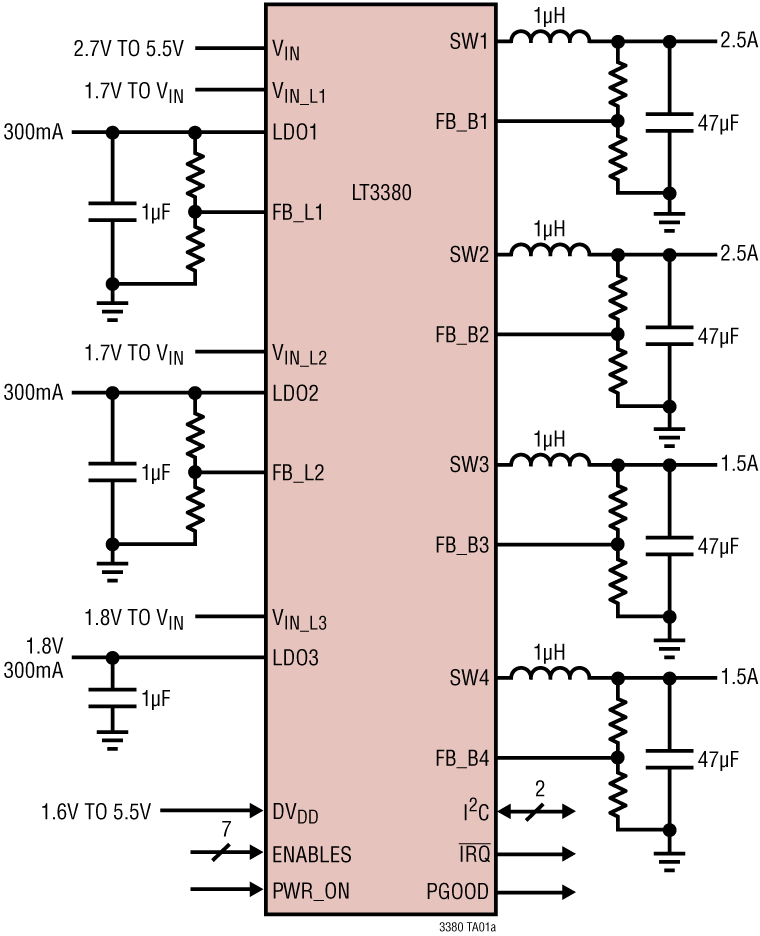
LT3380 Demo Board | Multi-Output Power Management Solution with 4 Buck Switching and 3 LDO Linear Regulators with I2C
Analog Devices Inc.DC2985A is a multi-output power management solution demonstration circuit, featuring the LT3380. It contains two 2.5A, two 1.5A synchronous step-down DC/DC regulators and three 300mA LDO regulators.
All regulators can be enabled with external enable pins. After the first regulator is enabled, the remaining enable pins use a precision threshold to allow hardwire-programmed Power-Up Sequence.
A micro-USB communication interface is integrated on board to allow software GUI to write or read the registers in LT3380 via its I2C serial port. This GUI can control regulator enables, power-down sequencing, output voltage levels, dynamic voltage scaling, operation modes, status reporting and other special functions.
Refer to LT3380 data sheet for more details on the electrical specifications and the setting of its command registers.

DC3008A
Analog Devices Inc.The LT8386 is a monolithic, synchronous, step-up DC-to-DC converter that utilizes fixed frequency, peak current control and provides PWM dimming for a string of LEDs. The LED current is programmed by an analog voltage or digital pulses at the CTRL pin. The LT8386 will maintain 2% current regulation through an external sense resistor over a wide range of output voltages.The LT8386 features Silent Switcher? technology designed to minimize EMI/EMC emissions with high efficiency. The switching frequency is programmable from 200kHz to 2MHz by an external resistor at the RT pin or by an external clock applied at the SYNC/SPRD pin. With the optional spread spectrum frequency modulation enabled, the frequency varies from 100% to 125% to reduce EMI.The LT8386 includes a driver for an external high side PMOS for PWM dimming. The 60V rated LT8386 is pin-to-pin compatible with the LT3922 and LT3922-1.APPLICATIONS Automotive and Industrial Lighting Heads Up Display (HUD)/Machine Vision
LP38501TS-ADJEV
National SemiconductorLP38501 1 - Single Channels per IC Positive Adjustable Linear Voltage Regulator Evaluation Board