App-Note-203 - Two Channel Optical Interrupters
TT electronics plcOptek has two types of dual channel optical interrupters available. The OPB822 family has two side-by-side channels on 0.212” centers and the OPB826 family has two vertical channels on 0.150” centers. These standard parts may be used for determining direction of rotation, speed, and relative location of a rotating shaft. This bulletin will discuss some of the design aspects of two channel encoding along with circuit concepts and unit performance.
App-Note-202 - Soldering to Semiconductor Leads
TT electronics plcNormal lead soldering information furnished on semiconductor product data sheets is limited to the maximum temperature, the maximum time at this temperature and the minimum distance from the temperature to the case of the unit. This bulletin discusses some of the aspects of soldering using an iron, a pot, or a flow bath. This will involve discussions of both hermetic or metal packaged parts and plastic encapsulated parts.
App-Note-200 - Thermal Behaviour of GaAs LEDs
TT electronics plcThe output power (P0) of a GaAs LED is a function of forward current (IF). As this forward current increases, the output power will also increase. This forward current flowing through the LED generates heat (P0) which causes the junction temperature (ƟI) of the diode to increase. As the junction temperature increases, the output power decreases.
App-Note-205 - Gallium Aluminum Arsenide
TT electronics plcThe first light source for actuating an optoelectronic photosensor was the tungsten filament or incandescent lamp. It was eventually replaced by the GaAs infrared emitting diode which offered longer life, smaller size, less power to operate and less heat generated. The GaAs LED is still the workhorse of the industry and will continue to be used in steadily decreasing numbers for the next few years. It will eventually be replaced by GaAIAs as the industry standard for two major reasons: GaAIAs offer at least twice the power output at the same input current (IF) level and significantly improved coupling efficiency.
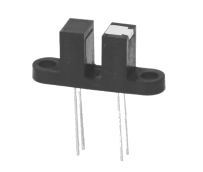
App-Note-201 - Motion Sensing With Interrupters
TT electronics plcThis application bulletin will discuss many of the variables associated with single channel encoding. This will include design considerations for using booth non-aperture and aperture transistors or Photologic® output devices. Refer to application bulletins 203 and 206 for additional information.
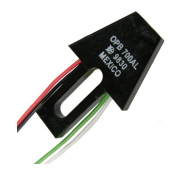
App-Note-204 - Reflective Assemblies Design Considerations
TT electronics plcA reflective assembly generally consists of a single emitter and sensor in the same housing. This provides a major mounting advantage because optical access to the surface to be sensed is required from only one side. However, this can lead to a wide variety of design variables involving mounting configurations, reflective surface, and sensing circuits.