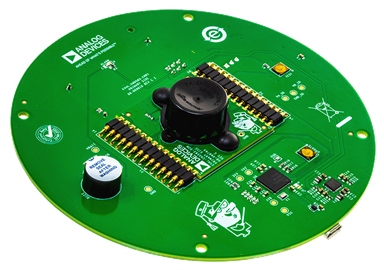
EVAL-ADUM4146WHB1Z
Analog Devices Inc.The ADuM4146 is a single-channel gate driver specifically optimized for driving silicon carbide (SiC), metal-oxide semiconductor field effect transistors (MOSFETs). Analog Devices, Inc., iCoupler? technology provides isolation between the input signal and the output gate drive.The ADuM4146 includes a Miller clamp to provide robust SiC turn off with a single-rail supply when the gate voltage drops to less than 2 V. Operation with unipolar or bipolar secondary supplies is possible with or without the Miller clamp operation.The Analog Devices chip scale transformers also provide isolated communication of control information between the high voltage and low voltage domains of the chip. Information on the status of the chip can be read back from dedicated outputs. Control of resetting the device after a fault on the secondary side is performed on the primary side of the device.Integrated onto the ADuM4146 is a desaturation detection circuit that provides protection against high voltage short-circuit SiC operation. The desaturation protection contains noise reducing features, such as a 300 ns masking time after a switching event to mask voltage spikes due to initial turn on (see Figure 17 in the data sheet). An optional internal 500 ?A current source allows low device count, and the internal blanking switch allows the addition of an external current source if more noise immunity is needed.The secondary undervoltage lockout (UVLO) is set to 14.5 V (typical) for Grade A and is set to 11.5 V (typical) for Grade B and Grade C with common SiC and insulated gate bipolar transistor (IGBT) levels taken into consideration. APPLICATIONS SiC/MOSFET/IGBT gate drivers Photovoltaic (PV) inverters Motor drives Power supplies

EVAL-ADUM4166EBZ
Analog Devices Inc.The ADuM4165/ADuM4166 are USB 2.0 port isolators, utilizing Analog Devices, Inc., iCoupler? technology to dynamically support all USB 2.0 data rates; low (1.5 Mbps), full (12 Mbps), or high (480 Mbps), as required. The devices support host isolation with automatic speed negotiation as well as peripheral isolation.High speed data is retimed for jitter reduction, requiring an external clock signal or crystal input. The ADuM4165 supports the clock or crystal input on the upstream side, and the ADuM4166 supports the clock or crystal input on the downstream side, offering two options to best suit the system design.The low power standby mode for downstream (Side 2) supports applications with limited available power, such as battery-operated peripherals. The upstream (Side 1) standby current meets USB 2.0 requirements for suspended operation.The isolators are specified over an extended industrial temperature range of ?55?C to +125?C and are available in a 20-lead, wide-body, increased creepage SOIC_IC with 8.3 mm creepage and clearance.APPLICATIONS USB peripheral, USB host, and USB hub isolation Electronic test and measurement equipment Medical devices and integrated PCs Industrial PCs and isolated USB ports for debug or upgrade USB isolator modules and USB cable isolatorsProtected by U.S. Patents 7,075,329; 8,432,182; 8,525,547; and 8,564,327. Other patents are pending.

EVAL-ADUM4471EBZ
Analog Devices Inc.The?ADuM4470?/ ADuM4471 /?ADuM4472?/?ADuM4473?/?ADuM4474 are quad-channel, digital isolations with a regulated DC/DC isolated power supply controller with an internal MOSFET driver. The DC/DC controller has an internal isolated PWM feedback from the secondary side based on the iCoupler? chip scale transformer technology and complete loop compensation. This eliminates the need to use an optocoupler for feedback and compensates the loop for stability.The ADuM447x isolator provides a more stable output voltage and higher efficiency compared to?unregulated isolated dc-to-dc power supplies. The fully integrated feedback and loop compensation in a wide-body SOIC package provide a smaller form factor and 8.3 mm creepage distance solution.The regulated feedback provides a relatively flat efficiency curve over the full output power range. The ADuM3070 enables a DC/DC converter with a 3.3 V to 24 V isolated output voltage range from either a 5.0 V or a 3.3 V input voltage, with an output power of up to 2.5 W.The ADuM447x isolators provide four independent isolation channels in a variety of channel configurations and data rates. (The x in ADuM447x throughout this data sheet stands for the ADuM4470 / ADuM4471 / ADuM4472 / ADuM4473 / ADuM4474).APPLICATIONS Power supply startup bias and gate drives Isolated sensor interfaces Process controls RS-232/RS-422/RS-485 transceivers

EVAL-ADUM6421ARNZ
Analog Devices Inc.The ADuM6420A/ADuM6421A/ADuM6422A/ADuM6423A/ADuM6424A1 are quad-channel digital isolators with an isoPower?, integrated, isolated dc-to-dc converter. Based on the Analog Devices, Inc., iCoupler? technology, the dc-to-dc converter provides regulated, isolated power that meets CISPR 32/EN 55032 Class B limits at a full load on a 2-layer printed circuit board (PCB) with ferrites. Popular voltage combinations and the associated output current levels are listed in Table 1 in the data sheet.The ADuM6420A/ADuM6421A/ADuM6422A/ADuM6423A/ADuM6424A eliminate the need for a separate, isolated dc-to-dc converter in 500 mW, isolated designs. The iCoupler chip scale transformer technology is used for isolated logic signals and for the magnetic components of the dc-to-dc converter. The result is a small form factor, total isolation solution.The ADuM6420A/ADuM6421A/ADuM6422A/ADuM6423A/ADuM6424A isolators provide four independent isolation channels. See the Pin Configurations and Function Descriptions in the data sheet for additional information.APPLICATIONS RS-232 transceivers Power supply start-up bias and gate drives Isolated sensor interfaces Automotive on-board charger (OBC) and dc to dc Industrial programmable logic controllers (PLCs)1 Protected by U.S. Patents 5,952,849; 6,873,065; 6,903,578; and 7,075,329. Other patents are pending.
EVAL-ADUM6421AURNZ
Analog Devices Inc.The ADuM6420A/ADuM6421A/ADuM6422A/ADuM6423A/ADuM6424A1 are quad-channel digital isolators with an isoPower?, integrated, isolated dc-to-dc converter. Based on the Analog Devices, Inc., iCoupler? technology, the dc-to-dc converter provides regulated, isolated power that meets CISPR 32/EN 55032 Class B limits at a full load on a 2-layer printed circuit board (PCB) with ferrites. Popular voltage combinations and the associated output current levels are listed in Table 1 in the data sheet.The ADuM6420A/ADuM6421A/ADuM6422A/ADuM6423A/ADuM6424A eliminate the need for a separate, isolated dc-to-dc converter in 500 mW, isolated designs. The iCoupler chip scale transformer technology is used for isolated logic signals and for the magnetic components of the dc-to-dc converter. The result is a small form factor, total isolation solution.The ADuM6420A/ADuM6421A/ADuM6422A/ADuM6423A/ADuM6424A isolators provide four independent isolation channels. See the Pin Configurations and Function Descriptions in the data sheet for additional information.APPLICATIONS RS-232 transceivers Power supply start-up bias and gate drives Isolated sensor interfaces Automotive on-board charger (OBC) and dc to dc Industrial programmable logic controllers (PLCs)1 Protected by U.S. Patents 5,952,849; 6,873,065; 6,903,578; and 7,075,329. Other patents are pending.

EVAL-ADUM7223EBZ
Analog Devices Inc.The ADuM7223 is a 4A isolated, half-bridge gate driver that employ Analog Devices, Inc.?s iCoupler? technology to provide independent and isolated high-side and low-side outputs. Combining high speed CMOS and monolithic transformer technology, these isolation components provide outstanding performance characteristics superior to alternatives such as the combination of pulse transformers and non-isolated gate drivers. By integrating the isolator and driver in a single package, propagation delay is a maximum of only 60 ns and the propagation skew from channel to channel is a maximum of only 7ns.The ADuM7223 provides two independent isolation channels.The ADuM7223 operates with an input supply ranging from 3.0 V to 5.5 V, providing compatibility with lower voltage systems. The outputs operate in a wide range from 4.5V to 18V with three output voltage versions available. The 5 ? 5 mm, LGA package provides 565 V operating voltage from input to output and 700 V from output to output.In comparison to gate drivers employing high voltage level translation methodologies, these gate drivers offer the benefit of true, galvanic isolation between the input and each output. As a result, these gate drivers provide reliable control over the switching characteristics of IGBT/MOSFET configurations over a wide range of positive or negative switching voltages.APPLICATIONS Switching power supplies Isolated IGBT/MOSFET gate drives Industrial inverters

EVAL-ADUM7643EBZ
Analog Devices Inc.The ADuM7640?/?ADuM7641?/?ADuM7642?/ ADuM7643 are 6-channel digital isolators based on the Analog Devices, Inc., iCoupler? technology. These 1 kV digital isolation devices are packaged in a small 20-lead QSOP. They offer space savings and a lower price than 2.5 kV or 5 kV isolation solutions when only functional isolation is needed.This family, like many Analog Devices isolators, offers very lowpower consumption, using one-tenth to one-sixth the power of other digital isolators, with the supply voltage on either sideranging from 3.0 V to 5.5 V. Despite their low power consumption,the ADuM7640 / ADuM7641 / ADuM7642 / ADuM7643 provide low pulse width distortion (< 6 ns for C grade) and a channel-by-channel glitch filter to protect the device against extraneous noise disturbances. Four channel direction combinations areavailable with a maximum data rate of 1 Mbps or 25 Mbps. Allproducts have a default output high logic state in the absence of input power.APPLICATIONS General-purpose, multichannel isolation SPI interface/data converter isolation RS-232/RS-422/RS-485 transceivers Industrial field bus isolation

EVAL-ADV7173EBZ
Analog Devices Inc.The ADV7172 / ADV7173?is an integrated Digital Video Encoder that converts digital CCIR-601 4:2:2 8-bit component video data into a standard analog baseband television signal compatible with worldwide standards.There are six DACs available on the ADV7172 / ADV7173. In addition to the Composite output signal there is the facility to output S-VHS Y/C Video, RGB Video and YUV Video.The on-board SSAF (Super Sub-Alias Filter), with extended luminance frequency response and sharp stopband attenuation, enables studio quality video playback on modern TVs, giving optimal horizontal line resolution. An additional sharpness control feature allows extra luminance boost on the frequency response.An advanced power management circuit enables optimal control of power consumption in both normal operating modes and power down or sleep modes. A PC?98-Compliant autodetect feature has been added to allow the user to determine whether or not the DACs are correctly terminated. If not, the ADV7172 /? ADV7173 flags that they are not connected through the Status bit and provides the option of automatically powering them down, thereby reducing power consumption.The ADV7172 / ADV7173 also supports both PAL and NTSC square pixel operation. The parts also incorporate WSS and CGMS-A data control generation.APPLICATIONS High Performance DVD Playback Systems Portable Video Equipment including Digital Still Cameras and Laptop PCs Video Games PC Video/Multimedia and Digital Satellite/Cable Systems (Set-Top Boxes/IRD)

EVAL-ADV7180-48EBZ
Analog Devices Inc.The ADV7180 automatically detects and converts standard analog baseband television signals compatible with worldwide NTSC, PAL, and SECAM standards into 4:2:2 component video data compatible with the 8-bit ITU-R BT.656 interface standard.The simple digital output interface connects gluelessly to a wide range of MPEG encoders, codecs, mobile video processors, and Analog Devices, Inc., digital video encoders, such as the ADV7391. External HS, VS, and FIELD signals provide timing references for LCD controllers and other video ASICs, if required. Accurate 10-bit analog-to-digital conversion provides professional quality video performance for consumer applications with true 8-bit data resolution. Three analog video input channels accept standard composite, S-video, or component video signals, supporting a wide range of consumer video sources. AGC and clamp-restore circuitry allow an input video signal peak-to-peak range to 1.0 V. Alternatively, these can be bypassed for manual settings.The line-locked clock output allows the output data rate, timing signals, and output clock signals to be synchronous, asynchronous, or line locked even with ?5% line length variation. Output control signals allow glueless interface connections in many applications. The ADV7180 is programmed via a 2-wire, serial bidirectional port (I2C? compatible) and is fabricated in a 1.8 V CMOS process. Its monolithic CMOS construction ensures greater functionality with lower power dissipation. LFCSP package options makes the decoder ideal for space-constrained portable applications. A 64-lead LQFP package is pin compatible with the ADV7181C.The 48-Lead LQFP, 40-lead LFCSP, and 32-lead LFCSP use one pin to output VS or FIELD.APPLICATIONS Digital camcorders and PDAs Low cost SDTV PIP decoder for digital TVs Multichannel DVRs for video security AV receivers and video transcoding PCI-/USB-based video capture and TV tuner cards Personal media players and recorders Smartphone/multimedia handsets In-car/automotive infotainment units Rearview camera/vehicle safety systems
EVAL-ADV7180LQEBZ
Analog Devices Inc.The ADV7180 automatically detects and converts standard analog baseband television signals compatible with worldwide NTSC, PAL, and SECAM standards into 4:2:2 component video data compatible with the 8-bit ITU-R BT.656 interface standard.The simple digital output interface connects gluelessly to a wide range of MPEG encoders, codecs, mobile video processors, and Analog Devices, Inc., digital video encoders, such as the ADV7391. External HS, VS, and FIELD signals provide timing references for LCD controllers and other video ASICs, if required. Accurate 10-bit analog-to-digital conversion provides professional quality video performance for consumer applications with true 8-bit data resolution. Three analog video input channels accept standard composite, S-video, or component video signals, supporting a wide range of consumer video sources. AGC and clamp-restore circuitry allow an input video signal peak-to-peak range to 1.0 V. Alternatively, these can be bypassed for manual settings.The line-locked clock output allows the output data rate, timing signals, and output clock signals to be synchronous, asynchronous, or line locked even with ?5% line length variation. Output control signals allow glueless interface connections in many applications. The ADV7180 is programmed via a 2-wire, serial bidirectional port (I2C? compatible) and is fabricated in a 1.8 V CMOS process. Its monolithic CMOS construction ensures greater functionality with lower power dissipation. LFCSP package options makes the decoder ideal for space-constrained portable applications. A 64-lead LQFP package is pin compatible with the ADV7181C.The 48-Lead LQFP, 40-lead LFCSP, and 32-lead LFCSP use one pin to output VS or FIELD.APPLICATIONS Digital camcorders and PDAs Low cost SDTV PIP decoder for digital TVs Multichannel DVRs for video security AV receivers and video transcoding PCI-/USB-based video capture and TV tuner cards Personal media players and recorders Smartphone/multimedia handsets In-car/automotive infotainment units Rearview camera/vehicle safety systems

EVAL-ADV7282AEBZ
Analog Devices Inc.The ADV7282A has the same pinout as and is software compatible with the ADV7282. The mobile industry processor interface (MIPI?) model of the ADV7282A (ADV7282A-M) has the same pinout as and is software compatible with the ADV7282-M.All features, functionality, and specifications are shared by the ADV7282A and the ADV7282A-M, unless otherwise noted.The ADV7282A is a versatile one-chip, multiformat video decoder that automatically detects standard analog baseband video signals and converts them into YCrCb 4:2:2 component video data streams.The analog input of the ADV7282A features an input mux (4-channel on ADV7282A, 6-channel on ADV7282A-M), a single 10-bit analog-to-digital converter (ADC) and an on-chip differential to single-ended converter to accommodate the direct connection of differential, pseudo differential, or single-ended CVBS without the need for external amplifier circuitry.The standard definition processor (SDP) in the ADV7282A automatically detects PAL, NTSC and SECAM standards in the form of composite, S-Video (Y/C) and component. The analog video is converted into a 4:2:2 component video data stream that is output either via an 8-bit ITU-R BT.656 standard-compatible interface (ADV7282A) or via a MIPI CSI-2 Tx (hereafter referred to as MIPI Tx) interface (ADV7282A-M). The ADV7282A also feature a deinterlacer for interlaced to progressive (I2P) conversion.The ADV7282A offers short to battery (STB) diagnostic sense inputs and general-purpose outputs.The ADV7282A is provided in a space-saving LFCSP surface-mount, RoHS compliant package. The ADV7282A is rated over the ?40?C to +105?C temperature range, making it ideal for automotive applications.The ADV7282A must be configured in accordance with the I2C writes provided in the evaluation board script files.Applications Advanced driver assistance Automotive infotainment DVRs for video security Media players

EVAL-ADV7393EBZ
Analog Devices Inc.The ADV7390?/?ADV7391?/?ADV7392?/ ADV7393?are a family of high speed, digital-to-analog video encoders on single monolithic chips. Three 2.7 V/3.3 V, 10-bit video DACs (a single DAC for the WLCSP package) provide support for composite (CVBS), S-Video (Y-C), or component (YPrPb/RGB) analog outputs in either standard definition (SD) or high definition (HD) video formats. The single DAC WLCSP package supports CVBS (NTSC and PAL) output only in SD resolution (see Table 2).Optimized for low power operation, occupying a minimal footprint, and requiring few external components, these encoders are ideally suited to portable and power-sensitive applications requiring TV-out functionality. Cable detection and DAC auto power-down features ensure that power consumption is kept to a minimum.The ADV7390 / ADV7391 have an 8-bit video input port that supports SD video formats over an SDR interface and HD video formats over a DDR interface. The ADV7392 / ADV7393 have a 16-bit video input port that can be configured in a variety of ways. SD RGB input is supported.All members of the family support embedded EAV/SAV timing codes, external video synchronization signals, and the I2C? and communication protocol. Table 1 and Table 2 list the video standards directly supported by the ADV7390/ADV7391/ ADV7392/ADV7393 family.APPLICATIONS Mobile handsets Digital still cameras Portable media and DVD players Portable game consoles Digital camcorders Set-top box (STB) Automotive infotainment (ADV7392 and ADV7393 only)

EVAL-ADV7614EB1Z
Analog Devices Inc.The ADV7614 is a high quality, single-chip integrated 4:1 multiplexed High-Definition Multimedia Interface (HDMI?) receiver. The ADV7614 incorporates a quad input HDMI receiver that supports all HDTV formats up to 1080p and displays resolutions up to UXGA (1600 ? 1200 at 60 Hz). The reception of encrypted video is possible with the inclusion of HDCP. The HDMI receiver also includes programmable/adaptive equalization that ensures robust operation of the interface with cable lengths up to 30 meters.The ADV7614 provides complete audio support for eight channels of I2S audio, Sony/Philips digital interface format (S/PDIF) digital audio output, and super audio CD (SACD) and compressed SACD support with direct stream digital (DSD) and direct stream transfer (DST) output interfaces, respectively.The HDMI receiver also supports high bit rate (HBR) audio streaming to allow recovery (and downstream processing) of compressed lossless audio formats, including Dolby? TrueHD and DTS?-HD master audio or DTS-HD high resolution audio. In addition, it also provides an advanced audio functionality, such as a mute controller that prevents audible extraneous noise in the audio output.Fabricated in an advanced CMOS process, the ADV7614 is provided in a space-saving, 260-ball, 15 mm ? 15 mm, CSP_BGA surface-mount, RoHS-compliant package, and is specified over the ?40?C to +70?C temperature range. APPLICATIONS Advanced TVs AVR video receivers PDP HDTVs LCD TVs (HDTV ready) OLED HDTVs LCD/DLP front projectors HDMI switcher

EVAL-ADV7625-SMZ
Analog Devices Inc.The ADV7625 is a high performance, five-input, dual-output, High-Definition Multimedia Interface (HDMI?) transceiver with crosspoint and splitter capabilities. The ADV7625 supports 3 GHz video and features two independent HDMI receivers, two independent HDMI transmitters, two audio output ports, two audio input ports, and a pixel port input. The ADV7625 supports all HDCP repeater functions through fully tested Analog Devices, Inc., repeater software libraries and drivers.The HDMI receivers and transmitters in the ADV7625 support the reception and transmission of 3 GHz video formats up to 4k ? 2k at 24 Hz/25 Hz/30 Hz, in addition to all mandatory HDMI 3D TV formats. The receivers and transmitters also provide support for THX? Media Director?.Each HDMI receiver features an integrated equalizer that ensures robust operation of the interface with cable lengths up to 30 meters. The HDMI receivers share a 768-byte volatile extended display identification data (EDID) memory, which can facilitate one or two EDIDs, one for each receiver. Each HDMI port features dedicated 5 V detect and Hot Plug? assert pins.Each HDMI transmitter supports audio return channel (ARC) and features an integrated HDMI CEC controller that supports capability discovery and control (CDC).The ADV7625 offers two audio output ports and two audio input ports. Each audio port supports the extraction and insertion of up to eight channels of audio data out of or into the HDMI streams. HDMI audio formats, including I2S, S/PDIF, direct stream digital (DSD), and high bit rate (HBR) audio are supported.The ADV7625 features a TTL pixel port input that facilitates the reception of digital video data from an analog front-end decoder (for example, the ADV7180, ADV7181D, or ADV7842).The ADV7625 has an integrated on-screen display (OSD) generator that enables the creation and control of high quality character- and icon-based system status and control displays. The OSD can be overlaid on 3 GHz video formats and 3D video. Customers who are interested in using OSD are provided with Blimp, the Analog Devices OSD development tool.The ADV7625 is provided in a space-saving, 260-ball, 15 mm ? 15 mm CSP_BGA surface-mount, RoHS-compliant package and is specified over the 0?C to 70?C temperature range. APPLICATIONS AVRs Soundbar with HDMI repeater support Matrix switch Other repeater applications

EVAL-ADV7840EB1Z
Analog Devices Inc.The ADV7840 is a high quality, single chip, multiformat video decoder graphics digitizer with an integrated 4:1 multiplexed HDMI? receiver.This multiformat 3D comb filter decoder supports the conversion of PAL, NTSC, and SECAM standards in the form of a compositeor an S-Video input signal into a digital ITU-R BT.656 format.SCART and overlay functionality are enabled by the ability of theADV7840 to process CVBS and standard definition RGB signals simultaneously.The ADV7840 contains one main component processor (CP),which processes YPrPb and RGB component formats, including RGB graphics. The CP also processes the video signals from theHDMI receiver. The ADV7840 can operate in quad HDMI andanalog input mode, thus allowing for fast switching between theADCs and HDMI.The ADV7840 supports the decoding of a component RGB/YPrPb video signal into a digital YCrCb or RGB pixel output stream. The support for component video includes 525i, 625i,525p, 625p, 720p, 1080i, 1080p, and 1250i standards, as well asmany other HD and SMPTE standards.Graphics digitization is also supported by the ADV7840. TheADV7840 is capable of digitizing RGB graphics signals from VGA to UXGA rates and converting them into a digital RGB or YCrCb pixel output stream.The ADV7840 incorporates a quad input HDMI 1.3-compatible receiver that supports all HDTV formats up to 1080p and display resolutions up to UXGA (1600 ? 1200 at 60 Hz). The reception of encrypted video is possible with the inclusion of HDCP. The HDMI receiver also includes programmable equalization that ensures robust operation of the interface with cablelengths up to 30 meters. The HDMI receiver has advanced audio functionality, such as a mute controller, that prevents audible extraneous noise in the audio output.Fabricated in an advanced CMOS process, the ADV7840 is provided in a 19 mm ? 19 mm, 416-ball, CSP_BGA, surface-mount, RoHS-compliant package and is specified over the 0?C to +70?C temperature range.ApplicationsAdvanced TVsPDP HDTVsLCD TVs (HDTV ready)LCD/DLP? rear projection HDTVsCRT HDTVsLCoS? HDTVsAVR video receiversLCD/DLP front projectorsHDTV STBs with PVRCRT HDTVProjectorsDVD recorders with progressive scan input support

EVAL-ADV8003-SMZ-P
Analog Devices Inc.The ADV8003 is a multiple input video signal processor that can de-interlace and scale SD, ED, or HD video data to HD formats, generate a bitmap on-screen display (OSD) and output the video with OSD overlaid on two High Definition Multimedia Interface (HDMI) transmitters and a video encoder.Video can be input into the ADV8003 in a number of ways: using the 48-bit TTL pixel port, using the 24-bit external OSD TTL pixel port, or from a device with a HDMI transmitter such as the ADV7850. The ADV8003 supports many of the formats outlined in the CEA-861 and VESA specifications, as well as several other widely used timing formats.Using two external DDR2 memories, the ADV8003 can perform high performance, motion adaptive interlaced to progressive conversion on SD and HD content. Using a single DDR2 memory, the HD de-interlacing is limited to intrafield.The ADV8003 features primary and secondary video scalers that enable simultaneous output of multiple different resolutions. Detail enhancement and image enhancing techniques such as random, mosquito, and block noise reduction allow for improved final image quality. The frame rate converter of the ADV8003 allows the conversion between common frame rates with support to output two different frame rates simultaneously under certain conditions.The ADV8003 has a flexible digital core that allows the user to configure the part in several different modes: using a single video processing channel, using dual video processing channels, or displaying OSD on multiple outputs of different resolutions. The ADV8003 can accept OSD information from either an external OSD source on the 24-bit external OSD TTL pixel data input or internally generate a high quality, bitmap-based OSD. The internal OSD is highly flexible and allows the system designer to easily incorporate features like scrolling text and animation in various color depths up to 24-bit true color.Analog Devices, Inc., provides an OSD development tool (Blimp) to assist in the design, debug, and emulation of the OSD prior to integration with the system application. When the design is complete, the OSD development tool automatically generates code to which system APIs can be added before integration with the system application and an OSD design resource, which must be downloaded to an external SPI flash memory.Video can be output from the ADV8003 using one or both of the HDMI transmitters and/or the 6-DAC SD/HD video encoder. The flexible multiplexing in the part allows simultaneous output of HD formats on the HDMI transmitters and on the HD DACs (for example, 1080p) with SD formats on the SD DACs (for example, 480i).Both of the HDMI transmitters on the ADV8003 support all mandatory and many optional 3D video resolutions and audio return channels (ARC). Each transmitter also features a full CEC master. The ADV8003 can receive up to six channels of I2S, S/PDIF, direct stream digital (DSD), and high bit rate (HBR). The six 12-bit NSV? video DACs allow for composite (CVBS), S-Video (Y/C), and component (YPrPb) analog outputs in standard, enhanced, and high definition video formats. Oversampling of 216 MHz (SD and ED) and 297 MHz (HD) removes the requirement for external output filtering.The ADV8003 can also support 30-bit TTL in and 30-bit TTL out mode for professional applications.The ADV8003 supports the I2C? protocol for communication with the system microcontroller.APPLICATIONS High end A/V receivers Upconverting DVD players/recorders Blu-ray players/recorders Set-top boxes Video conferencing Standalone video processors HDMI splitters

EVAL-ADXL1002Z
Analog Devices Inc.The ADXL1001/ADXL1002 deliver ultralow noise density over an extended frequency range with two full-scale range options, and are optimized for industrial condition monitoring. The ADXL1001 (?100 g) and the ADXL1002 (?50 g) have typical noise densities of 30 ?g/?Hz and 25 ?g/?Hz, respectively. Both accelerometer devices have stable and repeatable sensitivity, which is immune to external shocks up to 10,000 g.The ADXL1001/ADXL1002 have an integrated full electrostatic self test (ST) function and an overrange (OR) indicator that allow advanced system level features and are useful for embedded applications. With low power and single-supply operation of 3.3 V to 5.25 V, the ADXL1001/ADXL1002 also enable wireless sensing product design. The ADXL1001/ ADXL1002 are available in a 5 mm ? 5 mm ? 1.80 mm LFCSP package, and are rated for operation over a ?40?C to +125?C temperature range.Applications Condition monitoring Predictive maintenance Asset health Test and measurement Health usage monitoring system (HUMS)

EVAL-ADXL1004Z
Analog Devices Inc.The ADXL1004 delivers ultralow noise density over an extended frequency range and is optimized for bearing fault detection and diagnostics. The ADXL1004 has typical noise density of 125 ?g/?Hz across the linear frequency range. Microelectronicmechanical systems (MEMS) accelerometers have stable and repeatable sensitivity, and are immune to external shocks up to 10,000 g.The integrated signal conditioning electronics enable such features as full electrostatic self test (ST) and an overrange (OR) indicator, useful for embedded applications. With low power and single-supply operation of 3.3 V to 5.25 V, the ADXL1004 also enables wireless sensing product design. The ADXL1004 is available in a 5 mm ? 5 mm ? 1.80 mm LFCSP package, and operates over the ?40?C to +125?C temperature range.Applications Condition monitoring Predictive maintenance Asset health Test and measurement Health usage monitoring system (HUMSs) Acoustic emissions

EVAL-ADXL295Z
Analog Devices Inc.The ADXL195?/ ADXL295 are dual spectrum accelerometers that measure baseband acceleration in up to two axes (XL-X and XL-Y), as well as high frequency (HF) acceleration energy. Identical, independent X and Y sense structures are implemented to achieve the best possible fail-safe performance.The XL-X and XL-Y channels output baseband acceleration information with a nominal full-scale range of ?120 g and a bandwidth of 408 Hz. The acceleration data is provided as a 12-bit, twos complement word with a resolution of 62.5 mg/LSB.HF acceleration within the frequency band of 15.5 kHz to 23 kHz is rectified and filtered to generate an average g (gAVG) energy measurement. The HF channel has a nominal full-scale range of 40 gAVG and a bandwidth of 393 Hz. When combined with the XL-X and XL-Y information, HF acceleration information allows for enhanced vehicle impact detection and discrimination.The ADXL195 / ADXL295 are available in a 16-lead, narrow-body SOIC package with an exposed pad. The ADXL195 / ADXL295 can operate at 3.3 V and 5 V and are specified for operation from ?40?C to +105?C.APPLICATIONS Enhanced crash sensing Shock detection

EVAL-ADXL312-SDP
Analog Devices Inc.The ADXL312 is a small, thin, low power, 3-axis accelerometer with high resolution (13-bit) measurement up to ?12 g. Digital output data is formatted as 16-bit twos complement and is accessible through either a serial port interface (SPI) (3- or 4-wire) or I2C digital interface.The ADXL312 is well suited for car alarm or black box applications. It measures the static acceleration of gravity in tilt-sensing applications, as well as dynamic acceleration resulting from motion or shock. Its high resolution (2.9 mg/LSB) enables resolution of inclination changes of as little as 0.25?. A built-in FIFO facilitates using oversampling techniques to improve resolution to as little as 0.05? of inclination.Several special sensing functions are provided. Activity and inactivity sensing detects the presence or absence of motion and whether the acceleration on any axis exceeds a user-set level. These functions can be mapped to interrupt output pins. An integrated 32 level FIFO can be used to store data to minimize host processor intervention.Low power modes enable intelligent motion-based power management with threshold sensing and active acceleration measurement at extremely low power dissipation.The ADXL312 is supplied in a small, thin 5 mm ? 5 mm ? 1.45 mm, 32-lead, LFCSP package.Applications Car alarm Hill start aid (HSA) Electronic parking brake Data recorder (black box)