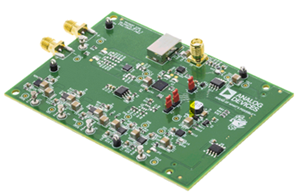
ADL9005-EVALZ
Analog Devices Inc.The ADL9005 is a gallium arsenide (GaAs), monolithic microwave integrated circuit (MMIC), pseudomorphic high electron mobility transistor (pHEMT), wideband, LNA that operates from 0.01 to 26.5 GHz. The ADL9005 provides a typical gain of 17.5 dB from 0.01 GHz to 14 GHz with a positive gain slope from 14 GHz to 20 GHz, a 13.5 dBm typical output power at 1 dB compression (OP1dB) from 0.01 GHz to 20 GHz, a 2.5 dB typical noise figure from 0.01 GHz to 14 GHz, and a typical output third-order intercept (OIP3) of 26 dBm from 0.01 GHz to 14 GHz, requiring only 80 mA from a 5 V supply voltage. The saturated output power (PSAT) of up to 16 dBm enables the LNA to function as a local oscillator (LO) driver for many of Analog Devices, Inc., balanced, inphase/quadrature (I/Q) or image rejection mixers. The ADL9005 also features inputs and outputs (I/Os) that are internally matched to 50 ?, making it ideal for surface-mounted technology (SMT)-based, high capacity microwave radio applications.The ADL9005 is housed in a RoHS-compliant, 4 mm ? 4 mm, LFCSP.Multifunction pin names may be referenced by their relevant function only.APPLICATIONSTest instrumentationMilitaryCommunications

ADM1270RQ-EVALZ
Analog Devices Inc.The ADM1270 is a current-limiting controller that providesinrush current limiting and overcurrent protection for modularor battery-powered systems. When circuit boards are insertedinto a live backplane, discharged supply bypass capacitors drawlarge transient currents from the backplane power bus as theycharge. These transient currents can cause permanent damageto connector pins, as well as dips on the backplane supply thatcan reset other boards in the system.The ADM1270 is designed to control the inrush current, whenpowering on the system, via an external P-channel field effecttransistor (FET).To protect the system from a reverse polarity input supply, thereis a provision made to control an additional external P-channelFET. This feature prevents reverse current flow in case of a reversepolarity connection, which can damage the load or the ADM1270.The ADM1270 is available in a 3 mm ? 3 mm, 16-lead LFCSP anda 16-lead QSOP. Applications Industrial modules Battery-powered/portable instrumentation

ADM7150CP-EVALZ
Analog Devices Inc.The ADM7150 is a low dropout linear regulator that operates from 4.5 V to 16 V and provides up to 800 mA of output current. Using an advanced proprietary architecture, they provide high power supply rejection, low noise, and achieve excellent line and loadtransient response with a 10 ?F ceramic output capacitor.The ADM7150 is available in 1.8 V, 2.8 V, 3.0 V, 3.3 V and 5.0 V fixed output. 16 fixed output voltages between 1.5 V and 5.0 V are available upon request.The ADM7150 regulator typical output noise is 1.0 ?Vrms from 100Hz to 100KHz for fixed output voltage options and

ADM7155CP-02-EVALZ
Analog Devices Inc.The ADM7155 is an adjustable linear regulator that operates from 2.3 V to 5.5 V and provides up to 600 mA of load current. Output voltages from 1.2 V to 3.4 V are possible depending on the model. Using an advanced proprietary architecture, it provides high power supply rejection and ultralow noise, achieving excellent line and load transient response with only a 10 ?F ceramic output capacitor.The ADM7155 is available in four models that optimize power dissipation and PSRR performance as a function of input and output voltage. The ADM7155 regulator typical output noise is 0.9 ?V rms from 100 Hz to 100 kHz for fixed output voltage options and 1.5 nV/?Hz for noise spectral density from 10 kHz to 1 MHz. The ADM7155?is available in 8-lead, 3 mm ? 3 mm LFCSP and 8-lead SOIC?packages, making it not only a very compact solution but also?providing excellent thermal performance for applications requiring?up to 600 mA of load current in a small, low profile footprint.Applications Regulation to noise sensitive applications: PLLs, VCOs, and PLLs with integrated VCOs Communications and infrastructure Backhaul and microwave links

ADM8612-EVALZ
Analog Devices Inc.The ADM8611 /?ADM8612?/?ADM8613?/?ADM8614?/?ADM8615?are voltage supervisory circuits that monitor power supply voltage levels and code execution integrity in microprocessor-based systems. Apart from providing power-on reset signals, an on-chip watchdog timer can reset the microprocessor if it fails to strobe within a preset timeout period. A reset signal can also be asserted by an external push-button through a manual reset input.The ultralow power consumption of these devices makes them suitable for power efficiency sensitive systems, such as battery-powered portable devices and energy meters.The features of each member of the device family are shown in Table 9 in the data sheet. Each device subdivides into submodels with differences in factory preset voltage monitoring threshold options. In the range of 2 V to 4.63 V, 10 options are available for the ADM8611. In the range of 2.32 V to 4.63 V, five options are available for both the ADM8613 and ADM8614. A separate supply input allows the ADM8612 and ADM8615 to monitor 20 different low voltage levels from 0.5 V to 1.9 V. Not all device options are available as standard models.The ADM8611, ADM8612, ADM8613, and ADM8615 can reset on demand through the manual reset input. The watchdog function on the ADM8613, ADM8614, and ADM8615 monitors the heartbeat of the microprocessor through the WDI pin. The ADM8613 and ADM8614 have a watchdog disable input, which allows the user to disable the watchdog function, if required. The ADM8614 also has a watchdog timeout extension input, allowing the watchdog timeout to be extended from 1.6 sec to 100 sec.The ADM8611/ADM8612/ADM8613/ADM8614/ADM8615 are available in a 6-ball, 1.46 mm ? 0.96 mm WLCSP. These devices are specified over the temperature range of ?40?C to +85?C.??APPLICATIONS Portable/battery-operated equipment Microprocessor systems Energy metering Energy harvesting

ADM8843EB-EVALZ
Analog Devices Inc.The ADM8843 uses charge pump technology to provide thepower to drive up to four LEDs. The LEDs are used for backlightinga color LCD display that has regulated constant currentfor uniform brightness intensity. The main display can use up tothree LEDs, and the sub display uses one LED. The CTRL1 andCTRL2 digital input control pins control the shutdown operationand the brightness of the main and sub displays.To maximize power efficiency, the charge pump can operate in1?, 1.5?, or 2? mode. The charge pump automatically switchesamong 1?/1.5?/2? modes, based on the input voltage, tomaintain sufficient drive for the LED anodes at the highestpower efficiency.Improved brightness matching of the LEDs is achieved by afeedback pin that senses individual LED current with a typicalmatching accuracy of 0.3%.Applications Cellular phones with main and sub displays White LED backlighting Camera flash/strobes and movie light applications Micro TFT color displays DSC PDAs
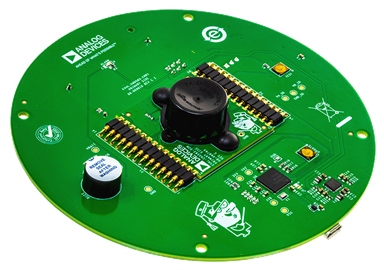
AD-MRLIDAR1-EBZ
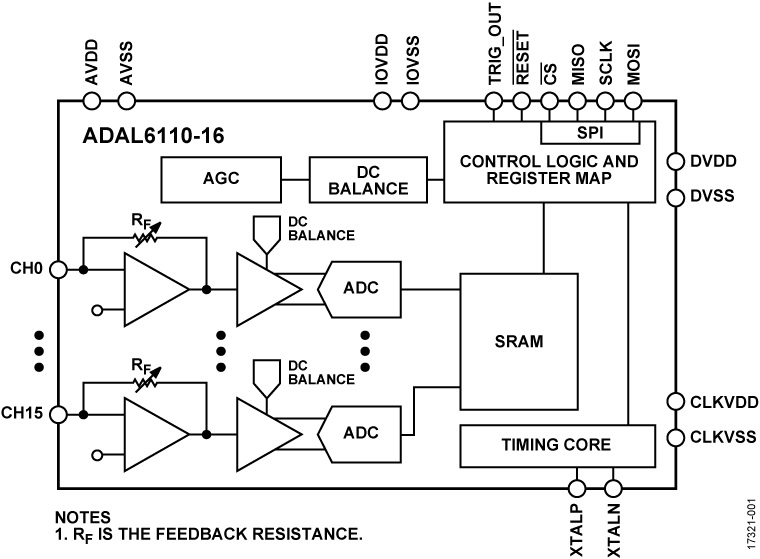
Analog Devices Inc.The ADAL6110-16 is a light detection and ranging (LIDAR)signal processor IC that supports simultaneous capture of up to16 channels. Each channel is integrated with a 16-bit analog todigital converter (ADC) to measure the optical return signal.The ADAL6110-16 stores the captured waveforms to staticrandom access memory (SRAM) storage. The data outputreadout and functional configuration of the LIDAR signalprocessor occurs over a 4-wire serial port interface (SPI).The LIDAR signal processor features a dc balance control toreject signal offset and corruption due to modulated interference,eliminating the need for external dc cancellation circuitry. Inaddition, the LIDAR signal processor has a built-in automaticgain control (AGC) that modifies the gain of the system toensure the signal of interest is automatically scaled to themeasurement range.The ADAL6110-16 simplifies the traditional multichannelLIDAR system implementation by integrating the transimpedanceamplifier (TIA), gain and sampling stages, as well as providingthe transmitter fire signal, all of which are managed by on-chipcontrol logic. No external components are required between thephotodiodes and the TIA interface of each channel in theLIDAR signal processor.Applications Autonomous systems collision avoidance Corridor mapping Dynamic suspension and flight control Drone altitude monitoring Industrial distance measurement Mounted safety curtain systems Parking spot monitoring Blind spot detection

ADMV1009-EVALZ
Analog Devices Inc.The ADMV1009 is a compact, gallium arsenide (GaAs) design,monolithic microwave integrated circuit (MMIC), upper sideband(USB), differential, upconverter in a RoHS compliant packageoptimized for point to point microwave radio designs thatoperate in the 12.7 GHz to 15.4 GHz frequency range.The ADMV1009 provides 21 dB of conversion gain with 20 dBof sideband rejection. The ADMV1009 uses a radio frequency (RF)amplifier preceded by a passive, double balanced mixer, where adriver amplifier drives the local oscillator (LO). IF1 and IF2 mixerinputs are provided, and an external 180? balun is needed todrive the IF pins differentially. The ADMV1009 is a muchsmaller alternative to hybrid style single sideband (SSB)upconverter assemblies and eliminates the need for wirebonding by allowing the use of surface-mount manufacturingassemblies.The ADMV1009 upconverter comes in a compact, thermallyenhanced, 4.9 mm ? 4.9 mm LCC package. The ADMV1009operates over the ?40?C to +85?C temperature range.Applications Point to point microwave radios Radars and electronic warfare systems Instrumentation, automatic test equipment

ADMV1128IQ-EVALZ
Analog Devices Inc.The ADMV1128 is a silicon on isolator (SOI), microwave, upconverter and downconverter optimized for 5G radio designs operating in the 24 GHz to 29.5 GHz frequency range.Both upconverters and downconverters offer two modes of frequency translation. One mode is conversion from and/or to single-ended or complex intermediate frequency (IF) signals, which then pass through an on-chip 90? IF hybrid, known as IF mode.The other mode is a direct conversion from and/or to differential baseband inphase/quadrature (I/Q) inputs and outputs, known as baseband mode. The I/Q baseband output common-mode voltage is programmable between 0 V and 1.5 V. The SPI provides fine adjustment of the quadrature phase to optimize I/Q demodulation performance.When the device is used as an image rejecting downconverter, the unwanted image term is typically rejected to 24 dBc, before calibration. The ADMV1128 offers a square law power detector to allow monitoring of the power levels at the mixer inputs of the downconverter.The RF receive input, RF transmit output, and local oscillator (LO) interface are all single-ended and matched to 50 ?. The on-chip RF switch provides the option to combine the transmit and receive RF ports together for time division duplex (TDD) applications. The serial port interface (SPI) provides adjustment of the quadrature phase to allow optimum sideband rejection. In addition, the SPI allows powering down the output envelope detector to reduce power consumption when carrier feedthrough optimization is not necessary.The ADMV1128 upconverter and downconverter is housed in a compact, thermally enhanced, 6 mm ? 6.5 mm, ball grid array (BGA) package. This BGA package enables the ability to heat sink the ADMV1128 from the top of the package for the most efficient thermal heat sinking. The ADMV1128 operates over the ?40?C to +95?C TC range.APPLICATIONS Millimeter-wave 5G applications Point to point microwave radios Radar and electronic warfare systems Instrumentation and automatic test equipment (ATE)

ADMV7410-EVALZ
Analog Devices Inc.The ADMV7410 is a fully integrated system in package (SiP)in phase/quadrature (I/Q) downconverter that operatesbetween an intermediate frequency (IF) output range of dc and2 GHz and a radio frequency (RF) input range of 71 GHz and76 GHz. The device provides a small signal conversion gain of13 dB with 30 dBc of image rejection. The ADMV7410 uses alow noise amplifier followed by an image rejection mixer that isdriven by a 6? local oscillator (LO) multiplier. Differential Iand Q mixer outputs are provided for direct conversionapplications. Alternatively, the outputs can be combined usingan external 90? hybrid and two external 180? hybrids for single-ended applications. The ADMV7410 comes in a fully integrated, surface-mount,34-terminal, 11 mm ? 13 mm, chip array small outline no leadcavity (LGA_CAV) package. The ADMV7410 operates over the?40?C to +85?C case temperature range.APPLICATIONS E-band communication systems High capacity wireless backhauls Test and measurement Aerospace and defense

ADMV8416-EVALZ
Analog Devices Inc.The ADMV8416 is a monolithic microwave integrated circuit (MMIC), tunable band-pass filter that features a user selectable pass-band frequency. The 3 dB filter bandwidth is approximately 15% of the center frequency (fCENTER), and the 20 dB filter bandwidth is 37%. Additionally, fCENTER can be varied between 6.8 GHz to 16.8 GHz by applying an analog fCENTER tuning voltage between 0 V to 15 V. The usable pass band corner frequencies (fCORNER) span from 6.3 GHz to 18 GHz. This tunable filter can be used as a much smaller alternative to large switched filter banks and cavity tuned filters. The filter has excellent microphonics due to the monolithic design and provides a dynamically adjustable solution.Applications Test and measurement equipment Military radar and electronic warfare (EW) systems Video satellite (VSAT) communications

ADMV8420-EVALZ
Analog Devices Inc.ADMV8420ACPZThe ADMV8420 is a monolithic microwave integrated circuit (MMIC), tunable band-pass filter that features a user-selectable pass band frequency. The 3 dB filter bandwidth is approximately 20%, and the 20 dB filter bandwidth is approximately 40%. Additionally, the center frequency (fCENTER) varies between 11.1 GHz to 19.6 GHz by applying a center frequency control voltage between 0 V to 15 V. The usable pass band corner frequencies (fCORNER) span from 10 GHz to 21.7 GHz. This tunable filter is a smaller alternative to switched filter banks and cavity tuned filters. The ADMV8420 has minimal microphonics due to the monolithic design and provides a dynamically adjustable solution in advanced communications applications.ADMV8420CHIPSThe ADMV8420 is a monolithic microwave IC (MMIC), tunable band-pass filter (BPF) that features a user?selectable pass band frequency. The 3 dB filter bandwidth is approximately 20%, and the 20 dB filter bandwidth is approximately 40%. Additionally, the center frequency (fCENTER) varies between 10.5 GHz to 21 GHz by applying a center frequency control voltage (VFCTL) between 0 V to 15 V. The usable pass band 3 dB corner frequency (f3dB) spans from 10 GHz to 22.8 GHz. This tunable filter is a smaller alternative to switched filter banks and cavity tuned filters. The ADMV8420 has minimal microphonics due to the monolithic design and provides a dynamically adjustable solution in advanced communications applications.Applications Test and measurement equipment Military radar and electronic warfare systems Very small aperture terminal (VSAT) communications Airport scanners

ADMV8526-EVALZ
Analog Devices Inc.The ADMV8526 is an RF band-pass filter that features a digitally selectable frequency of operation. The filter center frequency (fCENTER) can be adjusted from 1.25 GHz to 2.60 GHz, using an 8-bit value (256 states) that incorporates a patent pending interpolation technique.The typical 3 dB bandwidth is 9% and adjustability is ?2%. Insertion loss is typically 4 dB, and the 20 dB rejection is 16% away from fCENTER, which is ideally suited for minimizing system interferers.This tunable filter can be used as a smaller alternative to large switched filter banks and discrete component-based tunable filters, and this device provides a dynamically adjustable solution in advanced communications applications.

ADMV8913-EVALZ
Analog Devices Inc.The ADMV8913 is a fully monolithic microwave integrated circuit that that features a digitally selectable frequency of operation. The device has an integrated high-pass filter and an integrated low-pass filter, that allow a pass-band response within the 7 to 12 GHz frequency range.The flexible architecture of the ADMV8913 allows for 3 dB cutoff frequency (f3dB) of the high-pass and the low-pass filter to be controlled independently. The digital logic control on each filter is 4 bits wide (16 states) and controls the on-chip reactive elements to adjust the f3dB. The typical insertion loss is 5 dB, and the wideband rejection is 35 dB, which is ideally suitable for minimizing system harmonics.This tunable filter can be used as a smaller alternative to large switched filter banks and cavity tuned filters, and this device provides a dynamically adjustable solution in advanced communications applications.APPLICATIONSTest and measurement equipmentMilitary radar and electronic warfare/electronic countermeasuresSatellite communicationsIndustrial and medical equipment

ADN4604-EVALZ
Analog Devices Inc.The ADN4604 is a 16 ? 16 asynchronous, protocol agnostic, digital crosspoint switch, with 16 differential PECL-/CML-compatible inputs and 16 differential CML outputs.The ADN4604 is optimized for nonreturn-to-zero (NRZ) signaling with data rates of up to 4.25 Gbps per port. Each port offers a fixed level of input equalization and programmable output swing and output preemphasis.The ADN4604 nonblocking switch core implements a 16 ? 16 crossbar and supports independent channel switching through the serial control interface. The ADN4604 has low latency and very low channel-to-channel skew.An I2C? or SPI interface is used to control the device and provide access to advanced features, such as additional levels of preemphasis and output disable.The ADN4604 is packaged in a 100-lead TQFP package and operates from ?40?C to +85?C.APPLICATIONS Fiber optic network switching High speed serial backplane routing to OC-48 with FEC XAUI: 10GBASE-KX4 Gigabit Ethernet over backplane: 1000BASE-KX 1?, 2?, and 4? Fibre Channel InfiniBand? Digital video (HDMI, DVI, DisplayPort, 3G-/HD-/SD-SDI) Data storage networks

ADN4612-EVALZ
Analog Devices Inc.The ADN4612 is a 12 ? 12 asynchronous, protocol agnostic, digitalcrosspoint switch with 12 differential PECL-/CML-compatibleinputs and 12 differential CML outputs.The ADN4612 is optimized for nonreturn-to-zero (NRZ) signalingwith data rates of up to 11.3 Gbps per port. Each port providesprogrammable input equalization, loss of signal (LOS) detection,programmable output swing, and output preemphasis/deemphasis.The ADN4612 nonblocking switch core implements a 12 ? 12crossbar and supports independent channel switching throughthe serial control interface. The ADN4612 has low latency andvery low channel-to-channel skew.The ADN4612 is packaged in an 88-lead LFCSP package andoperates from ?40?C to +85?C.Applications Fiber optic network switching 10 Gigabit Ethernet over backplane 10GBASE-KR 802.3ap XLAUI/CAUI (802.3ba) SONET OC-192/STM-64x 1?, 2?, 4?, 8?, and 10? Fibre Channel

ADN8834CB-EVALZ
Analog Devices Inc.The ADN88341 is a monolithic TEC controller with an integrated TEC controller. It has a linear power stage, a pulse-width modulation (PWM) power stage, and two zero-drift, rail-to-rail operational amplifiers. The linear controller works with the PWM driver to control the internal power MOSFETs in an H-bridge configuration. By measuring the thermal sensor feedback voltage and using the integrated operational amplifiers as a proportional integral differential (PID) compensator to condition the signal, the ADN8834 drives current through a TEC to settle the temperature of a laser diode or a passive component attached to the TEC module to the programmed target temperature.The ADN8834 supports negative temperature coefficient (NTC) thermistors as well as positive temperature coefficient (PTC) resistive temperature detectors (RTD). The target temperature is set as an analog voltage input either from a digital-to-analog converter (DAC) or from an external resistor divider.The temperature control loop of the ADN8834 is stabilized by PID compensation utilizing the built in, zero drift chopper amplifiers. The internal 2.50 V reference voltage provides a 1% accurate output that is used to bias a thermistor temperature sensing bridge as well as a voltage divider network to program the maximum TEC current and voltage limits for both the heating and cooling modes. With the zero drift chopper amplifiers, extremely good long-term temperature stability is maintained via an autonomous analog temperature control loop.APPLICATIONS TEC temperature control Optical modules Optical fiber amplifiers Optical networking systems Instruments requiring TEC temperature control1 Product is covered by U.S. Patent No. 6,486,643.

ADP1031CP-4-EVALZ
Analog Devices Inc.The ADP1031 is a high performance, isolated micropowermanagement unit (PMU) that combines an isolated flybackdc-to-dc regulator, an inverting dc-to-dc regulator, and abuck dc-to-dc regulator, providing three isolated power rails.Additionally, the ADP1031 contains four, high speed, serialperipheral interface (SPI) isolation channels and three general-purpose isolators for channel to channel applications where lowpower dissipation and small solution size is required.Operating over an input voltage range of +4.5 V to +60 V, theADP1031 generates isolated output voltages of +6 V to +28 V(adjustable version) or+ 21 V and +24 V (fixed versions) forVOUT1, factory programmable voltages of +5.15 V, +5.0 V, or+3.3 V for VOUT2, and an adjustable output voltages of ?24 V to?5 V for VOUT3.By default, the ADP1031 flyback regulator operates at a 250 kHzswitching frequency and the buck and inverting regulators operateat 125 kHz. All three regulators are phase shifted relative to eachother to reduce electromagnetic interference (EMI). The ADP1031can be driven by an external oscillator in the range of 350 kHzto 750 kHz to ease noise filtering in sensitive applications.The digital isolators integrated in the ADP1031 use AnalogDevices, Inc., iCoupler? chip scale transformer technology,optimized for low power and low radiated emissions.The ADP1031 is available in a 9 mm ? 7 mm, 41-lead LFCSP andis rated for a ?40?C to +125?C operating junction temperaturerange.Applications Industrial automation and process control Instrumentation and data acquisition systems Data and power isolation

ADP1034CP-1-EVALZ
Analog Devices Inc.The ADP1034 is high performance, isolated micropower management unit (PMU) that combines an isolated flyback dc-to-dc regu-lator, an inverting buck boost dc-to-dc regulator, and a buck dc-to-dc regulator, providing three isolated power rails. The ADP1034 includes four high speed serial peripheral interface (SPI) isolation channels and three general-purpose isolators for channel to channel applications where low power dissipation and small solution size are required.Operating over an input voltage range of 4.5 V to 60 V, the ADP1034 generates isolated output voltage ranges of 6 V to 28 V for VOUT1, ?24 V to ?2 V for VOUT3, and a factory-programmable voltage of 5 V for VOUT2. Additionally, a PPC_IN pin is provided for adjusting the VOUT1 setting on demand through a serial command that allows higher efficiency in system level applications.By default, the ADP1034 flyback regulator operates at a 250 kHz switching frequency, and the buck and inverting regulators operate at 125 kHz. The ADP1034 can be driven by an external oscillator in the range of 350 kHz to 750 kHz to ease noise filtering in sensitive applications.The digital isolators integrated in the ADP1034 use Analog Devices, Inc., iCoupler? chip scale transformer technology optimized for low power and low radiated emissions. The ADP1034 is available in a 9 mm ? 7 mm, 41-lead lead frame chip scale package (LFCSP) and is rated for a ?40?C to +125?C operating junction temperature range.APPLICATIONSIndustrial automation and process controlInstrumentation and data acquisition systemsData and power isolation

ADP1071-2EBZ12.1V
Analog Devices Inc.The ADP1071-1/ADP1071-2 are pulse-width modulation (PWM) current mode fixed frequency synchronous flyback controllers designed for isolated dc-to-dc power supplies. Analog Devices proprietary iCouplers? are integrated in the ADP1071-1/ADP1071-2 to eliminate the bulky signal trans-formers and optocouplers that transmit signals over the isolation boundary. Integrating the iCouplers reduces system design complexity, cost, and component count and improves overall system reliability. With the integrated isolators and metal-oxide semiconductor field effect transistor (MOSFET) drivers on both the primary and the secondary side, the ADP1071-1/ADP1071-2 offer a compact system level design and yield a higher efficiency than a diode rectified flyback converter at heavy loads.Output regulation is achieved by sensing the output voltage on the secondary side, where the feedback and the PWM signals are transmitted between the primary and secondary sides through the iCouplers.The ADP1071-1/ADP1071-2 are offered in a 16-lead SOIC_W package with an isolation voltage rating of 5 kV rms. The ADP1071-2 is designed for isolated dc-to-dc applications typically with an input voltage less than 36 V, and the ADP1071-1 targets high input voltage applications, in which the dc input voltage can exceed 60 V.The ADP1071-1/ADP1071-2 offer features such as input current protection, output overvoltage protection (OVP), undervoltage lockout (UVLO), precision enable with adjustable hysteresis, overtemperature protection (OTP), and power saving light load mode (LLM).Applications Isolated dc-to-dc or ac-to-dc power conversion Telecom, industrial Small cell PoE powered device Enterprise switches and routers