EVAL-ADXL362Z
Analog Devices Inc.The ADXL362 is an ultralow power, 3-axis MEMS accelerometer that consumes less than 2 ?A at a 100 Hz output data rate and 270 nA when in motion triggered wake-up mode. Unlike accelerometers that use power duty cycling to achieve low power consumption, the ADXL362 does not alias input signals by undersampling; it samples the full bandwidth of the sensor at all data rates.The ADXL362 always provides 12-bit output resolution; 8-bit formatted data is also provided for more efficient single-byte transfers when a lower resolution is sufficient. Measurement ranges of ?2 g, ?4 g, and ?8 g are available, with a resolution of 1 mg/LSB on the ?2 g range. For applications where a noise level lower than the normal 550 ?g/?Hz of the ADXL362 is desired, either of two lower noise modes (down to 175 ?g/?Hz typical) can be selected at minimal increase in supply current.In addition to its ultralow power consumption, the ADXL362 has many features to enable true system level power reduction. It includes a deep multimode output FIFO, a built-in micropower temperature sensor, and several activity detection modes including adjustable threshold sleep and wake-up operation that can run as low as 270 nA at a 6 Hz (approximate) measurement rate. A pin output is provided to directly control an external switch when activity is detected, if desired. In addition, the ADXL362 has provisions for external control of sampling time and/or an external clock.The ADXL362 operates on a wide 1.6 V to 3.5 V supply range, and can interface, if necessary, to a host operating on a separate, lower supply voltage. The ADXL362 is available in a 3 mm ? 3.25 mm ? 1.06 mm package.APPLICATIONS Hearing aids Home healthcare devices Motion enabled power save switches Wireless sensors Motion enabled metering devices

EVAL-ADXL363Z-S
Analog Devices Inc.The ADXL363 is an ultralow power, three-sensor combination consisting of a 3-axis MEMS accelerometer, a temperature sensor, and an on-board analog-to-digital converter (ADC) input for synchronous conversion of an external signal. The entire system consumes less than 2 ?A at a 100 Hz output data rate and 270 nA when in motion triggered wake-up mode.The ADXL363 communicates via a serial port interface (SPI) and always provides 12-bit output resolution for all three sensors.The ADXL363 temperature sensor operates with a scale factor of 0.065?C/LSB (typical). Acceleration and temperature data can be stored in a 512-sample multimode first in, first out (FIFO) buffer, allowing up to 13 sec of data to be stored.In addition to the accelerometer and temperature sensor, the ADXL363 also provides access to an internal ADC for synchronous conversion of an additional analog input.The ADXL363 operates on a wide 1.6 V to 3.5 V supply range, and can interface, if necessary, to a host operating on a separate, lower supply voltage. The ADXL363 is available in a 3 mm ? 3.25 mm ? 1.06 mm package.APPLICATIONS Home healthcare devices Wireless sensors Motion enabled metering devices

EVAL-ADXL367-SDP
Analog Devices Inc.The ADXL367 is an ultralow power, 3-axis microelectromechanical systems (MEMS) accelerometer that consumes only 0.89 ?A at a 100 Hz output data rate and 180 nA when in motion-triggered wake-up mode. Unlike accelerometers that use power duty cycling to achieve low power consumption, the ADXL367 does not alias input signals by undersampling, but samples the full bandwidth of the sensor at all data rates.The ADXL367 always provides 14-bit output resolution. 8-bit formatted data is offered for more efficient single-byte transfers when a lower resolution is sufficient. 12-bit formatted data is also provided for ADXL362 design compatibility. Measurement ranges of ?2 g, ?4 g, and ?8 g are available, with a resolution of 0.25 mg/LSB on the ?2 g range.In addition to its ultralow power consumption, the ADXL367 has many features to enable true system level power reduction. It includes a deep multimode output first in, first out (FIFO), a built-in micropower temperature sensor, an internal analog-to-digital converter (ADC) for synchronous conversion of an additional analog input with interrupt capability, single-tap and double-tap detection that can operate at any output data rate with only an added 35 nA of current, and a state machine to prevent a false triggering. In addition, the ADXL367 has provisions for external control of the sampling time and/or an external clock.The ADXL367 operates on a wide 1.1 V to 3.6 V supply range, and can interface, if necessary, to a host operating on a separate supply voltage. The ADXL367 is available in a 2.2 mm ? 2.3 mm ? 0.87 mm package.APPLICATIONS 24/7 Always on sensing Industrial Digital Healthcare Prosumer Hearing aids Vital signs monitoring devices Motion-enabled power save switches Motion-enabled metering devices Smart watch with single-cell operation Smart homes
ADXL367 Breakout Board
Analog Devices Inc.The EVAL-ADXL367Z is a simple breakout board that enables easy connection of an ADXL367 into an existing system. The ADXL367 is a nanowatt, 3-axis, digital-output accelerometer whose industry leading low power consumption and built-in features make it ideal for use in a wide variety of applications. Due to its small size, the EVAL-ADXL367Z has minimal effect on performance of the system and of the accelerometer, and thus it is ideal for evaluation of the ADXL367 in an existing system. Note that the ADXL367 must be communicated with digitally via SPI or I2C. No processor is included with the EVAL-ADXL367Z; firmware must be supplied externally by the user. For evaluation boards that include a processor, please see the EVAL-ADXL367-SDP.
MARKETS & TECHNOLOGY
Industrial
Digital Healthcare
Prosumer
Automotive
Aerospace and Defense

EVAL-ADXL372Z-S
Analog Devices Inc.The ADXL372 is an ultralow power, 3-axis, ?200 g MEMS accelerometer that consumes 22 ?A at a 3200 Hz output data rate (ODR). The ADXL372 does not power cycle its front end to achieve its low power operation and therefore does not run the risk of aliasing the output of the sensor.In addition to its ultralow power consumption, the ADXL372 has many features to enable impact detection while providing system level power reduction. The device includes a deep multimode output first in, first out (FIFO), several activity detection modes, and a method for capturing only the peak acceleration of over threshold events.Two additional lower power modes with interrupt driven, wake-up features are available for monitoring motion during periods of inactivity. In wake-up mode, acceleration data can be averaged to obtain a low enough output noise to trigger on low g thresholds. In instant on mode, the ADXL372 consumes 1.4 ?A while continuously monitoring the environment for impacts. When an impact event that exceeds the internally set threshold is detected, the device switches to normal operating mode fast enough to record the event.High g applications tend to experience acceleration content over a wide range of frequencies. The ADXL372 includes a 4-pole low-pass antialiasing filter to attenuate out of band signals that are common in high g applications. The ADXL372 also incorporates a high-pass filter to eliminate initial and slow changing errors, such as ambient temperature drift.The ADXL372 provides 12-bit output data at 100 mg/LSB scale factor. The user can access configuration and data registers via the serial peripheral interface (SPI) or limited I2C protocol. The ADXL372 operates over a wide supply voltage range and is available in a 3 mm ? 3.25 mm ? 1.06 mm package.Multifunction pin names may be referenced by their relevant function only.APPLICATIONS Impact and shock detection Asset health assessment Portable Internet of Things (IoT) edge nodes Concussion and head trauma detection

EVAL-ADXL375Z-S
Analog Devices Inc.The ADXL375 is a small, thin, 3-axis MEMS accelerometer that provides low power consumption and high resolution measurement up to ?200?g. The digital output data is formatted as 16-bit, twos complement data and is accessible through a SPI (3- or 4-wire) or I2C digital interface.An integrated memory management system with a 32-level first in, first out (FIFO) buffer can be used to store data to minimize host processor activity and lower overall system power consumption.Low power modes enable intelligent motion-based power management with threshold sensing and active acceleration measurement at extremely low power dissipation.The ADXL375 is supplied in a small, thin, 3 mm ? 5 mm ? 1 mm, 14-lead LGA.APPLICATIONS Concussion and head trauma detection High force event detection

EVAL-ADXRS290Z
Analog Devices Inc.The ADXRS290 is a high performance pitch and roll (dual-axis in-plane) angular rate sensor (gyroscope) designed for use in stabilization applications.The ADXRS290 provides an output full-scale range of ?100?/s with a sensitivity of 200 LSB/?/s. Its resonating disk sensor structure enables angular rate measurement about the axes normal to the sides of the package around an in-plane axis. Angular rate data is formatted as 16-bit twos complement and is accessible through a SPI digital interface. The ADXRS290 exhibits a low noise floor of 0.004?/s/?Hz and features programmable high-pass and low-pass filters.The ADXRS290 is available in a 4.5 mm ? 5.8 mm ? 1.2 mm, 18-terminal cavity laminate package.APPLICATIONS Optical image stabilization Platform stabilization Wearable products
EVAL-ADXRS290Z-M2
Analog Devices Inc.The ADXRS290 is a high performance pitch and roll (dual-axis in-plane) angular rate sensor (gyroscope) designed for use in stabilization applications.The ADXRS290 provides an output full-scale range of ?100?/s with a sensitivity of 200 LSB/?/s. Its resonating disk sensor structure enables angular rate measurement about the axes normal to the sides of the package around an in-plane axis. Angular rate data is formatted as 16-bit twos complement and is accessible through a SPI digital interface. The ADXRS290 exhibits a low noise floor of 0.004?/s/?Hz and features programmable high-pass and low-pass filters.The ADXRS290 is available in a 4.5 mm ? 5.8 mm ? 1.2 mm, 18-terminal cavity laminate package.APPLICATIONS Optical image stabilization Platform stabilization Wearable products

EVAL-ADXRS453Z-S
Analog Devices Inc.The ADXRS453 is an angular rate sensor (gyroscope) intended for industrial, instrumentation, and stabilization applications in high vibration environments. An advanced, differential, quad sensor design rejects the influence of linear acceleration, enabling the ADXRS453 to offer high accuracy rate sensing in harsh envi-ronments where shock and vibration are present.The ADXRS453 uses an internal, continuous self-test architec-ture. The integrity of the electromechanical system is checked by applying a high frequency electrostatic force to the sense structure to generate a rate signal that can be differentiated from the base-band rate data and internally analyzed.The ADXRS453 is capable of sensing an angular rate of up to ?300?/sec. Angular rate data is presented as a 16-bit word that is part of a 32-bit SPI message.The ADXRS453 is available in a 16-lead plastic cavity SOIC (SOIC_CAV) and an SMT-compatible vertical mount package (LCC_V), and is capable of operating across a wide voltage range (3.3 V to 5 V). ApplicationsRotation sensing in high vibration environments Rotation sensing for industrial and instrumentation applicationsHigh performance platform stabilization
EVAL-ADXRS453Z-V
Analog Devices Inc.The ADXRS453 is an angular rate sensor (gyroscope) intended for industrial, instrumentation, and stabilization applications in high vibration environments. An advanced, differential, quad sensor design rejects the influence of linear acceleration, enabling the ADXRS453 to offer high accuracy rate sensing in harsh envi-ronments where shock and vibration are present.The ADXRS453 uses an internal, continuous self-test architec-ture. The integrity of the electromechanical system is checked by applying a high frequency electrostatic force to the sense structure to generate a rate signal that can be differentiated from the base-band rate data and internally analyzed.The ADXRS453 is capable of sensing an angular rate of up to ?300?/sec. Angular rate data is presented as a 16-bit word that is part of a 32-bit SPI message.The ADXRS453 is available in a 16-lead plastic cavity SOIC (SOIC_CAV) and an SMT-compatible vertical mount package (LCC_V), and is capable of operating across a wide voltage range (3.3 V to 5 V). ApplicationsRotation sensing in high vibration environments Rotation sensing for industrial and instrumentation applicationsHigh performance platform stabilization

EVAL-ADXRS623Z
Analog Devices Inc.The ADXRS623 is a complete angular rate sensor (gyroscope)that uses the Analog Devices, Inc. surface-micromachiningprocess to create a functionally complete and low cost angularrate sensor integrated with all required electronics on one chip.The manufacturing technique for this device is the same highvolume BiMOS process used for high reliability automotiveairbag accelerometers.The ADXRS623 is an automotive grade gyroscope. Automotive grade gyroscopes have more extensive guaranteed min/max specifications due to automotive testing.The output signal, RATEOUT (1B, 2A), is a voltageproportional to the angular rate about the axis that is normal tothe top surface of the package. The output is ratiometric withrespect to a provided reference supply. A single externalresistor between SUMJ and RATEOUT can be used to lowerthe scale factor. An external capacitor sets the bandwidth. Otherexternal capacitors are required for operation.A temperature output is provided for compensation techniques.Two digital self-test inputs electromechanically excite thesensor to test proper operation of both the sensor and the signalconditioning circuits. The ADXRS623 is available in a 7 mm ?7 mm ? 3 mm BGA chip scale package.APPLICATIONS Inertial measurement units Platform stabilization Robotics

EVAL-ADXRS800Z-S
Analog Devices Inc.The ADXRS800 is an angular rate sensor (gyroscope) intended for automotive electronic stability control, vehicle rollover detection, and other high performance applications. An advanced, differential, quad-sensor design rejects the influence of linear acceleration, enabling the ADXRS800 to operate in exceedingly harsh environments where shock and vibration are present.The ADXRS800 uses an internal, continuous self-test archi-tecture. The integrity of the electromechanical system is checked by applying a high frequency electrostatic force to the sense structure to generate a rate signal that can be differentiated from the baseband rate data and internally analyzed.The ADXRS800 is capable of sensing an angular rate of up to ?300?/sec. Angular rate data is presented as a 16-bit word, as part of a 32-bit SPI message.The ADXRS800 is available in a cavity plastic SOIC-16 and an SMT-compatible vertical mount package and is capable of operating across both a wide voltage range (3.3 V to 5 V) and temperature range (?40?C to 105?C).APPLICATIONS Electronic stability control High performance platform stabilization

Highest Performance, Low EMI Evaluation Board for LT8357
Analog Devices Inc.Evaluation circuit EVAL-LT8357-AZ features the LT8357 as a 200kHz low EMI and low IQ, boost controller with a 24V output from 4.5V to 20V input. This evaluation circuit features Spread Spectrum Frequency Modulation (SSFM) and EMI filters to provide optimum EMI performance. The board also contains placeholders and an outline to attach clips for an optional EMI Shield attachment. This application circuit can output 2A (see Figure 4 Maximum Output Current vs VIN curve in the user guide). When placed in shutdown, the converter has very low quiescent current, ideal in automotive and other battery-powered applications. PULSE SKIP and BURST modes are selectable with jumper JP1. Each user-selectable option enables low quiescent current at light load and can also be combined with SSFM operation using JP1.
The LT8357 boost controller IC operates over an input range of 3V to 60V, suitable for automotive, telecom and industrial applications. It exhibits a low quiescent current of 8μA, making it ideal for battery-operated systems. It drives a low side N-channel power MOSFET with a 5V split gate drive. The converter provides adjustable and synchronizable operation from 100kHz to 2MHz with SSFM option. At light load, either PULSE SKIP or low-ripple BURST mode can be selected to improve the efficiency. The LT8357 packs popular features such as soft-start, input undervoltage lockout, adjustable switching frequency and clock synchronization. The Power Good (PGOOD) flag indicates when the output voltage is in regulation.
The LT8357 comes in a thermally enhanced 12-lead plastic MSE package. The LT8357 data sheet gives a complete description of the part, pins, features, operation, and application information. The data sheet must be read in conjunction with the user guide for EVAL-LT8357-AZ.

LT8692S | 42V/2A plus 3× 8V/1A, 2MHz Quad Monolithic Synchronous Step-Down Regulator
Analog Devices Inc.Demonstration circuit EVAL-LT8692S-AZ is an ultracompact 4 rail power supply featuring the LT8692S, a 42V quad monolithic synchronous step-down Silent Switcher®. The demo circuit is designed for 5V, 3.3V, 1.8V, and 1.2V outputs from a nominal 12V input. The 3.3V, 1.8V and 1.2V converters are powered from the high voltage buck regulator with 5V output, which is powered from a wide range of 6.2V to 42V input. The current capability is 2A for the channel 1, and 1A for the low voltage channels.
Internal soft-start, individual current limit, independent enable for each channel simplify the complex design of quad-output power converters. All regulators can be synchronized to a common external clock input or internal oscillator of 2MHz.
The table in the demo manual summarizes the performance of the demo board at room temperature. The circuit can be easily modified for different applications.
The LT8692S data sheet gives a complete description of the part, operation and application information. The data sheet must be read in conjunction with the quick start guide for demo circuit EVAL-LT8692S-AZ.
EVAL-LTC2387-REF1Z
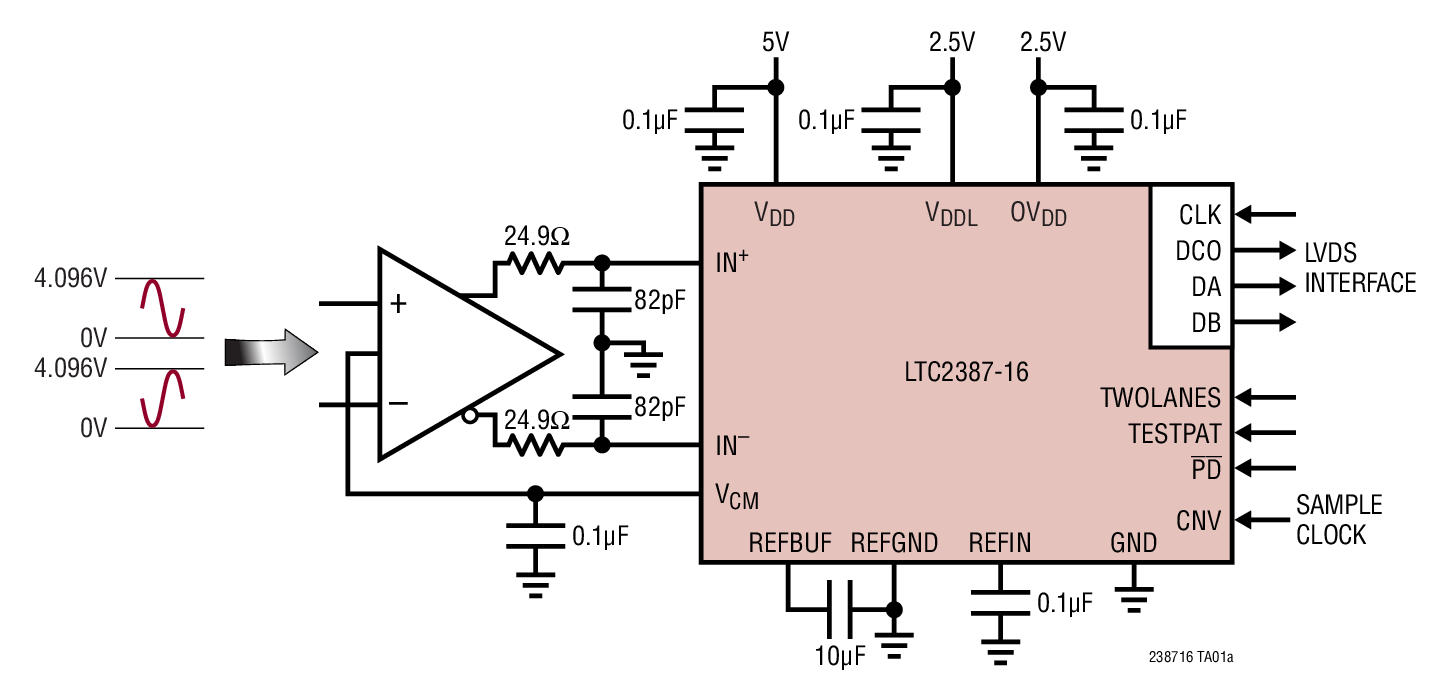
Analog Devices Inc.The LTC2387-16 is a low noise, high speed, 16-bit 15Msps successive approximation register (SAR) ADC ideally suited for a wide range of applications. The combination of excellent linearity and wide dynamic range makes the LTC2387-16 ideal for high speed imaging and instrumentation applications. No-latency operation provides a unique solution for high speed control loop applications. The very low distortion at high input frequencies enables communications applications requiring wide dynamic range and significant signal bandwidth.To support high speed operation while minimizing the number of data lines, the LTC2387-16 features a serial LVDS digital interface. The LVDS interface has one-lane and two-lane output modes, allowing the user to optimize the interface data rate for each application.Applications High Speed Data Acquisition Imaging Communications Control Loops Instrumentation ATE

EVAL-LTC6229MS8E
Analog Devices Inc.The LTC6228/LTC6229 are single/dual very fast, low noise rail-to-rail output, unity gain stable op amps. They have a gain-bandwidth product of 890MHz and a slew rate of 500V/?s. The low input referred voltage noise of only 0.88nV/?Hz and low distortion performance of better than ?100dB at 4VP-P even for signals as fast as 2MHz make them ideal for applications that require high dynamic range and deal with high slew rate signals, such as driving A/D converters. Additional features include Shutdown and the ability to enable/disable internal bias current cancellation to optimize noise performance.The combination of low offset, low offset drift, high gain and high CMRR make the LTC6228 family the superior choice for wide dynamic range applications.The LTC6228 family maintains excellent performance for supply voltages of 2.8V to 11.75V and the devices are specified at supplies of 3V, 5V and 10V(?5V). With an input range extending to the negative rail and an output range that encompasses the entire supply range, the operational amplifier can accommodate wide swinging signals, and single supply operation.For space constrained PCB layouts, the LTC6228 is available in a 2mm ? 2mm DFN and the LTC6229 is available in a 3mm ? 3mm DFN. The amplifiers are also available in conventional leaded packages. These amplifiers can be used as improved replacements for many high speed op amps to improve speed, noise, distortion and dynamic range.Applications Optical Electronics: Fast Transimpedance Amplifiers Driving High Dynamic Range A/D Converters Active Filters Video Amplifiers High Speed Differential to Single-Ended Conversion Low Voltage Hi-Fi Amplification

EVALPRAHVOPAMP-1RZ
Analog Devices Inc.The ADA4700-1 is a high voltage, precision, single-channel operational amplifier with a wide operating voltage range (?5 V to ?50 V) and relatively high output current drive. Its advanced design combines low power (170 mW for a ?50 V supply), high bandwidth (3.5 MHz), and a high slew rate with unity-gain stability and phase inversion free performance. The ability to swing near rail to rail at the output enables designers to maximize signal-to-noise ratios (SNRs).The ADA4700-1 is designed for applications requiring both ac and dc precision performance, making the ADA4700-1 useful in a wide variety of applications, including high voltage test equipment and instrumentation, high voltage regulators and power amplifiers, power supply control and protection, and as an amplifier or buffer for transducers with wide output ranges. It is particularly well suited for high intensity LED testing applications where it provides highly accurate voltage and current feedback as well as a predriver to provide accurate voltage and/or current sourcing stimulus to the LED string under test.The ADA4700-1 is specified over the industrial temperature range of ?40?C to +85?C and includes thermal regulation at a junction temperature greater than 145?C and an integrated current limit. The ADA4700-1 is available in a thermally enhanced, 8-lead SOIC package with an exposed pad.APPLICATIONSAutomated and bench top test equipmentHigh-voltage regulators and power amplifiersData acquisition and signal conditioningPiezo drivers and predriversGeneral-purpose current sensing

EVAL-SSM3582Z
Analog Devices Inc.TThe SSM3582A is a fully integrated, high efficiency, digital input stereo Class-D audio amplifier. The device can operate from a single supply and requires only a few external components, significantly reducing the circuit bill of materials.A proprietary, spread spectrum ?-? modulation scheme enables direct connection to the speaker and ensures state-of-the-art analog performance while lowering radiated emissions compared to other Class-D architectures. An optional ultralow electromagnetic interference (EMI) mode significantly reduces radiated emissions above 100 MHz, enabling longer speaker cable lengths. Audio is transmitted digitally to the amplifier, minimizing the possibility of signal corruption in digital environments. The amplifier provides outstanding analog performance, with a 106 dB signal-to-noise ratio and a low 0.004% total harmonic distortion + noise (THD + N).The SSM3582A operates from a single 4.5 V to 16.5 V supply and is capable of delivering 2? 15 W rms continuously into 8 ? and 4 ? loads at The pulse code modulation (PCM) audio serial port supports most common protocols, such as I2S, left justified, and time division multiplexing (TDM), and can address up to 16 devices on a single interface, for up to 32 audio playback channels.IC operation is controlled through a dedicated I2C interface. The two ADDRx pins (2?, five-level) define up to 16 individual addresses in I2C and standalone modes and automatically set the default TDM slots attribution.A micropower shutdown mode is triggered by removing the digital audio interface clock, with a typical current of An automatic power-down feature shuts down the amplifier and the digital-to-analog converter (DAC) when no signal is present at the input, minimizing power consumption during digital silence. The device restarts when nonzero data is present at the input. Mute and unmute transitions are pop and click free.The SSM3582A is specified over the commercial temperature range of ?40?C to +85?C. The device has built in thermal shutdown and output short-circuit protection, as well as an early thermal warning with programmable gain limiting to maintain operation.The SSM3582A is available in a 40-lead, 6 mm ? 6 mm lead frame chip scale package (LFCSP), with a thermal pad to improve heat dissipation.Applications Mobile computing All in one computers Portable electronics Wireless speakers Televisions

EVAL-SSM6515Z
Analog Devices Inc.The SSM6515 is a fully integrated, high efficiency, mono Class-D audio amplifier with digital input that is ideally suited for use in wireless headphones. The application circuit requires few external components and operates from a 1.8 V (PVDD) supply and a 1.2 V to 1.8 V (IOVDD) supply. With 1.8 V signaling, these can be shared. It can deliver 85 mW of continuous output power into a 16 ? load with 90% efficiency at 55 mW into a 16 ? load and it has a signal-to-noise ratio (SNR) of 113 dB, A weighted. Spread spectrum, stable common-mode pulse density modulation provides a much lower electromagnetic interference (EMI) radiated emissions compared with other Class-D architectures.The digital input eliminates the need of an external digital-to-analog converter (DAC). The SSM6515 has a micropower shutdown mode with a typical shutdown current of 6 ?A at the 1.8 V PVDD supply and can automatically power down with no input. The device also includes pop and click suppression circuitry that minimizes voltage glitches at the output during turn on and turn off. Inputs support various serial audio formats, including I2S, time division multiplexing (TDM), and pulse density modulation (PDM).The SSM6515 is designed to operate with an I2C control interface or in standalone mode and specified over the temperature range of ?40?C to +85?C. The device has built-in output short-circuit protection. The SSM6515 is available in a halide free, 11-ball, 0.984 mm ? 1.444 mm, 0.35 mm pitch wafer-level chip scale package (WLCSP).APPLICATIONS Wireless headphones Active noise canceling headphones Smartphone earpiece speakers Hearing assistance devices Portable electronics

EVALZ-ADPD2211
Analog Devices Inc.The ADPD2211 is an optical sensor optimized for biomedical applications. Very low power consumption and near theoretical signal-to-noise ratio (SNR) are achieved by packaging an ultralow capacitance deep junction silicon photodiode operated in zero bias photoconductive mode with a low noise current amplifier. The ADPD2211 offers a typical 400 kHz bandwidth performance, which is well suited for use with pulsed excitation. The ADPD2211 uses very little power during operation and incorporates a power-down pin, enabling power cycling to optimize battery life in portable applications. The ADPD2211 provides shot noise limited performance, making it an excellent choice for measuring signals with the highest possible fidelity in low light conditions. This combination of low power, very high SNR, and electromagnetic interference (EMI) immunity enables low power system solutions not possible with traditional photodiode (PD) and transimpedance amplifier (TIA) systems.Applications Heart rate, pulse oximetry monitoring (photoplethysmography) Battery-powered medical sensors Chemical analysis