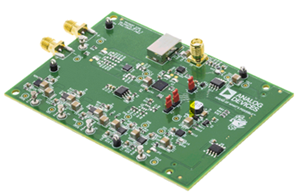
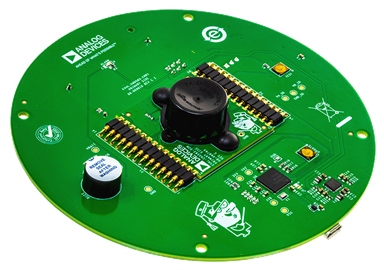
ADN8833CB-EVALZ
Analog Devices Inc.The ADN8833 is a monolithic H-bridge TEC driver with integrat-ed 1 A power MOSFETs. It has a linear power stage with the linear driver (LDR) output and a pulse-width modulation (PWM) power stage with the SW output. Depending on the control voltage at the CONT input, the ADN8833 drives current through a TEC to settle the temperature of a laser diode or a passive component attached to the TEC module to the programmed target temperature.The control voltage applied to the CONT input is generated by a digital-to-analog converter (DAC) closing the digital proportional, integral, derivative (PID) loop of temperature control system.The internal 2.5 V reference voltage provides a 1% accurate output that is used to bias a voltage divider network to program the maximum TEC current and voltage limits for both the heating and cooling modes. It can also be a reference voltage for the DAC and the temperature sensing circuit, including a thermistor bridge and an analog-to-digital converter (ADC).APPLICATIONS TEC temperature control Optical modules Optical fiber amplifiers Optical networking systems Instruments requiring TEC temperature control

ADN8834CP-EVALZ
Analog Devices Inc.The ADN88341 is a monolithic TEC controller with an integrated TEC controller. It has a linear power stage, a pulse-width modulation (PWM) power stage, and two zero-drift, rail-to-rail operational amplifiers. The linear controller works with the PWM driver to control the internal power MOSFETs in an H-bridge configuration. By measuring the thermal sensor feedback voltage and using the integrated operational amplifiers as a proportional integral differential (PID) compensator to condition the signal, the ADN8834 drives current through a TEC to settle the temperature of a laser diode or a passive component attached to the TEC module to the programmed target temperature.The ADN8834 supports negative temperature coefficient (NTC) thermistors as well as positive temperature coefficient (PTC) resistive temperature detectors (RTD). The target temperature is set as an analog voltage input either from a digital-to-analog converter (DAC) or from an external resistor divider.The temperature control loop of the ADN8834 is stabilized by PID compensation utilizing the built in, zero drift chopper amplifiers. The internal 2.50 V reference voltage provides a 1% accurate output that is used to bias a thermistor temperature sensing bridge as well as a voltage divider network to program the maximum TEC current and voltage limits for both the heating and cooling modes. With the zero drift chopper amplifiers, extremely good long-term temperature stability is maintained via an autonomous analog temperature control loop.APPLICATIONS TEC temperature control Optical modules Optical fiber amplifiers Optical networking systems Instruments requiring TEC temperature control1 Product is covered by U.S. Patent No. 6,486,643.
ADN8834MB-EVALZ
Analog Devices Inc.The ADN88341 is a monolithic TEC controller with an integrated TEC controller. It has a linear power stage, a pulse-width modulation (PWM) power stage, and two zero-drift, rail-to-rail operational amplifiers. The linear controller works with the PWM driver to control the internal power MOSFETs in an H-bridge configuration. By measuring the thermal sensor feedback voltage and using the integrated operational amplifiers as a proportional integral differential (PID) compensator to condition the signal, the ADN8834 drives current through a TEC to settle the temperature of a laser diode or a passive component attached to the TEC module to the programmed target temperature.The ADN8834 supports negative temperature coefficient (NTC) thermistors as well as positive temperature coefficient (PTC) resistive temperature detectors (RTD). The target temperature is set as an analog voltage input either from a digital-to-analog converter (DAC) or from an external resistor divider.The temperature control loop of the ADN8834 is stabilized by PID compensation utilizing the built in, zero drift chopper amplifiers. The internal 2.50 V reference voltage provides a 1% accurate output that is used to bias a thermistor temperature sensing bridge as well as a voltage divider network to program the maximum TEC current and voltage limits for both the heating and cooling modes. With the zero drift chopper amplifiers, extremely good long-term temperature stability is maintained via an autonomous analog temperature control loop.APPLICATIONS TEC temperature control Optical modules Optical fiber amplifiers Optical networking systems Instruments requiring TEC temperature control1 Product is covered by U.S. Patent No. 6,486,643.

ADP1032CP-1-EVALZ
Analog Devices Inc.The ADP1032 is a high performance, isolated micropower management unit (PMU) that combines an isolated flyback and a dc-to-dc regulator providing two isolated power rails. Additionally, the ADP1032 contains four high speed serial peripheral interface (SPI) isolation channels and three general-purpose isolators for channel to channel applications where low power dissipation and small solution size is required. Operating over an input voltage range of 4.5 V to 60 V, the ADP1032 generates isolated output voltages of 6 V to 28 V (adjustable version) or 24 V (fixed version) for VOUT1, and factory programmable voltages of 5.15 V, 5.0 V, or 3.3 V for VOUT2.?By default, the ADP1032 flyback regulator operates at a 250 kHz switching frequency, and the buck regulator operates at 125 kHz.?The two regulators are phase shifted relative to each other to reduce electromagnetic interference (EMI). The ADP1032 can be driven by an external oscillator in the range of 350 kHz to 750 kHz to ease noise filtering in sensitive applications.?The digital isolators integrated in the ADP1032 use Analog Devices, Inc., iCoupler? chip scale transformer technology, optimized for low power and low radiated emissions. The ADP1032 is available in a 9 mm ? 7 mm, 41-lead LFCSP and is rated for a ?40?C to +125?C operating junction temperature range.?
ADP1032CP-4-EVALZ
Analog Devices Inc.The ADP1032 is a high performance, isolated micropower management unit (PMU) that combines an isolated flyback and a dc-to-dc regulator providing two isolated power rails. Additionally, the ADP1032 contains four high speed serial peripheral interface (SPI) isolation channels and three general-purpose isolators for channel to channel applications where low power dissipation and small solution size is required. Operating over an input voltage range of 4.5 V to 60 V, the ADP1032 generates isolated output voltages of 6 V to 28 V (adjustable version) or 24 V (fixed version) for VOUT1, and factory programmable voltages of 5.15 V, 5.0 V, or 3.3 V for VOUT2.?By default, the ADP1032 flyback regulator operates at a 250 kHz switching frequency, and the buck regulator operates at 125 kHz.?The two regulators are phase shifted relative to each other to reduce electromagnetic interference (EMI). The ADP1032 can be driven by an external oscillator in the range of 350 kHz to 750 kHz to ease noise filtering in sensitive applications.?The digital isolators integrated in the ADP1032 use Analog Devices, Inc., iCoupler? chip scale transformer technology, optimized for low power and low radiated emissions. The ADP1032 is available in a 9 mm ? 7 mm, 41-lead LFCSP and is rated for a ?40?C to +125?C operating junction temperature range.?

ADP1046A-100-EVALZ
Analog Devices Inc.The ADP1046A is a flexible, digital secondary side controller designed for ac-to-dc and isolated dc-to-dc secondary sideapplications. The ADP1046A is pin-compatible with theADP1043A and offers several enhancements and new features,including voltage feedforward and improved loop response to maximize efficiency.The ADP1046A is optimized for minimal component count,maximum flexibility, and minimum design time. Featuresinclude local and remote voltage sense, primary and secondary side current sense, digital pulse-width modulation (PWM)generation, current sharing, and redundant OrFET control. The control loop digital filter and compensation terms are integrated and can be programmed over the I2C interface. Programmableprotection features include overcurrent protection (OCP), over-voltage protection (OVP), undervoltage lockout (UVLO), and overtemperature protection (OTP).The built-in EEPROM provides extensive programming of theintegrated loop filter, PWM signal timing, inrush current, andsoft start timing and sequencing. Reliability is improved through a built-in checksum and programmable protection circuits.A comprehensive GUI is provided for easy design of loop filter characteristics and programming of the safety features.The industry-standard I2C bus provides access to the many monitoring and system test functions.The ADP1046A is available in a 32-lead LFCSP and operatesfrom a single 3.3 V supply.APPLICATIONS AC-to-DC power supplies Isolated dc-to-dc power supplies Redundant power supply systems Server, storage, network, and communications infrastructure
ADP1046ADC1-EVALZ
Analog Devices Inc.The ADP1046A is a flexible, digital secondary side controller designed for ac-to-dc and isolated dc-to-dc secondary sideapplications. The ADP1046A is pin-compatible with theADP1043A and offers several enhancements and new features,including voltage feedforward and improved loop response to maximize efficiency.The ADP1046A is optimized for minimal component count,maximum flexibility, and minimum design time. Featuresinclude local and remote voltage sense, primary and secondary side current sense, digital pulse-width modulation (PWM)generation, current sharing, and redundant OrFET control. The control loop digital filter and compensation terms are integrated and can be programmed over the I2C interface. Programmableprotection features include overcurrent protection (OCP), over-voltage protection (OVP), undervoltage lockout (UVLO), and overtemperature protection (OTP).The built-in EEPROM provides extensive programming of theintegrated loop filter, PWM signal timing, inrush current, andsoft start timing and sequencing. Reliability is improved through a built-in checksum and programmable protection circuits.A comprehensive GUI is provided for easy design of loop filter characteristics and programming of the safety features.The industry-standard I2C bus provides access to the many monitoring and system test functions.The ADP1046A is available in a 32-lead LFCSP and operatesfrom a single 3.3 V supply.APPLICATIONS AC-to-DC power supplies Isolated dc-to-dc power supplies Redundant power supply systems Server, storage, network, and communications infrastructure

ADP1055-EVALZ
Analog Devices Inc.The ADP1055 is a flexible, feature-rich digital secondary side controller that targets ac-to-dc and isolated dc-to-dc secondary side applications. The ADP1055 is optimized for minimal component count, maximum flexibility, and minimum design time. Features include differential remote voltage sense, primary and secondary side current sense, pulse-width modulation (PWM) generation, frequency synchronization, redundant OVP, and current sharing. The control loop digital filter and compensation terms are integrated and can be programmed over the PMBus? interface. Programmable protection features include overcurrent (OCP), overvoltage (OVP) limiting, undervoltage lockout (UVLO), and external overtemperature (OTP).The built-in EEPROM provides extensive programming of the integrated loop filter, PWM signal timing, inrush current, and soft start timing and sequencing. Reliability is improved through a built-in checksum and programmable protection circuits.A comprehensive GUI is provided for easy design of loop filter characteristics and programming of the safety features. The industry-standard PMBus provides access to the many monitoring and system test functions. The ADP1055 is available in a 32-lead LFCSP and operates from a single 3.3 V supply.APPLICATIONS Isolated dc-to-dc power supplies and modules Redundant power supply systems

ADP121CB-1.8-EVALZ
Analog Devices Inc.The ADP121 is a quiescent current, low dropout, linear regulator that operates from 2.3 V to 5.5 V and provides up to 150 mA of output current. The low 135 mV dropout voltage at 150 mA load improves efficiency and allows operation over a wide input voltage range. The low 30 ?A of quiescent current at full load makes the ADP121 ideal for battery-operated portable equipment.The ADP121 is available in output voltages ranging from 1.2 V to 3.3 V. The parts are optimized for stable operation with small 1 ?F ceramic output capacitors. The ADP121 delivers good transient performance with minimal board area.Short-circuit protection and thermal overload protection circuits prevent damage in adverse conditions. The ADP121 is available in a tiny 5-lead TSOT and 4-ball 0.4 mm pitch WLCSP pack-ages and utilizes the smallest footprint solution to meet a variety of portable applications.
ADP121UJZ-REDYKIT
Analog Devices Inc.The ADP121 is a quiescent current, low dropout, linear regulator that operates from 2.3 V to 5.5 V and provides up to 150 mA of output current. The low 135 mV dropout voltage at 150 mA load improves efficiency and allows operation over a wide input voltage range. The low 30 ?A of quiescent current at full load makes the ADP121 ideal for battery-operated portable equipment.The ADP121 is available in output voltages ranging from 1.2 V to 3.3 V. The parts are optimized for stable operation with small 1 ?F ceramic output capacitors. The ADP121 delivers good transient performance with minimal board area.Short-circuit protection and thermal overload protection circuits prevent damage in adverse conditions. The ADP121 is available in a tiny 5-lead TSOT and 4-ball 0.4 mm pitch WLCSP pack-ages and utilizes the smallest footprint solution to meet a variety of portable applications.

ADP150CB-3.3-EVALZ
Analog Devices Inc.The ADP150 is an ultralow noise (9 ?V), low dropout, linear regulator that operates from 2.2 V to 5.5 V and provides up to 150 mA of output current. The low 105 mV dropout voltage at 150 mA load improves efficiency and allows operation over a wide input voltage range.Using an innovative circuit topology, the ADP150 achieves ultralow noise performance without the necessity of an additional noise bypass capacitor, making it ideal for noise sensitive analog and RF applications. The ADP150 also achieves ultralow noise performance without compromising PSRR or line and load transient performance. The ADP150 offers the best combination of ultralow noise and quiescent current consumption to maximize battery life in portable applications.The ADP150 is specifically designed for stable operation with tiny 1 ?F ? 30% ceramic input and output capacitors to meet the requirements of high performance, space-constrained applications.The ADP150 is available in 14 fixed output voltage options, ranging from 1.8 V to 3.3 V.Short-circuit and thermal overload protection circuits prevent damage in adverse conditions. The ADP150 is available in tiny 5-lead TSOT and 4-ball, 0.4 mm pitch WLCSP packages for the smallest footprint solution to meet a variety of portable power applications.Applications Mobile phones Digital camera and audio devices Portable and battery-powered equipment Post dc-to-dc regulation Portable medical devices RF, PLL, VCO, and clock power supplies
ADP150UJZ-REDYKIT
Analog Devices Inc.The ADP150 is an ultralow noise (9 ?V), low dropout, linear regulator that operates from 2.2 V to 5.5 V and provides up to 150 mA of output current. The low 105 mV dropout voltage at 150 mA load improves efficiency and allows operation over a wide input voltage range.Using an innovative circuit topology, the ADP150 achieves ultralow noise performance without the necessity of an additional noise bypass capacitor, making it ideal for noise sensitive analog and RF applications. The ADP150 also achieves ultralow noise performance without compromising PSRR or line and load transient performance. The ADP150 offers the best combination of ultralow noise and quiescent current consumption to maximize battery life in portable applications.The ADP150 is specifically designed for stable operation with tiny 1 ?F ? 30% ceramic input and output capacitors to meet the requirements of high performance, space-constrained applications.The ADP150 is available in 14 fixed output voltage options, ranging from 1.8 V to 3.3 V.Short-circuit and thermal overload protection circuits prevent damage in adverse conditions. The ADP150 is available in tiny 5-lead TSOT and 4-ball, 0.4 mm pitch WLCSP packages for the smallest footprint solution to meet a variety of portable power applications.Applications Mobile phones Digital camera and audio devices Portable and battery-powered equipment Post dc-to-dc regulation Portable medical devices RF, PLL, VCO, and clock power supplies

ADP151CPZ-REDYKIT
Analog Devices Inc.The ADP151 is an ultralow noise, low dropout (LDO) linear regulator that operates from 2.2 V to 5.5 V and provides up to 200 mA of output current. The low 135 mV dropout voltage at 200 mA load improves efficiency and allows operation over a wide input voltage range.Using an innovative circuit topology, the ADP151 achieves ultralow noise performance without the necessity of a bypass capacitor, making the device ideal for noise-sensitive analog and RF applications. The ADP151 also achieves ultralow noise performance without compromising the power supply rejection ratio (PSRR) or transient line and load performance. The low 265 ?A of operating supply current at 200 mA load makes the ADP151 suitable for battery-operated portable equipment.The ADP151 also includes an internal pull-down resistor on the EN input.The ADP151 is specifically designed for stable operation with tiny 1 ?F, ?30% ceramic input and output capacitors to meet the requirements of high performance, space constrained applications.The ADP151 is capable of 16 fixed output voltage options, ranging from 1.1 V to 3.3 V.Short-circuit and thermal overload protection circuits prevent damage in adverse conditions. The ADP151 is available in tiny 5-lead TSOT, 6-lead LFCSP, and 4-ball, 0.4 mm pitch, halide-free WLCSP packages for the smallest footprint solution to meet a variety of portable power application requirements.APPLICATIONS RF, voltage controlled oscillator (VCO), and phase locked loop (PLL) power supplies Mobile phones Digital camera and audio devices Portable and battery-powered equipment Post dc-to-dc regulation Portable medical devices Automotive

ADP1607-001-EVALZ
Analog Devices Inc.The ADP1607 is a high efficiency, synchronous, fixed frequency, step-up dc-to-dc switching converter with an adjustable output voltage between 1.8 V and 3.3 V for use in portable applications.The 2 MHz operating frequency enables the use of small footprint, low profile external components. Additionally, the synchronous rectification, internal compensation, internal fixed current limit, and current mode architecture allow for excellent transient response and a minimal external part count.Other key features include fixed PWM and light load PFM mode options, true output isolation, thermal shutdown (TSD), and logic controlled enable. Available in a lead-free, thin, 6-lead LFCSP package, the ADP1607 is ideal for providing efficient power conversion in portable devices.APPLICATIONS 1-cell and 2-cell alkaline and NiMH/NiCd powered devices Portable audio players, instruments, and medical devices Solar cell applications Miniature hard disk power supplies Power LED status indicators

ADP160UJZ-REDYKIT
Analog Devices Inc.The ADP160 / ADP161 / ADP162 / ADP163?are ultralow quiescentcurrent, low dropout, linear regulators that operate from 2.2 Vto 5.5 V and provide up to 150 mA of output current. The low195 mV dropout voltage at 150 mA load improves efficiency andallows operation over a wide input voltage range.The ADP16x are specifically designed for stable operation withtiny 1 ?F ? 30% ceramic input and output capacitors to meetthe requirements of high performance, space-constrainedapplications.The ADP160 is available in 15 fixed output voltage options,ranging from 1.2 V to 4.2 V. The ADP160 / ADP161 also includea switched resistor to discharge the output automatically when the LDO is disabled. The ADP162 is identical to the ADP160but does not include the output discharge function.The ADP161and ADP163 are available as a adjustable outputvoltage regulators. They are only available in a 5-lead TSOTpackage. The ADP163 is identical to the ADP161 but does notinclude the output discharge function.Short-circuit and thermal overload protection circuits preventdamage in adverse conditions. The ADP160 and ADP162 areavailable in a tiny 5-lead TSOT and a 4-ball, 0.5 mm pitchWLCSP package for the smallest footprint solution to meet avariety of portable power applications.APPLICATIONS Mobile phones Digital cameras and audio devices Portable and battery-powered equipment Post dc-to-dc regulation Portable medical devices

ADP1610-EVALZ
Analog Devices Inc.The ADP1610 is a dc-to-dc step-up switching converter with an integrated 1.2 A, 0.2 ? power switch capable of providing an output voltage as high as 12 V. With a package height of less that 1.1 mm, the ADP1610 is optimal for space-constrained applications such as portable devices or thin film transistor (TFT) liquid crystal displays (LCDs). The ADP1610 operates in pulse-width modulation (PWM) current mode with up to 92% efficiency. Adjustable soft start prevents inrush currents at startup. The pin-selectable switching frequency and PWM current-mode architecture allow excellent transient response, easy noise filtering, and the use of small, cost-saving external inductors and capacitors. The ADP1610 is offered in the Pb-free 8-lead MSOP and operates over the temperature range of ?40?C to +85?C.APPLICATIONS TFT LC bias supplies Portable applications Industrial/instrumentation equipment

ADP1612-5-EVALZ
Analog Devices Inc.The ADP1612/ADP1613 are step-up dc-to-dc switching con-verters with an integrated power switch capable of providing an output voltage as high as 20 V. With a package height of less than 1.1 mm, the ADP1612/ADP1613 are optimal for space-constrained applications such as portable devices or thin film transistor (TFT) liquid crystal displays (LCDs).The ADP1612/ADP1613 operate in current mode pulse-width modulation (PWM) with up to 94% efficiency. Adjustable soft start prevents inrush currents when the part is enabled. The pin-selectable switching frequency and PWM current-mode architecture allow for excellent transient response, easy noise filtering, and the use of small, cost-saving external inductors and capacitors. Other key features include undervoltage lockout (UVLO), thermal shutdown (TSD), and logic controlled enable.The ADP1612/ADP1613 are available in the lead-free 8-lead MSOP.ApplicationsTFT LCD bias suppliesPortable applicationsIndustrial/instrumentation equipment

ADP165CP-EVALZ
Analog Devices Inc.The ADP165/ADP166 are very low quiescent current, low dropout, linear regulator that operate from 2.2 V to 5.5 V and provides up to 150 mA of output current. The low 120 mV dropout voltage at 150 mA load improves efficiency and allows operation over a wide input voltage range.The ADP165/ADP166 are specifically designed for stable operation with a tiny 1 ?F ? 30% ceramic input and output capacitors to meet the requirements of high performance, space-constrained applications.The ADP165/ADP166 are available in seven fixed output voltage options, ranging from 1.2 V to 3.3 V, and an adjustable output option. The ADP165 also include a switched resistor to discharge the output automatically when the LDO is disabled. The ADP166 is identical to the ADP165, but does not include the output discharge function.Short-circuit and thermal overload protection circuits prevent damage in adverse conditions. The ADP165/ADP166 are available in a tiny 5-lead TSOT, a 6-lead LFCSP and a 4-ball, 0.5 mm pitch WLCSP package for the smallest footprint solution to meet a variety of portable power applications.Applications Portable and battery-powered equipment Post dc-to-dc regulation Portable medical devices Wireless sensor network (WSN) devices

ADP166CB-EVALZ
Analog Devices Inc.The ADP165?/ ADP166 are very low quiescent current, low dropout, linear regulator that operate from 2.2 V to 5.5 V and provides up to 150 mA of output current. The low 120 mV dropout voltage at 150 mA load improves efficiency and allows operation over a wide input voltage range.The ADP165 / ADP166 are specifically designed for stable operation with a tiny 1 ?F ? 30% ceramic input and output capacitors to meet the requirements of high performance, space-constrained applications.The ADP165 / ADP166 are available in seven fixed output voltage options, ranging from 1.2 V to 3.3 V, and an adjustable output option. The ADP165 also include a switched resistor to discharge the output automatically when the LDO is disabled. The ADP166 is identical to the ADP165, but does not include the output discharge function.Short-circuit and thermal overload protection circuits prevent damage in adverse conditions. The ADP165 / ADP166 are available in a tiny 5-lead TSOT, a 6-lead LFCSP and a 4-ball, 0.5 mm pitch WLCSP package for the smallest footprint solution to meet a variety of portable power applications.APPLICATIONS Portable and battery-powered equipment Post dc-to-dc regulation Portable medical devices Wireless sensor network (WSN) devices

ADP1714-3.3-EVALZ
Analog Devices Inc.The ADP1712?/ ADP1713?/ ADP1714, available in a tiny, 5-lead TSOT package, are low dropout linear regulators that operate from 2.5 V to 5.5 V and provide up to 300 mA of output current. The low 170 mV dropout voltage at a 300 mA load improves efficiency and allows operation over a wide input voltage range. Using a novel scaling architecture, ground current is a very low 75 ?A when driving a 100 ?A load, making the ADP1712/ ADP1713/ADP1714 ideal for battery-operated portable equipment.The ADP1712 / ADP1713 / ADP1714 are available in 16 fixed output voltage options. The ADP1712 is also available in an adjustable version, which allows output voltages that range from 0.8 V to 5 V via an external divider. The ADP1712 fixed version allows an external capacitor to be connected to program the soft-start time. The ADP1713 allows a reference bypass capacitor to be connected, which reduces output voltage noise and improves power supply rejection. The ADP1714 includes a tracking feature, which allows the output to follow an external voltage rail or reference.The ADP1712/ADP1713/ADP1714 are optimized for stable operation with small 2.2 ?F ceramic output capacitors, allowing good transient performance while occupying minimal board space. An enable pin controls the output voltage on all devices, and an undervoltage lockout circuit disables the regulator if IN drops below a minimum threshold. The parts also have short circuit protection and thermal overload protection, which prevent damage to the devices in adverse conditions.APPLICATIONS Mobile phones Digital camera and audio devices Portable and battery-powered equipment Post dc-dc regulation