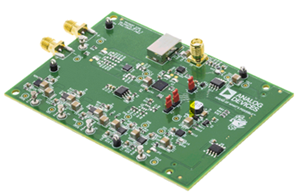
AD9915/PCBZ
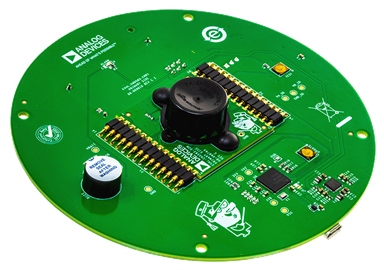
Analog Devices Inc.The AD9915 is a direct digital synthesizer (DDS) featuring a 12-bit DAC. The AD9915 uses advanced DDS technology, coupled with an internal high speed, high performance DAC to form a digitally programmable, complete high frequency synthesizer capable of generating a frequency-agile analog output sinusoidal waveform at up to 1.0 GHz. The AD9915 enables fast frequency hopping and fine tuning resolution (64-bit capable using programmable modulus mode). The AD9915 also offers fast phase and amplitude hopping capability. The frequency tuning and control words are loaded into the AD9915 via a serial or parallel input/output port. The AD9915 also supports a user defined linear sweep mode of operation for generating linear swept waveforms of frequency, phase, or amplitude. A high speed, 32-bit parallel data input port is included, enabling high data rates for polar modulation schemes and fast reprogramming of the phase, frequency, and amplitude tuning words.The AD9915 is specified to operate over the extended industrial temperature range.APPLICATIONS Agile LO frequency synthesis Programmable clock generator FM chirp source for radar and scanning systems Test and measurement equipment Acousto-optic device drivers Polar modulator Fast frequency hopping

AD9959/PCBZ
Analog Devices Inc.The AD9959 consists of four direct digital synthesizer (DDS)cores that provide independent frequency, phase, and amplitudecontrol on each channel. This flexibility can be used to correct imbalances between signals due to analog processing, such asfiltering, amplification, or PCB layout-related mismatches.Because all channels share a common system clock, they areinherently synchronized. Synchronization of multiple devices is supported.The AD9959 can perform up to a 16-level modulation of fre-quency, phase, or amplitude (FSK, PSK, ASK). Modulation isperformed by applying data to the profile pins. In addition, theAD9959 also supports linear sweep of frequency, phase, or amplitude for applications such as radar and instrumentation. The AD9959 serial I/O port offers multiple configurations to provide significant flexibility. The serial I/O port offers an SPI-compatible mode of operation that is virtually identical to the SPI operation found in earlier Analog Devices, Inc., DDS products. Flexibility is provided by four data pins (SDIO_0/SDIO_1/SDIO_2/SDIO_3) that allow four programmable modes of serial I/O operation.The AD9959 uses advanced DDS technology that provides low power dissipation with high performance. The device incorporates four integrated, high speed 10-bit DACs with excellent wideband and narrow-band SFDR. Each channel has a dedicated 32-bit frequency tuning word, 14 bits of phase offset, and a 10-bit output scale multiplier. The DAC outputs are supply referenced and must be terminated into AVDD by a resistor or an AVDD center-tapped transformer. Each DAC has its own programmable reference to enable different full-scale currents for each channel. The DDS acts as a high resolution frequency divider with the REFCLK as the input and the DAC providing the output. The REFCLK input source is common to all channels and can be driven directly or used in combination with an integrated REFCLK multiplier (PLL) up to a maximum of 500 MSPS. The PLL multiplication factor is programmable from 4 to 20, in integer steps. The REFCLK input also features an oscillator circuit to support an external crystal as the REFCLK source. The crystal must be between 20 MHz and 30 MHz. The crystal can be used in combination with the REFCLK multiplier.The AD9959 comes in a space-saving 56-lead LFCSP package. The DDS core (AVDD and DVDD pins) is powered by a 1.8 V supply. The digital I/O interface (SPI) operates at 3.3 V and requires DVDD_I/O (Pin 49) be connected to 3.3 V. The AD9959 operates over the industrial temperature range of ?40?C to +85?C.APPLICATIONSAgile local oscillators Phased array radars/sonars Instrumentation Synchronized clocking RF source for AOTF

AD9986-FMCB-EBZ
Analog Devices Inc.The AD9986 is a highly integrated device with a 16-bit, 12 GSPS maximum sample rate RF DAC core, and a 12-bit, 6 GSPS rate RF ADC core. The AD9986 supports four transmitter channels and two receiver channels with four transmitter, two receiver (4T2R) configuration. The AD9986 is well suited for 2-antenna and 4-antenna transmitter applications requiring a wide bandwidth observation receiver path for the digital predistortion. The AD9986 supports up to a 6 GSPS complex transmit and receive data rate in single channel mode. The maximum radio channel bandwidth supported is 1.2 GHz and 2.4 GHz for the transmit and receive paths, respectively (4T2R). The AD9986 features a 16 lane, 24.75 Gbps JESD204C or 15.5 Gbps JESD204B serial data port, an on-chip clock multiplier, and digital signal processing capability targeted at multiband, direct-to-RF radio applications. APPLICATIONS Wireless communications infrastructure W-CDMA, LTE, LTE-A, Massive-MIMO Microwave point-to-point, E-band, and 5G mm Wave Broadband communications systems DOCSIS 3.1 and 4.0 CMTS Communications test and measurement system
ADA4254RU-EBZ
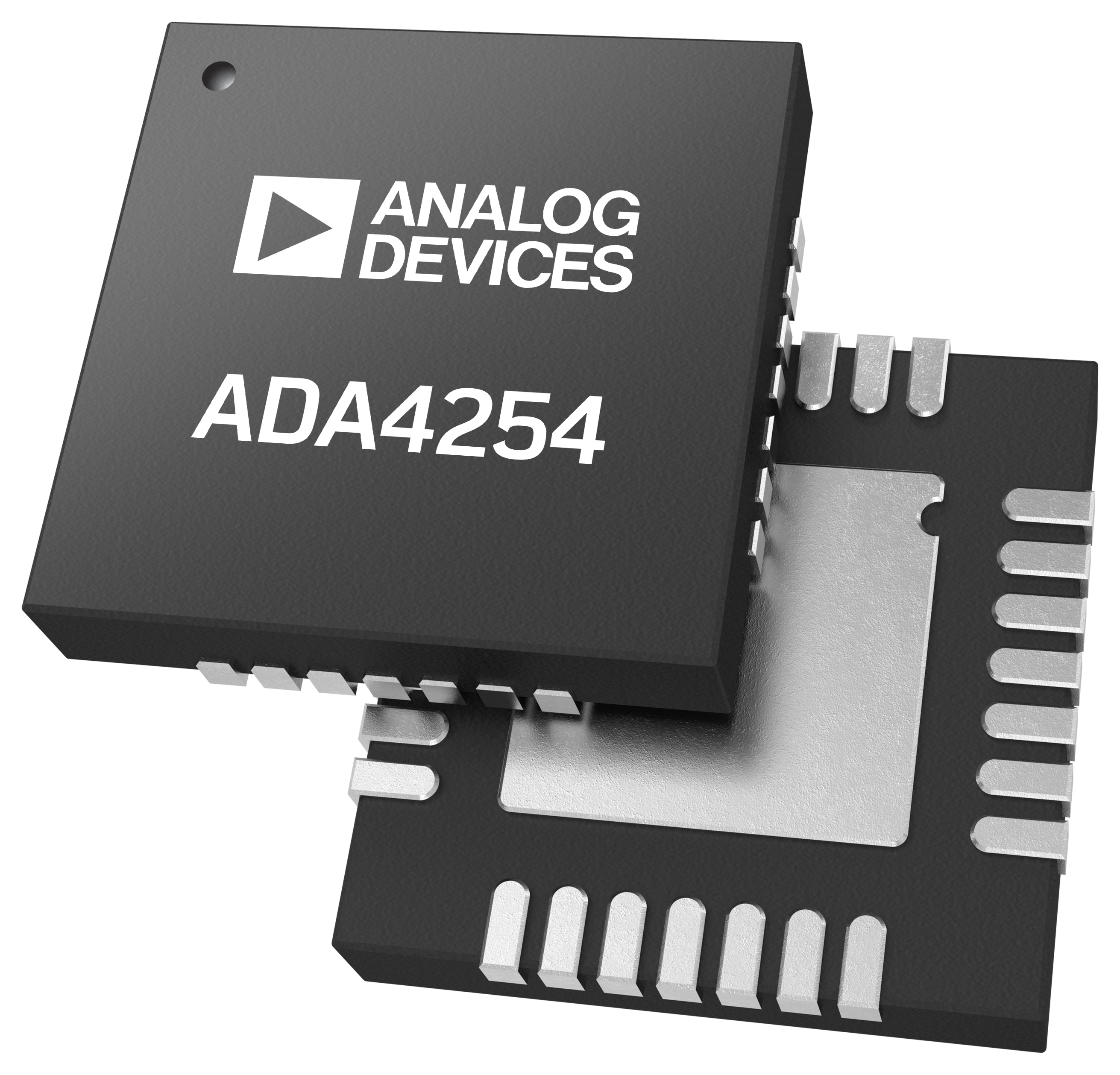
Analog Devices Inc.The ADA4254 is a zero drift, high voltage, low power?programmable gain instrumentation amplifier (PGIA) designed?for process control and industrial applications. The ADA4254?features 12 binary weighted gains ranging from 1/16 V/V to?128 V/V and three scaling gain options of 1 V/V, 1.25 V/V, and?1.375 V/V, resulting in 36 possible gain settings. The power?consumption of the ADA4254 is a mere 22 mW, making the?device an excellent choice for industrial systems that demand?precision, robustness, and low power.The zero drift amplifier topology of the ADA4254 self calibrates dc errors and low frequency 1/f noise, achieving excellent dc precision over the entire specified temperature range. This high level of precision maximizes dynamic range and greatly reduces calibration requirements in many applications.?The input multiplexer provides ?60 V protection to the high impedance inputs of the amplifier, while providing the capability to switch between two input sources. In addition, integrated electromagnetic interference (EMI) filters block harsh RF noise from the sensitive inputs of the amplifier.?Various safety features on the ADA4254 detect both internal and external faults. The serial port interface (SPI) supports cyclical redundancy check (CRC) error detection to ensure robust communication. These safety features ease system safety integrity level (SIL) certification.?Seven general-purpose input/output (GPIO) pins, which can be configured to provide various special functions, are included in the ADA4254. An excitation current source output is available to bias sensors such as resistance temperature detectors (RTDs).?The ADA4254 is specified over the ?40?C to +105?C temperature range and is offered in a compact 5 mm ? 5 mm, 28-lead LFCSP and a 24-lead TSSOP.?Applications Universal process control front ends Data acquisition systems Test and measurement systems?

ADA4817-2ACP-EBZ
Analog Devices Inc.The ADA4817-1 (single) and ADA4817-2 (dual) FastFET? amplifiers are unity-gain stable, ultrahigh speed, voltage feedback amplifiers with FET inputs. These amplifiers were developed with the Analog Devices, Inc., proprietary eXtra fast complementary bipolar (XFCB) process, which allows the amplifiers to achieve ultralow noise (4 nV/?Hz; 2.5 fA/?Hz) as well as very high input impedances.With 1.3 pF of input capacitance, low noise (4 nV/?Hz), low offset voltage (2 mV maximum), and 1050 MHz ?3 dB bandwidth, the ADA4817-1/ADA4817-2 are ideal for data acquisition front ends as well as wideband transimpedance applications, such as photodiode preamps.With a wide supply voltage range from 5 V to 10 V and the ability to operate on either single or dual supplies, the ADA4817-1/ADA4817-2 are designed to work in a variety of applications including active filtering and analog-to-digital converter (ADC) driving. The ADA4817-1 is available in a 3 mm ? 3 mm, 8-lead LFCSP and 8-lead SOIC, and the ADA4817-2 is available in a 4 mm ? 4 mm, 16-lead LFCSP. These packages feature a low distortion pinout that improves second harmonic distortion and simplifies circuit board layout. They also feature an exposed pad that provides a low thermal resistance path to the printed circuit board (PCB). The EPAD enables more efficient heat transfer and increases reliability. These products are rated to work over the extended industrial temperature range (?40?C to +105?C).Applications Photodiode amplifiers Data acquisition front ends Instrumentation Filters ADC drivers Output buffers

ADA4830-1BCP-EBZ
Analog Devices Inc.The ADA4830-1 (single) and ADA4830-2 (dual) are monolithic, high speed difference amplifiers that integrate input overvoltage (short-to-battery) protection of up to 18 V with a wide input common-mode voltage range and excellent ESD robustness. They are intended for use as receivers for differential or pseudo differential CVBS and other high speed video signals in harsh, noisy environments such as automotive infotainment and vision systems. The ADA4830-1 and ADA4830-2 combine high speed and precision, which allows for accurate reproduction of CVBS video signals, yet rejects unwanted common-mode error voltages.The short to battery protection that is integrated into the ADA4830-1 employs fast switching circuitry to clamp and hold internal voltage nodes at a safe level when an input overvoltage condition is detected. This protection allows the inputs of the ADA4830-1 to be directly connected to a remote video source, such as a rearview camera, without the need for large expensive series capacitors. The ADA4830-1 can withstand direct short to battery voltages as high as 18 V on its input pins.The ADA4830-1 is designed to operate at supply voltages as low as 2.9 V and as high as 5.5 V, using only 6.8 mA of supply current per channel. The device provides true single-supply capability, allowing the input signal to extend 8.5 V below the negative rail and to 8.5 V above ground on a single 5 V supply. At the output, the amplifier can swing to within 250 mV of either supply rail into a 150 ? load.The ADA4830-1 presents a gain of 0.5 V/V at its output. This is designed to keep the video signal within the allowed range of the video decoder, which is typically 1 V p-p or less.The ADA4830-1 is available in a 3 mm ? 3 mm, 8-lead LFCSP package and is specified for operation over the automotive temperature range of ?40?C to +125?C.Applications Automotive vision systems Automotive infotainment Surveillance systems

ADA4891-4AR-EBZ
Analog Devices Inc.The ADA4891-1 (single), ADA4891-2 (dual), ADA4891-3 (triple), and ADA4891-4 (quad) are CMOS, high speed amplifiers that offer high performance at a low cost. The amplifiers feature true single-supply capability, with an input voltage range that extends 300 mV below the negative rail. In spite of their low cost, the ADA4891 family provides high performance and versatility. The rail-to-rail output stage enables the output to swing within 50 mV of each rail, enabling maximum dynamic range. The ADA4891 family of amplifiers is ideal for imaging applications, such as consumer video, CCD buffers, and contact image sensor buffers. Low distortion and fast settling time also make them ideal for active filter applications. The ADA4891-1/ADA4891-2/ADA4891-3/ADA4891-4 are available in a wide variety of packages. The ADA4891-1 is available in 8-lead SOIC and 5-lead SOT-23 packages. The ADA4891-2 is available in 8-lead SOIC and 8-lead MSOP packages. The ADA4891-3 and ADA4891-4 are available in 14-lead SOIC and 14-lead TSSOP packages. The amplifiers are specified to operate over the extended temperature range of ?40?C to +125?C.Applications Imaging Consumer video Active filters Coaxial cable drivers Clock buffers Photodiode preamp Contact image sensor and buffers

ADA4950-2YCP-EBZ
Analog Devices Inc.The ADA4950-1/ADA4950-2 are gain-selectable versions of the ADA4932-1/ADA4932-2 with on-chip feedback and gain resistors It is an ideal choice for driving high performance ADCs as a single-ended-to-differential or differential-to-differential amplifier. The output common-mode voltage is user adjustable by means of an internal common-mode feedback loop, allowing the ADA4950-x output to match the input of the ADC. The internal feedback loop also provides exceptional output balance as well as suppression of even-order harmonic distortion products.Differential gain configurations of 1, 2, and 3 are easily realized with internal feedback networks that are connected externally to set the closed-loop gain of the amplifier.The ADA4950-x is fabricated using the Analog Devices, Inc., proprietary silicon-germanium (SiGe) complementary bipolar process, enabling it to achieve low levels of distortion and noise at low power consumption. The low offset and excellent dynamic performance of the ADA4950-x make it well suited for a wide variety of data acquisition and signal processing applications.The ADA4950-x is available in a Pb-free, 3 mm ? 3 mm, 16-lead LFCSP (ADA4950-1, single) or a Pb-free 4 mm ? 4 mm, 24-lead LFCSP (ADA4950-2, dual). The pinout has been optimized to facilitate PCB layout and minimize distortion. The ADA4950-1/ADA4950-2 are specified to operate over the -40?C to +105?C temperature range; both operate on supplies from +3 V to ?5 V.ApplicationsADC driversSingle-ended-to-differential convertersIF and baseband gain blocksDifferential buffersLine drivers


ADCLK854/PCBZ
Analog Devices Inc.The ADCLK854 is a 1.2 GHz/250 MHz LVDS/CMOS fanout buffer optimized for low jitter and low power operation. Possible configurations range from 12 LVDS to 24 CMOS outputs, including combinations of LVDS and CMOS outputs. Three control lines are used to determine whether fixed blocks of outputs (three banks of four) are LVDS or CMOS outputs.The ADCLK854 offers two selectable inputs and a sleep mode feature. The IN_SEL pin state determines which input is fanned out to all the outputs. The SLEEP pin enables a sleep mode to power down the device.The inputs accept various types of single-ended and differential logic levels including LVPECL, LVDS, HSTL, CML, and CMOS. Table 8 provides interface options for each type of connection.This device is available in a 48-pin LFCSP package. It is specified for operation over the standard industrial temperature range of ?40?C to +85?C.APPLICATIONSLow jitter clock distributionClock and data signal restorationLevel translationWireless communicationsWired communicationsMedical and industrial imagingATE and high performance instrumentation

ADCLK914/PCBZ
Analog Devices Inc.The ADCLK914 is an ultrafast clock/data buffer fabricated onthe Analog Devices, Inc., proprietary, complementary bipolar(XFCB-3) silicon-germanium (SiGe) process. The ADCLK914features high voltage differential signaling (HVDS) outputssuitable for driving the latest Analog Devices high speed digitalto-analogconverters (DACs). The ADCLK914 has a single,differential open-collector output.The ADCLK914 buffer operates up to 7.5 GHz with a 160 pspropagation delay and adds only 110 fs random jitter (RJ).The input has a center tapped, 100 ?, on-chip terminationresistor and accepts LVPECL, CML, CMOS, LVTTL, or LVDS(ac-coupled only). A VREF pin is available for biasing ac-coupledinputs.The HVDS output stage is designed to directly drive 1.9 V eachside into 50 ? terminated to VCC for a total differential outputswing of 3.8 V.The ADCLK914 is available in a 16-lead LFCSP. It is specifiedfor operation over the extended industrial temperature range of?40?C to +125?C.Applications Clock and data signal restoration High speed converter clocking Broadband communications Cellular infrastructure High speed line receivers ATE and high performance instrumentation Level shifting Threshold detection?

ADCMP380-EVALZ
Analog Devices Inc.The ADCMP380 is an ultralow power voltage comparator with internal reference suitable for use in general-purpose applications. The ultralow power consumption of this device makes it suitable for power efficiency sensitive systems, such as battery-powered portable devices and energy meters.The ADCMP380 is available with a 0.5 V and 1 V internal reference with ?2.2% and ?1.6% accuracy, respectively, over the full temperature range; this internal reference enables the device to monitor the node of interest accurately to 0.5 V. The enable input allows the user to hold the output low regardless of thestate of the input.The ADCMP380 is available in a 6-ball, 1.46 mm ? 0.96 mm WLCSP and is specified over the temperature range of ?40?C to +85?C.APPLICATIONS Portable/battery-operated equipment Battery monitors Energy harvesting

ADCMXL_BRKOUT/PCBZ
Analog Devices Inc.The ADcmXL3021 is a complete vibration sensing system that combines high performance vibration sensing (using micro-electromechanical systems (MEMS) accelerometers) with a variety of signal processing functions to simplify the development of smart sensor nodes in condition-based monitoring (CBM) systems. The typical ultralow noise density (26 ?g/?Hz) in the MEMS accelerometers supports excellent resolution. The wide bandwidth (dc to 10 kHz within 3 dB flatness) enables tracking of key vibration signatures on many machine platforms.The signal processing includes high speed data sampling (220 kSPS), 4096 time sample record lengths, filtering, windowing, fast Fourier transform (FFT), user configurable spectral or time statistic alarms, and error flags. The serial peripheral interface (SPI) provides access to a register structure that contains the vibration data and a wide range of user configurable functions.The ADcmXL3021 is available in a 23.7 mm ? 27.0 mm ? 12.4 mm aluminum package with four mounting flanges to support installation with standard machine screws. This package provides consistent mechanical coupling to the core sensors over a broad frequency range. The electrical interface is through a 14-pin connector on a 36 mm flexible cable, which enables a wide range of location and orientation options for system mating connectors.The ADcmXL3021 requires only a single, 3.3 V power supply and supports an operating temperature range of ?40?C to +105?C.Applications Vibration analysis CBM systems Machine health Instrumentation and diagnostics Safety shutoff sensing

ADD5211EB-EVALZ
Analog Devices Inc.The ADD5211 is a four-string, white LED driver for backlight applications based on high efficiency, current mode, step-up converter technology. The boost controller drives an external MOSFET switch for step-up regulation from an input voltage of 4.5 V to 40 V and a pin adjustable operating frequency from 200 kHz to 1.2 MHz. An adjustable UVLO function is implemented to reduce input current during power-off.The ADD5211 provides four regulated current sinks for uniform brightness intensity. Each current sink can be driven from 40 mA to 200 mA; the LED driving current is pin adjustable using an external resistor. With an input PWM interface, the ADD5211 drives up to four parallel strings of multiple series connected LEDs.Additional features include LED short protection, LED open protection, boost output short protection, overvoltage protection, cycle-by-cycle current limit, and thermal shutdown for both the IC and the LED array. An open-drain fault output is also included. A programmable soft start is implemented to reduce inrush current during startup. Applications LCD monitor and TV LED backlights Industrial lighting

ADF70301-868EZKIT
Analog Devices Inc.The ADF7030-1 is a fully integrated, radio transceiver achieving high performance at very low power. The ADF7030-1 is ideally suited for applications that require long range, network robustness, and long battery life. It is suitable for applications that operate in the ISM, SRD, and licensed frequency bands at 169.4 MHz to 169.6 MHz, 426 MHz to 470 MHz, and 863 MHz to 960 MHz. It provides extensive support for standards-based protocols like IEEE802.15.4g while also providing flexibility to support a wide range of proprietary protocols.The highly configurable low intermediate frequency (IF) receiver supports a large range of receiver channel bandwidths from 2.6 kHz to 406 kHz. This range of receiver channel bandwidths allows the ADF7030-1 to support ultranarrow-band, narrow-band, and wideband channel spacing.The ADF7030-1 features two independent PAs supporting output power ranges of ?20 dBm to +13 dBm and ?20 dBm to +17 dBm. The PAs support ultrafine adjustment of the power with a step resolution of 0.1 dB. The PA output power is exceptionally robust over temperature and voltage. The PAs have an automatic power ramp control to limit spectral splatter to meet regulatory standards.The ADF7030-1 features an on-chip ARM??Cortex?-M0 processor that performs radio control, radio calibration, and packet management. Cortex-M0 eases the processing burden of the host processor because the ADF7030-1 integrates the lower layers of a typical communication protocol stack. This internal processor also permits the download and execution of Analog Devices, Inc., provided firmware modules that can extend the functionality of the ADF7030-1.The ADF7030-1 has two packet modes: generic packet mode and IEEE802.15.4g mode. In generic packet mode, the packet format is highly flexible and fully programmable, thereby ensuring its compatibility with proprietary packet formats. In IEEE802.15.4g packet mode, the packet format conforms to the?IEEE802.15.4g standard. FEC, as per the IEEE802.15.4g standard, is also supported.The ADF7030-1 operates with a power supply range of 2.2 V to 3.6 V and has very low power consumption in both Tx and Rx modes, enabling long lifetimes in battery-operated systems. An ultralow power deep sleep mode achieves a typical current of 10 nA with the configuration memory retained.A complete wireless solution can be built using a small number of external discrete components and a host processor (typically a microcontroller). The host processor can configure the ADF7030-1 using a simple command-based protocol over a standard 4-wire SPI interface. A single-byte command transitions the radio between states or performs a radio function.The ADF7030-1 is available in two package types: a 6 mm ? 6 mm, 40-lead LFCSP and a 7 mm ? 7 mm, 48-lead LQFP. Both package types use NiPdAu plating to mitigate against silver migration in high humidity applications. The ADF7030-1 operating temperature range is ?40?C to +85?C.For Figure 13 to Figure 19, Figure 30, Figure 42, Figure 60, Figure 61, and Figure 75 in the Typical Performance Characteristics section, PA_COARSE is a programmable value that provides a coarse adjustment of the PA output power. This value can be programmed in the range of 1 to 6 for PA1, and from 1 to 10 for PA2. PA_FINE is a programmable value that provides a fine adjustment of the PA output power. This value can be programmed in the range of 3 to 127 for both PA1 and PA2. PA_MICRO is a programmable value that provides a microadjustment (typically

ADL5243-EVALZ
Analog Devices Inc.The ADL5243 is a high performance, digitally controlled variable gain amplifier operating from 100 MHz to 4000 MHz.The VGA integrates two high performance amplifiers and a digital step attenuator (DSA). Amplifier 1 (AMP1) is an internally matched gain block amplifier with 20 dB gain, and Amplifier 2 (AMP2) is a broadband ? W driver amplifier that requires very few external tuning components. The DSA is 6-bit with a 31.5 dB gain control range, 0.5 dB steps, and ?0.25 dB step accuracy. The attenuation of the DSA can be controlled using a serial or parallel interface.The gain block and DSA are internally matched to 50 ? at their inputs and outputs, and all three internal devices are separately biased. The separate bias allows all or part of the ADL5243 to be used, which allows for easy reuse throughout a design. The pinout of the ADL5243 also enables the gain block, DSA, or ? W driver amplifier to be first, giving the VGA maximum flexibility in a signal chain.The ADL5243 consumes 175 mA and operates off a single supply ranging from 4.75 V to 5.25 V. The VGA is packaged in a thermally efficient, 5 mm ? 5 mm, 32-lead LFCSP and is fully specified for operation from ?40?C to +85?C. A fully populated evaluation board is available.ApplicationsWireless infrastructureAutomated test equipmentRF/IF gain control

ADL5370-EVALZ
Analog Devices Inc.The ADL5370 is the first in the fixed-gain quadrature modulator(F-MOD) family designed for use from 300 MHz to 1000 MHz.Its excellent phase accuracy and amplitude balance enable highperformance intermediate frequency or direct radio frequencymodulation for communication systems.The ADL5370 provides a greater than 500 MHz, 3 dB basebandbandwidth, making it ideally suited for use in broadband zeroIF or low IF-to-RF applications and in broadband digitalpredistortion transmitters.The ADL5370 accepts two differential baseband inputs and asingle-ended LO and generates a single-ended 50 ? output.The ADL5370 is fabricated using the Analog Devices, Inc.advanced silicon-germanium bipolar process. It is available in a24-lead, exposed-paddle, Pb-free, LFCSP package. Performance isspecified over a ?40?C to +85?C temperature range. A Pb-freeevaluation board is available.Applications Cellular communication systems at 450 MHz CDMA2000/GSM WiMAX/broadband wireless access systems Cable communication equipment Satellite modems

ADL5375-15-EVALZ
Analog Devices Inc.The ADL5375 is a broadband quadrature modulator designed for operation from 400 MHz to 6 GHz. Its excellent phase accuracy and amplitude balance enable high performance intermediate frequency or direct radio frequency modulation for communication systems.The ADL5375 features a broad baseband bandwidth, along with an output gain flatness that varies no more than 1 dB from 450 MHz to 3.8 GHz. These features, coupled with a broadband output return loss of

ADL5380-EVALZ
Analog Devices Inc.The ADL5380 is a broadband quadrature I-Q demodulator that covers an RF/IF input frequency range from 400 MHz to 6 GHz. With a NF = 10.9 dB, IP1dB = 11.6 dBm, and IIP3 = 29.7 dBm @ 900 MHz, the ADL5380 demodulator offers outstanding dynamic range suitable for the demanding infrastructure direct-conversion requirements. The differential RF inputs provide a well-behaved broadband input impedance of 50 ? and are best driven from a 1:1 balun for optimum performance.Excellent demodulation accuracy is achieved with amplitude and phase balances of ~0.07 dB and ~0.2?, respectively. The demodulated in-phase (I) and quadrature (Q) differential outputs are fully buffered and provide a voltage conversion gain of ~7 dB. The buffered baseband outputs are capable of driving a 2 Vp-p differential signal into 200 ?.The fully balanced design minimizes effects from second-order distortion. The leakage from the LO port to the RF port is 65 dBm.The ADL5380 operates off a single 4.75 V to 5.25 V supply. The supply current is adjustable by placing an external resistor from the ADJ pin to either the positive supply, VS, (to increase supply current and improve IIP3) or to ground (which decreases supply current at the expense of IIP3).The ADL5380 is fabricated using the Analog Devices, Inc., advanced silicon-germanium bipolar process and is available in a 24-lead exposed paddle LFCSP.APPLICATIONS Cellular W-CDMA/GSM/LTE Microwave point-to-(multi)point radios Broadband wireless and WiMAX

ADL5391-EVALZ
Analog Devices Inc.The ADL5391 draws on three decades of experience in advanced analog multiplier products. It provides the same general mathematical function that has been field proven to provide an exceptional degree of versatility in function synthesis:VW?= ? ? (VX?x VY)/1 V + VZThe most significant advance in the ADL5391 is the use of anew multiplier core architecture, which differs markedly fromthe conventional form that has been in use since 1970. Theconventional structure that employs a current mode, translinearcore is fundamentally asymmetric with respect to the X and Yinputs, leading to relative amplitude and timing misalignmentsthat are problematic at high frequencies. The new multiplier coreeliminates these misalignments by offering symmetric signalpaths for both X and Y inputs. The Z input allows a signal to beadded directly to the output. This can be used to cancel a carrieror to apply a static offset voltage.The fully differential X, Y, and Z input interfaces are operationalover a ?2 V range, and they can be used in single-ended fashion.The user can apply a common mode at these inputs to varyfrom the internally set VPOS/2 down to ground. If these inputsare ac-coupled, their nominal voltage will be VPOS/2. These inputinterfaces each present a differential 500 ? input impedance up toapproximately 700 MHz, decreasing to 50 ? at 2 GHz. The gainscaling input, GADJ, can be used for fine adjustment of the gainscaling constant (?) about unity.The differential output can swing ?2 V about the VPOS/2common-mode and can be taken in a single-ended fashion aswell. The output common mode is designed to interface directlyto the inputs of another ADL5391. Light dc loads can be groundreferenced; however, ac-coupling of the outputs is recommendedfor heavy loads.The ENBL pin allows the ADL5391 to be disabled quickly to astandby mode. It operates off supply voltages from 4.5 V to 5.5 Vwhile consuming approximately 130 mA.The ADL5391 is fabricated on Analog Devices, Inc. proprietary,high performance, 65 GHz, SOI complementary, SiGe bipolarIC process. It is available in a 16-lead, RoHS compliant, LFCSPand operates over a ?40?C to +85?C temperature range.Evaluation boards are available.Applications Wideband multiplication and summing High frequency analog modulation Adaptive antennas (diversity/phased array) Square-law detectors and true rms detectors Accurate polynomial function synthesis DC capable VGA with very fast control