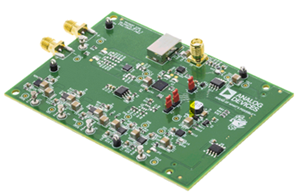
EVAL-AD7768FMCZ
Analog Devices Inc.The AD7768/AD7768-4 are 8-channel and 4-channel,simultaneous sampling sigma-delta (?-?) analog-to-digitalconverters (ADCs), respectively, with a ?-? modulator and digital filter per channel, enabling synchronized sampling of ac and dc signals. The AD7768/AD7768-4 achieve 108 dB dynamic range at amaximum input bandwidth of 110.8 kHz, combined with typicalperformance of ?2 ppm integral nonlinearity (INL), ?50 ?Voffset error, and ?30 ppm gain error. The AD7768/AD7768-4 user can trade off input bandwidth,output data rate, and power dissipation, and select one of threepower modes to optimize for noise targets and power consumption. The flexibility of the AD7768/AD7768-4 allows them to become reusable platforms for low power dc and highperformance ac measurement modules. The AD7768/AD7768-4 have three modes: fast mode (256 kSPS maximum, 110.8 kHz input bandwidth, 51.5 mW per channel),median mode (128 kSPS maximum, 55.4 kHz input bandwidth,27.5 mW per channel) and low power mode (32 kSPS maximum, 13.8 kHz input bandwidth, 9.375 mW per channel).The AD7768/AD7768-4 offer extensive digital filteringcapabilities, such as a wideband, low ?0.005 dB pass-bandripple, antialiasing low-pass filter with sharp roll-off, and 105 dB attenuation at the Nyquist frequency.Frequency domain measurements can use the wideband linear phase filter. This filter has a flat pass band (?0.005 dB ripple)from dc to 102.4 kHz at 256 kSPS, from dc to 51.2 kHz at 128 kSPS, or from dc to 12.8 kHz at 32 kSPS. The AD7768/AD7768-4 also offer sinc response via a sinc5 filter, a low latency path for low bandwidth, and low noisemeasurements. The wideband and sinc5 filters can be selected and run on a per channel basis. Within these filter options, the user can improve the dynamicrange by selecting from decimation rates of ?32, ?64, ?128,?256, ?512, and ?1024. The ability to vary the decimation filtering optimizes noise performance to the required inputbandwidth.Embedded analog functionality on each ADC channel makesdesign easier, such as a precharge buffer on each analog inputthat reduces analog input current and a precharge reference buffer per channel reduces input current and glitches on thereference input terminals.The device operates with a 5 V AVDD1A and AVDD1B supply,a 2.25 V to 5.0 V AVDD2A and AVDD2B supply, and a 2.5 V to 3.3 V or 1.8 V IOVDD supply (see the 1.8 V IOVDD Operationsection for specific requirements for operating at 1.8 V IOVDD).The device requires an external reference; the absolute inputreference voltage range is 1 V to AVDD1 ? AVSS.Applications Data acquisition systems: USB/PXI/Ethernet Instrumentation and industrial control loops Audio test and measurement Vibration and asset condition monitoring 3-phase power quality analysis Sonar High precision medical electroencephalogram (EEG)/electromyography (EMG)/electrocardiogram (ECG)

EVAL-AD7771FMCZ
Analog Devices Inc.The AD7771 is an 8-channel, simultaneous sampling analog-to-digital converter (ADC). Eight full ?-? ADCs are on-chip. The AD7771 provides an ultralow input current to allow direct sensor connection. Each input channel has a programmable gain stage allowing gains of 1, 2, 4, and 8 to map lower amplitude sensor outputs into the full-scale ADC input range, maximizing the dynamic range of the signal chain. The AD7771 accepts a VREF voltage from 1 V up to 3.6 V. The analog inputs accept unipolar (0 V to VREF) or true bipolar (?VREF/2 V) analog input signals with 3.3 V or ?1.65 V analog supply voltages, respectively. The analog inputs can be configured to accept true differential or single-ended signals to match different sensor output configurations.Each channel contains an ADC modulator and a sinc3/sinc5, low latency digital filter. A sample rate converter (SRC) is provided to allow fine resolution control over the AD7771 output data rate (ODR). This control can be used in applications where the ODR resolution is required to maintain coherency with 0.01 Hz changes in the line frequency. The SRC is programmable through the serial port interface (SPI). The AD7771 implements two different interfaces: a data output interface and SPI control interface. The ADC data output interface is dedicated to transmitting the ADC conversion results from the AD7771 to the processor. The SPI writes to and reads from the AD7771 configuration registers and for the control and reading of data from the successive approximation register (SAR) ADC. The SPI can also be configured to output the ?-? conversion data.The AD7771 includes a 12-bit SAR ADC. This ADC can be used for AD7771 diagnostics without having to decommission one of the ?-? ADC channels dedicated to system measurement functions. With the use of an external multiplexer, which can be controlled through the three general-purpose input/output pins (GPIOs), and signal conditioning, the SAR ADC can validate the ?-? ADC measurements in applications where functional safety is required. In addition, the AD7771 SAR ADC includes an internal multiplexer to sense internal nodes.The AD7771 contains a 2.5 V reference and reference buffer. The reference has a typical temperature coefficient of ?10 ppm/?C.The AD7771 offers two modes of operation: high resolution mode and low power mode. High resolution mode provides a higher dynamic range while consuming 16.6 mW per channel; low power mode consumes only 5.25 mW per channel at a reduced dynamic range specification.The specified operating temperature range is ?40?C to +105?C, although the device is operational up to +125?C.Note that throughout this data sheet, certain terms are used to refer to either the multifunction pins or a range of pins. The multifunction pins, such as DCLK0/SDO, are referred to either by the entire pin name or by a single function of the pin, for example, DCLK0, when only that function is relevant. In the case of ranges of pins, AVSSx refers to the following pins: AVSS1A, AVSS1B, AVSS2A, AVSS2B, AVSS3, and AVSS4.Applications Power quality and measurement applications General-purpose data acquisition Electroencephalography (EEG) Industrial process control

EVAL-AD7779-ARDZ
Analog Devices Inc.The AD7779 is an 8-channel, simultaneous sampling ADC.There are eight full ?-? ADCs on chip. The AD7779 providesan ultralow input current to allow direct sensor connection. Eachinput channel has a programmable gain stage allowing gains of1, 2, 4, and 8 to map lower amplitude sensor outputs into thefull-scale ADC input range, maximizing the dynamic range ofthe signal chain. The AD7779 accepts VREF from 1 V up to 3.6 V.The analog inputs accept unipolar (0 V to VREF/GAIN) or truebipolar (?VREF/GAIN/2 V) analog input signals with 3.3 V or?1.65 V analog supply voltages. The analog inputs can beconfigured to accept true differential, pseudo differential, or singleendedsignals to match different sensor output configurations.Each channel contains an ADC modulator and a sinc3, lowlatency digital filter. An SRC is provided to allow fine resolutioncontrol over the AD7779 ODR. This control can be used inapplications where the ODR resolution is required to maintaincoherency with 0.01 Hz changes in the line frequency. The SRCis programmable through the serial port interface (SPI). TheAD7779 implements two different interfaces: a data outputinterface and SPI control interface. The ADC data outputinterface is dedicated to transmitting the ADC conversionresults from the AD7779 to the processor. The SPI interfaceis used to write to and read from the AD7779 configurationregisters and for the control and reading of data from the SARADC. The SPI interface can also be configured to output the?-? conversion data.The AD7779 includes a 12-bit SAR ADC. This ADC can be usedfor AD7779 diagnostics without having to decommission one ofthe ?-? ADC channels dedicated to system measurement functions.With the use of an external multiplexer, which can becontrolled through the three general-purpose inputs/outputs pins(GPIOs), and signal conditioning, the SAR ADC can be used tovalidate the ?-? ADC measurements in applications wherefunctional safety is required. In addition, the AD7779 SAR ADCincludes an internal multiplexer to sense internal nodes.The AD7779 contains a 2.5 V reference and reference buffer.The reference has a typical temperature coefficient of 10 ppm/?C.The AD7779 offers two modes of operation: high resolutionmode and low power mode. High resolution mode provides ahigher dynamic range while consuming 10.75 mW per channel;low power mode consumes just 3.37 mW per channel at areduced dynamic range specification.The specified operating temperature range is ?40?C to +105?C,although the device is operational up to +125?C.Applications Circuit breakers General-purpose data acquisition Electroencephalography (EEG) Industrial process control

EVAL-AD7916SDZ
Analog Devices Inc.The AD7915/AD7916 are 16-bit, successive approximation, analog-to-digital converters (ADCs) that operate from a single power supply, VDD. They contain a low power, high speed, 16-bit sampling ADC and a versatile serial interface port. On the CNV rising edge, the AD7915/AD7916 sample the voltage difference between the IN+ and IN? pins. The voltages on these pins typically swing in opposite phases between 0 V and VREF. The reference voltage, REF, is applied externally and can be set independent of the supply voltage, VDD. The power consumption of the AD7915/AD7916 scales linearly with throughput.The AD7915/AD7916 are serial peripheral interface (SPI) compatible, which features the ability, using the SDI input, to daisy-chain several ADCs on a single 3-wire bus. They are compatible with 1.8 V, 2.5 V, 3 V, and 5 V logic using the separate VIO supply.The AD7915/AD7916 are available in a 10-lead MSOP or a 10-lead LFCSP with operation specified from ?40?C to +125?C.APPLICATIONS Automated test equipment Data acquisition systems Medical instruments Machine automation

EVAL-AD7928SDZ
Analog Devices Inc.The AD7908 / AD7918 / AD7928 are, respectively, 8-bit, 10-bit, and 12-bit, high speed, low power, 8-channel, successive approximation ADCs. The parts operate from a single 2.7 V to 5.25 V power supply and feature throughput rates up to 1 MSPS. The parts contain a low noise, wide bandwidth track-and-hold amplifier that can handle input frequencies in excess of 8 MHz.The conversion process and data acquisition are controlled using CS and the serial clock signal, allowing the device to easily interface with microprocessors or DSPs. The input signal is sampled on the falling edge of CS and conversion is also initiated at this point. There are no pipeline delays associated with the part.The AD7908 / AD7918 / AD7928 use advanced design techniques to achieve very low power dissipation at maximum throughput rates. At maximum throughput rates, the AD7908 / AD7918 / AD7928 consume 2 mA maximum with 3 V supplies; with 5 V supplies, the current consumption is 2.7 mA maximum.Through the configuration of the control register, the analog input range for the part can be selected as 0 V to REFIN or 0 V to 2 ? REFIN, with either straight binary or twos complement output coding. The AD7908 / AD7918 / AD7928 each feature eight single-ended analog inputs with a channel sequencer to allow a preprogrammed selection of channels to be converted sequentially.The conversion time for the AD7908 / AD7918 / AD7928 is determined by the SCLK frequency, which is also used as the master clock to control the conversion.PRODUCT HIGHLIGHTS High Throughput with Low Power Consumption. The AD7908 / AD7918 / AD7928 offer up to 1 MSPS throughput rates. At the maximum throughput rate with 3 V supplies, the AD7908 / AD7918 / AD7928 dissipate just 6 mW of power maximum. Eight Single-Ended Inputs with a Channel Sequencer. A sequence of channels can be selected, through which the ADC cycles and converts on. Single-Supply Operation with VDRIVE Function. The AD7908 / AD7918 / AD7928 operate from a single 2.7 V to 5.25 V supply. The VDRIVE function allows the serial interface to connect directly to either 3 V or 5 V processor systems independent of AVDD. Flexible Power/Serial Clock Speed Management. The conversion rate is determined by the serial clock, allowing the conversion time to be reduced through the serial clock speed increase. The parts also feature various shutdown modes to maximize power efficiency at lower throughput rates. Current consumption is 0.5 ?A max when in full shutdown. No Pipeline Delay. The parts feature a standard successive approximation ADC with accurate control of the sampling instant via a CS input and once off conversion control.

EVAL-AD7988-5SDZ
Analog Devices Inc.The AD7988-1/AD7988-5 are 16-bit, successive approximation,analog-to-digital converters (ADC) that operate from a singlepower supply, VDD. The AD7988-1 offers a 100 kSPS throughput,and the AD7988-5 offers a 500 kSPS throughput. They are lowpower, 16-bit sampling ADCs with a versatile serial interfaceport. On the CNV rising edge, they sample an analog input,IN+, between 0 V to VREF with respect to a ground sense, IN?.The reference voltage, REF, is applied externally and can be setindependent of the supply voltage, VDD.The SPI-compatible serial interface also features the ability todaisy-chain several ADCs on a single 3-wire bus using the SDIinput. It is compatible with 1.8 V, 2.5 V, 3 V, or 5 V logic usingthe separate supply, VIO.The AD7988-1/AD7988-5 generics are housed in a 10-leadMSOP or a 10-lead LFCSP with operation specified from ?40?Cto +125?C.Applications Automated test equipment Data acquisition systems Medical instruments Machine automation

EVAL-AD7997EBZ
Analog Devices Inc.The AD7997 / AD7998?are 8-channel, 10- and 12-bit, low power, successive approximation ADCs with an I2C-compatible interface. The parts operate from a single 2.7 V to 5.5 V power supply and feature a 2 ?s conversion time. The parts contain an 8-channel multiplexer and track-and-hold amplifier that can handle input frequencies up to 11 MHz. The AD7997 / AD7998 provide a 2-wire serial interface that is compatible with I2C interfaces. Each part comes in two versions, AD7997-0 / AD7998-0 and AD7997-1 / AD7998-1, and each version allows at least two different I2C addresses. The I2C interface on the AD7997-0 / AD7998-0 supports standard and fast I2C interface modes. The I2C interface on the AD7997-1 / AD7998-1 supports standard, fast, and high speed I2C interface modes. The AD7997 / AD7998 normally remain in a shutdown state while not converting, and power up only for conversions. The conversion process can be controlled using the CONVST pin, by a command mode where conversions occur across I2C write operations or an automatic conversion interval mode selected through software control. The AD7997 / AD7998 require an external reference that should be applied to the REFIN pin and can be in the range of 1.2 V to VDD. This allows the widest dynamic input range to the ADC.On-chip limit registers can be programmed with high and low limits for the conversion result, and an open-drain, out-of-range indicator output (ALERT) becomes active when the programmed high or low limits are violated by the conversion result. This output can be used as an interrupt.PRODUCT HIGHLIGHTS 2 ?s conversion time with low power consumption. I2C-compatible serial interface with pin-selectable addresses. Two AD7997 / AD7998 versions allow five AD7997 / AD7998 devices to be connected to the same serial bus. The parts feature automatic shutdown while not converting to maximize power efficiency. Current consumption is 1 ?A max when in shutdown mode at 3V. Reference can be driven up to the power supply. Out-of-range indicator that can be software disabled or enabled. One-shot and automatic conversion rates. Registers store minimum and maximum conversion results.

EVAL-AD8421ACPZ
Analog Devices Inc.The AD8421 is a low cost, low power, extremely low noise, ultralow bias current, high speed instrumentation amplifier that is ideally suited for a broad spectrum of signal conditioning and data acquisition applications. This product features extremely high CMRR, allowing it to extract low level signals in the presence of high frequency common-mode noise over a wide temperature range. The 10 MHz bandwidth, 35 V/?s slew rate, and 0.6 ?s settling time to 0.001% (G = 10) allow the AD8421 to amplify high speed signals and excel in applications that require high channel count, multiplexed systems. Even at higher gains, the current feedback architecture maintains high performance; for example, at G = 100, the bandwidth is 2 MHz and the settling time is 0.8 ?s. The AD8421 has excellent distortion performance, making it suitable for use in demanding applications such as vibration analysis. The AD8421 delivers industry-leading 3 nV/?Hz input voltage noise and 200 fA/?Hz current noise with only 2 mA quiescent current, making it an ideal choice for measuring low level signals. For applications with high source impedance, the AD8421 employs innovative process technology and design techniques to provide noise performance that is limited only by the sensor. The AD8421 uses unique protection methods to ensure robust inputs while still maintaining very low noise. This protection allows input voltages up to 40 V from the opposite supply rail without damage to the part. A single resistor sets gains between 1 and 10,000. The reference pin can be used to apply a precise offset to the output voltage.The AD8421 performance is specified from ?40?C to +85?C for the 8-lead MSOP and SOIC packages, and from ?40?C to 125?C for the 8-lead LFCSP package.Applications Medical instrumentation Precision data acquisition Microphone preamplification Vibration analysis Multiplexed input applications ADC driver

EVAL-AD9246S
Analog Devices Inc.The AD9246S is a monolithic, single 1.8 V supply, 14-bit, 125 MSPS analog-to-digital converter (ADC), featuring a high performance sample-and-hold amplifier (SHA) and on-chip voltage reference. The product uses a multistage differential pipeline architecture with output error correction logic to provide 14-bit accuracy at 125 MSPS data rates and guarantees no missing codes over the full operating temperature range.The wide bandwidth, truly differential SHA allows a variety of user-selectable input ranges and offsets, including single-ended applications. It is suitable for multiplexed systems that switch full-scale voltage levels in successive channels and for sampling single-channel inputs at frequencies well beyond the Nyquist rate. Combined with power and cost savings over previously available ADCs, the AD9246S is suitable for applications in communications, imaging, and medical ultrasound.A differential clock input controls all internal conversion cycles. A duty cycle stabilizer (DCS) compensates for wide variations in the clock duty cycle while maintaining excellent overall ADC performance.The digital output data is presented in offset binary, Gray code, or twos complement formats. A data output clock (DCO) is provided to ensure proper latch timing with receiving logic.The AD9246S is available in a 48-lead Quad flat pack and is specified over temperature range of ?55?C to +125?C.Product Highlights The AD9246S operates from a single 1.8 V power supply and features a separate digital output driver supply to accommodate 1.8 V to 3.3 V logic families. The patented SHA input maintains excellent performance for input frequencies up to 225 MHz. The clock DCS maintains overall ADC performance over a wide range of clock pulse widths. A standard serial port interface supports various product features and functions, such as data formatting (offset binary, twos complement, or Gray coding), enabling the clock DCS, power-down, and voltage reference mode. The AD9246S is pin-compatible with the AD9233, allowing a simple migration from 12 bits to 14 bits Applications Ultrasound equipment IF sampling in communications receivers IS-95, CDMA-One, IMT-2000 Battery-powered instruments Hand-held scopemeters Low cost digital oscilloscopes

EVAL-AD9838SDZ
Analog Devices Inc.The AD9838 is a low power DDS device capable of producing high performance sine and triangular outputs. It also has an on-board comparator that allows a square wave to be produced for clock generation. Consuming only 11 mW of power at 2.3 V the AD9838 is an ideal candidate for power-sensitive applications.Capability for phase modulation and frequency modulation is provided. The frequency registers are 28 bits; with a 16 MHz clock rate, resolution of 0.06 Hz can be achieved; with a 5 MHz clock rate, the AD9838 can be tuned to 0.02 Hz resolution. Frequency and phase modulation are configured by loading registers through the serial interface and toggling the registers using software or the FSELECT pin and PSELECT pin, respectively.The AD9838 is written to via a 3-wire serial interface. This serial interface operates at clock rates up to 40 MHz and is compatible with DSP and microcontroller standards.The device operates with a power supply from 2.3 V to 5.5 V. The analog and digital sections are independent and can be run from different power supplies; for example, AVDD can equal 5 V with DVDD equal to 3 V.The AD9838 has a power-down pin (SLEEP) that allows external control of the power-down mode. Sections of the device that are not being used can be powered down to minimize current consumption. For example, the DAC can be powered down when a clock output is being generated.The AD9838 is available in a 20-lead LFCSP_WQ package.APPLICATIONS Frequency stimulus/waveform generation Frequency phase tuning and modulation Low power RF/communications systems Liquid and gas flow measurement Sensory applications: proximity, motion, and defect detection Test and medical equipment

EVAL-ADA4355EBZ
Analog Devices Inc.The ADA4355 is a complete, high performance, current input ?Module?. For space savings, the ADA4355 includes all the required active and passive components to realize a complete current to bits data acquisition solution, supporting a small form factor, optical modules as well as multichannel systems. The high speed transimpedance amplifier (TIA) of the device supports 10 ns pulse widths, allowing high spatial resolution for Time of Flight (ToF) measurements. Additionally, the ADA4355 includes three TIA gain (TZ) settings to maximize dynamic range. An internal, selectable, analog low-pass filter (LPF) can limit the device bandwidth with a corner frequency of 100 MHz to minimize broadband noise while also serving as an antialiasing filter for the 125 MSPS ADC. For lower bandwidth signals, or wider signal pulses (for example, 20 ?s or wider), the filter can be set to a corner frequency of 1.0 MHz to provide additional noise reduction. The 14-bit ADC converts the amplified voltage signal at a rate of up to 125 MSPS and outputs the digitized signals through two serial, low voltage differential signaling (LVDS) data lanes, operating at rates of up to 1 Gbps per lane. The data clock output (DCO) operates at frequencies of up to 500 MHz and supports double data rate (DDR) operation. The ADA4355 exhibits fast overdrive recovery from a large input current signal and is available in a 12.00 mm ? 6.00 mm CSP_BGA package with a ?40?C to +85?C operating temperature range. APPLICATIONSCurrent to voltage conversionChemical analyzers Mass spectroscopy Time of Flight Fiber optic sensing OTDR Optical amplifiers Reconfigurable optical add and drop multiplexers (ROADM)

EVAL-ADAQ4003PMDZ
Analog Devices Inc.The ADAQ4003 is a ?Module? precision data acquisition (DAQ), signal chain solution that reduces the development cycle of a precision measurement system by transferring the signal chain design challenge of component selection, optimization, and layout from the designer to the device.Using system-in-package (SIP) technology, the ADAQ4003 reduces end system component count by combining multiple common signal processing and conditioning blocks into a single device. These blocks include a high resolution 18-bit, 2 MSPS successive approximation register (SAR), analog-to-digital converter (ADC), a low noise, fully differential ADC driver amplifier (FDA), and a stable reference buffer.Using Analog Devices, Inc., iPassives? technology, the ADAQ4003 also incorporates crucial passive components with superior matching and drift characteristics to minimize temperature dependent error sources and to offer optimized performance (see Figure 1 in the data sheet). Housing this signal chain solution in a small, 7 mm ? 7 mm, 0.80 mm pitch, 49-ball CSP_BGA enables compact form factor designs without sacrificing performance and simplifies end system bill of materials management. This level of system integration makes the ADAQ4003 much less sensitive to printed circuit board (PCB) layout while still providing flexibility to adapt to a wide range of signal levels.The serial peripheral interface (SPI)-compatible, serial user interface is compatible with 1.8 V, 2.5 V, 3 V, or 5 V logic, using a separate VIO supply. Specified operation of ADAQ4003 is from ?40?C to +125?C.APPLICATIONS Automatic test equipment Machine automation Process controls Medical instrumentation Digital control loops

EVAL-ADAQ8088EBZ
Analog Devices Inc.The ADAQ8088 is a dual-channel analog system in package (SIP) that integrates three common signal processing and conditioning blocks to support a variety of demodulator applications and data acquisition applications. The device integrates all active and passive components to form a complete signal chain between the output of an I/Q demodulator and the input to an analog-to-digital converter (ADC). The device also forms the complete signal chain between a transducer output and the input to an ADC in baseband data acquisition systems. No external components are required for proper functionality. Each channel contains a preamplifier, followed by an 8-pole, low-pass filter with a 36 MHz, 3 dB frequency and a differential ADC driver optimized to drive 12-bit to 14-bit pipeline ADCs with speeds up to 150 MSPS. Encapsulated in a 6 mm ? 12 mm CSP_BGA package, the ADAQ8088 minimizes space requirements in high density multichannel systems. The ADAQ8088 operating temperature range is from ?40?C to +85?C. APPLICATIONS IF broadband demodulators Medical imaging (CW ultrasound beam forming) Phased array systems Radar Adaptive antennas Communications receivers Radio Links Wireless local loop RF instrumentation Satellite modems Baseband data acquisition system Multichannel digitizer instruments Ultrasonic non-destructive test
EVAL-ADATE318BCPZ
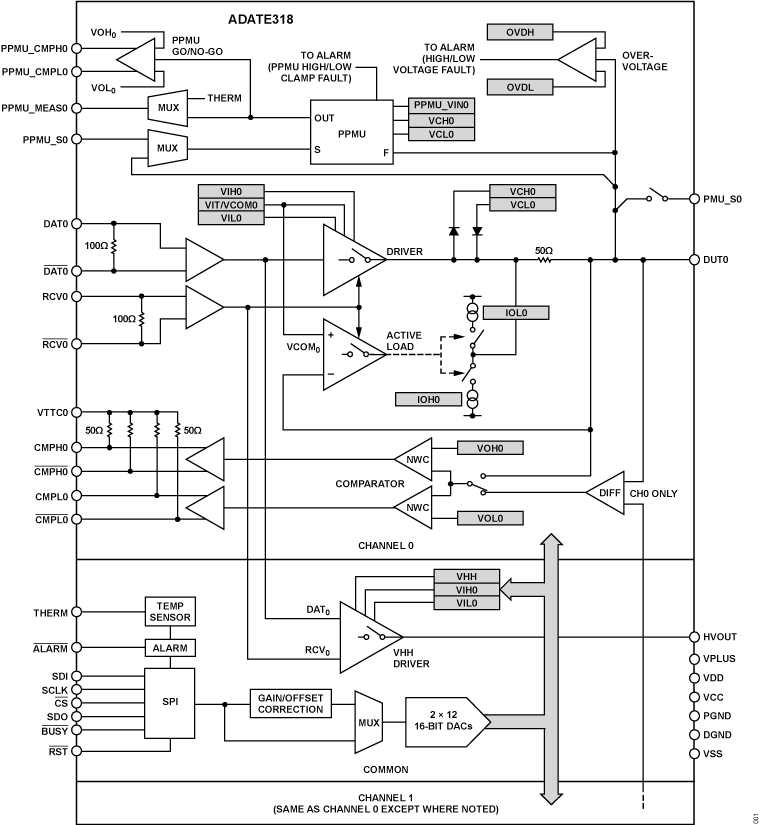
Analog Devices Inc.The ADATE318 is a complete, single-chip ATE solution that performs the pin electronics functions of driver, comparator, and active load (DCL), four quadrant, per pin, parametric measurement unit (PPMU). It has VHH drive capability per chip to support flash memory testing applications and integrated 16-bit DACs with an on-chip calibration engine to provide all necessary dc levels for operation of the part.The driver features three active states: data high, data low, and terminate mode, as well as a high impedance inhibit state. The inhibit state, in conjunction with the integrated dynamic clamps, facilitates the implementation of a high speed active termination. The output voltage capability is ?1.5 V to +6.5 V to accommodate a wide range of ATE and instrumentation applications.The ADATE318 can be used as a dual, single-ended drive/ receive channel or as a single differential drive/receive channel. Each channel of the ADATE318 features a high speed window comparator as well as a programmable threshold differential comparator for differential ATE applications. A four quadrant PPMU is also provided per channel.All dc levels for DCL and PPMU functions are generated by 24 on-chip 16-bit DACs. To facilitate accurate levels programming, the ADATE318 contains an integrated calibration function to correct gain and offset errors for each functional block. Correction coefficients can be stored on chip, and any values written to the DACs are automatically adjusted using the appropriate correction factors.The ADATE318 uses a serial programmable interface (SPI) bus to program all functional blocks, DACs, and on-chip calibration constants. It also has an on-chip temperature sensor and over/undervoltage fault clamps for monitoring and reporting the device temperature and any output pin or PPMU voltage faults that may occur during operation.Applications Automatic test equipment Semiconductor test systems Board test systems Instrumentation and characterization equipment

EVAL-ADATE334EBZ
Analog Devices Inc.The ADATE334 is a complete dual-channel automatic test equipment (ATE) solution that performs the pin electronics functions of a driver, comparator, and active load (DCL), and a four-quadrant per pin parametric measurement unit (PPMU). Dedicated, 16-bit DACs with on-chip calibration registers provide all necessary dc levels for device operation.The high voltage driver features three active states: high mode, low mode, and terminate mode, as well as a high impedance inhibit state. The inhibit state, in conjunction with the integrated dynamic clamps, facilitates significant attenuation of transmission line reflections when the driver is not actively terminating the line. The open-circuit drive capability is ?1.5 V to +7.0 V to accommodate a wide range of ATE and instrumentation applications.The low voltage driver, working in conjunction with the high voltage driver, can provide 25 mV p-p to 600 mV p-p signals at up to 4.6 Gbps in a 50 ? environment.The ADATE334 can be used either as a dual, single-ended pin electronics channel or as a single differential channel. In addition to per-channel, high speed window comparators, the ADATE334 provides a programmable threshold differential comparator for differential ATE applications and a zero-crossing comparator.All dc levels for DCL and PPMU functions are generated by dedicated, on-chip, 16-bit DACs. To facilitate accurate level programming, the ADATE334 includes an integrated calibration function that corrects gain and offset errors of each functional block. Correction coefficients can be stored on-chip, and any values written to the DACs automatically adjust using the appropriate correction factors.The ADATE334 uses a serial programmable interface (SPI) bus to program all functional blocks, DACs, and on-chip calibration constants. The ADATE334 has an on-chip temperature sensor to monitor temperature and overvoltage and undervoltage alarms that monitor and report any output pin or transient PPMU voltage faults that can occur during operation. The ADATE334 also provides a per channel, open-drain relay driver.For more information on the ADATE334, contact ADATE334@anlaog.com.

EVAL-ADAU1372Z
Analog Devices Inc.The ADAU1372 is a codec with four inputs and two outputs, which incorporates asynchronous sample rate converters. Optimized for low latency and low power, the ADAU1372 is ideal for headsets, handsets, and headphones. The ADAU1372 has built-in programmable gain amplifiers (PGAs); thus, with the addition of just a few passive components and a crystal, the ADAU1372 provides a solution for headset audio needs. Microphone preamplifiers, ADCs, DACs, headphone amplifiers and serial ports for connections to an external DSP.APPLICATIONS Handsets, headsets, and headphones Bluetooth handsets, headsets, and headphones Personal navigation devices Digital still and video cameras

EVAL-ADAU1452REVBZ
Analog Devices Inc.The ADAU1452 /?ADAU1451?/?ADAU1450 are automotive qualified audio processors that far exceed the digital signal processing capabilities of earlier SigmaDSP? devices. The restructured hardware architecture is optimized for efficient audio processing. The audio processing algorithms are realized in sample-by-sample and block-by-block paradigms that can both be executed simultaneously in a signal processing flow created using the graphical programming tool, SigmaStudio?. The restructured digital signal processor (DSP) core architecture enables some types of audio processing algorithms to be executed using significantly fewer instructions than were required on previous SigmaDSP generations, leading to vastly improved code efficiency.The 1.2 V, 32-bit DSP core can run at frequencies of up to 294.912 MHz and execute up to 6144 instructions per sample at the standard sample rate of 48 kHz. However, in addition to industry-standard rates, a wide range of sample rates are available. The integer PLL and flexible clock generator hardware can generate up to 15 audio sample rates simultaneously. These clock generators, along with the on-board asynchronous sample rate converters (ASRCs) and a flexible hardware audio routing matrix, make the ADAU1452 / ADAU1451 / ADAU1450 ideal audio hubs that greatly simplify the design of complex multirate audio systems.The ADAU1452 / ADAU1451 / ADAU1450 interface with a wide range of analog-to-digital converters (ADCs), digital-to-analog converters (DACs), digital audio devices, amplifiers, and control circuitry, due to their highly configurable serial ports, S/PDIF interfaces (on the ADAU1452 and ADAU1451), and multipurpose input/output pins. The devices can also directly interface with pulse density modulation (PDM) output microelectromechanical (MEMS) microphones, due to integrated decimation filters specifically designed for that purpose.Independent slave and master I2C/serial peripheral interface (SPI) control ports allow the ADAU1452 / ADAU1451 / ADAU1450 not only to be programmed and configured by an external master device, but also to act as masters that can program and configure external slave devices directly. This flexibility, combined with self boot functionality, enables the design of standalone systems that do not require any external input to operate.The power efficient DSP core executes full programs, consumes only a few hundred milliwatts (mW) of power, and can run at a maximum program load while consuming less than a watt, even in worst case temperatures exceeding 100?C. This relatively low power consumption and small footprint make the ADAU1452 / ADAU1451 / ADAU1450 ideal replacements for large, general-purpose DSPs that consume more power at the same processing load.Differences between the ADAU1452, ADAU1451, and ADAU1450The five variants of this device are differentiated by memory, DSP core frequency, availability of S/PDIF interfaces, ASRC configuration, and temperature range.Because the ADAU1450 does not contain an S/PDIF receiver or transmitter, the SPDIFIN and SPDIFOUT pins are nonfunctional. Additionally, the settings of any registers related to the S/PDIF input or output in the ADAU1450 do not have any effect on the operation of the device.Because the ADAU1450 does not contain ASRCs, the settings of any registers related to the ASRCs in the ADAU1450 do not have any effect on the operation of the device.APPLICATIONS Automotive audio processing Head units Navigation systems Rear seat entertainment systems DSP amplifiers (sound system amplifiers) Commercial and professional audio processing Consumer audio processing

EVAL-ADAU7002Z
Analog Devices Inc.The ADAU7002 converts a stereo PDM bit stream into a PCMoutput. The source for the PDM data can be two microphonesor other PDM sources. The PCM audio data is output on aserial audio interface port in either I2S or TDM format.The ADAU7002 is specified over the commercial temperaturerange (?40?C to +85?C). It is available in a halide-free, 8-ball,1.56 mm ? 0.76 mm, wafer level chip scale package (WLCSP).Applications Mobile computing Portable electronics Consumer electronics

EVAL-ADBMS6830MSW
Analog Devices Inc.The ADBMS6830 is a multicell battery stack monitor that measures up to 16 series connected battery cells with a lifetime total measurement error (TME) of less than 2 mV over the full temperature range. The measurement input range of ?2 V to +5.5 V makes the ADBMS6830 suitable for most battery chemistries and allows measurement of voltages across bus bars. Provisions are made for bypassing bus bars without dedicating any measurement channels.All cells can be measured simultaneously and redundantly with two individual analog-to-digital converters (ADCs). The continuously operating ADCs with a high sampling rate of 4.096 MHz allow reduced external analog filtering and aliasing free measurement results. Higher noise reduction can be achieved by subsequent programmable infinite impulse response (IIR) filters.Multiple ADBMS6830s can be connected in series, permitting simultaneous cell monitoring of long, high voltage battery strings.Each ADBMS6830 has an isolated serial port interface (isoSPI?) for high speed, RF immune, long distance communications. Multiple devices are connected in a daisy chain with one host processor connection. This daisy chain can be operated bidirectionally, ensuring communication integrity even in the event of a fault along the communication path.The ADBMS6830 can be powered from the battery stack or an isolated supply. The ADBMS6830 includes passive balancing with individual pulse-width modulation (PWM) duty cycle control and up to 300 mA discharge current for each cell. Other features include an on-board 5 V regulator, up to 10 general-purpose inputs/outputs, and a sleep mode, where current consumption is reduced to 4 ?A.APPLICATIONS Electric and hybrid electric vehicles Backup battery systems Grid energy storage

EVAL-ADCMP561BRQZ
Analog Devices Inc.The ADCMP561/ADCMP562 are high speed comparators fabricated on Analog Devices, Inc., proprietary XFCB process. The devices feature a 700 ps propagation delay with less than 75 ps overdrive dispersion. Dispersion, a measure of the difference in propagation delay under differing overdrive conditions, is a particularly important characteristic of comparators. A separate programmable hysteresis pin is available on the ADCMP562.A differential input stage permits consistent propagation delay with a wide variety of signals in the common-mode range from ?2.0 Vto +3.0 V. Outputs are complementary digital signals that are fully compatible with PECL 10 K and 10 KH logic families. The outputs provide sufficient drive current to directly drive transmission lines terminated in 50 ? to VDD ? 2 V. A latch input, which is included, permits tracking, track-and-hold, or sample-and-hold modes of operation. The latch input pins contain internal pull-ups that set the latch in tracking mode when left open.The ADCMP561/ADCMP562 are specified over the industrial temperature range (?40?C to +85?C).Applications Automatic test equipment High speed instrumentation Scope and logic analyzer front ends Window comparators High speed line receivers Threshold detection Peak detection High speed triggers Patient diagnostics Disk drive read channel detection Hand-held test instruments Zero-crossing detectors Line receivers and signal restoration Clock drivers