Top Manufacturers
MORE
Stock

Displaying 2921 - 2940 of 12848

Evaluation Kits

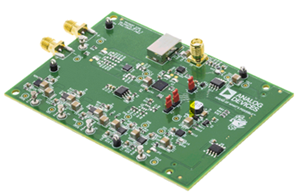
ADL5385-DIFFLO-EBZ

Analog Devices Inc.
The ADL5385 is a silicon, monolithic, quadrature modulatordesigned for use from 30 MHz to 2200 MHz. Its excellent phaseaccuracy and amplitude balance enable both high performanceintermediate frequency (IF) and direct radio frequency (RF)modulation for communication systems.The ADL5385 takes the signals from two differential basebandinputs and modulates them onto two carriers in quadraturewith each other. The two internal carriers are derived from asingle-ended, external local oscillator input signal at twice thefrequency as the desired carrier output. The two modulatedsignals are summed together in a differential-to-single-endedamplifier designed to drive 50 ? loads.The ADL5385 can be used as either an IF or a direct-to-RFmodulator in digital communication systems. The widebaseband input bandwidth allows for either baseband drive ordrive from a complex IF. Typical applications are in radio-linktransmitters, cable modem termination systems, and broadbandwireless access systems.The ADL5385 is fabricated using the Analog Devices, Inc.,advanced silicon germanium bipolar process and is packaged ina 24-lead, RoHS-compliant LFCSP with exposed pad. Performanceis specified over ?40?C to +85?C. A RoHS-compliant evaluationboard is also available.Applications Radio-link infrastructure Cable modem termination systems UHF/VHF radio Wireless infrastructure systems Wireless local loop WiMAX/broadband wireless access systems

ADL5387-EVALZ

Analog Devices Inc.
The ADL5387 is a broadband quadrature I/Q demodulator that covers an RF/IF input frequency range from 30 MHz to 2 GHz. With a NF = 13.2 dB, IP1dB = 12.7 dBm, and IIP3 = 32 dBm @ 450 MHz, the ADL5387 demodulator offers outstanding dynamic range suitable for the demanding infrastructure direct-conversion requirements. The differential RF/IF inputs provide a well-behaved broadband input impedance of 50 ? and are best driven from a 1:1 balun for optimum performance.Ultrabroadband operation is achieved with a divide-by-2 method for local oscillator (LO) quadrature generation. Over a wide range of LO levels, excellent demodulation accuracy is achieved with amplitude and phase balances ~0.05 dB and ~0.4?, respectively. The demodulated in-phase (I) and quadrature (Q) differential outputs are fully buffered and provide a voltage conversion gain of >4 dB. The buffered baseband outputs are capable of driving a 2 Vp-p differential signal into 200 ?.The fully balanced design minimizes effects from second-order distortion. The leakage from the LO port to the RF port is 60 dBm.The ADL5387 operates off a single 4.75 V to 5.25 V supply. The supply current is adjustable with an external resistor from the BIAS pin to ground.The ADL5387 is fabricated using the Analog Devices, Inc. advanced silicon-germanium bipolar process and is available in a 24-lead exposed paddle LFCSP.APPLICATIONS QAM/QPSK RF/IF demodulators W-CDMA/CDMA/CDMA2000/GSM Microwave point-to-(multi)point radios Broadband wireless and WiMAX Broadband CATVs

ADL5531-EVALZ

Analog Devices Inc.
The ADL5531 is a broadband, fixed-gain, linear amplifier that operates at frequencies up to 500 MHz. The device can be used in a wide variety of equipment, including cellular, satellite, broadband, and instrumentation equipment.The ADL5531 provides a gain of 20 dB, which is stable over frequency, temperature, power supply, and from device to device. This amplifier is single-ended and internally matched to 50 ?. Only input/output ac coupling capacitors, power supply decoupling capacitors, and external inductors are required for operation.The ADL5531 is fabricated on a GaAs HBT process and has an ESD rating of ?2 kV (Class 2). The device is packaged in an 8-lead 3 mm ? 3 mm LFCSP that uses an exposed paddle for excellent thermal impedance.The ADL5531 consumes 100 mA on a single 5 V supply and is fully specified for operation from ?40?C to +85?C.The dual-channel 20 dB gain version, ADL5534, is also available.

ADL5569-EVALZ

Analog Devices Inc.
The ADL5569 is a high performance, dual, differential amplifier with 20 dB of voltage gain, optimized for applications spanning from dc to 6.5 GHz. The amplifier is available in a dual format, and it offers a low referred to input (RTI) noise spectral density (NSD) of 1.0 nV/?Hz (at 100 MHz) and excellent distortion performance over a wide frequency range, making it an ideal driver for high speed 12-bit to 16-bit analog-to-digital converters (ADCs). The ADL5569 is ideally suited for use in high performance zero intermediate frequency (IF) and complex IF receiver designs. In addition, this device has excellent low distortion for single-ended input driver applications.Using two external series resistors for each amplifier expands the gain flexibility of the amplifier and allows any gain selection from 6 dB to 20 dB for a differential input. For a single-ended input, the gain can be adjusted from 6 dB to 17 dB with the addition of some external resistors. This device maintains low distortion through its output common-mode range of 2.0 V to 3.0 V, providing a flexible capability for driving ADCs with ac levels up to 2 VP-P.Operating from a single 5 V supply, the quiescent current of the ADL5569 is typically 86 mA per amplifier. When disabled, the amplifiers consume only 8 mA per amplifier.The device is optimized for wideband, low distortion, and low noise operation, giving it unprecedented second harmonic distortion (HD2) and third harmonic distortion (HD3) from dc to 4 GHz. These attributes, together with its adjustable gain capability, make this device the amplifier of choice for driving a wide variety of ADCs, mixers, pin diode attenuators, surface acoustic wave (SAW) filters, and a multitude of discrete radio frequency (RF) devices.Fabricated on an Analog Devices, Inc., high speed silicon germanium (SiGe) process, the ADL5569 is supplied in a compact 2.5 mm ? 3 mm, 16-lead LFCSP package and operates over the ?40?C to +85?C temperature range.APPLICATIONS Differential ADC drivers for GSPS ADCs High speed data acquisition Single-ended to differential conversion DAC buffering DC coupling and level shifting RF/IF gain blocks Balun alternative from dc to 4 GHz SAW filter interfacing

ADL5606-EVALZ

Analog Devices Inc.
The ADL5606 is a broadband, two-stage, 1 W RF driver amplifier that operates over a frequency range of 1800 MHz to 2700 MHz. The device can be used in a wide variety of wired and wireless applications, including ISM, MC-GSM, W-CDMA, TD-SCDMA, and LTE.The ADL5606 operates on a 5 V supply voltage and a supply current of 362 mA. The driver also incorporates a fast power-up/power-down function for TDD applications, applications that require a power saving mode, and applications that intermittently transmit data.The ADL5606 is fabricated on a GaAs HBT process and is packaged in a compact 4 mm ? 4 mm, 16-lead LFCSP that uses an exposed paddle for excellent thermal impedance. The ADL5606 operates from ?40?C to +85?C. A fully populated evaluation board tuned to 2140 MHz is also available.Applications Wireless infrastructure Automated test equipment ISM/AMR applications

ADL5721-EVALZ

Analog Devices Inc.
The ADL5721 is a narrow-band, high performance, low noise amplifier targeting microwave radio link receiver designs. The monolithic silicon germanium (SiGe) design is optimized for microwave radio link bands ranging from 5.9 GHz to 8.5 GHz. The unique design offers a single-ended 50 ? input impedance and provides a 100 ? balanced differential output that is ideal for driving Analog Devices, Inc., differential downconverters and radio frequency (RF) sampling analog-to-digital converters (ADCs). This low noise amplifier (LNA) provides noise figure performance that, in the past, required more expensive three-five (III-V) compounds process technology to achieve. This LNA uses a band switch feature to allow the input P1dB and noise figure to trade off for optimum system performance.The ADL5721 and ADL5723 to ADL5726 family of narrow-band LNAs are each packaged in a tiny, thermally enhanced, 2.00 mm ? 2.00 mm LFCSP package. The ADL5721 and ADL5723 to ADL5726 family operates over the temperature range of ?40?C to +85?C.Applications Point to point microwave radios Instrumentation Satellite communications (SATCOM) Phased arrays

ADL8111-EVALZ

Analog Devices Inc.
The ADL8111 is a low noise amplifier (LNA) with a nonreflective bypass switch that provides broadband operation from 10 MHz to 8000 MHz. The ADL8111 provides a low noise figure of 2.8 dB with a high output third-order intercept (OIP3) of 34 dBm simultaneously, which delivers a high dynamic range. The ADL8111 provides a gain of 12.5 dB that is stable over frequency, temperature, power supply, and from device to device.The integration of an amplifier and two single-pole, quad-throw (SP4T) nonreflective switches allows multiple gain andlinearity values. The addition of switches also offers high input intercept performance and prevents distortion on the high signal level applications.The ADL8111 has a high electrostatic discharge (ESD) rating of ?750 V (Class 1B) and is fully specified for operation across a wide temperature range of ?40?C to +85?C. The ADL8111 is offered in a 6 mm ? 6 mm, 28-terminal land grid array (LGA) package.Applications Military Test instrumentation Communications

ADL8121-EVALZ

Analog Devices Inc.
The ADL8121 is a gallium arsenide (GaAs), monolithic microwave integrated circuit (MMIC), pseudomorphic high electron mobility transistor (pHEMT), low noise wideband amplifier that operates from 0.025 GHz to 12 GHz.The ADL8121 provides a typical gain of 16.5 dB, a 2.5 dB typical noise figure, and a typical output third-order intercept (OIP3) of 36 dBm across the 0.025 GHz to 10 GHz frequency range, requiring only 95 mA from a 5 V supply voltage. The saturated output power (PSAT) of 21.5 dBm typical across the 0.025 GHz to 10 GHz frequency range enables the low noise amplifier (LNA) to function as a local oscillator (LO) driver for many of Analog Devices, Inc., balanced, in-phase and quadrature (I/Q) or image rejection mixers.The ADL8121 also features inputs and outputs that are internally matched to 50 ?, making the device ideal for surface-mounted technology (SMT)-based and is housed in a RoHS-compliant, 2 mm ? 2 mm, 6-lead LFCSP.APPLICATIONSTest instrumentationMilitary communicationsMilitary radarTelecommunications

ADM1266-EVALZ

Analog Devices Inc.
The ADM1266 Super Sequencer? is a configurable supervisory/sequencing device that offers a single-chip solution for supply monitoring and sequencing in systems with up to 17 supplies.?For systems with more supplies (up to 257), the operation of up?to 16 ADM1266 devices can be synchronized through a proprietary?2-wire interface (interdevice bus). The sequencing engine (SE) monitors the supply fault detectors?(SFDs), programmable driver input/outputs (PDIOs), general-purpose?inputs/outputs (GPIOs), and timers, and controls the?PDIOs and GPIOs to sequence the supplies up and down as?required. The logical core of the device is an ARM? Cortex-M3?microcontroller. The firmware is supplied by Analog Devices,?Inc., and all configuration is performed through an intuitive?graphic user interface (GUI). Additionally, the ADM1266 integrates an analog-to-digital?converter (ADC) and voltage output digital-to-analog converters?(DACs) that can be used to adjust either the feedback node or?reference of a dc-to-dc converter to implement a closed-loop,?autonomous, margining system.A block of nonvolatile EEPROM is available to record voltage,?time, and fault information when instructed to by the sequencing?engine configuration.APPLICATIONS Communications infrastructure Industrial test and measurement

ADM7154CP-3.3EVALZ

Analog Devices Inc.
TThe ADM7154 is a linear regulator that operates from 2.3 V to5.5 V and provides up to 600 mA of load current. Using anadvanced proprietary architecture, it provides high powersupply rejection and ultralow noise, achieving excellent line andload transient response with only a 10 ?F ceramic output capacitor.There are 16 standard output voltages for the ADM7154. Thefollowing voltages are available in stock: 1.2 V, 1.8 V, 2.5 V, 2.8 V,3.0 V, and 3.3 V. Additional voltages are available by specialorder: 1.3 V, 1.5 V, 1.6 V, 2.0 V, 2.2 V, 2.6 V, 2.7 V, 2.9 V, 3.1 V,and 3.2 V.The ADM7154 regulator typical output noise is 0.9 ?V rms from100 Hz to 100 kHz for fixed output voltage options and1.5 nV/?Hz for noise spectral density from 10 kHz to 1 MHz. The ADM7154 is available in 8-lead, 3 mm ? 3 mm LFCSP and8-lead SOIC packages, making it not only a very compactsolution, but also providing excellent thermal performance forapplications requiring up to 600 mA of load current in a small,low profile footprint.Applications Regulation to noise sensitive applications: PLLs, VCOs, and PLLs with integrated VCOs Communications and infrastructure Backhaul and microwave links

ADM7160CP-EVALZ

Analog Devices Inc.
The ADM7160 is an ultralow noise, low dropout linear regulator that operates from 2.2 V to 5.5 V and provides up to 200 mA of output current. The low 150 mV dropout voltage at 200 mA load improves efficiency and allows operation over a wide input voltage range.Using an innovative circuit topology, the ADM7160 achieves ultralow noise performance without the need for a bypass capacitor, making it ideal for noise-sensitive analog front end and RF applications. The ADM7160 also achieves ultralow noise performance without compromising PSRR or transient line and load performance.Current-limit and thermal overload protection circuits prevent damage under adverse conditions. The ADM7160 also includes an internal pull-down resistor on the EN input.The ADM7160 is specifically designed for stable operation with tiny 1 ?F, ?30% ceramic input and output capacitors to meet the requirements of high performance, space constrained applications.The ADM7160 is available in tiny 5-lead TSOT and 6-lead LFCSP packages with 16 fixed output voltage options, ranging from 1.1 V to 3.3 V. The LFCSP offers a very compact solution that provides excellent thermal performance for applications that require up to 200 mA of output current in a small, low profile footprint.Applications ADC/DAC power supplies RF, VCO, and PLL power supplies Post dc-to-dc regulation

ADM7160UJ-EVALZ

Analog Devices Inc.
The ADM7160 is an ultralow noise, low dropout linear regulator that operates from 2.2 V to 5.5 V and provides up to 200 mA of output current. The low 150 mV dropout voltage at 200 mA load improves efficiency and allows operation over a wide input voltage range.Using an innovative circuit topology, the ADM7160 achieves ultralow noise performance without the need for a bypass capacitor, making it ideal for noise-sensitive analog front end and RF applications. The ADM7160 also achieves ultralow noise performance without compromising PSRR or transient line and load performance.Current-limit and thermal overload protection circuits prevent damage under adverse conditions. The ADM7160 also includes an internal pull-down resistor on the EN input.The ADM7160 is specifically designed for stable operation with tiny 1 ?F, ?30% ceramic input and output capacitors to meet the requirements of high performance, space constrained applications.The ADM7160 is available in tiny 5-lead TSOT and 6-lead LFCSP packages with 16 fixed output voltage options, ranging from 1.1 V to 3.3 V. The LFCSP offers a very compact solution that provides excellent thermal performance for applications that require up to 200 mA of output current in a small, low profile footprint.Applications ADC/DAC power supplies RF, VCO, and PLL power supplies Post dc-to-dc regulation

ADM8611-EVALZ

Analog Devices Inc.
The ADM8611/ADM8612/ADM8613/ADM8614/ADM8615?are voltage supervisory circuits that monitor power supply voltage levels and code execution integrity in microprocessor-based systems. Apart from providing power-on reset signals, an on-chip watchdog timer can reset the microprocessor if it fails to strobe within a preset timeout period. A reset signal can also be asserted by an external push-button through a manual reset input.The ultralow power consumption of these devices makes them suitable for power efficiency sensitive systems, such as battery-powered portable devices and energy meters.The features of each member of the device family are shown in Table 9 in the data sheet. Each device subdivides into submodels with differences in factory preset voltage monitoring threshold options. In the range of 2 V to 4.63 V, 10 options are available for the ADM8611. In the range of 2.32 V to 4.63 V, five options are available for both the ADM8613 and ADM8614. A separate supply input allows the ADM8612 and ADM8615 to monitor 20 different low voltage levels from 0.5 V to 1.9 V. Not all device options are available as standard models.The ADM8611, ADM8612, ADM8613, and ADM8615 can reset on demand through the manual reset input. The watchdog function on the ADM8613, ADM8614, and ADM8615 monitors the heartbeat of the microprocessor through the WDI pin. The ADM8613 and ADM8614 have a watchdog disable input, which allows the user to disable the watchdog function, if required. The ADM8614 also has a watchdog timeout extension input, allowing the watchdog timeout to be extended from 1.6 sec to 100 sec.The ADM8611/ADM8612/ADM8613/ADM8614/ADM8615 are available in a 6-ball, 1.46 mm ? 0.96 mm WLCSP. These devices are specified over the temperature range of ?40?C to +85?C.??Applications Portable/battery-operated equipment Microprocessor systems Energy metering Energy harvesting

ADM8614-EVALZ

Analog Devices Inc.
The ADM8611 /?ADM8612?/?ADM8613?/?ADM8614?/?ADM8615?are voltage supervisory circuits that monitor power supply voltage levels and code execution integrity in microprocessor-based systems. Apart from providing power-on reset signals, an on-chip watchdog timer can reset the microprocessor if it fails to strobe within a preset timeout period. A reset signal can also be asserted by an external push-button through a manual reset input.The ultralow power consumption of these devices makes them suitable for power efficiency sensitive systems, such as battery-powered portable devices and energy meters.The features of each member of the device family are shown in Table 9 in the data sheet. Each device subdivides into submodels with differences in factory preset voltage monitoring threshold options. In the range of 2 V to 4.63 V, 10 options are available for the ADM8611. In the range of 2.32 V to 4.63 V, five options are available for both the ADM8613 and ADM8614. A separate supply input allows the ADM8612 and ADM8615 to monitor 20 different low voltage levels from 0.5 V to 1.9 V. Not all device options are available as standard models.The ADM8611, ADM8612, ADM8613, and ADM8615 can reset on demand through the manual reset input. The watchdog function on the ADM8613, ADM8614, and ADM8615 monitors the heartbeat of the microprocessor through the WDI pin. The ADM8613 and ADM8614 have a watchdog disable input, which allows the user to disable the watchdog function, if required. The ADM8614 also has a watchdog timeout extension input, allowing the watchdog timeout to be extended from 1.6 sec to 100 sec.The ADM8611/ADM8612/ADM8613/ADM8614/ADM8615 are available in a 6-ball, 1.46 mm ? 0.96 mm WLCSP. These devices are specified over the temperature range of ?40?C to +85?C.??APPLICATIONS Portable/battery-operated equipment Microprocessor systems Energy metering Energy harvesting

ADM8615-EVALZ

Analog Devices Inc.
The ADM8611 /?ADM8612?/?ADM8613?/?ADM8614?/?ADM8615?are voltage supervisory circuits that monitor power supply voltage levels and code execution integrity in microprocessor-based systems. Apart from providing power-on reset signals, an on-chip watchdog timer can reset the microprocessor if it fails to strobe within a preset timeout period. A reset signal can also be asserted by an external push-button through a manual reset input.The ultralow power consumption of these devices makes them suitable for power efficiency sensitive systems, such as battery-powered portable devices and energy meters.The features of each member of the device family are shown in Table 9 in the data sheet. Each device subdivides into submodels with differences in factory preset voltage monitoring threshold options. In the range of 2 V to 4.63 V, 10 options are available for the ADM8611. In the range of 2.32 V to 4.63 V, five options are available for both the ADM8613 and ADM8614. A separate supply input allows the ADM8612 and ADM8615 to monitor 20 different low voltage levels from 0.5 V to 1.9 V. Not all device options are available as standard models.The ADM8611, ADM8612, ADM8613, and ADM8615 can reset on demand through the manual reset input. The watchdog function on the ADM8613, ADM8614, and ADM8615 monitors the heartbeat of the microprocessor through the WDI pin. The ADM8613 and ADM8614 have a watchdog disable input, which allows the user to disable the watchdog function, if required. The ADM8614 also has a watchdog timeout extension input, allowing the watchdog timeout to be extended from 1.6 sec to 100 sec.The ADM8611/ADM8612/ADM8613/ADM8614/ADM8615 are available in a 6-ball, 1.46 mm ? 0.96 mm WLCSP. These devices are specified over the temperature range of ?40?C to +85?C.??APPLICATIONS Portable/battery-operated equipment Microprocessor systems Energy metering Energy harvesting

ADMV1012-EVALZ

Analog Devices Inc.
The ADMV1012 is a compact, gallium arsenide (GaAs) design, monolithic microwave integrated circuit (MMIC) double sideband (DSB) downconverter in a RoHS compliant package optimized for point to point microwave radio designs that operate in the 17.5 GHz to 24 GHz input frequency range. The ADMV1012 provides 15 dB of conversion gain with 25 dB of image rejection, and 2.5 dB noise figure. The ADMV1012 uses a radio frequency (RF) low noise amplifier (LNA) followed by an in phase/quadrature (I/Q), double balanced mixer, where a driver amplifier drives the local oscillator (LO) with a ?2 multiplier. IF1 and IF2 mixer quadrature outputs are provided, and an external 90? hybrid is required to select the required sideband.The I/Q mixer topology reduces the need for filtering of unwanted sideband. The ADMV1012 is a much smaller alternative to hybrid style DSB downconverter assemblies and eliminates the need for wire bonding by allowing the use of surface-mount manufacturing assemblies.The ADMV1012 downconverter comes in a compact, thermally enhanced, 4.9 mm ? 4.9 mm, 32-terminal LCC. The ADMV1012 operates over the ?40?C to +85?C temperature range.Applications Point to point microwave radios Radars and electronic warfare systems Instrumentation, automatic test equipment (ATE)Satellite communications

ADMV1128IF-EVALZ

Analog Devices Inc.
The ADMV1128 is a silicon on isolator (SOI), microwave, upconverter and downconverter optimized for 5G radio designs operating in the 24 GHz to 29.5 GHz frequency range.Both upconverters and downconverters offer two modes of frequency translation. One mode is conversion from and/or to single-ended or complex intermediate frequency (IF) signals, which then pass through an on-chip 90? IF hybrid, known as IF mode.The other mode is a direct conversion from and/or to differential baseband inphase/quadrature (I/Q) inputs and outputs, known as baseband mode. The I/Q baseband output common-mode voltage is programmable between 0 V and 1.5 V. The SPI provides fine adjustment of the quadrature phase to optimize I/Q demodulation performance.When the device is used as an image rejecting downconverter, the unwanted image term is typically rejected to 24 dBc, before calibration. The ADMV1128 offers a square law power detector to allow monitoring of the power levels at the mixer inputs of the downconverter.The RF receive input, RF transmit output, and local oscillator (LO) interface are all single-ended and matched to 50 ?. The on-chip RF switch provides the option to combine the transmit and receive RF ports together for time division duplex (TDD) applications. The serial port interface (SPI) provides adjustment of the quadrature phase to allow optimum sideband rejection. In addition, the SPI allows powering down the output envelope detector to reduce power consumption when carrier feedthrough optimization is not necessary.The ADMV1128 upconverter and downconverter is housed in a compact, thermally enhanced, 6 mm ? 6.5 mm, ball grid array (BGA) package. This BGA package enables the ability to heat sink the ADMV1128 from the top of the package for the most efficient thermal heat sinking. The ADMV1128 operates over the ?40?C to +95?C TC range.APPLICATIONS Millimeter-wave 5G applications Point to point microwave radios Radar and electronic warfare systems Instrumentation and automatic test equipment (ATE)

ADMV4530IF-EVALZ

Analog Devices Inc.
The ADMV4530 is a highly integrated upconverter with an in-phase/quadrature (I/Q) mixer that is ideally suited for next generation Ka band satellite communications.An integrated low phase noise, fractional-N phase-locked loop (PLL) with a voltage controlled oscillator (VCO) and internal 2? multiplier generate the necessary on-chip local oscillator (LO) signal for the I/Q mixer, eliminating the need for external frequency synthesis. The VCO uses an internal autocalibration routine that allows the PLL to select the necessary settings and locks in approximately 100 ?s.The single-ended reference input to the PLL operates up to 500 MHz and features internal reference dividers and a multiplier for added flexibility. Additionally, the phase frequency detector (PFD) comparison frequency can be up to 250 MHz for integer mode and 160 MHz for fraction-N mode.The upconverter consists of an I/Q mixer that can operate in either I/Q mode with 500 MHz of bandwidth or in IF mode up to 3 GHz of bandwidth, which allows various radio architectures and backward compatibility with legacy systems.Immediately following the I/Q mixer are stages of gain and variable attenuation. The configuration can achieve a minimum 1 dB compression point (P1dB) compression point of 19 dBm, eliminating the need for external stages of gain.A programmable 4-wire serial port interface (SPI) allows adjustment of the quadrature phase for optimum sideband suppression. In addition, the SPI allows nulling of LO feedthrough in IF mode. In I/Q mode, the LO feedthrough can be nulled by applying external dc offset to the differential baseband I/Q inputs.An IF automatic gain control (AGC) adjusts the IF variable gain amplifier (VGA) to compensate for input power variations. During normal operation, this AGC feature can be enabled or disabled via the SPI. When disabled during normal operation, the AGC feature only works on a test tone during power-down mode to track temperature variations.The ADMV4530 upconverter comes in a RoHs compliant, 6 mm ? 6 mm, 40-terminal land grid array (LGA) package. The ADMV4530 operates over the ?40?C to +85?C case temperature range.Applications Satellite communication Point to point microwave communication

ADMV4928-EVALZ

Analog Devices Inc.
The ADMV4928 is a silicon on insulator (SOI), 37.0 GHz to 43.5 GHz, mmW 5G beamformer. The RF integrated circuit (RFIC) is highly integrated and contains 16 independent transmit and receive channels. The ADMV4928 supports eight horizontal and eight vertical polarized antennas via independent RFV and RFH input/outputs.In transmit mode, both the RFV input and RFH input signals feed into separate amplifiers. Each path after the amplifiers splits into eight independent channels via the 1:8 power splitters. In receive mode, input signals pass through either the vertical or horizontal receive channels and combine via two independent 8:1 combiners to the common RFV pin or RFH pin. In either mode, each transmit and receive channel includes a vector modulator (VM) to control the phase, and two digital variable gain amplifiers (DVGAs) to control the amplitude. The VM provides a full 360? phase adjustment range in either transmit or receive mode to provide 6 bits of resolution for 5.625? phase steps. A phase step policy for the transmit and receive VM is provided to ensure optimum phase step performance. The total DVGA dynamic range in transmit mode is 34.5, which provides 6 bits of resolution that results in 0.5 dB amplitude steps and 5 bits of resolution that results in 1 dB amplitude steps. In receive mode, the total dynamic range is 28 dB, which provides 5 bits of resolution that results in 0.5 dB amplitude steps and 5 bits of resolution that results in 1 dB amplitude steps. The DVGAs provide a flat phase response across the full gain range. A gain policy for DVGA1 and DVGA2 is provided in the AN-2074 Application Note, ADMV4928 Application Note to ensure optimized performance across the attenuation range with 0.5 dB step resolution from 0 dB to 34.5 dB attenuation for transmit mode and 0.5 dB step resolution from 0 dB to 28 dB attenuation for receive mode. The transmit channels contain individual transmit power detectors to detect either modulated or continuous wave signals to calibrate for each channel gain as well as channel to channel gain mismatch. Each receive channel contains an RF power overload circuit (receive channel overload detection circuit) to prevent potential damage to the device as a result of blocker instances. The ADMV4928 RF ports can be connected directly to a patch antenna to create a dual polarization mmW 5G subarray.The ADMV4928 can be programmed using a 3-wire or 4-wire serial port interface (SPI). An integrated, on-chip low dropout (LDO) voltage regulator generates the 1.0 V supply for the SPI circuitry to reduce the number of supply domains required. Various SPI modes are available to enable fast startup and control during normal operation. The amplitude and phase for each channel can be set individually or multiple channels can be programmed simultaneously using the on-chip memory for beamforming. The on-chip memory can store up to 2048 beam positions that can be allocated for either transmit mode or receive mode for the horizontal channels and vertical channels. On-chip nonvolatile memory (NVM) is used to store the calibrated gain and phase offset coefficients and the reference values for each individual channel from the factory. These values are used to perform channel to channel or chip to chip calibration. In addition, four address pins (CHIP_ADDx) allow independent SPI control of up to 16 devices on the same serial lines. To control multiple devices via the same serial lines with the same instructions, activate broadcast mode via the external enable pin (BR_EN). Dedicated horizontal and vertical polarization load pins (LOAD_V and LOAD_H) provide the synchronization of all devices in the same array. A horizontal and vertical polarization transmit mode and receive mode control pin (TRX_H or TRX_V) is provided for fast switching between transmit mode and receive mode.The ADMV4928 comes in a compact, 239-ball, 10 mm ? 7 mm chip scale package ball grid array (CSP_BGA). The ADMV4928 operates over the ?40?C to +95?C case temperature (TC) range. This CSP_BGA package enables the ability to heatsink the ADMV4928 from the topside of the package for the most efficient thermal heatsinking and to allow flexible antenna placement on the opposite side of the printed circuit board (PCB).APPLICATIONSmmW 5G applicationBroadband communication

ADMV7310-EVALZ

Analog Devices Inc.
The ADMV7310 is a fully integrated system in package (SiP),in phase/quadrature (I/Q) upconverter that operates betweenan intermediate frequency (IF) input range of dc to 2 GHz anda radio frequency (RF) output range of 71 GHz to 76 GHz. Thedevice uses an image rejection mixer that is driven by a 6? localoscillator (LO) multiplier. The mixer RF output is followed by avariable gain amplifier (VGA) and a power amplifier (PA),providing a conversion gain of 35 dB typical. Differential I andQ mixer inputs are provided and can be driven with differentialI and Q baseband waveforms for direct conversion applications.Alternatively, the inputs can be driven using an external 90? hybridand two external 180? hybrids for single-ended applications.The ADMV7310 comes in a fully integrated, surface-mount,50-terminal, 16.00 mm ? 14.00 mm, chip array small outline nolead cavity (LGA_CAV) package. The ADMV7310 operatesover the ?40?C to +85?C temperature range.APPLICATIONS E-band communication systems High capacity wireless backhauls Test and measurement Aerospace and defense

Displaying 2921 - 2940 of 12848

Latest Parts

IN STOCK 13664
Buy

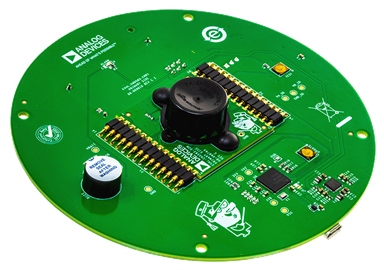
ASX00049

Arduino

* $43.33 - * $50.43

IN STOCK 2835
Buy

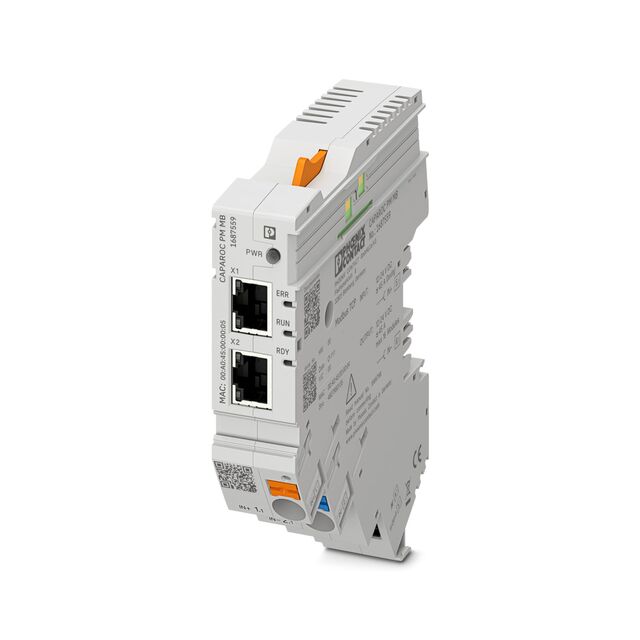
1687559

Phoenix Contact Ltd

[no prices available]

IN STOCK 4
Buy

Reference Designs

RD006

Wurth Elektronik

RD006 - 3 W Dual-output isolated auxiliary supply for communication interfaces and measurement systems

CN0583

Analog Devices Inc.

Multistandard Micropower Verified Smoke Detection System-on-Module

Technical Resources

EVALUATION KITS

EVAL-AD7124-8SDZ

Analog Devices Inc.

$0.00 - * $79.23

IN STOCK 792
Buy
View All