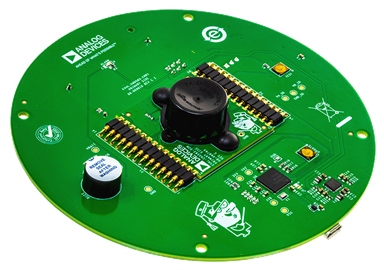
VS1063
Part Number : VS1063
Sparkfun ElectronicsCY8C29466, VS1063 Audio Processing Audio Evaluation Board

VS1053
Part Number : VS1053
Sparkfun ElectronicsVS1053B MP3 Player Audio Arduino Platform Evaluation Expansion Board

GB206
Part Number : GB206
Sparkfun ElectronicsPIC24FJ256GB206 USB 2.0 Host/Controller Interface Evaluation Board


BQ24075
Part Number : BQ24075
Sparkfun ElectronicsBQ24075, BQ27441-G1A Battery Charger Power Management Evaluation Board

OM11043,598
Part Number : OM11043,598
Sparkfun ElectronicsOM11043,598 Inventor Kit mbed Starter Kit

DS18B20
Part Number : DS18B20
Sparkfun ElectronicsIC Temperature Sensor -55°C ~ 125°C Exposed Lead Wires


ICM-20948
Part Number : ICM-20948
Sparkfun ElectronicsICM-20948 Accelerometer, Gyroscope, Magnetometer Sensor Qwiic Platform Evaluation Expansion Board

ADS1015
Part Number : ADS1015
Sparkfun ElectronicsADS1015 Analog to Digital Converter (ADC) Sensor Qwiic Platform Evaluation Expansion Board


HMC6343
Part Number : HMC6343
Sparkfun ElectronicsHMC6343 - Magnetic, Digital Compass Sensor Evaluation Board

V3
Part Number : V3
Sparkfun ElectronicsATmega32U4 Fio v3 series AVR MCU 8-Bit Embedded Evaluation Board
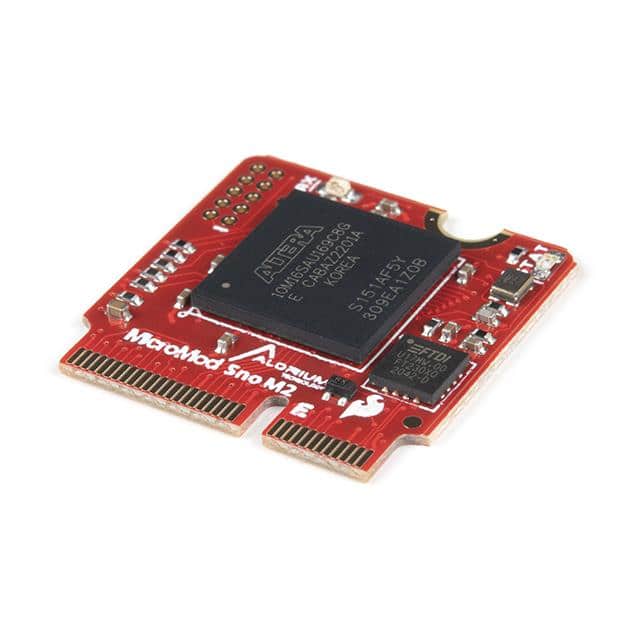
10M16SAU169C8G
Part Number : 10M16SAU169C8G
Sparkfun ElectronicsMicroMod Alorium Sno M2 Processor 10M16SAU169C8G series FPGA Evaluation Board


QRE1113
Part Number : QRE1113
Sparkfun ElectronicsQRE1113 series Proximity, Infrared Sensor Evaluation Board
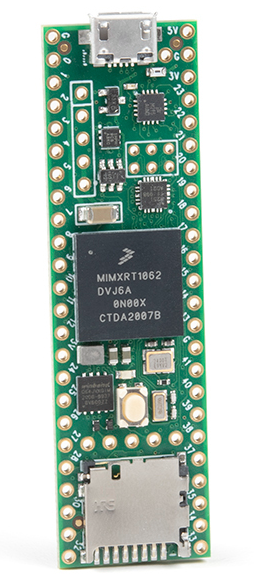
DEV-16771
Part Number : DEV-16771
Sparkfun ElectronicsTeensy 4.1
The Teensy 4.1 represents the latest version of the highly popular development platform, boasting impressive features and enhancements. It is equipped with a powerful ARM Cortex-M7 processor running at 600MHz and a NXP iMXRT1062 chip. Compared to its predecessor, the Teensy 4.0, it offers four times larger flash memory and introduces two additional memory expansion options. The Teensy 4.1 retains the same compact size and shape as the Teensy 3.6, measuring 2.4 inches by 0.7 inches, while delivering enhanced I/O capabilities. These include an ethernet PHY, an SD card socket, and a USB host port.
Operating at 600MHz, the Teensy 4.1 consumes approximately 100mA of current and supports dynamic clock scaling. Unlike conventional microcontrollers, where changing the clock speed can lead to issues with baud rates and other functionalities, the hardware of the Teensy 4.1, combined with the software support provided by Teensyduino for Arduino timing functions, enables seamless speed changes. Serial baud rates, audio streaming sample rates, and Arduino functions such as delay() and millis() continue to operate correctly even when the CPU speed is altered. Additionally, Teensyduino's extensions like IntervalTimer and elapsedMillis function properly in conjunction with speed variations. The Teensy 4.1 also incorporates a power shut-off feature. By connecting a pushbutton to the On/Off pin, you can completely disable the 3.3V power supply by holding the button for five seconds, and restore power with a brief button press. Furthermore, if a coin cell is connected to VBAT, the Teensy 4.1's RTC (Real-Time Clock) remains functional and retains date and time information while the power is off. It is worth noting that the Teensy 4.1 can also be overclocked well beyond its default speed of 600MHz.
The ARM Cortex-M7 processor introduces a host of powerful CPU features to the realm of real-time microcontroller platforms. With its dual-issue superscalar architecture, the Cortex-M7 is capable of executing two instructions per clock cycle at 600MHz. The effectiveness of simultaneous execution depends on the compiler's ordering of instructions and registers. Initial benchmarks indicate that Arduino-compiled C++ code achieves dual instruction execution in numerically intensive tasks involving integers and pointers about 40% to 50% of the time. The Cortex-M7 also marks the first utilization of branch prediction in an ARM microcontroller. In the case of the M4 architecture, loops and other code requiring branching incur a three-clock-cycle delay. However, with the M7, after a loop has iterated a few times, the branch prediction feature eliminates this overhead, enabling branch instructions to execute in a single clock cycle.
The inclusion of Tightly Coupled Memory (TCM) is a notable highlight of the Cortex-M7. TCM provides the M7 processor with rapid, single-cycle access to memory via two 64-bit wide buses. The Instruction Tightly Coupled Memory (ITCM) bus facilitates fetching instructions through a 64-bit path, while the Data Tightly Coupled Memory (DTCM) bus comprises a pair of 32-bit paths, enabling the M7 to perform up to two separate memory accesses within the same cycle. These high-speed buses operate independently from the M7's main AXI bus, which handles communication with other peripherals and memory. Tightly Coupled Memory allows for efficient allocation of up to 512 bytes of memory. When using Teensyduino, your Arduino sketch code is automatically allocated into the ITCM, and all non-malloc memory usage is directed to the fast DTCM, unless you specifically override this optimized default allocation using additional keywords. Memory that is not accessed via the tightly coupled buses is optimized for Direct Memory Access (DMA) access by peripherals. As the majority of the M7's memory access occurs through the two tightly coupled buses, powerful DMA-based peripherals can efficiently access the non-TCM memory, resulting in highly efficient input/output operations.
The Cortex-M7 processor integrated into the Teensy 4.1 includes a floating-point unit (FPU) that supports both 64-bit "double" and 32-bit "float" data types. In comparison, the FPU present in the Teensy 3.5, 3.6, and Atmel SAMD51 chips only accelerates 32-bit floating-point operations. Consequently, any usage of double precision or double precision functions such as log(), sin(), and cos() on those platforms relies on slower software-based math computations. However, with the Teensy 4.1, all these calculations are efficiently executed using the hardware-accelerated FPU.
Note: It's important to be aware that the Teensy 4.1 does not include headers and must be purchased separately and soldered onto the board yourself.