5228
Part Number : 5228
AdafruitAdafruit Industries Monochrome 1.3 128x64 SH1106G SPI OLED Monochrome Display
5274
Part Number : 5274
AdafruitALPHA SINGLE-GANG 16MM RIGHT-ANGLE PC MOUNT - 1M LINEAR - RV16AF-41-15R1-B1M-30H4
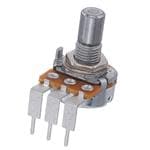
5275
Part Number : 5275
AdafruitALPHA SINGLE-GANG 16MM RIGHT-ANGLE PC MOUNT - 500K LINEAR - RV16AF-41-15R1-B500K-30H4
5278
Part Number : 5278
AdafruitALPHA SINGLE-GANG 16MM RIGHT-ANGLE PC MOUNT - 50K LINEAR - RV16AF-41-15R1-B50K-30H4
5331
Part Number : 5331
AdafruitETCHED GLOW-THROUGH KEYCAP WITH GLITCH LOGO - MX COMPATIBLE SWITCHES

5308
Part Number : 5308
AdafruitELECTRIFY - AN OPTIMISTS PLAYBOOK FOR OUR CLEAN ENERGY FUTURE - BY SAUL GRIFFITH

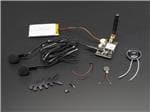
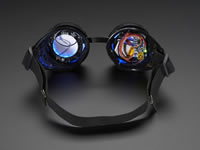
2221
Part Number : 2221
AdafruitAs of October 12th, 2015 this product now ships with an Adafruit Trinket with a micro-USB plug.
One of the most popular Trinket projects now has its own kit pack! Make your very own programmable NeoPixel goggles with 2 x 16 LED rings and an Adafruit Trinket. It even comes with a rechargeable LiPoly battery and charger. It's a great easy build and when you're done you'll have the coolest accessory.
Follow along with our popular Kaleidoscope Eyes tutorial. The pack contains almost everything you need to put a pair of NeoPixel Rings in our costume goggles and power them with an Adafruit Trinket. The LED rings fit perfectly inside 50mm round goggles and we include a 3.7v 150mAh battery and and Micro Lipo charger so you can run the battery and charge it all while contained in the goggles themselves.
These are fairly easy to put together and should take around an hour to make. You'll need some basic soldering and hand tools to install the JST connector on the bottom side of the Trinket and connect your NeoPixel rings. We don't include a soldering iron or solder but sell them in the Adafruit store and you can find epoxy or hot glue at most hardware/craft stores. The soldering is easy and is possible to do by beginners, its a 1-2 hour project (30 minutes if you are a kit-making expert!)
You'll also need a classic USB Micro B cable to program the Trinket, we don't include it as people tend to have too many USB cables in their desk drawer.
Please note! They look great, but we don't recommend putting the goggles over your eyes when they're all lit up since the lights can be bright and the goggle lenses can be hard to see out of. However, the goggles work great for costumes/accessories when they're put on top of your forehead!
3010
Part Number : 3010
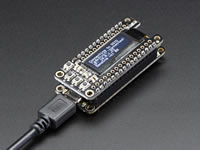
AdafruitFeather is the new development board from Adafruit, and like its namesake it is thin, light, and lets you fly! We designed Feather to be a new standard for portable microcontroller cores. This is the Adafruit Feather M0 WiFi w/ATWINC1500 - our take on an 'all-in-one' Arduino-compatible + high speed, reliable WiFi with built in USB and battery charging. Its an Adafruit Feather M0 with a WiFi module, ready to rock!
Connect your Feather to the Internet with this fine new FCC-certified WiFi module from Atmel. This 802.11bgn-capable WiFi module is the best new thing for networking your devices, with built-in low-power management capabilites, Soft-AP, SSL TSL 1.2 support and rock solid performance. We were running our adafruit.io MQTT demo for a full weekend straight with no hiccups (it would have run longer but we had to go to work, so we unplugged it). This module is very fast & easy to use in comparison to other WiFi modules we've used in the past.
This module works with 802.11b, g, or n networks & supports WEP, WPA and WPA2 encryption. You can connect to your own WiFi networks or create your own with "Soft AP" mode, where it becomes its own access point (we have an example of it creating a webserver that you can then control the Arduino's pins). You can clock it as fast as 12MHz for speedy, reliable packet streaming. And scanning/connecting to networks is very fast, just a second or two.
You might be wondering why use this when you can get a HUZZAH Feather? Well, you get:
A highly-capable Cortex M0+ processor with ton more I/O pins, lots of 12-bit ADCs, a 10-bit DAC, 6 total SERCOMs that can each do SPI, I2C or UART (3 are used by the existing interfaces, leaving you 3), plenty of timers, PWMs, DMA, native USB, and more
The ATWINC has much lower power usage, about 12mA for the WINC & 10mA for the ATSAMD21 with auto-powermanagement on for the WiFi and no power management for the ARM. With manual power management, you can get the WiFi module to down to ~2mA by putting it to sleep.
This is compared to the ESP's ~70mA average current draw, and whose deep sleep mode requires a WDT reset.
We also found that we could stream more reliably (less 'bursty') with the ATWINC, although altogether the ESP has higher throughput.
You also dont have to 'yield' all the time to the WiFi core, since its a separate chip. You get full reign of the processor and timing
Of course, both WiFi-capable Feathers have their strengths and tradeoffs, & we love both equally!
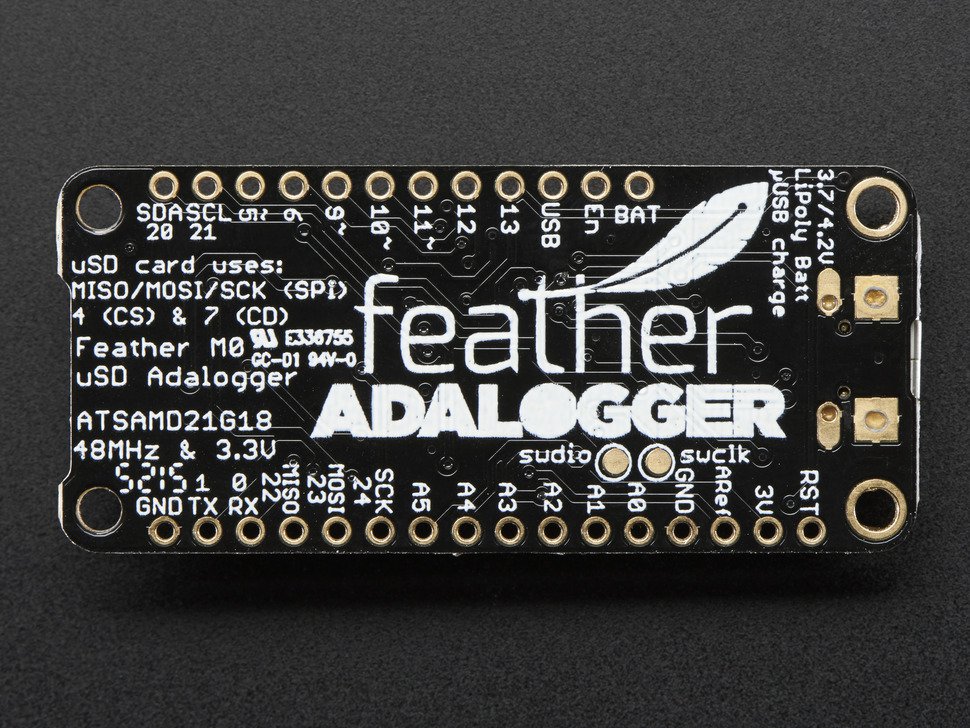
At the Feather M0's heart is an ATSAMD21G18 ARM Cortex M0 processor, clocked at 48 MHz and at 3.3V logic, the same one used in the new Arduino Zero. This chip has a whopping 256K of FLASH (8x more than the Atmega328 or 32u4) and 32K of RAM (16x as much)! This chip comes with built in USB so it has USB-to-Serial program & debug capability built in with no need for an FTDI-like chip. For advanced users who are comfortable with ASF, the SWDIO/SWCLK pins are available on the bottom, and when connected to a CMSIS-DAP debugger can be used to use Atmel Studio for debugging.
To make it easy to use for portable projects, we added a connector for any of our 3.7V Lithium polymer batteries and built in battery charging. You don't need to use a battery, it will run just fine straight from the micro USB connector. But, if you do have a battery, you can take it on the go, then plug in the USB to recharge. The Feather will automatically switch over to USB power when its available. We also tied the battery through a divider to an analog pin, so you can measure and monitor the battery voltage to detect when you need a recharge.
Here's some handy specs! Like all Feather M0's you get:
Measures 2.1" x 0.9" x 0.3" (53.65mm x 23mm x 8mm) without headers soldered in. Note it is 0.1" longer than most Feathers
Light as a (large?) feather - 6.1 grams
ATSAMD21G18 @ 48MHz with 3.3V logic/power
256KB FLASH, 32KB SRAM, No EEPROM
3.3V regulator (AP2112K-3.3) with 600mA peak current output, WiFi can draw 300mA peak during xmit
USB native support, comes with USB bootloader and serial port debugging
You also get tons of pins - 20 GPIO pins
Hardware Serial, hardware I2C, hardware SPI support
8 x PWM pins
10 x analog inputs
1 x analog output
Built in 200mA lipoly charger with charging status indicator LED
Pin #13 red LED for general purpose blinking
Power/enable pin
4 mounting holes
Reset button
Comes fully assembled and tested, with a USB bootloader that lets you quickly use it with the Arduino IDE. We also toss in some header so you can solder it in and plug into a solderless breadboard. Lipoly battery and MicroUSB cable not included (but we do have lots of options in the shop if you'd like!)
3077
Part Number : 3077
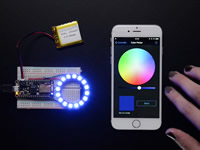
AdafruitFeather is the new development board from Adafruit, and like its namesake it is thin, light, and lets you fly! We designed Feather to be a new standard for portable microcontroller cores.
This is the Adafruit Feather 32u4 Radio (RFM69HCW) 433MHz - our take on an microcontroller packet radio transceiver with built in USB and battery charging. Its an Adafruit Feather 32u4 with a 433 MHz radio module cooked in! Great for making wireless networks that can go further than 2.4GHz 802.15.4 and similar, are more flexible than Bluetooth LE and without the high power requirements of WiFi.
This is the 433 MHz frequency module version.
At the Feather 32u4's heart is at ATmega32u4 clocked at 8 MHz and at 3.3V logic, a chip setup we've had tons of experience with as it's the same as the Flora. This chip has 32K of flash and 2K of RAM, with built in USB so not only does it have a USB-to-Serial program & debug capability built in with no need for an FTDI-like chip, it can also act like a mouse, keyboard, USB MIDI device, etc.
To make it easy to use for portable projects, we added a connector for any of our 3.7V Lithium polymer batteries and built in battery charging. You don't need a battery, it will run just fine straight from the micro USB connector. But, if you do have a battery, you can take it on the go, then plug in the USB to recharge. The Feather will automatically switch over to USB power when its available. We also tied the battery thru a divider to an analog pin, so you can measure and monitor the battery voltage to detect when you need a recharge.
Here's some handy specs! Like all Feather 32u4's you get:
Measures 2.0" x 0.9" x 0.28" (51mm x 23mm x 8mm) without headers soldered in
Light as a (large?) feather - 5.5 grams
ATmega32u4 @ 8MHz with 3.3V logic/power
3.3V regulator with 500mA peak current output
USB native support, comes with USB bootloader and serial port debugging
You also get tons of pins - 20 GPIO pins
Hardware Serial, hardware I2C, hardware SPI support
8 x PWM pins
10 x analog inputs
Built in 100mA lipoly charger with charging status indicator LED
Pin #13 red LED for general purpose blinking
Power/enable pin
4 mounting holes
Reset button
This Feather 32u4 Radio uses the extra space left over to add a RFM69HCW 433 MHz radio module:
SX1231 based module with SPI interface
Packet radio with ready-to-go library
Uses the amateur or license-free ISM band (ITU "Europe" license-free ISM or ITU "American" amateur with limitations)
+13 to +20 dBm up to 100 mW Power Output Capability (selectable in software)
Range of approx. 350 meters, depending on obstructions, frequency, antenna and power output
Create multipoint networks with individual node addresses
Encrypted packet engine with AES-128
Simple wire antenna or spot for uFL connector
Comes fully assembled and tested, with a USB bootloader that lets you quickly use it with the Arduino IDE. We also toss in some headers so you can solder it in and plug into a solderless breadboard. You will need to cut and solder on a small piece of wire (any solid or stranded core is fine) in order to create your antenna. Lipoly battery and USB cable not included but we do have lots of options in the shop if you'd like!
2227
Part Number : 2227
Adafruit70-pin Hirose Receptacle Header for Intel Edison - 3mm Height - Hirose DF40HC(3.0)-70DS