
Search results
811-SS-003-30-007191
Preci-dip
From $0.71 • 1 k+ units available from Quarktwin Electronic Components
811-SS-003-30-007191
Preci-dip
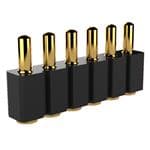
Conn Spring Loaded Connector HDR 3 POS 2.54mm Solder ST SMD T/R
| Distributor | SKU | Stock | MOQ | 1 | 10 | 50 | 100 | 1,000 | 10,000 | |
|---|---|---|---|---|---|---|---|---|---|---|
| DigiKey | 811-SS-003-30-007191-ND | 0 | $1.45 | $1.45 | Buy | |||||
| Mouser Electronics | 437-811SS00330007191 | 0 | 1 | $2.31 | $2.10 | $1.98 | $1.80 | $1.29 | $1.15 | |
| AVNET Europe | 811-SS-003-30-007191 | 0 | 600 | $3.08 | $1.98 | Buy | ||||
| Quarktwin Electronic Components | 811-SS-003-30-007191 | 5,976 | 10 | $1.20 | $1.08 | $1.08 | $0.98 | $0.79 | $0.71 | Buy |
120VAC Input: 3.3V/1.2A Output: Non-Isolated Flyback

Texas Instruments
120VAC Input: 3.3V/1.2A Output: Non-Isolated Flyback
Texas Instruments
This reference design uses the UCC28C42 in a non-isolated flyback topology to generate 3.3V: 1.2V and 22V from a US line AC input. The total output power is 4W. The 3.3V output is regulated by the UCC28C42. A TLV1117LV LDO is used to generate the 1.2V output from the 3.3V output. The 22V output is unregulated and designed only to provide 20mA.
PCB Assembly Guidelines for 0.4mm Package-On-Package (PoP) Packages, Part II (Rev. A)

Texas Instruments
PCB Assembly Guidelines for 0.4mm Package-On-Package (PoP) Packages, Part II (Rev. A)
Texas Instruments
Once the bottom circuit board has been designed, the assembly guidelines for package-on-package (PoP) versions of the OMAP35xx processor and the memory device must be considered. <p> PoP packages ha
Solar Dice: a Sensor Node in the Internet of Things (IoT) Reference Design

Texas Instruments
Solar Dice: a Sensor Node in the Internet of Things (IoT) Reference Design
Texas Instruments
The Solar Dice are a battery-less: wirelessly-transmitting device for the Internet of Things. An onboard accelerometer detects the orientation of the Dice and wirelessly transmits this to a host: such as a USB dongle or smartphone. The reference design demonstrates an ultra-low power sensor node: which is enabled by ultra-low power optimized code for the CC430 and ultra-low power management through the TPS62740. The entire system draws a mere 2.36µA when in standby mode. The Solar Dice are just an example of an unlimited number of different sensor types (temperature: humidity: pressure: etc.) that are enabled by the TPS62740 and CC430.

Power Mode Settings Within the TMS470
Texas Instruments
Power Mode Settings Within the TMS470
Texas Instruments
The TMS470 family of ARM7 microcontrollers has four modes of operation: Standby Idle Halt and Run. The device starts in Run mode and the other three are considered low-power modes. Additional power savings are available by disabling the flash memory.This application report explains how to change into the low-power modes and how to disable and enable the flash.This application report also de
Class 3 Multi-Output Flyback Converter for PoE PD Application Reference Design
Texas Instruments
Class 3 Multi-Output Flyback Converter for PoE PD Application Reference Design
Texas Instruments
PMP841 is a high efficiency, non-isolated Power-over-Ethernet PD power supply reference design intended to ease implementation of PoE in devices such as IP phones, WLAN AP's and security cameras. The reference design uses a TPS2375 PoE Powered Device Controller to implement all necessary detection,
DC2548A

Analog Devices Inc.
DC2548A
Analog Devices Inc.
The LT8672 is an active rectifier controller for reverse input protection. It drives an external N-channel MOSFET to replace a power Schottky diode. Its very low quiescent current and fast transient response meet the tough requirements in automotive applications where AC input signals of up to 100kHz are present. These signals are rectified with minimum power dissipation on the external FET, simplifying thermal management on the PCB.With a drop of only 20mV, the LT8672 solution eases the minimum input voltage requirement during cold crank and start-stop, allowing simpler and more efficient circuits. If the input power source fails or is shorted, a fast turn-off minimizes reverse current transients. An available shutdown mode reduces the quiescent current to 3.5?A.An integrated auxiliary boost regulator provides the required boost voltage to turn the external FET fully on. A power good pin signals when the external FET is ready to take load current.Applications Automotive Battery Protection Industrial Supplies Portable Instrumentation
CT-6ER101
Nidec Corporation
From $0.57 • 100+ units available from multiple sources
CT-6ER101
Nidec Corporation
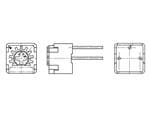
Res Cermet Trimmer 100 Ohm 10% 1/2W 1(Elec)/1(Mech)Turn 2.6mm (7 X 7 X 5.8mm) Pin Thru-Hole Bulk
| Distributor | SKU | Stock | MOQ | 1 | 10 | 50 | 100 | 1,000 | 10,000 | |
|---|---|---|---|---|---|---|---|---|---|---|
| DigiKey | 563-CT-6ER101-ND | 217 | 1 | $1.13 | $0.95 | $0.84 | $0.84 | $0.67 | $0.59 | Buy |
| Mouser Electronics | 229-CT-6ER101 | 0 | 1 | $1.40 | $0.97 | $0.97 | $0.79 | $0.72 | $0.62 | |
| AVNET Express | CT-6ER101 | 0 | 200 | $0.50 | $0.45 | Buy | ||||
| Newark | CT-6ER101 | 400 | 1 | $0.83 | $0.73 | $0.64 | $0.62 | $0.62 | $0.62 | Buy |
| Farnell | CT-6ER101 | 367 | 1 | $0.84 | $0.70 | $0.57 | $0.57 | $0.57 | $0.57 | Buy |
Low Cost 32V@3A Boost Converter Efficiently Powers Inkjet Printer Reference Design

Texas Instruments
Low Cost 32V@3A Boost Converter Efficiently Powers Inkjet Printer Reference Design
Texas Instruments
This boost converter operates from a 24V supply and regulates a 32V@3A output. The converter is designed with low cost in mind: but also delivers 96% efficiency. Aluminum output caps effectively handle large load current transients.
AD9959/PCBZ

Analog Devices Inc.
AD9959/PCBZ
Analog Devices Inc.
The AD9959 consists of four direct digital synthesizer (DDS)cores that provide independent frequency, phase, and amplitudecontrol on each channel. This flexibility can be used to correct imbalances between signals due to analog processing, such asfiltering, amplification, or PCB layout-related mismatches.Because all channels share a common system clock, they areinherently synchronized. Synchronization of multiple devices is supported.The AD9959 can perform up to a 16-level modulation of fre-quency, phase, or amplitude (FSK, PSK, ASK). Modulation isperformed by applying data to the profile pins. In addition, theAD9959 also supports linear sweep of frequency, phase, or amplitude for applications such as radar and instrumentation. The AD9959 serial I/O port offers multiple configurations to provide significant flexibility. The serial I/O port offers an SPI-compatible mode of operation that is virtually identical to the SPI operation found in earlier Analog Devices, Inc., DDS products. Flexibility is provided by four data pins (SDIO_0/SDIO_1/SDIO_2/SDIO_3) that allow four programmable modes of serial I/O operation.The AD9959 uses advanced DDS technology that provides low power dissipation with high performance. The device incorporates four integrated, high speed 10-bit DACs with excellent wideband and narrow-band SFDR. Each channel has a dedicated 32-bit frequency tuning word, 14 bits of phase offset, and a 10-bit output scale multiplier. The DAC outputs are supply referenced and must be terminated into AVDD by a resistor or an AVDD center-tapped transformer. Each DAC has its own programmable reference to enable different full-scale currents for each channel. The DDS acts as a high resolution frequency divider with the REFCLK as the input and the DAC providing the output. The REFCLK input source is common to all channels and can be driven directly or used in combination with an integrated REFCLK multiplier (PLL) up to a maximum of 500 MSPS. The PLL multiplication factor is programmable from 4 to 20, in integer steps. The REFCLK input also features an oscillator circuit to support an external crystal as the REFCLK source. The crystal must be between 20 MHz and 30 MHz. The crystal can be used in combination with the REFCLK multiplier.The AD9959 comes in a space-saving 56-lead LFCSP package. The DDS core (AVDD and DVDD pins) is powered by a 1.8 V supply. The digital I/O interface (SPI) operates at 3.3 V and requires DVDD_I/O (Pin 49) be connected to 3.3 V. The AD9959 operates over the industrial temperature range of ?40?C to +85?C.APPLICATIONSAgile local oscillators Phased array radars/sonars Instrumentation Synchronized clocking RF source for AOTF

AN-1558 Clocking High-Speed A/D Converters (Rev. B)
Texas Instruments
AN-1558 Clocking High-Speed A/D Converters (Rev. B)
Texas Instruments
Extremely high-speed ADCs (>1 GSPS) demand a low-jitter sample clock in order to preserve signal-tonoiseratio (SNR). These 8- and 10-bit converters have best-case noise floors set by quantization noise.For an N-bit ADC sampling a full-scale sinusoid the well known expression for SNR (in dB) is: SNR =6.02N + 1.76. This sets the best case noise floor for an 8-bit ADC at −49.9 dBc. The noise f
AD-MRLIDAR1-EBZ
Analog Devices Inc.
AD-MRLIDAR1-EBZ
Analog Devices Inc.
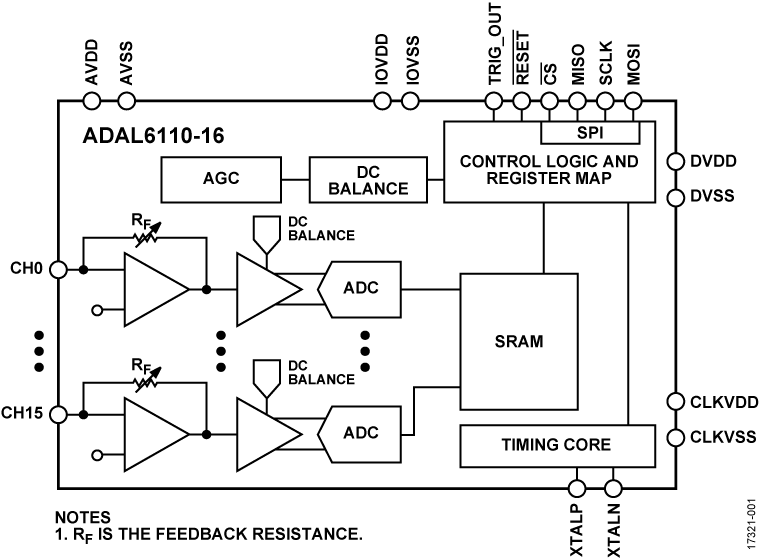
The ADAL6110-16 is a light detection and ranging (LIDAR)signal processor IC that supports simultaneous capture of up to16 channels. Each channel is integrated with a 16-bit analog todigital converter (ADC) to measure the optical return signal.The ADAL6110-16 stores the captured waveforms to staticrandom access memory (SRAM) storage. The data outputreadout and functional configuration of the LIDAR signalprocessor occurs over a 4-wire serial port interface (SPI).The LIDAR signal processor features a dc balance control toreject signal offset and corruption due to modulated interference,eliminating the need for external dc cancellation circuitry. Inaddition, the LIDAR signal processor has a built-in automaticgain control (AGC) that modifies the gain of the system toensure the signal of interest is automatically scaled to themeasurement range.The ADAL6110-16 simplifies the traditional multichannelLIDAR system implementation by integrating the transimpedanceamplifier (TIA), gain and sampling stages, as well as providingthe transmitter fire signal, all of which are managed by on-chipcontrol logic. No external components are required between thephotodiodes and the TIA interface of each channel in theLIDAR signal processor.Applications Autonomous systems collision avoidance Corridor mapping Dynamic suspension and flight control Drone altitude monitoring Industrial distance measurement Mounted safety curtain systems Parking spot monitoring Blind spot detection