
Search results

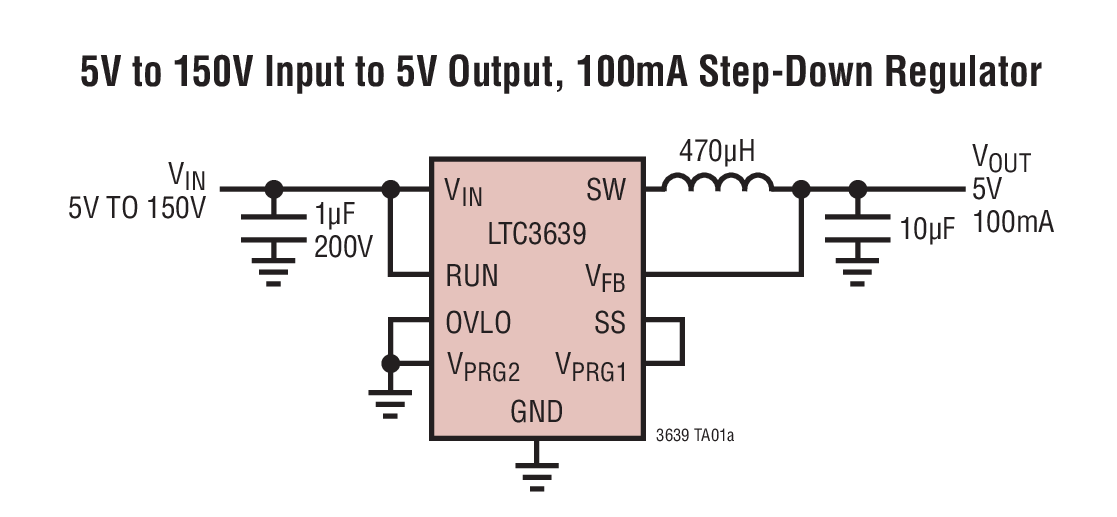
LTC3639EMSE Demo Board | Sync Buck, 4V ≤ VIN ≤ 150V, VOUT = 1.8V/3.3V/5V/Adj @ 100mA
Analog Devices Inc.
LTC3639EMSE Demo Board | Sync Buck, 4V ≤ VIN ≤ 150V, VOUT = 1.8V/3.3V/5V/Adj @ 100mA
Analog Devices Inc.
Demonstration circuit 1901A is a 150V input, 100mA output DC/DC power supply featuring the LTC3639. The IC operates in a high efficiency Burst Mode® operation and includes internal high and low side power MOSFETs. The board will accept an input voltage between 4V and 150V, and provide jumper selected output voltages of 1.8V, 3.3V, 5V and an option for additional voltages. The IC includes internal soft-start and a provision for increasing soft-start time.

12 Cell 4A Stackable Slave Bidirectional Active Cell Balancer Featuring LTC6804-2 and LTC3300-1(x2)

Analog Devices Inc.
12 Cell 4A Stackable Slave Bidirectional Active Cell Balancer Featuring LTC6804-2 and LTC3300-1(x2)
Analog Devices Inc.
Demonstration Circuit DC2100B-D is a stackable, bidirectional cell balancer slave board using the LTC6804-2 and the LTC3300-1 ICs to achieve active balancing of up to 12 Li-Ion cells. It requires the DC2100B-C for proper operation. The DC2100B-D uses a single LTC6804-2 Multi-Cell Addressable Battery Stack Monitor IC to measure cell voltages and two LTC3300-1 Synchronous Flyback ICs to provide active cell balancing. The DC2100B-C controller board contains a PIC18F47J53 microcontroller, the LTM2884 isolated USB transceiver, the LTC6804-2, two LTC3300-1 ICs, and the LTC6820 isoSPI Interface IC to facilitate isolated communication. Up to seven DC2100B-D boards can be connected to a DC2100B-C to build a stacked system of eight total boards.
ADL5902-EVALZ

Analog Devices Inc.
ADL5902-EVALZ
Analog Devices Inc.
The ADL5902 is a true rms responding power detector that hasa 65 dB measurement range when driven with a single-ended 50 ? source. This feature makes the ADL5902 frequencyversatile by eliminating the need for a balun or any other form of external input tuning for operation up to 9 GHz.The ADL5902 provides a solution in a variety of high frequencysystems requiring an accurate measurement of signal power. Requiring only a single supply of 5 V and a few capacitors, it is easy to use and capable of being driven single-ended or with abalun for differential input drive. The ADL5902 can operate from 50 MHz to 9 GHz and can accept inputs from ?62 dBm to at least +3 dBm with large crest factors, such as GSM, CDMA,W-CDMA, TD-SCDMA, WiMAX, and LTE modulated signals.The ADL5902 can determine the true power of a high frequency signal having a complex low frequency modulation envelope or can be used as a simple low frequency rmsvoltmeter. Used as a power measurement device, VOUT isconnected to VSET. The output is then proportional to thelogarithm of the rms value of the input. In other words, thereading is presented directly in decibels and is scaled 1.06 V per decade, or 53 mV/dB; other slopes are easily arranged. In controller mode, the voltage applied to VSET determines thepower level required at the input to null the deviation from the set point. The output buffer can provide high load currents.The ADL5902 has 1.5 mW power consumption when powereddown by a logic high applied to the PWDN pin. It powers up within approximately 5 ?s to its nominal operating current of 73 mA at 25?C. The ADL5902 is supplied in a 4 mm ? 4 mm,16-lead LFCSP for operation over the wide temperature rangeof ?40?C to +125?C.The ADL5902 is also pin-compatible with the AD8363, 50 dBdynamic range TruPwr? detector. This feature allows the designer to create one circuit layout for projects requiring different dynamic ranges. A fully populated RoHS-compliant evaluation board is available.Applications Power amplifier linearization/control loops Transmitter power controls Transmitter signal strength indication (TSSI) RF instrumentation
6W Boost Converter Optimized for Low Profile/Small Area

Texas Instruments
6W Boost Converter Optimized for Low Profile/Small Area
Texas Instruments
This single cell Li-Ion battery input boost converter provides a 5.3V output at 1.1A (5.8W). It achieves 90% efficiency at full load and operates at 1MHz. PMP7426 uses the TPS55340 high voltage boost converter.
Understanding the Functional Enhancements of DSP/BIOS II and Their Utilization

Texas Instruments
Understanding the Functional Enhancements of DSP/BIOS II and Their Utilization
Texas Instruments
Building upon the software foundation architecture of DSP/BIOS DSP/BIOS II extends Texas Instruments? system software capabilities and services to enable the development of more advanced and complex applications; and provide support for traditional concurrent-system design paradigms. This support is a combination of additional software modules and modifications to the kernel to provide preemp
PMS 102 0075 SL
B&F Fastener Supply
From $0.03 • 100 k+ units available from DigiKey
PMS 102 0075 SL
B&F Fastener Supply
MACHINE SCREW PAN SLOTTED 10-32
| Distributor | SKU | Stock | MOQ | 1 | 10 | 50 | 100 | 1,000 | 10,000 | |
|---|---|---|---|---|---|---|---|---|---|---|
| DigiKey | H204-ND | 112,692 | $0.04 | $0.03 | $0.03 | Buy |
Implementation of a 3-Phase Rogowski Coil Based Watt Hour Meter Reference Design

Texas Instruments
Implementation of a 3-Phase Rogowski Coil Based Watt Hour Meter Reference Design
Texas Instruments
This design: implements a highly integrated single chip electricity metering solution: with support for Rogowski Coil current sensors. Hardware and software design files are provided to enable calculation of various parameters for multi-phase energy measurement: such as RMS current & voltage: active and reactive power and energies: power factor and frequency. The added hardware and software support for Rogowski Coils make it easy to interface with Rogowski coils with minimal hardware changes when migrating from traditional current transformers. The Rogowski coil current sense library implements an efficient software integration of the Rogowski output: enabling this to be a single chip solution for 3-phase e-metering. Software package also includes a dummy application for quick and easy evaluation of the hardware and software.
15V – 50V input to 12V@5A: Non Sync Buck
Texas Instruments
15V – 50V input to 12V@5A: Non Sync Buck
Texas Instruments
It is a non synchronous buck controller. It uses a constant on time (COT) device i.e. LM5085.This circuit has ceramic output capacitors which have very low ESR. Therefore the ripple is generated using the DCR of the inductor. The ripple voltage is then superimposed onto the feedback voltage.
330mW AC or DC Tiny Flyback Converter Power Supply Reference Design

Texas Instruments
330mW AC or DC Tiny Flyback Converter Power Supply Reference Design
Texas Instruments
The main purpose of the power supply is to convert the rectified AC Input to DC regulated current for 6 LEDs. The power supply provides protection for the LEDs: limits the transient input voltage and protect against inrush current at plug in. The overall power supply conformity (e.g. mains harmonics (EN): mains interference: international safety standards etc.) are not approved for all the applicable European Norms (EN).This application note describes the design of a tiny AC or DC Flyback power supply.It�s main purpose is to convert the rectified AC or DC Input to DC regulated output voltage. The power supply provides protection for this supply voltage: isolates the rest of the network from the output: limits the transient input voltage and protects against inrush current at plug in. The board fully complies to the EN55022 norm (Conductive average) and international safety standards. The secondary side is regulated at 3.3V. The controller is switching with a fixed frequency of 250 kHz. The heart of the power supply is the controller LM3481 current mode PWM from National Semiconductor.The advantage of the proposed solution is using a standard off the shelf transformer: small solution size and high ambient operating temperature up to 85�C (105�C possible).Based on the presented solution higher output power up to several Watt can also be achieved using the LM3481.
AD8334-EVALZ

Analog Devices Inc.
AD8334-EVALZ
Analog Devices Inc.
The AD8334 is an ultralow noise, quad channel linear-in-dB variable gain amplifier (VGA). Although optimized for ultrasound systems, it may be used as a low noise variable gain control in any application whose operating frequency is less than 100 MHz.Included in each channel are an ultralow noise preamp (LNA), an X-AMP? VGA with 48 dB of gain range, and a selectable gain postamp with adjustable output limiting. The LNA gain is 19 dB with a single-ended input and differential outputs. Using a single resistor, the LNA input impedance can be adjusted to match a signal source without compromising noise performance.The 48 dB gain range of the VGA makes these devices suitable for a variety of applications. Excellent bandwidth uniformity is maintained across the entire range. The gain control interface provides precise linear-in-dB scaling of 50 dB/V for control voltages between 40 mV and 1 V. Factory trim ensures excellent part-to-part and channel-to-channel gain matching. Differential signal paths result in superb second- and third-order distortion performance and low crosstalk.The AD8334 is a quad version of the single AD8331 and dual AD8332.For information on specs, see the AD8331/AD8332/AD8334 datasheet.Applications Ultrasound and sonar time-gain controls High performance automatic gain control (AGC) systems I/Q signal processing High speed, dual ADC drivers
AN-386 A Non-Complementary Audio Noise Reduction System (Rev. C)
Texas Instruments
AN-386 A Non-Complementary Audio Noise Reduction System (Rev. C)
Texas Instruments
The popularity of companding or complementary noise reduction systems is self-evident. Nearly allmedium to high quality cassette tape decks include either Dolby®B or Dolby C type noise reduction. Ascant few have different systems such as dbx or Hi-Com. The universal appeal of compandors to n.r.system designers is the amount of noise reduction they can offer yet one of the major reasons t