
Search results
DC1949A

Analog Devices Inc.
DC1949A
Analog Devices Inc.
The LT8602 is a quad channel, current mode, monolithic buck switching regulator with a programmable power-on reset. All regulators are synchronized to a single oscillator with an adjustable frequency from 250kHz to 2.2MHz. The LT8602 can be configured for micropower Burst Mode operation or pulse-skipping operation at light load. Micropower operation results in quiescent current of 30?A with all four regulators operating in the application below.The high voltage channels are synchronous buck regulators that operate from an input of 3V to 42V. The output currents are up to 1.5A (OUT1) and 2.5A (OUT2). The low voltage channels operate from an input of 2.6V to 5.5V. Internal synchronous power switches provide high efficiency with output currents up to 1.8A. The LT8602 uses a 2-phase clock with channels 1 and 3 operating 180? from channels 2 and 4 to reduce input ripple current on both HV and LV inputs. All channels have cycle-by-cycle current limit, providing protection against shorted outputs. Thermal shutdown provides additional protectionThe LT8602 is available in either a 40-lead 6mm ? 6mm QFN or a 48-Lead 7mm ? 7mm LQFP package.APPLICATIONS Automotive Systems Distributed Supply Regulation Industrial Controls and Power Supplies
Small Form Factor 12W Ultra Wide Range Power Supply for Protection Relays - Reference Design

Texas Instruments
Small Form Factor 12W Ultra Wide Range Power Supply for Protection Relays - Reference Design
Texas Instruments
This small form factor: 12W power supply solution for protection relays handles an ultra-wide range of both AC and DC inputs making it a suitable platform to power a variety of lower power protection relays that need to be placed in a small housing. The power supply is designed to output industry standard voltages required in protection relays while also providing excellent line and load regulation. This solution has been engineered for high wattage with good efficiency and has also been pre-compliance tested for IEC61000-4 (EFT and Surge) and CISPR 11 Class A (Interference).
EVAL-ADAU1472Z

Analog Devices Inc.
EVAL-ADAU1472Z
Analog Devices Inc.
The ADAU1472 is a high quality SigmaDSP? digital audio?processor with a large internal memory, enabling efficient audio?source separation, far field voice capture, speech processing, deep?learning, and advanced audio signal processing. The processor combines the highly optimized Cadence? Tensilica? HiFi? 4?audio/voice processor with custom Analog Devices, Inc.,?instruction extensions for math acceleration, and a flexible input and output architecture. The?HiFi 4 processor supports four 32-bit ? 32-bit multiplier?accumulators (MACs) per cycle with 72-bit accumulators, dual 64-bit memory load, and a native Institute of Electrical and?Electronics Engineers (IEEE) single precision, floating-point multiplier.The ADAU1472 processor offers performance up to 270.336 MHz,?supports low latency, sample by sample audio processing, and?block by block processing paradigms in parallel. The integer?phase-locked loop (PLL) and flexible clock generator hardware?can generate up to 15 audio sample rates simultaneously (8 kHz?to 192 kHz). These clock generators, along with the on-board?asynchronous sample rate converters (ASRCs) and flexible?hardware audio routing matrix, greatly simplify the design of?complex audio systems.The HiFi 4 digital signal processor (DSP) core has 480 kB of L1?memory running at the DSP core clock rate, which consists of?256 kB data random access memory (RAM), 64 kB instruction?RAM, 128 kB data cache, and 32 kB instruction cache, along with?2 MB of L2 system static random access memory (SRAM)?running at one half of the DSP core clock rate. The processor?also supports up to 2 GB of external flash memory to enable the?storage of large data tables and self boot code.Dual on-chip power domains allow low power operation,?including the capability of routing audio through a flexible audio?routing matrix with IOVDD as the only active supply.?The configurable voice detection hardware can detect human?speech onset while operating in a low power state and can?generate both internal DSP and external wake-up signals.The ADAU1472 interfaces with a wide range of analog-to-digital?converters (ADCs), digital-to-analog converters (DACs), digital?audio devices, amplifiers, and control circuitry due to its highly?configurable serial ports, Sony/Philips digital interface?format (S/PDIF) interfaces, and multipurpose input/output?pins. The device can also directly interface with up to 14 pulse?density modulated (PDM) output microphones due to?integrated decimation filters specifically designed for that?purpose. The PDM outputs with integrated interpolation filters?provide direct connectivity to PDM input Class D amplifiers.The processor has two serial peripheral interface (SPI) bus master?control ports that allow the device to communicate with multiple?SPI-compatible devices including support for single, dual, and?quad input/output operation. In addition, the SPI flash port?allows direct memory mapped read access with minimal central?processing unit (CPU) overhead and standalone self boot?operation.The combined high performance DSP core, large RAM, and?small footprint make the ADAU1472 an ideal replacement for?large, general-purpose DSPs that consume more power for the?same processing load.Applications Far field voice interface devices Audio source separation Embedded deep learning for audio Commercial and professional audio processing
CC2530 with Skyworks' SE2431L range extender FEM

Texas Instruments
CC2530 with Skyworks' SE2431L range extender FEM
Texas Instruments
The CC2530-SE2431L Reference Design contains schematic and layout for the CC2530-SE2431 evaluation module. The reference design demonstrates how to integrate CC2530/CC2531 and SE2431L: and the application note shows the RF performance of the combo and suggests ways for RF layout. For optimum RF performance: the schematic and layout should be copied as closely as possible. This is a 4-layer reference design with both an SMA connector for RF output matched to 50 ohm and an inverted-F PCB antenna.
LTC3855EUJ Demo Board | Dual Output, VIN = 4.5V to 14V, VOUT1 = 1.8V @ 17A, VOUT2 = 1.2V @ 17A

Analog Devices Inc.
LTC3855EUJ Demo Board | Dual Output, VIN = 4.5V to 14V, VOUT1 = 1.8V @ 17A, VOUT2 = 1.2V @ 17A
Analog Devices Inc.
Demonstration circuit DC1441A is a dual output synchronous buck converter featuring the LTC3855EUJ. The board provides two outputs of 1.8V/17A and 1.2V/17A from an input voltage of 4.5V to 14V at a switching frequency of 400kHz.
Boost Converter LED Driver Using 9V – 24V Input Range

Texas Instruments
Boost Converter LED Driver Using 9V – 24V Input Range
Texas Instruments
This reference design uses the TPS40211 current mode controller in a boost converter to regulate the current in a series string of 12 LEDs (42V) at 0.35A. Efficiency is greater than 94%.
LT8415EDDB Demo Board | Ultralow Power Boost Converter with Dual Half-Bridge Switches

Analog Devices Inc.
LT8415EDDB Demo Board | Ultralow Power Boost Converter with Dual Half-Bridge Switches
Analog Devices Inc.
DC1449A: Demo Board for the LT8415 Ultralow Power Boost Converter with Dual Half-Bridge Switches.
EVAL-ADA4571-2EBZ

Analog Devices Inc.
EVAL-ADA4571-2EBZ
Analog Devices Inc.
The ADA4571-2 is a 2-channel anisotropic magneto resistive (AMR) sensor with integrated signal conditioning amplifiersand ADC drivers. The device produces analog outputs that indicate the angular position of the surrounding magnetic field.Each channel consists of two die within one package: an AMR sensor and a variable gain instrumentation amplifier. The ADA4571-2 delivers clean and amplified cosine and sine output signals per channel related to the angle of a rotating magnetic field. The output voltage range is ratiometric to the supply voltage.Each sensing channel contains two separated wheatstone bridges at a relative angle of 45? to one another. A rotating magnetic field parallel to the plane of the IC package delivers two sinusoidal output signals, with the double frequency of the angle, ?, between the sensor and the magnetic field direction. Within a homogeneous field parallel to the plane of the IC package, the output signals are independent of airgap between the sensor and the magnet.The ADA4571-2 is available in a 16-lead SOIC package.Product Highlights Contactless angular measurement. Measures magnetic field direction rather than field intensity. Minimum sensitivity to air gap variations. Large working distance. Excellent accuracy, even for weak saturation fields. Minimal thermal and lifetime drift. Negligible hysteresis.Single-chip solution.Applications Permanent magnet synchronous motor (PMSM) control and positioning Contactless angular measurement and detection? Magnetic angular position sensing
SEPIC (5V@250mA) for Auxiliary Bias Supply

Texas Instruments
SEPIC (5V@250mA) for Auxiliary Bias Supply
Texas Instruments
The PMP5422 reference design provides an isolated 5V at 250mA from a 120VAC/60Hz input in less than 1 square inch of board space. This design uses the TPS40210 in a non-isolated SEPIC topology. The SEPIC clamping capacitor reduces ringing on the drain of the MOSFET and recaptures leakage energy to improve efficiency.
DC2873A-B

Analog Devices Inc.
DC2873A-B
Analog Devices Inc.
The LTC2688 is a 16-channel,16-bit, ?15 V digital-to-analog converter (DAC) with an integrated precision reference. The LTC2688 is guaranteed monotonic and has built in rail-to-rail output buffers that can source or sink up to 20 mA. This SoftSpan? DAC offers five output ranges up to ?15 V. The range of each channel is independently programmable.The internal 4.096 V precision reference sets the accuracy of the output voltage. An external reference can be used for additional range options. Three toggle pins support Input Register A and Input Register B toggle or sinusoidal dither at multiple frequencies. An analog multiplexer simplifies measurement of pin voltages, load currents, and junction temperature.Programmable offset and gain registers improve the accuracy of the DAC outputs.The serial peripheral interface (SPI) and MICROWIRE?-compatible, 3-wire serial interface operates on logic levels as low as 1.71 V and clock rates up to 50 MHz.APPLICATIONSOptical networkingInstrumentationData acquisitionAutomatic test equipmentProcess control and industrial automation
LTC5599 | 30MHz to 1300MHz Low Power Direct I/Q Modulator - DC590B Serial Board Required
Analog Devices Inc.
LTC5599 | 30MHz to 1300MHz Low Power Direct I/Q Modulator - DC590B Serial Board Required
Analog Devices Inc.
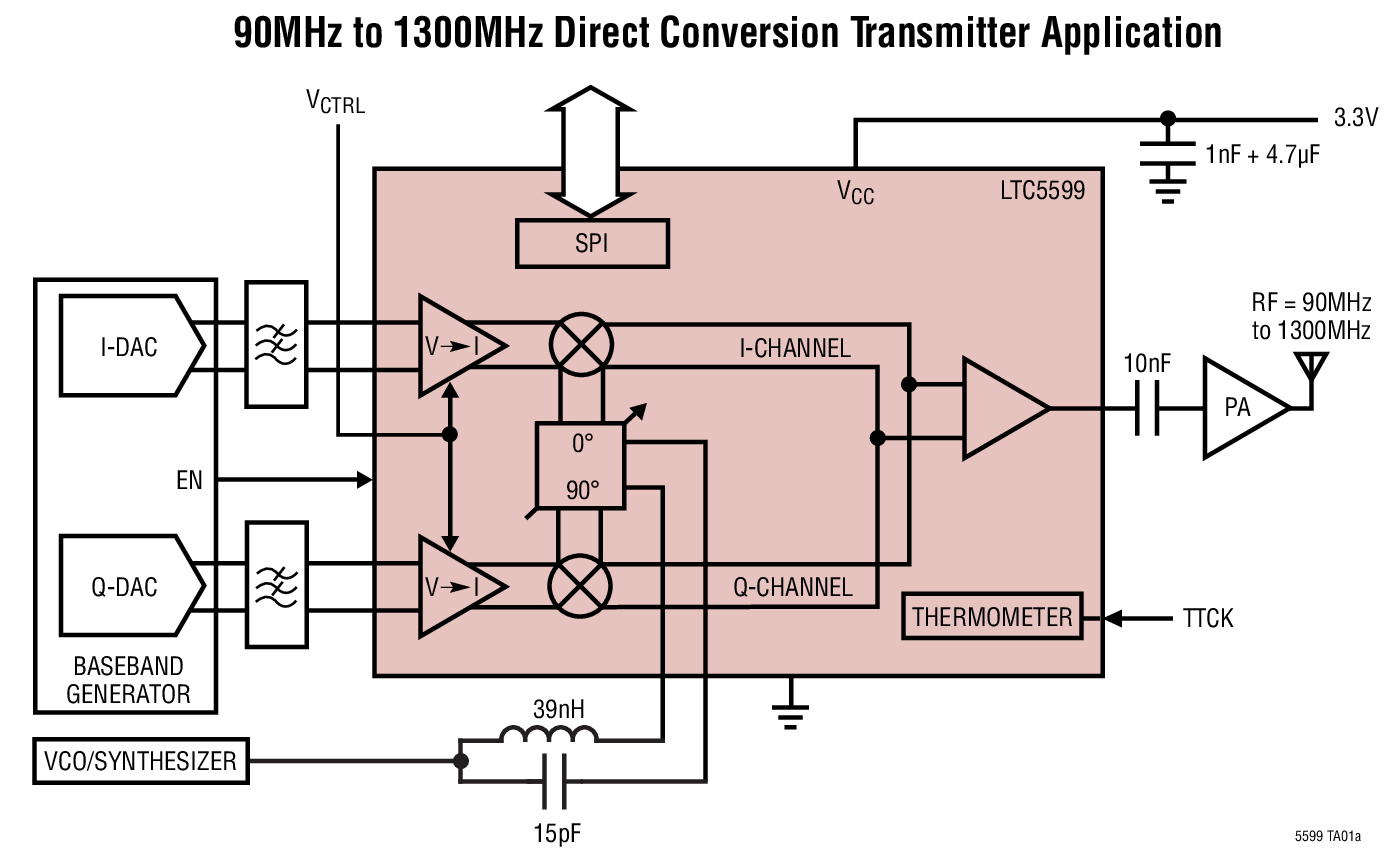
Demonstration circuit 2091A is optimized for evaluation of the LTC5599 low power direct quadrature modulator. The balanced I and Q baseband input ports can be either AC- or DC-coupled to a source with a common mode voltage level of about 1.4V. Fixed LC networks on the LO and RF ports cover a continuous 90MHz to 1300MHz range. The SPI interface controls the supply current, modulator gain, and allows optimization of the LO carrier feedthrough and side-band suppression.
CC1120EM 955 MHz Reference Design

Texas Instruments
CC1120EM 955 MHz Reference Design
Texas Instruments
The CC1120 955MHz EM reference design contains schematics and layout files for the CC1120EM 955MHz evaluation module. The reference design demonstrates good techniques for CC1120 decoupling and RF layout. For optimum RF performance: these parts should be copied accurately. This is a 4-layer reference design with a discrete balun and an SMA antenna connector designed for a single ended 50 ohm antenna. The RF section has been designed and characterized for operation in the 955 MHz frequency band.
Differential Passive Signal Switch on Computing (Rev. A)
Texas Instruments
Differential Passive Signal Switch on Computing (Rev. A)
Texas Instruments
This application report describes multiplexing applications for differential bus signals and how to use Texas Instruments high-speed passive-switch products (TS3DV416 TS3DV520 TS3DV520E TS3DV421 and others on the product roadmap such as TS3DSxxx and TS2DSxxxx) with various bandwidths and data rates. This application report describes the components that make up the system applications includin
CCFL to LED Conversion Power Supply

Texas Instruments
CCFL to LED Conversion Power Supply
Texas Instruments
Backlighting in portable device displays has historically utilized difficult-to-power cold cathode-fluorescent (CCFL) tubes. The tubes run on alternating current (AC) and need a large initial voltage of typically greater than 1 kV in order to fire them. Once they have fired: their operating voltage drops to under a kV. Because a notebook computer: for example: typically operates on low DC voltages (12V: 5V: 3.3V: etc.): a Royer oscillator must be used to transform this low voltage to the high-voltage AC required by the CCFL. The high voltages in the system are a potential safety hazard.The CCFL to LED conversion power supply reference design replaces the backlight CCFLs with strings of light-emitting diodes (LEDs). LEDs operate at low voltages of 3V TO 4V each and are extremely durable. They produce a brighter light whose spectral content can be more easily custom tailored to the needs of the backlight. Their brightness can be easily controlled to compensate for changes in ambient light. Also in contrast to the glass-tubed CCFLs: the physically small LEDs can be mounted on flexible strips: allowing the display to be more tolerant of and resistant to sudden shocks.The reference design: with National Semiconductor’s LM3431 three-channel: constant-current LED driver: uses two strings of six series-connected LEDs at a current of 30 mA per string. Each LED has a forward voltage drop of about 3.5V: making the total voltage across each string between 21V and 27V. With a 12V power source: the LM3431 is configured as a boost converter to generate this 21V to 27V output voltage.The design also includes a circuit utilizing a photodiode to make the brightness of the LEDs proportional to ambient light thus improving the readability of the display under all lighting conditions.